
The Complete Dentagum FAQ: Every Question About Remineralizing Gum Answered
This is the single most complete answer page for every common question about Dentagum and remineralizing gum: how to use it, how often, what is in it, whether it is safe for children, pets, and pregnancy, how long results take, what it costs, and where to buy it safely. Dentagum is chewed 2 to 4 times daily after meals for 10 to 20 minutes, delivering enamel support and antibacterial action through an ADA endorsed mechanism. Not recommended for children under 5 or for households with dogs due to xylitol toxicity. Every answer links to the full evidence based article on that topic.

Quick Answer
This is the single most complete answer page for every common question about Dentagum and remineralizing gum in general: how to use it, how often, what is actually in it, whether it is safe for children, pets, and pregnancy, how long results take, what it costs, and where to buy it safely. Dentagum is a nano hydroxyapatite and xylitol remineralizing gum, chewed 2 to 4 times daily after meals for 10 to 20 minutes per session, delivering enamel mineral support and antibacterial action through an ADA endorsed saliva stimulation mechanism. It is not recommended for children under 5 due to standard choking guidance around chewing gum in general, and xylitol is toxic to dogs, so it should always be stored securely. This page pulls every major question from the full content library into one place, with direct links to the detailed, evidence based article on each topic.
Last updated: July 2026. Compiled from ADA guidance, clinical literature on nano hydroxyapatite and xylitol, current Dentagum product specifications, and veterinary and pediatric safety sources
This page exists because the same handful of questions come up again and again about remineralizing gum, and most of them deserve a direct, evidence backed answer rather than a vague one. Below is every major question organized by category, each answered clearly, with a link to the fuller article where the topic has one. Use the table of contents to jump straight to the section you need.
The Basics: What Dentagum Is and How It Works

What is Dentagum?
Dentagum is a functional remineralizing chewing gum built around two active ingredients: nano hydroxyapatite (nano HAp) for enamel mineral support, and organic xylitol paired with organic erythritol for antibacterial action against cavity causing bacteria. It uses a natural gum base of organic chicle and organic mastic, and delivers its benefits primarily through the same saliva stimulation mechanism the ADA specifically endorses for sugar free gum after meals. For a full breakdown of the science, see our article on what remineralizing gum is and does.
Does remineralizing gum actually work?
The evidence supports it at multiple levels. Saliva stimulation from chewing sugar free gum is confirmed effective in seven clinical trials and endorsed by the ADA. Xylitol's antibacterial effect against Streptococcus mutans is supported by 10 of 10 chewing gum RCTs in a 2024 systematic review. Nano hydroxyapatite's remineralization and sensitivity reducing effects are supported by a 2023 meta analysis of 44 clinical trials. What no gum can do is regrow structurally lost enamel or replace brushing, flossing, and professional dental care. For the full evidence review, including what is proven, what is well supported, and what is honestly overclaimed in this category, see does remineralizing gum actually work.
What does the ADA say about chewing gum?
The ADA's position is specific: chewing sugarless gum for 20 minutes following meals has been shown in scientific studies to help prevent tooth decay, and if you cannot brush your teeth immediately after a meal, chewing gum can help. The mechanism is saliva stimulation to 10 to 12 times the resting rate. The ADA Seal of Acceptance applies only to sugar free gum, and the endorsement is explicit that gum is an adjunct for the post meal window, not a replacement for twice daily brushing and flossing. See what the ADA actually says about chewing gum for the full breakdown.
How to Use It
How many pieces of Dentagum should I chew per day?
The recommended use is 2 to 4 pieces daily, chewed after meals rather than all at once. This delivers the active ingredients within the clinically effective range while staying well below any digestive tolerance threshold. See safe daily limits for remineralizing gum for the full dosing science.
How long should I chew each piece?
10 to 20 minutes per session, matching the ADA's endorsed protocol for sugar free gum after meals. This window allows nano hydroxyapatite meaningful contact time with enamel and gives the saliva stimulation mechanism time to buffer post meal acid.
When is the best time to chew it?
After meals, specifically. This is when the mouth's pH has just dropped from bacterial fermentation of whatever you ate, and stimulated saliva is most needed to buffer that acid and begin redepositing minerals into enamel. Chewing at random times throughout the day, disconnected from meals, does not target this window the same way.
Should I brush before or after chewing gum?
Gum is designed for the windows when brushing is not an option, such as after lunch at your desk or after a meal at a restaurant. It complements, rather than replaces, your regular twice daily brushing routine. For the full timing framework covering brushing and gum together, see morning vs night: when is the best time to care for your teeth.
Ingredients and Formula
What is actually in Dentagum?
The full ingredient list includes nano hydroxyapatite (nHA), organic xylitol, organic erythritol, organic mastic gum, natural propolis, coconut oil, organic chicle gum (the base), organic eggshell powder, natural calcium bentonite clay, a natural terpene blend (menthone, carvone, cineol), and natural and organic spearmint extract. Every ingredient is named explicitly on the label, with no unspecified catch all terms.
What is nano hydroxyapatite and why does the particle size matter?
Nano hydroxyapatite is the same mineral that makes up enamel, produced at a 20 to 100 nanometre particle size small enough to penetrate the microporosities in early demineralized enamel. Standard, larger hydroxyapatite particles are 50 to 500 times bigger and mostly sit on the surface polishing enamel rather than depositing mineral into it. This distinction traces back to a genuinely surprising origin story involving a NASA patent that was never used by NASA itself. See hydroxyapatite was invented by NASA: the surprising origin story and what nano hydroxyapatite is for the full history and mechanism.
Why xylitol and erythritol together, rather than one or the other?
They work through complementary mechanisms against Streptococcus mutans, the primary cavity causing bacterium: xylitol disrupts its metabolism directly, while erythritol inhibits its ability to adhere to tooth surfaces. Erythritol is also notably gentler on digestion than xylitol, since it is absorbed at over 90 percent in the small intestine, meaning very little reaches the colon to cause the gas or bloating sometimes associated with xylitol alone at high doses. See sorbitol gum vs xylitol gum for the full sweetener comparison, and oral care for sensitive stomachs for the digestive comfort angle specifically.
Does Dentagum contain fluoride?
No. Dentagum's remineralization mechanism relies on nano hydroxyapatite rather than fluoride, positioning it as a fluoride free option for people who prefer to avoid fluoride or want an ingredient with a different remineralization mechanism.
Is Dentagum's gum base natural or synthetic?
Natural. The base is organic chicle (from the sapodilla tree) and organic mastic gum (a resin from Pistacia lentiscus), both named explicitly rather than hidden behind the generic term gum base, which can otherwise legally cover more than 40 synthetic, petroleum derived materials under FDA labeling rules. Mastic specifically has documented antibacterial and anti inflammatory properties across 14 independent clinical studies.
Safety, Dosing, and Sensitive Stomachs
Can you chew too much remineralizing gum?
Yes, technically, though the recommended 2 to 4 pieces daily sits well below where any concern begins. The clinically effective xylitol dose is 5 to 10 grams per day, and gastrointestinal tolerance typically becomes a factor only above 20 to 50 grams daily for most adults. At recommended use, Dentagum delivers meaningfully less xylitol than either of those thresholds. See can you chew too much remineralizing gum for the full breakdown, including the separate, unrelated consideration of jaw fatigue from excessive chewing frequency or duration.
Will Dentagum upset my stomach?
Most people tolerate it comfortably at the recommended dose, particularly since the formula pairs xylitol with erythritol, the gentler of the two sugar alcohols, rather than relying on xylitol alone at a maximized concentration. Anyone with a known sensitivity to sugar alcohols, or a diagnosed condition like IBS, should start with one piece daily and gradually increase over one to two weeks, spacing pieces after separate meals rather than chewing several together. See oral care for sensitive stomachs for the full ramp up strategy.
Is Dentagum tested for heavy metals?
Yes, and the results are publicly verifiable rather than a website claim. Dentagum is tested for Proposition 65 heavy metals, the strictest heavy metal safety standard in the United States, through Light Labs, an ISO/IEC 17025 accredited laboratory. Results are accessible directly at lightlabs.com and include specific values for lead, cadmium, arsenic, and mercury, each confirmed well below the Prop 65 threshold.
Kids, Pets, and Pregnancy
Is Dentagum safe for children?
Dentagum is formulated for adult use, and general pediatric dental guidance is relevant here regardless of gum brand: the American Academy of Pediatrics does not recommend chewing gum for children younger than 5, due to choking risk rather than any ingredient specific concern. For children 5 and older, sugar free xylitol gum in general is commonly considered acceptable by pediatric dentists when chewed under supervision, though parents should consult their own pediatric dentist about introducing any new oral care product to a child.

Is xylitol safe for dogs and other pets?
No. Xylitol, an ingredient in Dentagum and in most sugar free gums generally, is highly toxic to dogs even in small amounts. As few as two pieces of xylitol containing gum can trigger a dangerous hypoglycemic reaction in a small breed dog, and xylitol related poisoning is among the most common toxicity calls received by pet poison control hotlines. Always store gum securely out of reach of pets, and if a dog ingests any xylitol containing product, treat it as a veterinary emergency and contact a vet or animal poison control hotline immediately. Cats are not considered to be at similar risk according to veterinary toxicology sources. See safe daily limits for remineralizing gum for the full pet safety section.
Is Dentagum safe to chew during pregnancy?
The ingredients in Dentagum do not raise the kind of concerns associated with pregnancy specific restrictions, and there is meaningful research specifically supporting maternal xylitol gum use: a meta analysis of 11 randomized controlled trials involving 601 mothers found xylitol gum use significantly reduced the transmission of cavity causing bacteria from mother to child. Nano hydroxyapatite is the same mineral naturally present in enamel and bone, with a 2025 EU safety opinion confirming minimal systemic absorption. As with any product during pregnancy, discuss your full oral care routine with your obstetric provider or dentist if you have specific concerns. See pregnancy gingivitis: why your gums change and how to protect them for the full pregnancy oral health picture, including the xylitol transmission research in detail.
Results and Timeline
How long does it take to see results from remineralizing gum?
Remineralization is a gradual, cumulative process rather than an immediate one. Clinical research on nano hydroxyapatite generally measures meaningful outcomes over a period of weeks, with several sources in the broader literature suggesting at least 4 weeks of consistent use before evaluating results such as reduced sensitivity or smoother enamel texture. Some benefits, like fresher breath and reduced dry mouth discomfort from the saliva stimulation mechanism, are noticeable much sooner, often within the first few uses.
Will Dentagum whiten my teeth?
Dentagum's gum is formulated for remineralization and oral health support, not as a whitening product. Nano hydroxyapatite can contribute to a smoother, glossier enamel surface over time that reflects light more evenly, which some people notice as a subtle brightening, but this is different from active whitening. For dedicated whitening, Dentagum's Purple Whitening Strips use PAP+ alongside nano hydroxyapatite specifically for that purpose, and pairing the two products in sequence, strengthening enamel first, then whitening, is a strategy covered in enamel erosion and whitening: why you should strengthen before you brighten.
Allergens and Dietary Restrictions
Is Dentagum vegan?
No. The formula contains organic eggshell powder, which is not a vegan ingredient. It is also not certified kosher or halal.
Does Dentagum contain common allergens like soy, egg, or tree nuts?
The formula contains organic eggshell powder, which is derived from egg and is worth flagging specifically for anyone with an egg allergy, since egg is one of the nine major allergens the FDA requires labeling for under federal law, even though eggshell itself is composed primarily of calcium carbonate with minimal residual egg protein. Mastic gum, one of Dentagum's base ingredients, is a plant resin from the Pistacia lentiscus tree and is not related to tree nut allergens despite the word tree appearing in its description, since it is a resin rather than a nut product. Anyone with specific food allergies should review the full ingredient list directly and consult an allergist with any specific concerns before introducing a new oral care product.
Does Dentagum contain aspartame or other artificial sweeteners?
No. Dentagum's only sweeteners are organic xylitol and organic erythritol. It contains no aspartame, acesulfame potassium, saccharin, or sucralose, distinguishing it from most mainstream drugstore sugar free gum, which typically uses one or more of these artificial sweeteners in addition to sorbitol. See Dentagum vs drugstore sugar free gum for the full ingredient comparison.
Price, Where to Buy, and Guarantee
How much does Dentagum cost?
Dentagum is priced at $32.97 for a 60 piece pouch, which works out to $0.55 per piece, the lowest price per piece among nano hydroxyapatite gum brands in the US market. At the recommended 1-2 pieces daily, one pouch lasts 30 to 60 days. See is remineralizing gum worth it for the full cost benefit breakdown against the cost of dental procedures and comparable products.
Where can I buy Dentagum safely?
Dentagum is available directly at dentagum.co and through the brand's own registered seller account on Amazon. Both channels ship the same US manufactured, Prop 65 tested inventory. When buying on Amazon, confirm the listing shows Sold by Dentagum or Gold Umbrella Corporation rather than an unrelated third party reseller. See where to buy remineralizing gum in the US for the full guide, including how to spot fake reviews and unauthorized sellers in this category.
Is there a guarantee or return policy?
Yes. Dentagum offers a 30 day risk free guarantee on purchases made directly through dentagum.co, enforceable directly through the brand rather than subject to a third party reseller's separate policy.
What flavors are available?
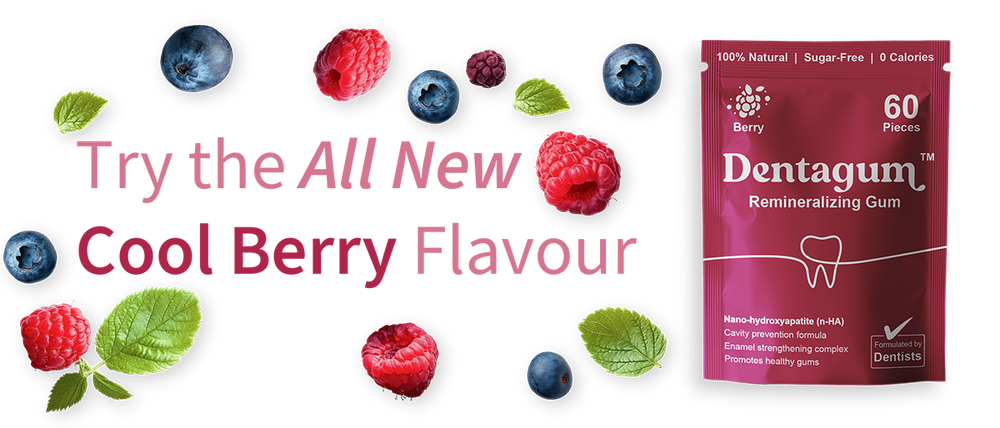
Dentagum is available in Mint, Cool Berry, Chill Watermelon, and Cool Mango, along with a variety pack option covering multiple flavors in one pouch.
How It Compares to Other Options
How is Dentagum different from regular sugar free gum like Trident or Orbit?
Both deliver the core ADA endorsed saliva stimulation benefit, since that mechanism works from any sugar free gum base. Where they differ: mainstream drugstore gum typically lists sorbitol as the primary sweetener with only trace xylitol, uses an unspecified likely synthetic gum base, and contains artificial sweeteners like aspartame. Dentagum uses xylitol as the primary sweetener at a meaningful concentration, a named natural gum base, no artificial sweeteners, and adds 5 percent nano hydroxyapatite, which mainstream gum does not contain at all. See Dentagum vs drugstore sugar free gum for the complete comparison.
How does Dentagum compare to other remineralizing gum brands?
The category has grown quickly, and formulas vary meaningfully between brands even when the marketing language sounds similar. The core criteria worth checking for any brand: nano hydroxyapatite specifically named (not generic hydroxyapatite), xylitol as the primary sweetener, a named natural gum base, and publicly verifiable third party testing. See how to choose a remineralizing gum: a 7 point buyer's checklist for the full framework, and remineralizing gum brands compared for a direct look at how leading brands measure up.
Purple Whitening Strips

What is the difference between Dentagum's gum and its Purple Whitening Strips?
The gum is a daily oral health product focused on remineralization, bacterial suppression, and saliva stimulation. The Purple Whitening Strips are a dedicated cosmetic whitening product built around PAP+, a peroxide free whitening active, combined with nano hydroxyapatite for enamel support during the whitening process. They serve different purposes and are designed to be used together in sequence rather than as substitutes for one another, with the gum building a stronger enamel foundation before or during a whitening treatment.
Why does Dentagum use PAP+ instead of traditional peroxide for whitening?
PAP+ works through a different oxidation mechanism than hydrogen peroxide, without the same degree of penetration into deeper tooth structure that drives sensitivity. Research has found peroxide free color correctors including PAP+ formulations increased enamel surface microhardness with no demineralization observed, and sensitivity occurred in under 3 percent of users compared to a much higher range for traditional peroxide treatments.
Quick Reference: The Core Facts
- Recommended use: 1 to 2 pieces daily, before or after meals, 10 to 20 minutes per session
- Price: $32.97 for 60 pieces ($0.55 per piece), lowest per piece in the nano hydroxyapatite gum category
- Key ingredients: Nano hydroxyapatite, organic xylitol, organic erythritol, organic mastic and chicle gum base, natural propolis
- Not recommended for: Children under 5 (general gum choking guidance), dogs and pets (xylitol toxicity), anyone with an egg allergy who has not reviewed the eggshell powder ingredient with an allergist
- Third party tested: Prop 65 heavy metals through Light Labs, results public at lightlabs.com
- Not vegan, kosher, or halal: Due to eggshell powder
- Available at: dentagum.co (30 day guarantee), Etsy, and Amazon
Frequently Asked Questions
Can I use Dentagum instead of brushing my teeth?
No. Dentagum, like any sugar free gum, is an ADA endorsed adjunct for windows when brushing is not possible, specifically the period after meals. It is not a substitute for twice daily brushing with fluoride toothpaste and daily flossing.
Does Dentagum expire?
Like most chewing gum products, Dentagum has a shelf life printed on the packaging. Check the date on your specific pouch and store it in a cool, dry place away from direct sunlight and away from pets.
Can I chew Dentagum if I have braces?
Chewing gum in general is often discouraged or restricted with braces due to the risk of gum sticking to and dislodging brackets and wires. Consult your orthodontist about whether any gum, including Dentagum, fits within your specific treatment plan.
Is Dentagum gluten free?
The listed ingredients do not include wheat, barley, rye, or other gluten containing grains. As with any dietary restriction, review the specific ingredient list on your product and consult the brand directly if you require formal gluten free certification assurance.
Bottom Line
This page pulls together the most common questions about Dentagum and remineralizing gum into one place: how to use it, what it contains, who should be cautious, how long results take, what it costs, and where to buy it safely. Every answer here links to a fuller article where the topic warrants deeper coverage, so this page works both as a fast reference and as a hub pointing to the complete evidence behind each answer.
If your specific question is not covered above, the full article library covers dozens of related topics in depth, from the science behind individual ingredients to how Dentagum compares against specific competitors, to the broader mouth body connection research shaping how people think about oral health today.
Try Dentagum: 2 to 4 Pieces Daily, 30 Day GuaranteeResearch Summary
This FAQ pillar compiles findings previously detailed across the Dentagum content library, including ADA Oral Health Topics guidance on chewing gum; the Limeback, Enax, and Meyer 2023 Biomimetics meta analysis of 44 clinical trials on nano hydroxyapatite; the 2024 European Archives of Paediatric Dentistry systematic review on xylitol chewing gum dosing; the Yates and Duane meta analysis of 11 RCTs on maternal xylitol transmission; American Academy of Pediatrics guidance on gum and choking risk in children under 5; ASPCA and Pet Poison Helpline data on xylitol toxicity in dogs; FDA FALCPA allergen labeling requirements for egg as one of nine major allergens; the 2025 EU Scientific Committee on Consumer Safety opinion on nano hydroxyapatite safety; and Dentagum's own Light Labs Certificate of Analysis for Prop 65 heavy metal testing, dated June 2026. Full citations for each specific claim are available in the linked articles referenced throughout this page. This page does not provide individualized medical, veterinary, or allergy advice; readers with specific health conditions, known allergies, or concerns about children or pets should consult the relevant qualified professional.
References
- American Dental Association. Chewing Gum. Oral Health Topics. ada.org. [20 minutes after meals; 10 to 12 times resting salivary flow; ADA Seal for sugar free gum only]
- Limeback H, Enax J, Meyer F. Clinical Evidence of Biomimetic Hydroxyapatite in Oral Care Products for Reducing Dentin Hypersensitivity. Biomimetics. 2023. PMC9844412. [44 clinical trials; 39.5 percent dentin hypersensitivity reduction versus placebo]
- Pienihäkkinen K et al. The effect of xylitol chewing gums and candies on caries occurrence in children: a systematic review. Eur Arch Paediatr Dent. 2024. [10 of 10 chewing gum RCTs statistically significant; 5 to 10g/day effective dosing across 3 to 5 exposures]
- Yates C, Duane B. Effect of maternal use of chewing gums containing xylitol on transmission of mutans streptococci in children: a meta analysis of randomized controlled trials. PubMed. [11 RCTs, 601 mothers; infant MS incidence risk ratio 0.54 to 0.56 versus control]
- American Academy of Pediatrics guidance, cited via multiple pediatric dental sources. [Chewing gum not recommended for children younger than 5 due to choking risk]
- ASPCA. Updated Safety Warning on Xylitol: How to Protect Your Pets. aspca.org. [Xylitol highly toxic to dogs; APCC hotline 888-426-4435; cats not at similar risk]
- U.S. Food and Drug Administration. Food Allergen Labeling and Consumer Protection Act (FALCPA). [Egg as one of nine major allergens requiring federal labeling]
- European Union Scientific Committee on Consumer Safety. Safety opinion on nano hydroxyapatite for use in oral care products. 2025. [Minimal systemic absorption; good safety profile confirmed]
- Dentagum. Light Labs Certificate of Analysis. June 2026. [Prop 65 heavy metal testing; publicly accessible at lightlabs.com]
