
Dentagum vs Drugstore Sugar-Free Gum: Is the Upgrade Worth It?
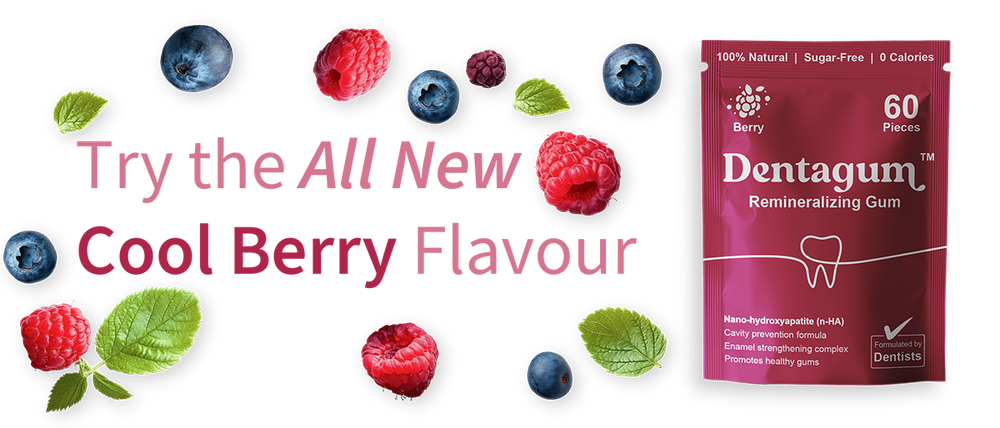
Trident, Orbit, and Extra all list sorbitol as their primary sweetener, use an unspecified synthetic gum base, and contain aspartame in their minor ingredients. None contain nano-hydroxyapatite. Dentagum uses organic xylitol as the primary sweetener, a named natural gum base, no artificial sweeteners, and 5% nano-HAp. Both deliver the same ADA-endorsed saliva-stimulation benefit. The price gap ($0.10-0.18/piece vs $0.55/piece) reflects genuine ingredient differences. For basic breath freshening, drugstore gum works fine. For active enamel support or sensitivity, the formula gap is real.

Quick Answer
Trident, Orbit, and Extra all list sorbitol as their primary sweetener, use an unspecified synthetic "gum base" (typically petroleum-derived polymers), and contain aspartame alongside acesulfame potassium and sucralose in their "less than 2%" ingredient bracket. None contain nano-hydroxyapatite. Dentagum uses organic xylitol as the primary sweetener, a named natural gum base (organic chicle and mastic), no aspartame or artificial sweeteners, and 5% nano-hydroxyapatite for direct enamel mineral delivery. Both categories deliver the ADA-endorsed core benefit of any sugar-free gum: saliva stimulation and post-meal acid buffering, confirmed in seven clinical trials. The price gap is real: roughly $0.10 to $0.18 per piece for drugstore gum versus $0.55 per piece for Dentagum. Whether the upgrade is worth it depends on what you're trying to accomplish. For basic breath freshening and the baseline saliva benefit, drugstore gum works fine. For active enamel support, sensitivity, or a documented antibacterial sweetener at clinical dose, the formula gap is real and the price difference reflects genuine ingredient differences, not just packaging and marketing.
Last updated: July 2026 | Ingredient data verified against current Trident, Orbit, and Extra product labels via ADA product listings, manufacturer websites, and Amazon retail listings
Most people's chewing gum decision happens on autopilot: grab whatever's at the checkout counter, usually Trident, Orbit, or Extra. These are legitimate sugar-free gums with real ADA endorsement behind the core mechanism. The question worth asking before defaulting to that habit is what you're actually getting in the pack, and what a functional gum like Dentagum adds on top of it. This is an honest, ingredient-by-ingredient comparison, not a takedown of drugstore gum, which does the basic job it claims to do.
What's Actually in Drugstore Gum

Reading the actual ingredient labels of the three biggest mainstream sugar-free gum brands is more informative than any marketing copy. Here is exactly what each contains, verified directly from manufacturer and ADA product listings.
Trident (Original, per ADA product listing): Sorbitol, gum base, xylitol, glycerin, mannitol; less than 2% of: acesulfame potassium, aspartame, BHT (to maintain freshness), natural and artificial flavoring, soy lecithin, sucralose, colors.
Orbit (Spearmint, per manufacturer listing): Sorbitol, gum base, glycerol, mannitol, natural and artificial flavors; less than 2% of: hydrogenated starch hydrolysate, aspartame, acesulfame K, soy lecithin, xylitol, BHT (to maintain freshness).
Extra gum follows a broadly similar formulation pattern across its flavor lineup: sorbitol-primary sweetening, an unspecified gum base, and a blend of artificial sweeteners including aspartame and acesulfame potassium in the minor ingredient bracket.
Three patterns are consistent across all three brands: sorbitol is the primary sweetener (not xylitol, despite xylitol appearing in the ingredient list), the gum base is listed as a single undifferentiated term with no specification of its composition, and aspartame appears in the minor ingredient bracket alongside other synthetic sweeteners. None of the three lists nano-hydroxyapatite or any active remineralizing mineral.
Side-by-Side: What's on the Label
- Primary sweetener: Trident/Orbit/Extra: sorbitol. Dentagum: organic xylitol.
- Xylitol presence: Trident/Orbit: present but listed 3rd-6th, meaning trace concentration. Dentagum: primary sweetener at meaningful clinical-relevant dose.
- Gum base: Trident/Orbit/Extra: "gum base" unspecified (typically petroleum-derived polymers). Dentagum: organic chicle and organic mastic gum, named explicitly.
- Artificial sweeteners: Trident/Orbit/Extra: aspartame, acesulfame potassium, sucralose all present in minor ingredients. Dentagum: none. Sweetened with xylitol and erythritol only.
- Active remineralizing mineral: Trident/Orbit/Extra: none. Dentagum: 5% nano-hydroxyapatite (20-100nm particle size).
- Third-party heavy metal testing publicly verifiable: Trident/Orbit/Extra: not published on consumer-facing product pages. Dentagum: Prop 65 tested via Light Labs, results public at lightlabs.com.
The Sweetener Gap: Sorbitol vs Xylitol
This is the single most important formula difference, and it's easy to miss because both sweeteners appear on drugstore gum labels. The order matters. Ingredient lists in the US are required to be listed in descending order by weight, so the first ingredient after the gum base is what you're primarily consuming.
In Trident and Orbit, sorbitol is listed first (before gum base in Trident's case, immediately after in Orbit's), with xylitol appearing third to sixth in the list. This means xylitol is present at a low concentration relative to sorbitol, likely for flavor rounding or marketing appeal ("contains xylitol" on packaging) rather than as the primary functional sweetener.
Sorbitol is non-cariogenic (it doesn't feed cavity-causing bacteria the way sugar does), which is the basis for drugstore gum being marketed as safe for teeth. But non-cariogenic is not the same as anti-cariogenic. A 2024 systematic review and meta-analysis in the International Journal of Dentistry states directly that sorbitol can be fermented to small degrees by cariogenic bacteria, unlike xylitol. Xylitol, by contrast, actively disrupts Streptococcus mutans through a specific metabolic mechanism: the bacteria transport it into their cells expecting to metabolize it like sugar, get trapped in a futile energy cycle they cannot complete, and die. A 2025 systematic review in BMC Oral Health found xylitol gum significantly reduced S. mutans counts compared to sorbitol gum in 12 of 14 clinical studies reviewed.
Dentagum uses organic xylitol as the primary sweetener, with organic erythritol as a complementary secondary sweetener (which independently inhibits S. mutans adhesion to tooth surfaces through a different mechanism). No sorbitol is used. This puts Dentagum's active antibacterial sweetening at a fundamentally different level than drugstore gum's trace-xylitol, sorbitol-primary approach. For the full mechanistic breakdown, see our article on sorbitol gum vs xylitol gum.
The Gum Base Gap: Synthetic vs Natural

All three drugstore brands list their gum base as a single undifferentiated ingredient: "gum base." Under current FDA labeling rules, this term can legally encompass more than 40 different materials, including synthetic rubber, polyvinyl acetate (also used in wood glue), polyisobutylene (also used in tire inner tubes), and various plasticizers and resins, all without individual disclosure. Consumer-facing product pages for Trident, Orbit, and Extra do not specify whether their gum base is synthetic or natural, and industry sourcing patterns strongly suggest synthetic petroleum-derived polymers, which is standard for the mass-market gum industry and has been since the mid-20th century when manufacturers largely abandoned natural chicle for cost and supply reasons.
Dentagum's gum base is organic chicle (from the sapodilla tree) and organic mastic gum (a resin from Pistacia lentiscus), both named explicitly on the ingredient label. Beyond avoiding petroleum-derived polymers, mastic specifically has documented biological activity: a 2023 state-of-the-art review in the Journal of Natural Medicine (Alwadi et al.) confirmed antibacterial, anti-inflammatory, and antimicrobial properties across 14 independent clinical studies. This means the gum base itself contributes oral health function rather than serving purely as an inert chewing medium.
One honest caveat worth including: a 2025 UCLA study found that both synthetic and natural gum bases release microplastic particles during chewing, with the particles in natural gum samples attributed to environmental contamination of ingredients rather than the plant resins themselves. The clear advantage of a natural base is avoiding petroleum-derived polymer chemistry and, in mastic's case, adding documented biological activity, not a guaranteed absence of microplastics.
The Mineral Gap: No Nano-HAp vs 5% Nano-HAp
This is the clearest functional distinction between the two categories. Neither Trident, Orbit, nor Extra contains any active remineralizing mineral ingredient. Their oral health value comes entirely from the saliva-stimulation mechanism of chewing gum in general (discussed below), which is real but ingredient-independent.
Dentagum contains 5% nano-hydroxyapatite at a particle size of 20 to 100 nanometers, matching the scale of enamel microporosities from acid erosion. Nano-HAp works by depositing the same mineral that enamel is made of directly into early demineralized lesions during chewing, supplementing the calcium and phosphate delivery that saliva alone provides. A 2023 systematic review and meta-analysis by Limeback, Enax, and Meyer covering 44 clinical trials found hydroxyapatite in oral care products significantly reduced dentin hypersensitivity by 39.5% compared to placebo. An 18-month RCT published in Frontiers in Public Health in 2023 found fluoride-free nano-HAp non-inferior to standard fluoride toothpaste for cavity prevention in adults. For the full evidence review on this ingredient, see our article on what nano-hydroxyapatite is.
This is the ingredient category most responsible for the price difference between drugstore and functional gum, and it is also the one with the clearest incremental clinical case: if enamel mineral support or sensitivity relief is a goal, drugstore gum simply does not address it at all.
The Aspartame Question
Aspartame appears in the "less than 2%" ingredient bracket of Trident, Orbit, and Extra, alongside acesulfame potassium and sucralose. Aspartame is FDA-approved and considered safe within acceptable daily intake limits by regulatory bodies, and it does not directly feed cavity-causing bacteria since it isn't fermented by oral bacteria.
The relevant consideration for a daily oral health habit specifically is emerging research on the oral and gut microbiome. A 2025 PMC review on artificial sweeteners and the gut microbiome found that aspartame and other tested non-nutritive sweeteners significantly impacted the human gut microbiome and their functions, with the oral microbiome similarly affected: aspartame decreased prevalence of Porphyromonas and Prevotella nanceiensis in the oral cavity. Whether these specific changes carry meaningful dental health consequences is not yet fully established, but for a product positioned specifically as an oral health tool, the presence of an ingredient with emerging microbiome concerns is a mismatch worth noting.
Dentagum contains no aspartame, acesulfame potassium, or sucralose. Its sweeteners (xylitol and erythritol) are both polyols with well-established safety profiles and documented positive oral health mechanisms, meaning the sweetening system does double duty: sweetness plus active antibacterial function, rather than sweetness alone.
What They Share: The Saliva Benefit

It would be inaccurate to present this comparison as drugstore gum having no oral health value. The core mechanism behind the ADA's endorsement of sugar-free gum applies equally to Trident, Orbit, Extra, and Dentagum: chewing any sugar-free gum base stimulates salivary flow to 10 to 12 times the resting rate, which buffers post-meal acid, delivers calcium and phosphate to enamel, and clears food debris. Seven clinical trials have confirmed sugar-free gum after meals reduces cavity incidence, and the mechanism review (Mandel, JADA 2008) attributed the benefit to saliva stimulation itself, not any specific ingredient.
This means someone chewing Trident after lunch is getting the same base ADA-endorsed benefit as someone chewing Dentagum. Both qualify for the ADA Seal of Acceptance category (sugar-free gum). The difference is entirely in what's layered on top of that base benefit: clinical-dose xylitol, nano-HAp mineral delivery, a biologically active natural gum base, and the absence of artificial sweeteners.
The Price Gap, Honestly Accounted

Drugstore sugar-free gum typically costs $1.50 to $2.50 for a 14 to 18-piece pack, or roughly $0.10 to $0.18 per piece. Dentagum costs $32.97 for 60 pieces, or $0.55 per piece. At three pieces per day, drugstore gum costs approximately $9 to $16 per month; Dentagum costs approximately $49.50 per month. The difference is real, and it should be evaluated honestly rather than dismissed.
What the additional $0.37 to $0.45 per piece buys: clinical-dose xylitol instead of trace xylitol behind sorbitol, 5% nano-hydroxyapatite (absent entirely from drugstore gum), a natural biologically active gum base instead of an unspecified synthetic one, zero artificial sweeteners instead of aspartame plus two others, and publicly verifiable third-party heavy metal testing. This is not a packaging or brand premium; it corresponds to specific, named, evidence-backed ingredient differences.
Whether that premium is worth it depends on what you value. For someone with a history of cavities, tooth sensitivity, or who wants active enamel support beyond the baseline saliva mechanism, the additional ingredients have a documented clinical rationale. For someone whose only goal is basic breath freshening and the general saliva-stimulation benefit, the price premium buys ingredients that person may not specifically need.
When Basic Drugstore Gum Is Genuinely Fine
Intellectual honesty requires acknowledging when the upgrade isn't necessary. If your only goal is fresh breath and you have no particular cavity risk, sensitivity, or enamel concerns, Trident, Orbit, or Extra chewed consistently after meals delivers the core ADA-endorsed saliva benefit at a much lower price point. The base mechanism (10 to 12x salivary flow stimulation, post-meal acid buffering) does not require nano-HAp or clinical-dose xylitol to function; it works from the act of chewing sugar-free gum itself.
The upgrade case strengthens specifically for: people with a history of fillings or cavities, tooth sensitivity (where nano-HAp's documented 39.5% hypersensitivity reduction is directly relevant), reduced salivary flow from medications or dry mouth, frequent snacking or coffee consumption creating more acid exposure windows, and anyone who wants to avoid artificial sweeteners in a product they're consuming multiple times daily. For a full cost-benefit breakdown, see our article on is remineralizing gum worth it.
Honest Decision Framework
- Stick with drugstore gum if: Your goal is basic breath freshening; you have no cavity history, sensitivity, or dry mouth; budget is a hard constraint; you're already following a strong brushing and flossing routine with low cavity risk.
- Upgrade to functional gum if: You have a history of cavities or fillings; you experience tooth sensitivity; you're on medications that reduce salivary flow; you snack or drink coffee frequently; you want to avoid aspartame and artificial sweeteners in a daily-use product; you want active enamel mineral support beyond baseline saliva stimulation.
- Either way: Chewing sugar-free gum after meals is a genuinely good habit with real clinical backing. The choice between drugstore and functional gum is about how much active ingredient support you want layered on top of that shared foundation.
Frequently Asked Questions
Is Trident or Orbit bad for your teeth?
No. Both are ADA-endorsed sugar-free gums that deliver the core saliva-stimulation benefit confirmed in seven clinical trials. They are not harmful to teeth. The comparison to functional gum like Dentagum is not about drugstore gum being bad; it's about what additional active ingredients (clinical-dose xylitol, nano-HAp, natural gum base, no artificial sweeteners) a functional gum adds on top of the same baseline benefit.
Does Trident or Orbit contain xylitol?
Yes, but at a low concentration. Both list xylitol on their ingredient labels, but sorbitol is the primary sweetener listed first (or immediately after gum base), with xylitol appearing third to sixth in the ingredient order. Since US ingredient labels list components in descending order by weight, this means xylitol is present at a meaningfully lower concentration than in a gum where xylitol is the primary sweetener, such as Dentagum.
Why does Dentagum cost more than Trident or Orbit?
The price difference corresponds to specific ingredient differences: Dentagum uses clinical-dose organic xylitol as the primary sweetener rather than trace xylitol behind sorbitol, adds 5% nano-hydroxyapatite (absent from drugstore gum entirely), uses a named natural gum base (organic chicle and mastic) rather than an unspecified likely-synthetic base, contains no artificial sweeteners, and publishes publicly verifiable third-party heavy metal testing. These are documented formulation choices, not a brand premium without substance behind it.
Does aspartame in gum matter for oral health?
Aspartame does not directly feed cavity-causing bacteria and is FDA-approved as safe within acceptable daily intake limits. The relevant consideration is emerging research on oral and gut microbiome effects: a 2025 review found aspartame significantly impacted gut microbiome composition, with corresponding changes observed in oral microbiome bacteria. Whether these specific changes carry meaningful dental consequences is not fully established, but for a product marketed specifically as an oral health tool, avoiding artificial sweeteners with emerging microbiome questions is a reasonable preference for some consumers.
Is it worth switching from Trident to a functional gum like Dentagum?
It depends on your goals. If you have a history of cavities, sensitivity, dry mouth, or frequent acid exposure from snacking or coffee, the additional active ingredients in functional gum (clinical-dose xylitol, nano-HAp) have documented clinical relevance to those concerns. If your only goal is fresh breath with low cavity risk, drugstore gum delivers the core ADA-endorsed benefit at a significantly lower price, and the additional formula complexity in functional gum may not be necessary for that specific use case.
What's actually in "gum base" on drugstore gum labels?
FDA labeling rules allow "gum base" to be listed as a single ingredient covering more than 40 possible materials, including synthetic rubber, polyvinyl acetate, polyisobutylene, and various resins and plasticizers, without individual disclosure. Trident, Orbit, and Extra's consumer product pages do not specify their gum base composition, which is consistent with standard mass-market gum industry practice of using synthetic petroleum-derived polymers. Dentagum's gum base is named explicitly as organic chicle and organic mastic gum.
Bottom Line
Trident, Orbit, and Extra deliver the same ADA-endorsed core benefit as any sugar-free gum: saliva stimulation and post-meal acid buffering, confirmed in seven clinical trials. What they don't deliver: meaningful xylitol dose (it's present but trace, behind sorbitol), any active remineralizing mineral, a natural gum base, or freedom from artificial sweeteners. Dentagum adds all four on top of the same shared foundation, at roughly three to five times the per-piece cost.
The honest verdict: if your only goal is fresh breath and you have low cavity risk, drugstore gum does the job the ADA endorses at a fraction of the price. If you have a history of dental issues, sensitivity, dry mouth, or simply want to avoid artificial sweeteners in something you chew daily, the ingredient gap between the two categories is real, documented, and reflected honestly in the price difference.
Try Dentagum: Clinical-Dose Xylitol + Nano-HAp, No AspartameResearch Summary
This article compares drugstore sugar-free gum ingredient labels against Dentagum's formula using verified manufacturer and ADA product listing data. Key sources include: ADA product listing for Trident Sugarfree Gum (12 flavors): sorbitol, gum base, xylitol, glycerin, mannitol, less than 2% acesulfame potassium, aspartame, BHT, natural and artificial flavoring, soy lecithin, sucralose, colors; Orbitgum.com manufacturer listings (Spearmint, Peppermint, Sweet Mint, Strawberry, Bubblemint): sorbitol, gum base, glycerol, mannitol, natural and artificial flavors, less than 2% hydrogenated starch hydrolysate, aspartame, acesulfame K, soy lecithin, xylitol, BHT; International Journal of Dentistry 2024 systematic review and meta-analysis (sorbitol fermented to small degrees by cariogenic bacteria, unlike xylitol); Söderling E, Pienihäkkinen K. BMC Oral Health 2025 (xylitol gum reduced S. mutans 12/14 studies vs sorbitol); Alwadi MAM et al. J Natural Med 2023 (mastic gum: antibacterial, anti-inflammatory, antimicrobial; 14 clinical studies); Limeback H, Enax J, Meyer F. Biomimetics 2023 (44 trials; 39.5% dentin hypersensitivity reduction nano-HAp); Paszynska E et al. Front Public Health 2023 (18-month RCT, nano-HAp non-inferior to fluoride toothpaste); PMC12025785 2025 (aspartame significantly impacted gut and oral microbiome; decreased Porphyromonas and Prevotella nanceiensis); UCLA / ACS Spring 2025 (both synthetic and natural gum bases release microplastics; natural gum contamination likely environmental); Mandel ID. JADA 2008 (7 clinical trials; saliva stimulation mechanism, not ingredient-specific); ADA Oral Health Topics, Chewing Gum (10-12x salivary flow; Seal of Acceptance for sugar-free gum; 20 min after meals); Dentagum ingredient label and pricing verified July 2026: $32.97/60 pieces = $0.55/piece; organic xylitol primary sweetener; organic erythritol secondary; 5% nano-HAp; organic chicle and organic mastic gum base; no aspartame/acesulfame K/sucralose; Prop 65 tested via Light Labs, publicly accessible at lightlabs.com. Drugstore gum pricing ($0.10-0.18/piece) reflects standard 14-18 piece retail pack pricing as of July 2026; actual prices vary by retailer and promotion.
References
- American Dental Association. Trident Sugarfree Gum, 12 Flavors. ADA Seal of Acceptance Product Search. ada.org. [Ingredients: Sorbitol, gum base, xylitol, glycerin, mannitol, less than 2% of: acesulfame potassium, aspartame, BHT, natural and artificial flavoring, soy lecithin, sucralose, colors]
- Trident brand product listings, Amazon.com and manufacturer verified. [Consistent ingredient pattern across flavors: sorbitol/gum base first, xylitol third position, aspartame and acesulfame potassium in minor ingredients]
- Orbitgum.com. ORBIT Spearmint, Peppermint, Sweet Mint, Strawberry, Bubblemint Sugarfree Chewing Gum product pages. [Ingredients: sorbitol, gum base, glycerol, mannitol, natural and artificial flavors, less than 2% hydrogenated starch hydrolysate, aspartame, acesulfame K, soy lecithin, xylitol, BHT]
- International Journal of Dentistry. Systematic review and meta-analysis on sorbitol vs xylitol fermentation. 2024. [Sorbitol can be fermented to small degrees by cariogenic bacteria, unlike xylitol]
- Söderling E, Pienihäkkinen K. Specific effects of xylitol chewing gum on mutans streptococci and caries. BMC Oral Health. 2025. [Xylitol gum reduced S. mutans in 12 of 14 studies vs sorbitol controls]
- Alwadi MAM et al. State-of-the-Art Review: Mastic (Pistacia lentiscus) Gum and Oral Health. J Natural Med. 2023. [14 independent clinical studies; antibacterial, anti-inflammatory, antimicrobial properties confirmed]
- Limeback H, Enax J, Meyer F. Clinical Evidence of Biomimetic Hydroxyapatite in Oral Care Products. Biomimetics. 2023. PMC9844412. [44 clinical trials; 39.5% dentin hypersensitivity reduction nano-HAp vs placebo]
- Paszynska E et al. Fluoride-free nano-hydroxyapatite: 18-month RCT. Front Public Health. 2023. [Nano-HAp non-inferior to fluoride toothpaste for caries prevention in adults]
- Artificial Sweeteners: A Double-Edged Sword for Gut Microbiome. PMC. PMC12025785. 2025. [Aspartame significantly impacted gut microbiome; oral microbiome affected: decreased Porphyromonas and Prevotella nanceiensis]
- UCLA / ACS Spring 2025. Ingestion of microplastics during chewing gum consumption. [Both synthetic and natural gum bases release microplastics; natural gum contamination likely environmental rather than resin-derived]
- Mandel ID. The role of saliva in maintaining oral homeostasis. JADA. 2008. [7 clinical trials confirming caries reduction from sugar-free gum; benefit attributed to saliva stimulation, not specific ingredients]
- American Dental Association. Chewing Gum. Oral Health Topics. ada.org. [10-12x resting salivary flow; ADA Seal for sugar-free gum; 20 minutes after meals]
