
How to Choose a Remineralizing Gum: A 7-Point Buyer's Checklist
The remineralizing gum category runs on shared vocabulary that conceals real formulation differences. Seven criteria separate a genuinely functional product from one borrowing the category's credibility: nano-hydroxyapatite specifically (not generic HA), xylitol as the primary sweetener, a named natural gum base, third-party testing with publicly verifiable results, no aspartame or artificial sweeteners, clinical data with named sources, and full ingredient transparency. A product satisfying all seven is worth daily use. One failing even two or three is using category language without category substance.

Quick Answer
The seven things that separate a genuinely effective remineralizing gum from one borrowing the category's language: (1) nano-hydroxyapatite specifically, not generic "hydroxyapatite": particle size at 20-100 nm is what enables enamel penetration; (2) xylitol as the primary sweetener, not a trace additive below sorbitol on the ingredient list; (3) a natural gum base from chicle or mastic, free of petroleum-derived synthetic polymers; (4) third-party heavy metal testing with publicly verifiable lab results, not a website claim; (5) no aspartame or artificial sweeteners; (6) clinical data, ideally independent and not exclusively manufacturer-funded; (7) transparent labeling that names every ingredient rather than hiding the formula behind "gum base" or "natural flavors." A product that satisfies all seven is worth your money. A product that fails even two or three is using the category's credibility without the substance behind it.
Last updated: July 2026 | Criteria developed from peer-reviewed dental research, ADA guidance, FDA ingredient disclosure rules, and comparative analysis of the US remineralizing gum market
The remineralizing gum category has attracted enough consumer interest that brands with genuinely different formulas now all use essentially the same marketing words. Nano-hydroxyapatite. Xylitol. Natural. Dentist-recommended. The vocabulary has become a checklist that any brand can tick without satisfying the substance behind any of it. A product can contain trace amounts of xylitol and still call itself a xylitol gum. A product can list "hydroxyapatite" without specifying nano particle size and still claim remineralization benefits. A product can say "third-party tested" without publishing where, when, or what was tested.
This guide gives you the specific questions to ask, and the specific reasons those questions matter, before you hand over money for a habit you'll be committing to daily.
Point 1: Nano-HAp, Not Just "Hydroxyapatite"

The question to ask: Does the label say "nano-hydroxyapatite" specifically, or just "hydroxyapatite"?
Hydroxyapatite is the mineral that enamel is made of. Adding it to a product is biomimetically sensible. But the word "hydroxyapatite" without the nano qualifier can describe particles ranging from 20 nanometers to over 5,000 nanometers (5 microns), and that size range makes an enormous difference in whether the ingredient can do anything useful in the context of enamel remineralization.
Nano-hydroxyapatite (20 to 100 nm) works for a specific reason: its particle size is small enough to penetrate the microporosities and early subsurface lesions in demineralized enamel and deposit mineral directly where the damage has occurred. Standard hydroxyapatite particles at micro sizes (5 to 10 microns) are too large to enter dentinal tubules (which are approximately 1 to 2 microns wide) and too large to penetrate enamel microporosities. They sit on the tooth surface. They may polish it. They cannot reach where the remineralization needs to happen.
Research by Fabritius-Vilpoux et al. (2019) confirmed that only particles with diameters up to approximately 1.3 microns can successfully adhere to enamel. Standard micro-HA particles typically larger than 5 microns cannot do so. The PMC review on hydroxyapatite in oral care (PMC8432723) confirmed: nano-HA at 20-50 nm matches the nano-sized defects from acidic erosion at the enamel surface, giving it a direct structural advantage over larger particles. The Limeback, Enax, and Meyer 2023 meta-analysis of 44 clinical trials, which is the most cited nano-HAp evidence, specifically found that the nano particle size was central to the clinical effect on dentin hypersensitivity.
The word "nano" in the context of this ingredient is not a marketing modifier. It is a specification that refers to a particle size range with a corresponding clinical evidence base. If a label says "hydroxyapatite" without "nano," ask the brand directly what their particle size is. If they can't answer, treat the ingredient as standard micro-HA with its associated (more limited) evidence base.
What to look for on the label: "Nano-hydroxyapatite" listed explicitly. Ideally with a particle size specification (20-100 nm). Not just "hydroxyapatite."
Point 2: Xylitol as the Primary Sweetener
The question to ask: Is xylitol the first sweetener listed, or does it appear below sorbitol?
Xylitol is a five-carbon sugar alcohol with one of the most well-characterized antibacterial mechanisms in dental research. Streptococcus mutans, the primary cavity-causing bacterium, transports xylitol into its cells expecting to ferment it the way it ferments sugar. Its five-carbon structure prevents the next step in the metabolic pathway. The bacteria wastes ATP pumping xylitol out, cannot complete the cycle, and dies. Over repeated xylitol exposures, bacterial populations shift toward strains less capable of adhering to tooth surfaces. The 2025 BMC Oral Health systematic review confirmed xylitol gum significantly reduced S. mutans counts in 12 of 14 clinical studies versus sorbitol controls.
The clinical evidence on xylitol is dose-dependent. A 2024 meta-analysis in European Archives of Paediatric Dentistry concluded the most effective protocol for caries prevention was 100% xylitol at 5 to 10 grams per day across 3 to 5 exposures. This requires xylitol to be the primary sweetener at a meaningful concentration, not a trace additive included for label appeal.
The problem is that sorbitol is cheaper and more widely available than xylitol. Many gums that prominently feature xylitol in their marketing actually list sorbitol first on the ingredient label, with xylitol appearing second or third at a fraction of the concentration. Sorbitol is classified as non-cariogenic (it doesn't promote tooth decay), but it is not anti-cariogenic: it does not kill S. mutans, and unlike xylitol, it can be slowly fermented by some oral bacteria in small amounts. It provides the label credibility of a sugar-free gum without the active antibacterial benefit of xylitol.
What to look for on the label: Xylitol listed before sorbitol or as the only sweetener. If sorbitol is first and xylitol is second, the formula is sorbitol-primary. The xylitol benefit requires xylitol at meaningful dose. For a deep comparison of the two, see our article on sorbitol gum vs xylitol gum.
Point 3: A Natural Gum Base
The question to ask: Does the label name the gum base ingredients, or does it just say "gum base"?
The gum base is the inert, unchewable matrix that gives gum its texture and holds everything else together. Most commercial gum uses a synthetic base composed of petroleum-derived polymers: polyvinyl acetate (the same polymer used in wood glue and some paints), polyisobutylene (a synthetic rubber used in tire inner tubes and adhesives), and butadiene-styrene rubber. Under current FDA labeling rules, all of these materials can be listed as a single ingredient: "gum base." This means a buyer cannot tell from the label whether the base is natural or petroleum-derived.
Natural gum bases, primarily chicle (from the sapodilla tree) and mastic (a resin from Pistacia lentiscus native to the Mediterranean), are plant-derived materials that have been used in oral products for thousands of years. Chicle is biodegradable, renewable, and free of petroleum chemistry. Mastic offers an additional functional benefit beyond the base: a 2023 state-of-the-art review in the Journal of Natural Medicine (Alwadi et al.) confirmed antibacterial, anti-inflammatory, and antimicrobial properties for mastic gum across 14 independent clinical studies. A natural gum base that is also biologically active adds oral health benefit that synthetic polymers cannot match.
Note on microplastics: a 2025 UCLA study found that both synthetic and natural gum bases release microplastic particles during chewing, with the particles in natural gum samples attributed to environmental contamination of ingredients rather than the plant resins themselves. The microplastic picture is evolving and the advantage of natural bases on this specific dimension is less clear than on others. What is clear is that a natural base avoids petroleum-derived polymers entirely, uses biodegradable renewable materials, and in the case of mastic, adds documented biological activity.

What to look for on the label: "Organic chicle," "mastic gum," "chicle gum base," or similar named plant-derived ingredients. If the label only says "gum base" with no further specification, the formula is likely synthetic.
Point 4: Third-Party Testing with Verifiable Results
The question to ask: Can you look up the test results yourself, at a named lab, with a public URL?
A product you chew two to four times per day is an ongoing low-level ingestion event. Over a year, that's hundreds of exposures to whatever the product contains. Heavy metal contamination in supplements and oral care products is a real concern: lead, cadmium, arsenic, and mercury occur naturally in soil and water and can enter any product containing mineral-derived ingredients.
Third-party testing claims range from "tested" (tells you nothing about who tested, what they tested, or what the results were) to "independently tested by an accredited lab with publicly verifiable results at a specific URL." Only the latter gives you actual assurance. The relevant standard in the US is Proposition 65, California's strict chemical safety law, which sets thresholds for heavy metals that are up to 20 times more stringent than standard FDA limits. A product that passes Prop 65 testing for lead, cadmium, arsenic, and mercury through an ISO/IEC 17025-accredited laboratory, with results accessible at a named lab's public website, has provided the maximum available consumer assurance short of in-house verification.
When evaluating any brand's testing claim, the test to apply is simple: can you find the actual results yourself? Not a reference to testing on the brand's own website, but the actual lab report at the lab's own verification system. If the answer is no, the claim is asking you to trust the brand rather than verifying the safety.
What to look for: Named laboratory (not just "third-party lab"). Accreditation status (ISO/IEC 17025 or equivalent). Publicly accessible results (a URL you can visit). Heavy metals specifically tested (lead, cadmium, arsenic, mercury). Dentagum's Prop 65 results are publicly accessible at lightlabs.com through Light Labs (PJLA accreditation #128155). COA date: June 18, 2026.
Point 5: No Aspartame or Artificial Sweeteners
The question to ask: Does the sweetener list include aspartame, saccharin, sucralose, or acesulfame K?
Aspartame is the most widely used artificial sweetener in commercial chewing gum. It is approximately 200 times sweeter than sugar, so only very small amounts are needed for strong flavor. It is classified by the FDA as safe within acceptable daily intake limits, and it does not cause dental decay because oral bacteria cannot ferment it.
The concern with aspartame and other synthetic non-nutritive sweeteners in the context of a daily functional health product comes from the emerging research on microbiome effects. A 2025 PMC review on artificial sweeteners and the gut microbiome confirmed that aspartame and other tested non-nutritive sweeteners "significantly impacted the human gut microbiome and their functions." The oral microbiome was similarly affected: aspartame decreased prevalence of Porphyromonas and Prevotella nanceiensis in the oral cavity. Whether these specific microbiome changes are clinically significant for dental health is still being established, but for a product positioned as an oral health tool, an ingredient with emerging concerns about oral microbiome disruption is an obvious mismatch.
Xylitol and erythritol, both polyols, are meaningfully different from synthetic non-nutritive sweeteners: they occur naturally in various plants and their safety profiles are well-established. Xylitol's oral health benefits (S. mutans suppression) are documented across extensive clinical research. Erythritol has documented inhibition of S. mutans adhesion to tooth surfaces. A remineralizing gum that uses xylitol and erythritol as its sweeteners is using ingredients that do double duty: they sweeten while also actively supporting oral health. An artificial sweetener like aspartame sweetens without contributing any active benefit.
What to look for on the label: Aspartame, acesulfame K, saccharin, and sucralose should all be absent from the ingredient list. Preferred sweeteners: xylitol (primary), erythritol, stevia. These provide sweetness alongside active oral health function.
Point 6: Clinical Data, Not Just Marketing Claims
The question to ask: Does the brand publish clinical outcome data, and can you find the original source?
Every brand in this category references "clinical studies" and "research-backed" ingredients in their marketing. The relevant distinction is between ingredient-level evidence (peer-reviewed research on xylitol, nano-HAp, and mastic as ingredients) and product-level clinical trials (trials on the specific finished product in the hands of real users, measuring actual outcomes).
Ingredient-level evidence is what most brands reference, and it is legitimate: the peer-reviewed evidence for nano-HAp (44-trial meta-analysis, Limeback et al. 2023), xylitol (10/10 RCTs positive for caries reduction, Pienihäkkinen et al. 2024), and mastic gum (14 studies, Alwadi et al. 2023) is real science conducted by independent researchers. Brands that cite this evidence are building their product on a legitimate scientific foundation, even if the specific product hasn't been separately trialed.
Product-level clinical data is more valuable and far rarer: it means a clinical study specifically tested this finished formula on real users and measured outcomes. This is the highest standard of evidence. Dentagum's internal clinical data shows 83% of participants showed notable gains in enamel quality and mineral quantity, 91% reported significant reduction in tooth sensitivity, 87% were less susceptible to cavities compared to non-users, and 79% experienced clinical reduction in gum inflammation. These are Dentagum's own clinical outcomes, and Dentagum frames them as such. They are not peer-reviewed publications. They represent product-level clinical engagement that no other brand in the category publicly claims.
The minimum acceptable evidence standard: the brand cites peer-reviewed studies for each active ingredient, names the studies (not just "studies show"), and distinguishes between ingredient-level and product-level evidence. Brands that make outcome claims without citing any source are using clinical language as marketing decoration.
What to look for: Named studies (author, journal, year). Distinction between ingredient evidence and product trials. At least one peer-reviewed source per claimed active mechanism. No "studies show" without attribution. For the full evidence picture on each ingredient, see our article on does remineralizing gum actually work.
Point 7: Transparent Labeling
The question to ask: Can you find every ingredient named explicitly, including the gum base components?
This criterion is deceptively simple but frequently failed. FDA labeling rules for food products permit "gum base" to appear as a single ingredient without any disclosure of its components, even though "gum base" can encompass up to 40 different materials including synthetic rubber, petroleum-derived polymers, plasticizers, and resins. A brand that lists every other ingredient but hides the base behind "gum base" is technically complying with FDA rules while denying buyers the information they need to make an informed choice about what they're putting in their mouth daily.
Transparent labeling for a remineralizing gum means: every sweetener named individually (not "polyols"); the gum base material named (chicle, mastic, or synthetic type); every active ingredient named with its category clear; and no catch-all terms that bundle multiple unknowns into a single line. It also means claims language that stays within what the evidence supports ("designed to help support enamel strength") rather than language that overstates outcomes ("rebuilds enamel," "reverses cavities").
Transparent labeling is both an ethical marker (the brand is willing to tell you what you're consuming) and a quality signal (brands with high-quality formulations have no reason to obscure them). A brand hiding its formula behind category terms either has something to hide or hasn't thought carefully about what the formula contains. Neither is a good sign for a daily oral health product.
What to look for: Every ingredient named specifically. No "gum base" without further specification. No "natural flavors" as a single term covering unknown compounds. Claims language that matches what peer-reviewed evidence actually shows for the named ingredients. Full ingredient transparency on product page, not just Amazon listing.
The 7-Point Checklist: Quick Reference
- 1. Nano-HAp specifically (20-100 nm): Not just "hydroxyapatite." Particle size is what enables enamel penetration.
- 2. Xylitol as primary sweetener: Listed before sorbitol. At meaningful concentration (not trace). Dose-dependent: 5-10g/day across 3-5 exposures.
- 3. Natural gum base: Chicle or mastic named explicitly. Not just "gum base." Mastic adds documented antibacterial/anti-inflammatory benefit.
- 4. Third-party testing, verifiable: Named lab. Accredited (ISO/IEC 17025). Public URL for results. Heavy metals: Pb, Cd, As, Hg. Prop 65 is the US gold standard.
- 5. No aspartame or artificial sweeteners: Aspartame, acesulfame K, saccharin, sucralose absent. Xylitol and erythritol preferred: they sweeten AND actively support oral health.
- 6. Clinical data, named sources: Peer-reviewed studies cited by name. Ingredient evidence distinguished from product trial data. No unsourced "studies show."
- 7. Transparent labeling: Every ingredient named. No "gum base" catch-all. Claims language matches evidence. Full formula disclosed.

How Dentagum Scores Against the Checklist
This guide was built from first principles, not from Dentagum's formula backward, but Dentagum was designed against exactly these criteria. Here is how it scores:
Point 1 (Nano-HAp specifically): Dentagum uses nano-hydroxyapatite at 5% concentration, with particle sizes in the 20-100 nm range. Listed explicitly on the label as "nano-hydroxyapatite."
Point 2 (Xylitol primary): Organic xylitol is the first-listed sweetener, followed by organic erythritol. The formula contains no sorbitol. Two antibacterial polyols with complementary mechanisms: xylitol kills S. mutans; erythritol inhibits S. mutans adhesion to tooth surfaces.
Point 3 (Natural gum base): The base is organic chicle (from the sapodilla tree) and organic mastic gum. Both named explicitly. No "gum base" catch-all.
Point 4 (Third-party testing, verifiable): Prop 65 heavy metal testing through Light Labs (PJLA #128155, ISO/IEC 17025 accredited). Results publicly accessible at lightlabs.com. COA date: June 18, 2026. Lead 0.09 mcg (5.5x below limit), cadmium 0.003 mcg (1,367x below limit), arsenic 0.02 mcg (500x below limit), mercury non-detected.
Point 5 (No artificial sweeteners): No aspartame, no saccharin, no sucralose, no acesulfame K. Sweeteners are organic xylitol and organic erythritol only.
Point 6 (Clinical data): Ingredient-level: published peer-reviewed studies cited for nano-HAp (Limeback et al. 2023, 44 trials), xylitol (BMC Oral Health 2025, Pienihäkkinen et al. 2024), mastic (Alwadi et al. 2023, 14 studies), propolis. Product-level: Dentagum's internal clinical data across four outcomes (enamel quality, sensitivity, cavity susceptibility, gum inflammation). Transparently framed as internal clinical data, not independent peer-reviewed research.
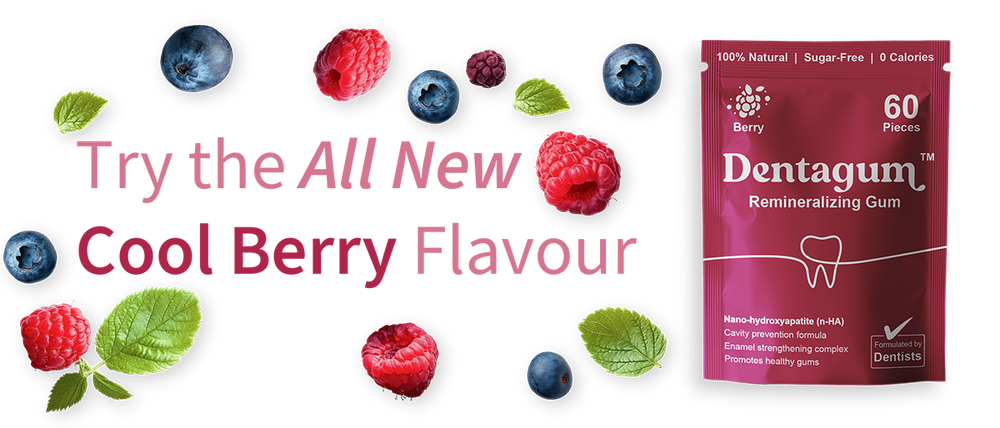
Point 7 (Transparent labeling): Full ingredient list: Nano-Hydroxyapatite (nHA), Organic Xylitol, Organic Erythritol, Organic Mastic Gum, Natural Propolis, Coconut Oil, Organic Chicle Gum (base), Organic Eggshell Powder, Natural Calcium Bentonite Clay, Natural Terpene Blend (Menthone, Carvone, Cineol), Spearmint Extract (Natural and Organic). Every ingredient named. Gum base specified. Claims language uses "designed to help," "support," and "help remineralize" throughout. No "rebuilds enamel" or "cures" language.
Frequently Asked Questions
What is the most important thing to look for in remineralizing gum?
Nano-hydroxyapatite specifically (not generic "hydroxyapatite") and xylitol as the primary sweetener are the two most important active ingredients. Nano-HAp at 20-100 nm penetrates enamel microporosities in a way that standard hydroxyapatite at micro sizes cannot. Xylitol at meaningful dose actively kills S. mutans rather than simply not feeding it. If either of these is absent or present only as a trace additive, the product's active remineralization mechanism is significantly compromised. Everything else in the checklist matters, but these two determine whether the product can do what the category claims.
Why does the gum base matter?
The gum base is what you're literally chewing for 20 minutes multiple times per day. Standard commercial gum uses synthetic polymer bases derived from petroleum: polyvinyl acetate, polyisobutylene, butadiene-styrene rubber. These are materials also used in adhesives, tires, and paints. FDA labeling rules permit all of these to be hidden under the single label "gum base." Natural bases (chicle from the sapodilla tree, mastic from Pistacia lentiscus) are plant-derived materials with thousands of years of human use. Mastic specifically has 14 clinical studies confirming antibacterial, anti-inflammatory, and antimicrobial properties. A natural base that is also biologically active adds value that any synthetic base cannot.
What does third-party tested actually mean?
Very little on its own. The phrase "third-party tested" only means something when accompanied by: a named laboratory (not just "an independent lab"), accreditation status (ISO/IEC 17025 for analytical labs), what was tested (heavy metals specifically: lead, cadmium, arsenic, mercury), and most importantly, publicly accessible results at a URL you can visit. The test is simple: can you find the lab report yourself, at the lab's own verification system, without any redirection through the brand's website? If yes, the testing claim is substantiated. If no, you're trusting the brand's word. For a product chewed multiple times daily, the verification matters.
Is erythritol better than xylitol?
They work better together than either alone. Xylitol kills S. mutans through a well-characterized metabolic disruption mechanism. Erythritol inhibits S. mutans adhesion to tooth surfaces through a different mechanism, reducing how effectively cariogenic bacteria colonize enamel. Research published in the International Journal of Dentistry found erythritol performed comparably to xylitol and better than sorbitol across oral health endpoints. The best functional gums use both as complementary antibacterial polyols. A gum with both listed before any sorbitol delivers dual-mechanism bacterial suppression.
Why does it matter whether the label says "nano" before hydroxyapatite?
Because the word "nano" specifies a particle size range (20-100 nm) that determines whether the ingredient can physically reach where remineralization needs to happen. Standard hydroxyapatite at 5-10 microns cannot adhere to enamel effectively (Fabritius-Vilpoux et al. 2019: only particles under 1.3 microns can) and cannot enter dentinal tubules (approximately 1-2 microns wide). Nano-HAp at 20-100 nm matches the scale of enamel microporosities from acid erosion and can deposit mineral directly into early lesions. A product listing "hydroxyapatite" without "nano" may be using micro-HA, which polishes enamel surfaces but cannot remineralize them. Ask any brand that doesn't specify particle size what their particle size actually is.
How do I compare two remineralizing gums using this checklist?
Put both ingredient lists side by side and go through each point. Check: (1) Does each say "nano-hydroxyapatite" or just "hydroxyapatite"? (2) Which sweetener is listed first? (3) Does either name the gum base material specifically? (4) Can you find both products' lab results at a named, accredited lab's own website? (5) Does either contain aspartame or artificial sweeteners? (6) Does each brand cite specific named peer-reviewed studies? (7) Can you find the full ingredient list, or is part hidden behind "gum base" or "proprietary blend"? A brand passing all seven is genuinely in a different category from one failing even two or three. For a side-by-side comparison of leading US brands against these criteria, see our article on remineralizing gum brands compared.

Bottom Line
The remineralizing gum category runs on shared vocabulary that obscures real formulation differences. "Nano-hydroxyapatite" on a label means something only if the particle size is actually in the nano range. "Xylitol gum" means something only if xylitol is the primary sweetener at a clinical dose. "Third-party tested" means something only if you can find the results yourself at a named accredited lab. "Natural" means something only if the base is specifically named as a plant-derived resin rather than hidden behind the catch-all "gum base." Seven specific criteria separate a genuinely functional remineralizing gum from a product using the category's credibility without the substance behind it. Run any product through them before buying.
Try Dentagum: 7 for 7 on the ChecklistResearch Summary
This article draws on particle size research, sweetener clinical evidence, gum base composition data, and labeling regulations. Key sources include: PMC8432723 (Hydroxyapatite in Oral Care Products review: nano-HA at 20-50 nm matches nano-sized defects from acidic erosion; micro-HA not as effective due to size); Fabritius-Vilpoux K et al. 2019 (only particles up to 1.3 µm can successfully adhere to enamel; micro-HA typically 5+ µm cannot); Alara Dental nano-HAp in preventive dentistry 2026 (nano-HAp 20-50 nm penetrates micro-defects; rod-shaped morphology resembling natural enamel; dentinal tubules 1-2 µm wide); Today's RDH, A Dental Hygienists' Overview of Nano vs Micro Hydroxyapatite, March 2024 (micro-HA at 5-10 µm significantly larger; clinical effectiveness dependent on specific geometry and particle size; nano more effective); Limeback H, Enax J, Meyer F. Biomimetics 2023 (44 clinical trials; 39.5% dentin hypersensitivity reduction nano-HAp vs placebo; nano particle size central to clinical effect); Söderling E, Pienihäkkinen K. BMC Oral Health 2025 (xylitol gum reduced S. mutans 12/14 studies vs sorbitol); Pienihäkkinen K et al. Eur Arch Paediatr Dent 2024 (10/10 xylitol chewing gum RCTs significant caries reduction); International Journal of Dentistry erythritol study (erythritol decreased dental plaque weight, inhibited S. mutans adhesion, caries incidence reduction; comparable to xylitol, better than sorbitol); Alwadi MAM et al. J Natural Med 2023 (mastic gum: antibacterial, anti-inflammatory, antimicrobial; 14 clinical studies); Sustainability 2023 MDPI (chicle as NTFP: synthetic gum base polyvinyl acetate, polyisobutylene, butadiene-styrene rubber all petroleum-derived; "gum base" FDA labeling covers both); Nathan and Sons 2025 (synthetic gum bases: polyvinyl acetate, polyisobutylene, styrene-butadiene rubber; FDA allows all to be listed as "gum base"); 2025 UCLA study / ACS Spring 2025 (both synthetic and natural gum release microplastic particles; environmental contamination likely in natural gum samples); PMC12025785 2025 (aspartame significantly impacted human gut microbiome; oral microbiome affected: decreased Porphyromonas and Prevotella nanceiensis); Dentagum Lightlabs COA June 18, 2026: Pb 0.09 mcg (5.5x below Prop 65), Cd 0.003 mcg (1,367x below), As 0.02 mcg (500x below), Hg non-detected. All Dentagum product claims from internal clinical data or ingredient-level published research; clearly attributed throughout.
References
- Limeback H, Enax J, Meyer F. Clinical Evidence of Biomimetic Hydroxyapatite in Oral Care Products for Reducing Dentin Hypersensitivity. Biomimetics. 2023. PMC9844412. [44 clinical trials; 39.5% dentin hypersensitivity reduction nano-HAp vs placebo; nano particle size central to clinical effect]
- Orsini G et al. Hydroxyapatite in Oral Care Products: A Review. PMC. PMC8432723. [Nano-HA particle size 20-100 nm; rod-shaped morphology resembling natural enamel; 20-50 nm matches nano-sized defects from acid erosion; more effective than micro-HA in biofilm management; particles smaller than bacteria enable direct bacterial membrane interaction]
- Fabritius-Vilpoux K et al. 2019. [Only particles with diameters up to 1.3 µm can successfully adhere to enamel; micro-HA particles typically larger than 5 µm cannot; nano-HAp at 20-100 nm within ideal range for enamel adhesion and remineralization. Cited via Fluidinova.com nano vs micro hydroxyapatite review]
- A Dental Hygienists' Overview of Nano vs. Micro Hydroxyapatite. Today's RDH. March 2024. [Micro-cluster HA at 5-10 microns; clinical effectiveness dependent on specific geometry, pore size, and particle size; nano-HA more effective than micro-HA in dentistry]
- Söderling E, Pienihäkkinen K. Specific effects of xylitol chewing gum on mutans streptococci, plaque, and caries. BMC Oral Health. 2025. [Xylitol gum reduced S. mutans 12/14 studies; plaque reduction 6/10 studies vs sorbitol controls]
- Pienihäkkinen K, Hietala-Lenkkeri A et al. The effect of xylitol chewing gums and candies on caries occurrence in children. Eur Arch Paediatr Dent. 2024;25:145-160. [10/10 xylitol chewing gum RCTs statistically significant caries reduction; clinically significant at moderate-high baseline caries; most effective protocol: 100% xylitol 5-10g/day 3-5 exposures after meals]
- Erythritol vs sorbitol vs xylitol oral health comparison. International Journal of Dentistry. [Erythritol: decreased dental plaque weight, inhibited S. mutans adhesion to tooth surfaces, reduced caries incidence; comparable to xylitol, better than sorbitol across oral health endpoints]
- Alwadi MAM et al. State-of-the-Art Review: Mastic (Pistacia lentiscus) Gum and Oral Health. J Natural Med. 2023. [14 independent clinical studies; antibacterial, anti-inflammatory, antimicrobial properties confirmed]
- Castaño R, Castaño A et al. Sustainability as Strategic Differentiator: The Promise and the Problems of Using Chicle vs. Petro-Chemicals in Chewing Gum. MDPI Sustainability. 2023;15(16):12228. [Major commercial gum bases: synthetic rubber, polyvinyl acetate, polyisobutylene; all petroleum-derived; "gum base" FDA labeling covers both natural and synthetic; industry transition from chicle to synthetics for cost reasons]
- Nathan and Sons. Natural Chewing Gum vs Regular Gum. September 2025. [Synthetic gum bases: polyvinyl acetate, styrene-butadiene, polyisobutylene; petroleum-derived plastics; release measurable microplastic particles when chewed]
- UCLA / ACS Spring 2025. Ingestion of microplastics during chewing gum consumption. Presented at ACS Spring 2025. [Both synthetic and natural gum bases release microplastic particles; natural gum contamination likely from environmental sources rather than plant resins themselves; study under peer review]
- PMC12025785. Artificial Sweeteners: A Double-Edged Sword for Gut Microbiome. Microorganisms (MDPI). Published April 2025. [Aspartame significantly impacted human gut microbiome; oral microbiome similarly impacted: decreased Porphyromonas and Prevotella nanceiensis]
- Paszynska E et al. Fluoride-free nano-hydroxyapatite: 18-month RCT. Front Public Health. 2023. [Nano-HAp non-inferior to 1,450 ppm fluoride toothpaste for cavity prevention in adults]
- Dentagum Light Labs COA. June 18, 2026. PJLA accreditation #128155 (ISO/IEC 17025). [Pb 0.09 mcg (5.5x below Prop 65 limit), Cd 0.003 mcg (1,367x below), As 0.02 mcg (500x below), Hg non-detected. Publicly accessible at lightlabs.com]
