
Is Remineralizing Gum Worth It? An Honest Cost-Benefit Breakdown
Remineralizing gum at $0.55 per piece costs $1.10 to $1.65 per day. A composite filling without insurance runs $150 to $400. A root canal and crown costs $1,500 to $3,200. For someone with a history of dental work, sensitivity, or reduced salivary flow, the preventive ROI case is real. For someone with excellent oral health and low cavity risk, regular sugar-free gum at $0.10 per piece delivers most of the practical benefit at a fraction of the cost. This article does the math honestly and tells you which scenario you're in.

Quick Answer
Remineralizing gum is worth it if the math works in your favor, and for most adults, it does. At $0.55 per piece (Dentagum's price, the lowest in the nano-HAp gum category), two pieces per day costs $33 per month. A single composite filling runs $150 to $400. A root canal and crown combination costs $1,500 to $3,000 without insurance. If using gum regularly after meals helps you avoid one filling per year, or delays a procedure by even a year, the financial return on the habit is clear. Beyond the math: remineralizing gum after meals is the only evidence-based oral health habit that fills the post-meal window that brushing and flossing cannot reach. The question is not whether the science is there (it is, with seven clinical trials and ADA endorsement for sugar-free gum after meals) but whether the cost fits the benefit. This article does the math honestly.
Last updated: July 2026 | Cost data sourced from CareCredit 2024 Synchrony national dental cost study, Delta Dental pricing data, Humana dental procedure cost guide, and ADA Health Policy Institute expenditure data
The most common objection to remineralizing gum is not about whether it works. It's about whether the cost is worth it compared to doing nothing, or compared to cheaper alternatives. That's a fair question. This article answers it with real numbers rather than vague gestures at "preventive value." The math is not complicated, but it requires laying out the actual cost of the alternatives: what happens when enamel damage accumulates and procedures become necessary.
What You're Actually Buying When You Buy Remineralizing Gum
Before the cost-benefit analysis makes sense, it helps to be clear about what remineralizing gum does and does not do, because the value proposition only holds for the things it actually delivers.
Remineralizing gum does three things that standard oral care (brushing and flossing) does not do: it provides post-meal oral acid neutralization when brushing isn't possible, it delivers enamel mineral support between brushing sessions, and it suppresses cariogenic bacteria throughout the day. These are not overlapping functions. Brushing removes plaque and delivers fluoride twice a day. It does nothing for the post-lunch or post-dinner acid window when you're at your desk or in a restaurant. That 20 to 40 minute window after every meal, when pH is below 5.5 and enamel is actively losing mineral, is what remineralizing gum addresses.
The ADA endorses sugar-free gum specifically for this function: 20 minutes after meals, stimulating salivary flow to 10 to 12 times the resting rate to neutralize post-meal acid. Seven clinical trials have confirmed a measurable reduction in cavity incidence from this habit. Nano-HAp (the active remineralizing ingredient in functional gum) adds direct enamel mineral delivery during those same windows. Xylitol adds antibacterial action against Streptococcus mutans throughout the chewing session.
Remineralizing gum does not replace brushing. It does not rebuild structurally lost enamel. It does not treat existing cavities or gum disease. It fills a specific gap in the oral care routine and is worth the money if you value that gap being filled. For a full breakdown of what the science supports, see our article on what remineralizing gum is and does.
The Cost-Per-Day Math
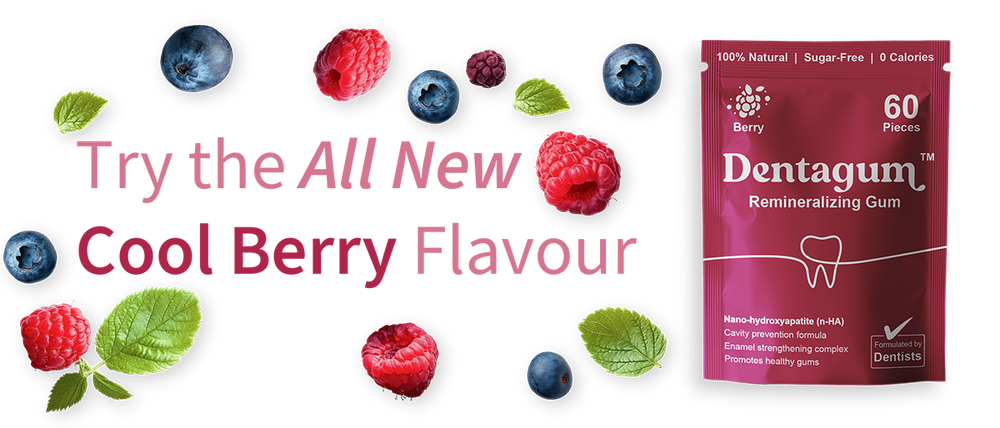
Dentagum is priced at $32.97 for 60 pieces. That's $0.55 per piece. This is the lowest price per piece in the nano-HAp gum category in the US market (Enamio: $0.83/piece; Larineco: $0.97/piece).
The recommended usage is 2 to 4 pieces per day, chewed for 10 to 20 minutes after meals. At two pieces per day (after two meals), the daily cost is $1.10. At three pieces per day (after three meals), it's $1.65. Monthly cost: $33 to $49.50.
To put those numbers in context:
$1.10 per day is less than a single gumball machine turn, less than a third of a coffee, and roughly the cost of two pieces of regular premium gum. It is the cost category of a habit, not a splurge. The question is whether the habit is worth that cost given what it delivers and what it potentially replaces.
The Cost of Doing Nothing: What Dental Procedures Actually Cost

The "cost of doing nothing" analysis is not a hypothetical. It is the most important number in this comparison, and most people underestimate it significantly.
Dental care is expensive, and it scales rapidly from minor to major. According to the 2024 Synchrony/CareCredit national dental cost study (conducted across all 50 US states), a routine dental exam with cleaning and X-rays costs approximately $203 nationally (ranging from $50 to $350 depending on location). A resin-based composite filling costs $150 to $400 per tooth for a single surface, with multi-surface fillings ranging considerably higher. If decay progresses beyond what a filling can address, the escalation is rapid: a dental crown costs $800 to $2,500. A root canal on a molar, which is often necessary when decay reaches the pulp, runs $900 to $1,175 for the root canal itself plus $800 to $1,500 for the crown that follows it, bringing the combined cost to $1,500 to $3,200 for one tooth without insurance (CareCredit 2024; Humana dental guide). Dental implants, needed when a tooth cannot be saved, cost $1,500 to $3,000+ per tooth before the crown.
The financial exposure is compounded by the fact that 38.9% of all dental spending in the US comes directly out of pocket (ValuePenguin analysis of CMS data, 2023), compared to just 10.4% out-of-pocket share for medical spending. Dental insurance annual maximums typically cap at $1,000 to $2,000, meaning a single root canal and crown can exhaust or exceed a full year's dental benefits in one procedure. 92% of Americans say they would consider delaying dental care due to cost (Synchrony Lifetime of Care study, 2023). 13% of the US population faces active cost barriers to dental care, compared to just 4-5% for other medical services (2024 ADA Health Policy Institute).
Against these numbers, the ROI calculation for remineralizing gum is straightforward. If using it consistently after meals helps you avoid one filling per year: the saving is $150 to $400 versus a habit cost of $396 to $594 per year (at 2 to 3 pieces/day). The gum costs more than the filling in that single-scenario case. But if it helps you avoid progression from a filling to a root canal, or delays a procedure by two to three years, the math inverts heavily. A habit that costs $400 per year and delays one root canal + crown by three years generates roughly $1,500 to $3,000 in deferred treatment cost.
The more honest framing is that remineralizing gum is not a "instead of" intervention. It is an "in addition to" intervention that changes the trajectory of oral health over years. The research on preventive oral care consistently shows that the cost of prevention is a fraction of the cost of restoration. The ADA's own position is that gum after meals reduces cavity incidence; the clinical math follows from that reduction.
US Dental Procedure Costs: The "Cost of Doing Nothing" Reference Table
- Routine exam + cleaning + X-rays: ~$203 national average ($50-$350 depending on location). CareCredit/Synchrony 2024 national study.
- Composite (tooth-colored) filling, single surface: $150-$400 per tooth. Multi-surface significantly higher. Delta Dental, Humana, CareCredit data.
- Dental crown: $800-$2,500 per tooth without insurance. Insurance covers roughly 50%, capped by annual maximum.
- Root canal, molar (excluding crown): $900-$1,175 without insurance (Humana). With crown: $1,500-$3,200 combined for one tooth.
- Dental implant (full single tooth restoration): $1,500-$3,000+ for the implant, plus $800-$1,500 for the crown. Total: $2,400-$4,500+ per tooth.
- Out-of-pocket reality: 38.9% of all US dental spending is out-of-pocket. Insurance annual maximums typically $1,000-$2,000, often exhausted by one major procedure.
- Delay cost: 44% of people who ignored a recommended dental procedure said it caused additional dental issues. 22% of people who delayed care said postponing resulted in other oral health problems (Synchrony 2023).
All procedure costs are approximate national averages; actual costs vary by location, provider, and insurance coverage. Sources: CareCredit/Synchrony 2024 national dental cost study; Humana dental resource guide; Delta Dental pricing data.
Compared to Sensitivity Toothpaste
The closest category competitor to remineralizing gum in the "daily oral health support" space is sensitivity toothpaste, specifically the potassium nitrate (Sensodyne) and stannous fluoride formulas most dentists recommend. A 4 oz tube of Sensodyne runs approximately $7 to $12 retail. At one to two tubes per month (the typical usage rate for a twice-daily brusher), the cost is $7 to $24 per month, or $0.23 to $0.80 per day.

The honest comparison is not competition but complementarity. Sensitivity toothpaste works during brushing sessions: it delivers desensitizing agents (potassium nitrate blocks dentin tubule nerve signals; stannous fluoride occlude exposed tubules) and fluoride for enamel remineralization during the two-minute brushing window. Remineralizing gum works between brushing sessions, in the post-meal acid window that toothpaste cannot reach. They address different timeframes in the daily oral exposure cycle.
Someone who uses both sensitivity toothpaste and remineralizing gum is getting coverage across the full oral care day: brushing delivers tubule occlusion and fluoride at the session. Gum delivers saliva stimulation, acid buffering, nano-HAp mineral delivery, and xylitol antibacterial action in the post-meal windows. The combined cost is roughly $40 to $70 per month for comprehensive daily coverage. Compared to the cost of a single filling, this represents about 4 to 17 months of combined preventive spending to cover the event that the prevention might defer.
Compared to Regular Sugar-Free Gum
The most direct comparison is between remineralizing gum and standard sugar-free gum (Trident, Orbit, Extra). A pack of regular sugar-free gum typically costs $1.50 to $2.50 for 14 to 18 pieces, or roughly $0.10 to $0.18 per piece. At three pieces per day, regular gum costs $0.30 to $0.54 per day, or $9 to $16 per month. Dentagum at three pieces per day costs $1.65 per day or $49.50 per month. The cost difference is approximately $33 to $40 per month.
Is the difference justified? For the base function (saliva stimulation and acid buffering), both deliver this. Regular sugar-free gum stimulates salivary flow and has seven clinical trials showing cavity reduction from post-meal use. The ADA endorsement applies to sugar-free gum in general.
The additional value in remineralizing gum comes from the active ingredients: nano-HAp (not present in any mainstream sugar-free gum) directly deposits enamel mineral, xylitol at a meaningful concentration kills S. mutans rather than simply not feeding it, and erythritol adds a second antibacterial polyol. For people whose primary goal is post-meal acid buffering, regular sugar-free gum provides real benefit at lower cost. For people who have sensitivity, are high-risk for cavities, are on medications that reduce saliva, or want the active remineralization benefit of nano-HAp, the additional cost of functional gum carries a clinical case behind it.
Who Gets the Most Value from Remineralizing Gum
The cost-benefit math shifts based on who is using it. Some people get more value than others, and being honest about that is more useful than claiming universal value.

The people who get the clearest return: those with a history of cavities or fillings (the preventive argument is most financially relevant when you have evidence your teeth are cavity-prone); people with tooth sensitivity (nano-HAp's 39.5% dentin hypersensitivity reduction in the Limeback/Enax/Meyer Biomimetics 2023 meta-analysis means they may reduce or replace sensitivity toothpaste, changing the cost comparison); people on medications that reduce salivary flow (discussed in our article on saliva and oral health); people who eat frequently between meals or snack regularly (each eating occasion is a new acid attack, and gum after each one closes that window); athletes or people who drink sports drinks regularly; and people without dental insurance facing out-of-pocket costs for any procedure.
The people for whom the math is less compelling: those with very low cavity risk (young adults with excellent enamel, no history of decay, healthy diet, excellent brushing habits), and those who are simply looking for a breath freshener (plain sugar-free gum at $0.10/piece does that equally well). If you're already visiting the dentist regularly, have zero fillings, eat well, and have pristine oral health with no history of sensitivity, the preventive case for remineralizing gum specifically (vs regular gum) is weaker. The base saliva benefit of any sugar-free gum is still real; the active ingredient premium is less clearly necessary for that specific person.
What the Research Shows About Prevention ROI
There is peer-reviewed evidence specifically relevant to the cost-effectiveness of preventive oral care habits. The clinical evidence for the gum mechanism itself is covered in detail in related articles; this section focuses on the ROI framing.
Seven clinical trials have confirmed that sugar-free gum after meals reduces cavity incidence. The ADA endorses the habit specifically on this basis. The 2025 BMC Oral Health systematic review confirmed xylitol gum reduced S. mutans counts in 12 of 14 clinical studies. Xylitol gum has been shown to reduce caries incidence by up to 70% in high-compliance populations in some studies (Effectiveness of Chewing Gum in Dental Hygiene, 2025). The Paszynska et al. 18-month RCT (Frontiers in Public Health, 2023) found fluoride-free nano-HAp non-inferior to standard fluoride toothpaste for cavity prevention in adults.
On the broader preventive ROI: the ADA's Health Policy Institute data shows that $1 spent on preventive dental care saves an estimated $8 to $50 in restorative treatment costs, depending on the population and intervention. This ratio is widely cited in public health dental economics literature. The exact number varies by study, but the directional finding is consistent: prevention is substantially cheaper than restoration across dental interventions. Remineralizing gum is the most accessible and most habit-compatible preventive intervention available between meals.
The cost savings from prevention are also asymmetric with time. The value of avoiding a filling is not just the filling cost today; it's also deferring the eventual crown that follows extensive multi-surface fillings, and the implant that can follow a tooth that can't be saved. Each step in the escalation is an order of magnitude more expensive than the previous one. Preventive habits interrupt the escalation at its earliest stage, when the cost of intervention is lowest and the benefit is largest.
The Honest Caveats
No cost-benefit analysis of a preventive product is complete without the caveats.
Remineralizing gum does not guarantee you won't get cavities. Genetics, diet, fluoride exposure, oral hygiene quality, and the specific bacterial composition of your oral microbiome all affect cavity risk in ways that no single product controls. The evidence shows that regular use reduces risk; it does not show that risk goes to zero.
The preventive benefit is not equally distributed. People with high baseline cavity risk, confirmed through history and dental assessment, get more value from preventive habits. People with low risk get less proportional benefit from adding another layer of prevention.
The cost is real. At $33 to $49.50 per month for consistent use at two to three pieces per day, remineralizing gum is a meaningful recurring cost for many households. For people on tight budgets, the more financially rational choice may be regular sugar-free gum (which delivers the saliva stimulation benefit) plus one tube of Sensodyne, for roughly $10 to $16 per month total. The base saliva stimulus from any sugar-free gum is the most important mechanism, and it does not require premium ingredients to work.
The honest verdict: if you have a history of dental issues, sensitivity, or reduced salivary flow, the full remineralizing formula with nano-HAp is worth the additional cost. If you have excellent oral health and minimal risk, regular sugar-free gum serves the core need and the premium is optional rather than essential.
The Value Decision: Who Should Buy Remineralizing Gum
- Strong case (clearest ROI): History of fillings or cavities; current tooth sensitivity; reduced salivary flow (medications, GLP-1, dry mouth); frequent snacker or coffee drinker; athlete using sports drinks; limited or no dental insurance; GLP-1 user with reduced eating frequency.
- Moderate case: No history of dental issues but wants proactive enamel support; conscious of oral health as a long-term investment; already using Sensodyne (gum fills the post-meal gap that toothpaste cannot).
- Weaker case (regular gum may suffice): Excellent oral health history, no sensitivity, no dry mouth, low cavity risk profile, tight budget. Regular sugar-free gum provides the core ADA-endorsed saliva benefit at a fraction of the cost.
- Value at $0.55/piece vs. category: Dentagum is the lowest price per piece among nano-HAp gums in the US. Enamio: $0.83/piece. Larineco: $0.97/piece. The premium over regular gum is $0.37-$0.45/piece, buying nano-HAp, clinical-dose xylitol, natural gum base, and Prop 65-verified safety testing.
Frequently Asked Questions
How much does remineralizing gum cost per month?
Dentagum costs $32.97 for 60 pieces, at $0.55 per piece. At two pieces per day (after two meals), the monthly cost is approximately $33. At three pieces per day (after three meals), it's approximately $49.50. This is the lowest price per piece in the US nano-HAp gum category: Enamio is $0.83/piece and Larineco is $0.97/piece. Regular sugar-free gum (Trident, Orbit) costs $0.10 to $0.18 per piece, or roughly $9 to $16 per month at three pieces per day, delivering the saliva stimulation benefit without the nano-HAp or clinical-dose xylitol.
Is remineralizing gum worth it if you already use Sensodyne?
Yes, for most people, because they address different time windows. Sensodyne works during your two-minute brushing sessions, delivering desensitizing agents and fluoride. Remineralizing gum works in the post-meal windows when brushing isn't happening, delivering saliva stimulation, acid buffering, nano-HAp mineral delivery, and xylitol antibacterial action. The two products are complementary rather than redundant. If budget is a constraint, sensitivity toothpaste addresses a more clinically urgent need (managing active sensitivity pain). Gum addresses the between-meal window and is additive to toothpaste, not substitutive.
How much does a dental filling cost without insurance?
A composite (tooth-colored) filling for a single surface typically runs $150 to $400 without insurance, based on national pricing data from CareCredit/Synchrony 2024, Delta Dental, and Humana. Multi-surface fillings cost considerably more. If the filling is delayed and decay progresses to the pulp, a root canal runs $700 to $1,175 (molar) and the crown that follows it adds $800 to $1,500, for a combined cost of $1,500 to $3,200 for one tooth. Dental implants (when the tooth can't be saved) run $1,500 to $3,000+ for the implant alone.
Is sugar-free gum just as good as remineralizing gum?
For the core saliva stimulation benefit, yes: any sugar-free gum stimulates salivary flow and helps buffer post-meal acid. The ADA endorses this function for all sugar-free gum. The difference is in the additional active ingredients. Remineralizing gum adds nano-HAp (direct enamel mineral delivery), clinical-dose xylitol (demonstrated S. mutans suppression in 12/14 studies: BMC Oral Health 2025), and erythritol (bacterial adhesion inhibition). These additions matter more for people with active sensitivity, cavity history, or reduced salivary flow. For a person with low cavity risk and healthy enamel, regular sugar-free gum provides most of the practical benefit at significantly lower cost.
How long does one pouch of Dentagum last?
At two pieces per day, 60 pieces lasts 30 days. At three pieces per day, it lasts 20 days. At the minimum recommended two pieces per day (after two meals), the monthly cost is $32.97, which is roughly one pouch per month. This is the most common usage pattern for people using it after lunch and dinner, with a third piece after breakfast for those who want full post-meal coverage.
Can I use remineralizing gum instead of going to the dentist?
No, and this should be stated plainly. Remineralizing gum is a preventive habit, not a treatment. It does not repair existing cavities, treat gum disease, or substitute for professional cleaning and examination. Existing dental problems require professional care. Remineralizing gum works in the space between dental visits, during the daily oral exposure cycles that brushing alone does not cover. If you have active pain, visible decay, or symptoms of gum disease, the right next step is a dental visit, not a change in gum brand.

Bottom Line
Remineralizing gum at $0.55 per piece (Dentagum's price, the lowest in the nano-HAp category) costs $1.10 to $1.65 per day at normal usage. A composite filling without insurance costs $150 to $400. A root canal and crown costs $1,500 to $3,200 for one tooth. If you're someone with a history of dental work, sensitivity, dry mouth, or frequent between-meal eating, the preventive ROI argument for the habit is not subtle.
The honest answer to "is it worth it" depends on your risk profile. If you have low cavity risk and great oral health, regular sugar-free gum delivers the core ADA-endorsed saliva benefit at a fraction of the cost, and the nano-HAp premium is an upgrade rather than a necessity. If you have a history of dental issues, sensitivity, or reduced salivary flow, the nano-HAp, clinical-dose xylitol, and natural base in a functional remineralizing gum are worth the additional cost. In either case, chewing sugar-free gum after meals is the right habit. The question is just which version.
Try Dentagum: $0.55/piece, 30-Day GuaranteeResearch Summary
This article draws on US dental procedure cost data, dental expenditure statistics, and clinical evidence for the gum habit. Key sources include: CareCredit/Synchrony 2024 national dental cost study (ASQ360 market research, all 50 states): routine exam ~$203; root canal molar ~$1,175; Humana dental procedure cost guide: root canal anterior $900, premolar $1,017, molar $1,175; crowns $800-$2,500; Dental Depot DFW average costs 2025: fillings $147-$2,800 depending on surfaces; root canal $770-$2,471; crown $800-$2,500; Delta Dental pricing data: amalgam filling $110-$455; composite up to $217 (resin-based, single surface); ValuePenguin Dental Health Report 2025 (CMS data): out-of-pocket costs 38.9% of dental spending vs 10.4% medical; $67.6 billion out-of-pocket in 2023; Synchrony Lifetime of Care study 2023 (1,000+ Americans 20-79): 92% would consider delaying general dental care due to cost; 83% even for emergency care; 44% ignored procedure caused additional issues; 54% cited cost as primary reason for not visiting dentist; 3 out of 4 Americans do not save for dental care; Dental Economics 2025 (ADA HPI 2024 report): 13% of population faced cost barriers to dental care vs 4-5% for other health services; ADA national dental expenditures 2024: $189 billion total, out-of-pocket spending majority; ADA chewing gum endorsement: 20 min after meals; 7 clinical trials confirming cavity reduction; ADA Seal for sugar-free gum; Söderling et al. BMC Oral Health 2025: xylitol gum reduced S. mutans 12/14 studies; Effectiveness of Chewing Gum in Dental Hygiene 2025: xylitol gum caries reduction up to 70% in high-compliance populations; Paszynska et al. Frontiers in Public Health 2023: 18-month RCT, nano-HAp non-inferior to fluoride toothpaste for cavity prevention; Limeback H, Enax J, Meyer F. Biomimetics 2023 (44 trials: 39.5% dentin hypersensitivity reduction nano-HAp); Dentagum pricing: $32.97/60 pieces = $0.55/piece; Enamio: $0.83/piece; Larineco: $0.97/piece. All Dentagum product claims from ingredient-level published research. Third-party pricing data cited for competitors; may change.
References
- CareCredit / Synchrony. 2024 Average Procedural Cost Study for Dental Practices Across the United States. Conducted by ASQ360 Market Research. [National average dental exam + cleaning + X-rays: ~$203 (range $50-$350); all 50 states + DC; root canal molar excluding crown: ~$1,175; crown average by type]
- Humana. Costs of Common Dental Procedures. humana.com. Updated June 2026. [Root canal molar (excluding final restoration): $1,175; premolar: $1,017; anterior: $900; composite resin filling: up to $217; crown prices by material; extraction prices]
- Dental Depot of DFW. Average Costs of 9 Common Dental Treatments. October 2025. [Fillings: $147-$2,800 depending on surfaces and material; root canal: $770-$2,471; crown: $800-$2,500; implant with abutment and crown: $2,400-$7,000+]
- Delta Dental. Tooth Fillings: Cost and Insurance Coverage. deltadental.com. Updated May 2026. [Amalgam fillings: $110-$455 depending on surfaces; composite up to $217 single surface; insurance typically covers 50-80% of fillings]
- Advanced Smile Dental. Root Canal Cost 2026: With and Without Insurance. [Root canal: $700-$1,600 without insurance; molar root canal + crown: $1,600-$3,200; insurance covers 50-80% post-deductible]
- ValuePenguin. Dental Health Report 2025. Analysis of CMS and ADA data. [Out-of-pocket costs: 38.9% of all dental spending (vs 10.4% medical); out-of-pocket: $67.6 billion of $173.8 billion total dental spending 2023; 34.1% of adults didn't see a dentist in the past year]
- Synchrony. Americans May Forgo Dental Treatments Due to Cost. PR Newswire. October 2023. Synchrony Lifetime of Care study, 1,000+ insured and uninsured Americans 20-79. [92% would consider delaying general dental care due to cost; 83% for emergency care; 44% who ignored a recommended procedure had additional dental issues; 54% cited cost as primary reason for not visiting dentist in past year; 3 in 4 do not save for dental care]
- Dental Economics. Helping patients overcome cost barriers. February 2025. [2024 ADA HPI report: 13% of population faced cost barriers to dental care vs 4-5% for other medical services; 92% of Synchrony study respondents would hold off on dental treatments; 17% ignored a recommended procedure; 22% who delayed care reported additional oral health problems]
- ADA Health Policy Institute. National Dental Expenditures 2024. ada.org. [Total national dental expenditures 2024: $189 billion; out-of-pocket spending majority of expenditures; 3.6% increase from 2023 adjusted for inflation]
- Söderling E, Pienihäkkinen K. Specific effects of xylitol chewing gum on mutans streptococci and caries. BMC Oral Health. 2025. [Xylitol gum reduced S. mutans in 12 of 14 studies vs sorbitol controls]
- Effectiveness of Chewing Gum in Dental Hygiene. IJES. 2025. Vol 11, No 24s. [Xylitol gum demonstrated caries incidence reduction up to 70% in high-compliance populations; significant S. mutans and plaque reductions; 7 clinical caries trials confirming sugar-free gum post-meal benefit]
- Paszynska E, Pawinska M, Grzebieluch W et al. Fluoride-free nano-hydroxyapatite as equally effective to standard fluoride toothpaste: 18-month RCT. Front Public Health. 2023. [Nano-HAp non-inferior to 1,450 ppm fluoride toothpaste for cavity prevention in adults over 18 months]
- Limeback H, Enax J, Meyer F. Clinical Evidence of Biomimetic Hydroxyapatite in Oral Care Products. Biomimetics. 2023. PMC9844412. [44 clinical trials; 39.5% dentin hypersensitivity reduction nano-HAp vs placebo]
- ADA. Chewing Gum. Oral Health Topics. ada.org. [Sugar-free gum endorsed: 20 min after meals; 7 clinical trials confirming cavity reduction; ADA Seal of Acceptance for sugar-free gum; saliva stimulation 10-12x resting rate]
