
Enamel Erosion and Whitening: Why You Should Strengthen Before You Brighten
Whitening enamel that is already weakened is one of the most common whitening mistakes. Weakened enamel has more microscopic porosity, letting whitening agents penetrate deeper toward sensitive dentin, producing more discomfort and patchier results. A 2025 study found peroxide-free color correctors like PAP+ increased enamel microhardness by 12.9 VHN with no demineralization, and sensitivity under 3 percent versus 43 to 80 percent for traditional peroxide. Nano-hydroxyapatite reduces whitening sensitivity when incorporated into bleaching protocols without compromising effectiveness. The evidence-backed sequence: strengthen with a remineralizing gum for several weeks, then whiten with a PAP+ and nano-HAp formula built to support enamel throughout treatment.

Quick Answer
Whitening enamel that is already thin, porous, or acid-weakened is one of the most common mistakes people make when trying to brighten their smile. Weakened enamel has more microscopic porosity for whitening agents to penetrate, which means more of the active ingredient reaches the sensitive dentin underneath, producing more discomfort and often a patchier, less predictable result. The research on peroxide-free whitening actives like PAP+ is genuinely encouraging here: a 2025 peer-reviewed study found peroxide-free color correctors increased enamel surface microhardness by 12.9 VHN with no demineralization observed, and sensitivity occurred in under 3% of users compared to substantially higher rates with traditional peroxide. Nano-hydroxyapatite, separately, has been shown in clinical research to reduce whitening-related sensitivity when incorporated into bleaching protocols, without compromising whitening effectiveness. The sequenced approach that follows from this evidence is straightforward: strengthen enamel first with a nano-HAp remineralizing gum, then whiten with a peroxide-free active like PAP+ once the enamel surface is in better condition to handle it. This is exactly the two-step sequence Dentagum's product line is built to support.
Last updated: July 2026. Reviewed against enamel erosion prevalence research, PAP+ and hydrogen peroxide comparative sensitivity data, and nano-hydroxyapatite pre-whitening enamel research
Most people approach whitening as a single, isolated decision: pick a product, apply it, see what happens. What gets skipped almost universally is any consideration of the enamel underneath. Enamel condition is not a footnote to the whitening conversation. It is the single biggest variable in how comfortable the process is and how good the final result looks. This article covers why that is, what the evidence actually shows, and how to sequence a strengthen-then-brighten routine correctly.
Why Enamel Condition Determines Your Whitening Experience
Enamel is not a flat, uniform barrier. At the microscopic level, it is a dense crystalline structure of hydroxyapatite, and its protective function depends heavily on how tightly packed that structure is. Healthy enamel has minimal porosity, meaning whitening agents largely stay at the surface where they act on stain molecules. Weakened enamel, whether from acid erosion, mineral loss, or existing microscopic cracks, has significantly more porosity. This is not a cosmetic distinction. It changes how any whitening product physically interacts with the tooth.
When enamel is porous, whitening agents penetrate more deeply and more quickly toward the dentin layer underneath, which is where the nerve-connected tubules that cause sensitivity are located. This produces two predictable outcomes: more sensitivity during and after treatment, since more of the active ingredient reaches the nerve-rich dentin, and often a less even, less predictable whitening result, since the agent is being absorbed unevenly across a compromised surface rather than acting uniformly on a smooth one.

How Common Is Weakened Enamel
This is not a rare, edge-case concern. Dental erosion affects a genuinely large share of the population. Research published in Frontiers in Dental Medicine describes dental erosion as a significant global health concern affecting nearly 30 percent of adults worldwide, with up to 29 percent of young adults aged 18 to 35 showing some degree of erosion and roughly 3 percent showing severe erosion. The ADA identifies frequent consumption of soft drinks, particularly carbonated sodas, as a primary risk factor for erosive tooth wear, alongside acidic snacks, sweets, and natural fruit juices.
The exposure sources are broader than most people assume. Carbonated soft drinks typically sit at a pH between 2.3 and 3.4, well below the critical threshold of approximately 5.5 at which enamel begins to demineralize. Fruit juices and many drinks marketed as healthy choices, including some sports drinks and flavored sparkling waters, fall into a similarly acidic range. A 2025 systematic review specifically examining beverages marketed as healthy found that athletes who consume sports drinks during exercise, when saliva flow is often reduced from dehydration, face particularly elevated erosion risk, with prevalence in some athlete populations reported as high as 100 percent in certain studies.
The practical implication is that a meaningful share of people considering a whitening treatment already have some degree of enamel weakening from ordinary dietary habits, whether they are aware of it or not, well before they ever apply a whitening product.
What Happens When You Whiten Weak Enamel
The research on traditional peroxide-based whitening applied to already-compromised enamel is consistent and worth taking seriously. In vitro studies have found that aggressive bleaching treatments can change enamel surface integrity, alter the microstructure of enamel crystals, and increase susceptibility to further demineralization. A study published in the Khalij Journal of Dental and Medical Research examining hydrogen peroxide and carbamide peroxide effects on enamel found decreased microhardness and mineral content, with phosphate levels decreasing and carbonate increasing, changes consistent with weakened enamel structure following whitening exposure. The same research specifically notes that fluoride varnish and remineralizing solutions may minimize the risk these side effects pose, which is the mechanistic basis for the strengthen-first approach this article covers.
Sensitivity data reinforces this picture. Research published in the Journal of Evidence Based Dental Practice confirms that between 43 and 80 percent of peroxide whitening users experience some degree of sensitivity. While this resolves on its own for most people, the wide range in that statistic reflects real variation in individual enamel condition and treatment intensity, and enamel that starts out weaker is a meaningful contributor to landing at the higher end of that range.
The Mechanics of Whitening on Compromised Enamel
- More porosity, more penetration: Weakened enamel allows whitening agents to reach dentin and nerve-connected tubules faster and in greater concentration
- Sensitivity range 43 to 80 percent: Peroxide whitening users report some sensitivity at this rate; enamel condition is a meaningful factor in where an individual lands within that range
- Microhardness and mineral loss documented: In vitro research confirms peroxide agents can reduce enamel microhardness and phosphate content, particularly relevant when starting enamel is already compromised
- Uneven results: Whitening agent absorbed unevenly across a porous, compromised surface tends to produce a patchier result than the same product applied to smooth, mineral-dense enamel
- Remineralization is the documented mitigation: Research specifically identifies remineralizing agents as a way to reduce these risks, which is the basis for a strengthen-before-brighten sequence
Why PAP+ Changes the Calculation
Phthalimidoperoxycaproic acid, known as PAP+, represents a meaningfully different chemistry from hydrogen peroxide, and the safety and comfort data reflects that difference clearly. A 2025 peer-reviewed study found that peroxide-free color correctors, including PAP+ formulations, increased enamel surface microhardness by 12.9 VHN with no demineralization observed, a striking contrast to the microhardness reduction documented with hydrogen peroxide exposure. The same research found sensitivity occurred in less than 3 percent of patients using peroxide-free formulas, compared to the substantially higher 43 to 80 percent range associated with traditional peroxide treatments.

This is not a marginal improvement. It reflects a genuinely different mechanism of action. PAP+ oxidizes stain molecules through a different chemical pathway than hydrogen peroxide, without the same degree of penetration into deeper tooth structure that drives both sensitivity and, in already-weakened enamel, further demineralization risk. Positioning PAP+ as a gentler active is not marketing language; it is a direct consequence of the mechanism, supported by the microhardness and sensitivity data above.
This does not mean PAP+ makes the enamel-condition consideration irrelevant. Even a gentler active performs better on enamel that starts in good condition. But choosing a peroxide-free active is the first and most important decision in reducing risk for anyone whose enamel may already be somewhat compromised, and it is the reason Dentagum's Purple Whitening Strips are built around PAP+ rather than traditional peroxide. For the full mechanism comparison, see our article on PAP+ vs hydrogen peroxide whitening.
Nano-HAp's Role Before and During Whitening
Nano-hydroxyapatite's relevance to whitening preparation comes from its core remineralization mechanism, described consistently across the clinical literature. Nano-HAp particles at 20 to 100 nanometres are small enough to penetrate the same microscopic porosities and early enamel lesions that make weakened enamel more vulnerable to whitening-related sensitivity in the first place. By depositing calcium phosphate mineral into these microporosities before a whitening treatment begins, nano-HAp reduces the surface porosity that would otherwise allow a whitening agent to penetrate more deeply than intended.

The clinical research on combining nano-HAp with whitening treatment directly supports this logic. A randomized controlled clinical trial evaluating a hydroxyapatite-capsaicin nanocomposite added to a 35 percent hydrogen peroxide bleaching gel found that the nano-HAp addition reduced tooth sensitivity intensity without compromising bleaching effectiveness, in a split-mouth design comparing the combination gel directly against hydrogen peroxide alone in the same patients. This is a direct demonstration that nano-HAp and whitening actives are mechanistically complementary rather than working against each other. Separately, the well-established evidence for nano-HAp's own sensitivity-reducing effect (a 2023 meta-analysis of 44 clinical trials by Limeback, Enax, and Meyer found hydroxyapatite in oral care products reduced dentin hypersensitivity by 39.5 percent compared to placebo) supports its use as a pre-whitening enamel conditioning step even before any bleaching active is introduced.
Chewing gum specifically adds a practical advantage over toothpaste-only nano-HAp delivery: extended contact time. A toothbrushing session lasts roughly two minutes, while a piece of remineralizing gum stays in contact with tooth surfaces for 10 to 20 minutes per session, giving nano-HAp meaningfully longer to deposit mineral into microporosities during each use.
The Strengthen-Then-Brighten Sequence
Bringing this together into a practical routine is straightforward. The sequence is not about using two products at the exact same moment; it is about establishing a stronger enamel baseline before introducing a whitening active, so the whitening step works on a surface better equipped to handle it.
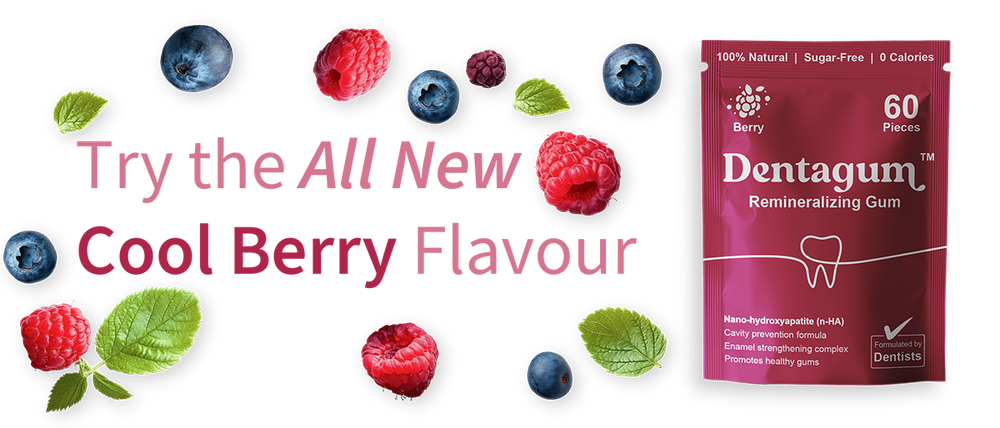
Step one is remineralization. Chewing Dentagum's remineralizing gum two to four times daily after meals, for 10 to 20 minutes per session, delivers nano-hydroxyapatite directly to enamel surfaces during the exact post-meal window when acid exposure has just occurred and the mouth is most receptive to mineral redeposition. This also delivers the broader oral health benefits of the formula: xylitol and erythritol working against cariogenic bacteria, and the saliva stimulation that supports the mouth's own natural remineralization process throughout the day.
Step two is whitening, introduced once a baseline strengthening period has passed. Dentagum's Purple Whitening Strips use PAP+ as the primary whitening active specifically because of the safety and comfort profile described above, working through oxidation without the deeper enamel penetration associated with traditional peroxide. The strips also incorporate nano-hydroxyapatite directly into the whitening formula itself, meaning the mineral support does not stop once whitening begins; it continues alongside the whitening process rather than being a strictly separate, sequential step.
This two-product approach reflects a genuinely different philosophy than most whitening brands, which treat whitening as an isolated cosmetic event disconnected from the underlying condition of the tooth. Sequencing remineralization first, then whitening with a formula that itself continues to support enamel, is a more complete approach to a brighter smile that does not come at the expense of enamel health.
How Long to Strengthen Before You Start Whitening
There is no universally studied fixed number of days that applies to every person, since baseline enamel condition varies considerably. That said, the remineralization research provides useful guidance. Clinical studies on nano-HAp toothpaste and gum use generally measure meaningful remineralization outcomes over a period of weeks rather than days, with several sources in the broader nano-HAp literature recommending at least four weeks of consistent use before evaluating results, since mineral redeposition into enamel microporosities is a cumulative, gradual process rather than an immediate one.
A reasonable, evidence-informed approach: use Dentagum's remineralizing gum consistently at the recommended two to four pieces daily for approximately three to four weeks before beginning a whitening strip treatment, particularly for anyone who has noticed existing sensitivity, frequently consumes acidic foods or beverages, or has not had a dental checkup recently to assess enamel condition directly. For people with no known sensitivity and generally strong enamel, a shorter strengthening period of one to two weeks as a precautionary baseline before whitening is a reasonable middle ground. Anyone with active, pronounced sensitivity or visible enamel wear should consult a dentist before beginning any whitening treatment regardless of product choice, since these signs can indicate enamel loss significant enough to warrant professional evaluation before cosmetic treatment.
Once whitening begins, continuing to chew remineralizing gum between whitening strip applications is a reasonable way to maintain the enamel support established during the strengthening phase, rather than treating strengthening as a one-time preparation step that ends the moment whitening starts.
A Practical Sequencing Guide
- Weeks 1 to 3 or 4: Chew Dentagum remineralizing gum 2 to 4 times daily after meals. This is the enamel-strengthening phase. No whitening product introduced yet.
- Existing sensitivity or frequent acidic diet: Lean toward the longer end of the strengthening window, closer to 4 weeks, before starting whitening.
- No known sensitivity, generally strong enamel: A shorter 1 to 2 week precautionary period is a reasonable middle ground.
- Visible enamel wear or pronounced existing sensitivity: See a dentist for evaluation before starting any whitening treatment, regardless of which product you choose.
- Once whitening begins: Continue chewing remineralizing gum between Purple Whitening Strip applications to maintain enamel support throughout the whitening period, not just before it.
Frequently Asked Questions
Is it bad to whiten teeth with weak or eroded enamel?
Whitening compromised enamel is more likely to cause discomfort and less predictable results than whitening healthy enamel. Weakened, more porous enamel allows whitening agents to penetrate more deeply toward nerve-connected dentin, increasing sensitivity risk, and in vitro research confirms peroxide agents can further reduce microhardness and mineral content when applied to already-compromised enamel. This does not mean whitening is off the table with weaker enamel, but it does mean strengthening enamel first and choosing a gentler, peroxide-free active like PAP+ meaningfully reduces the risk of a poor experience.
How do I know if my enamel is weakened before whitening?
Common signs include noticeable sensitivity to hot, cold, or sweet foods, a rough or pitted feeling on the tooth surface, visible thinning near the gumline, or a history of frequent acidic drink or food consumption, since roughly 30 percent of adults globally show some degree of dental erosion according to research published in Frontiers in Dental Medicine. A dental checkup and cleaning can directly assess enamel condition. In the absence of visible signs, a precautionary strengthening period before whitening is still a reasonable, low-risk step for anyone.
Why is PAP+ considered gentler than hydrogen peroxide for whitening?
PAP+ oxidizes stain molecules through a different chemical mechanism than hydrogen peroxide, without the same degree of penetration into deeper tooth structure. A 2025 peer-reviewed study found peroxide-free color correctors including PAP+ formulations increased enamel surface microhardness with no demineralization observed, and sensitivity occurred in under 3 percent of users, compared to the 43 to 80 percent range documented with traditional peroxide whitening. This makes PAP+ a meaningfully lower-risk choice, particularly for enamel that may already be somewhat compromised.
Does nano-hydroxyapatite actually help with whitening sensitivity?
Yes, in two distinct ways. First, nano-HAp used before whitening deposits mineral into enamel microporosities, reducing the surface porosity that would otherwise let whitening agents penetrate more deeply. Second, clinical research combining nano-HAp directly with a hydrogen peroxide bleaching gel found the nano-HAp addition reduced sensitivity intensity without compromising the whitening effectiveness of the treatment. Separately, a 2023 meta-analysis of 44 clinical trials found hydroxyapatite in oral care products reduced dentin hypersensitivity by 39.5 percent compared to placebo, supporting its broader role in sensitivity management around whitening.
How long should I strengthen my enamel before starting a whitening treatment?
A reasonable evidence-informed range is one to four weeks of consistent nano-HAp use, depending on your starting enamel condition. People with existing sensitivity or a frequently acidic diet should lean toward the longer end, closer to four weeks. People with generally strong enamel and no known sensitivity can use a shorter one to two week precautionary period. Anyone with pronounced existing sensitivity or visible enamel wear should see a dentist before beginning any whitening treatment.
Can I use remineralizing gum and whitening strips at the same time?
Yes, and continuing to use remineralizing gum during a whitening treatment, not just beforehand, is a reasonable way to maintain enamel support throughout the process. Dentagum's Purple Whitening Strips also incorporate nano-hydroxyapatite directly into the whitening formula, meaning mineral support continues during the whitening phase itself rather than stopping once strengthening ends.

Bottom Line
Whitening is not just a question of which active ingredient to use. It is a question of what condition your enamel is in when that active ingredient meets it. Nearly 30 percent of adults globally show some degree of dental erosion, and weakened, more porous enamel absorbs whitening agents more deeply, driving more sensitivity and less predictable results. The evidence on PAP+ is genuinely encouraging for anyone concerned about this: a 2025 study found it increased enamel microhardness with no demineralization observed and under 3 percent sensitivity, a dramatic contrast to traditional peroxide. Nano-hydroxyapatite adds a second layer of protection, both as a pre-whitening strengthening step and, when incorporated directly into a whitening formula, as ongoing support during treatment itself.
Dentagum's two-product line reflects exactly this sequence: remineralizing gum to strengthen enamel and reduce microporosity over several weeks, followed by Purple Whitening Strips built around PAP+ and nano-HAp to brighten safely once the enamel is better prepared to handle it. Strengthen first. Brighten second. The order matters as much as the products themselves.
Start with Dentagum Remineralizing GumResearch Summary
This article draws on dental erosion prevalence research, comparative peroxide and PAP+ sensitivity data, and nano-hydroxyapatite pre-whitening research. Key sources include: Frontiers in Dental Medicine 2022, The dynamic interplay of dietary acid pH and concentration during early-stage human enamel and dentine erosion (dental erosion affects nearly 30 percent of adults worldwide; up to 29 percent of young adults 18 to 35 show some erosion, 3 percent severe); ADA, Dental Erosion, Oral Health Topics (frequent soft drink and carbonated soda consumption as primary erosive risk factor; acidic snacks and fruit juice also contribute); Preprints.org 2025, Erosive Impact of Acidic Healthy Beverages on Dental Enamel systematic review 2013 to 2025 (carbonated soft drinks pH 2.3 to 3.4; sports drinks pH 3.1 to 3.5; athlete erosion prevalence up to 100 percent in some studies with dry mouth as key risk factor); Soltan et al, Khalij J Dent Med Res 2024;8(2):306-313 (hydrogen peroxide and carbamide peroxide decreased enamel microhardness and phosphate content, increased carbonate; remineralizing solutions identified as risk mitigation); Journal of Evidence Based Dental Practice, cited via Good Tooth Dental Care 2026 (43 to 80 percent of peroxide whitening users experience sensitivity, typically transient); PMC12384575 2025, Hydrogen Peroxide-Free Color Correctors for Tooth Whitening systematic review (PRISMA methodology, PubMed/Scopus/Web of Science through January 2025; peroxide-free color correctors increased enamel surface microhardness by 12.9 VHN with no demineralization; sensitivity under 3 percent versus higher rates for traditional peroxide); ScienceDirect 2024, hydroxyapatite-capsaicin nanocomposite bleaching gel RCT (split-mouth triple-blind trial, 54 participants; nHA-CAP addition to 35 percent hydrogen peroxide reduced sensitivity intensity without compromising bleaching effectiveness); Limeback H, Enax J, Meyer F, Biomimetics 2023 (44 clinical trials, 39.5 percent dentin hypersensitivity reduction from hydroxyapatite versus placebo); nano-HAp remineralization timeline guidance cited via selfwisebrand.com (at least 4 weeks of consistent use recommended before evaluating remineralization results). All Dentagum-specific product claims reflect the brand's formulation and recommended usage; ingredient-level evidence is cited for the mechanisms described, distinct from product-specific clinical trial data.
References
- The dynamic interplay of dietary acid pH and concentration during early-stage human enamel and dentine erosion. Frontiers in Dental Medicine. 2022. [Dental erosion affects nearly 30 percent of adults worldwide; up to 29 percent of young adults 18 to 35 show some erosion, 3 percent severe; fruit juice and carbonated drink consumption as primary causes]
- American Dental Association. Dental Erosion. Oral Health Topics. ada.org. [Frequent soft drink and carbonated soda consumption as primary risk factor for erosive tooth wear; acidic snacks, sweets, and natural fruit juice also contribute]
- Erosive Impact of Acidic Healthy Beverages on Dental Enamel: A Systematic Review 2013 to 2025. Preprints.org. May 2025. [Carbonated soft drinks pH 2.3 to 3.4; sports drinks pH 3.1 to 3.5; athlete erosion prevalence up to 100 percent in some studies; dry mouth during exercise as key risk factor]
- Soltan et al. The Influence of Teeth Whitening Products on Enamel Microhardness, Surface Texture and Mineral Content. Khalij Journal of Dental and Medical Research. 2024;8(2):306-313. [Hydrogen peroxide and carbamide peroxide decreased microhardness and phosphate, increased carbonate; fluoride varnish and remineralizing solutions identified as risk mitigation]
- Journal of Evidence Based Dental Practice, cited via Good Tooth Dental Care, Is Teeth Whitening Safe? What Science Actually Says in 2026. February 2026. [43 to 80 percent of peroxide whitening users experience some degree of sensitivity, typically transient]
- Hydrogen Peroxide-Free Color Correctors for Tooth Whitening in Adolescents and Young Adults: A Systematic Review of In Vitro and Clinical Evidence. PMC. PMC12384575. 2025. [PRISMA systematic review; peroxide-free color correctors increased enamel surface microhardness by 12.9 VHN (p less than 0.001) with no demineralization observed; sensitivity under 3 percent of patients versus higher rates for traditional peroxide]
- Synthesis and characterization of different nano-hydroxyapatites and their impact on dental enamel following topical application for dental bleaching. ScienceDirect. 2024. [Split-mouth, triple-blind randomized controlled trial, 54 participants; hydroxyapatite-capsaicin nanocomposite added to 35 percent hydrogen peroxide bleaching gel reduced tooth sensitivity intensity without compromising bleaching effectiveness]
- Limeback H, Enax J, Meyer F. Clinical Evidence of Biomimetic Hydroxyapatite in Oral Care Products for Reducing Dentin Hypersensitivity. Biomimetics. 2023. PMC9844412. [44 clinical trials; 39.5 percent dentin hypersensitivity reduction from hydroxyapatite versus placebo]
