
What Is Nano Hydroxyapatite and Why Is It in Oral Care?
Nano hydroxyapatite is the same mineral that makes up your tooth enamel, engineered down to nanoparticle size so it can actually rebuild what daily life wears away. Here's the science behind the ingredient your dentist might start recommending next.

Nano hydroxyapatite is a synthetic form of the mineral that already makes up around 97% of your tooth enamel, produced in nanoparticle sizes small enough to slip into the microscopic gaps and lesions in your teeth and rebuild them from within. It's not a new chemical compound. It's essentially the same thing your enamel is made of, just engineered to be more effective as a topical oral care ingredient.
If you've noticed it on the label of a toothpaste, gum, or mouthwash recently, you're not imagining things. It's become one of the fastest-growing ingredients in modern oral care, and the clinical research behind it is worth understanding.
Where Nano Hydroxyapatite Comes From
Hydroxyapatite is a naturally occurring calcium phosphate mineral. Your body uses it to build teeth and bones, which makes it inherently biocompatible, meaning your body recognizes it and doesn't treat it as a foreign substance.
The "nano" part refers to particle size. Standard hydroxyapatite particles are relatively large and sit on the enamel surface when applied topically. Nano hydroxyapatite particles are manufactured at around 20 nanometres, roughly 5,000 times smaller than the width of a human hair. At that scale, they can penetrate the microporosities in enamel rather than just coating the outside, which changes what the ingredient can actually do.
The history here is longer than most people realize. NASA developed a hydroxyapatite toothpaste in 1970 to help astronauts maintain their oral health in space. A Japanese company, Sangi Co. Ltd., purchased the rights and launched the world's first enamel restoration toothpaste in 1980. It's been the gold standard oral care ingredient in Japan ever since, and the rest of the world is only now catching up.
What Nano Hydroxyapatite Actually Does to Your Teeth
Your enamel is under constant attack. Every acidic food or drink, every sugary snack that feeds mouth bacteria, every bout of acid reflux temporarily lowers the pH in your mouth and causes mineral loss from the enamel surface. This process is called demineralization. Left unchecked over time, it leads to weakened enamel, sensitivity, and eventually cavities.
Nano hydroxyapatite works by reversing that process through remineralization: restoring calcium and phosphate back into the enamel structure. Because the particles are nanoscale, they can reach subsurface lesions that form in the early stages of enamel erosion, areas where fluoride (which primarily reinforces the outermost enamel layer) has a more limited reach. Research published via PubMed found that nano-HAp particles "penetrate enamel microporosities and subsurface lesions more effectively than fluoride compounds," which is relevant for early-stage decay that hasn't yet reached the surface.
Beyond remineralization, nano hydroxyapatite also fills in microscopic surface imperfections, producing a smoother enamel surface that reflects light more evenly. This is why some people notice a gradual brightening effect with consistent use. It's not bleaching. It's structural restoration.
The Research Behind It
The clinical evidence for nano hydroxyapatite has grown considerably in the last few years.
A 2022 systematic review and meta-analysis from the University of Bern, published in Clinical Oral Investigations, evaluated the efficacy of fluoride-free nano-hydroxyapatite agents for enamel remineralization and found meaningful support for its use as a caries-prevention ingredient. The review covered both in vivo and in situ clinical studies across patients of varying ages.
An 18-month randomized clinical trial published in 2023 compared a 10% nano-hydroxyapatite toothpaste directly against a standard 1,450-ppm fluoride toothpaste in adults. The result: nano-HAp protected teeth from new cavities at a comparable rate to fluoride. For people who want an alternative to fluoride, that's a clinically meaningful finding.
On sensitivity, the evidence is also encouraging. Most studies investigating nano-HA's effectiveness on tooth hypersensitivity have found it outperforms fluoride and potassium nitrate as a desensitizing agent. One analysis found an average 39.5% reduction in sensitivity among users. A 2014 study found that 15% nano-hydroxyapatite significantly reduced sensitivity to hot and cold within two to four weeks.
It's worth being honest about the limitations too. Nano hydroxyapatite is not yet FDA-approved as an anti-cavity agent in the United States. The only ingredient recognized in the FDA's over-the-counter monograph for cavity prevention is fluoride. Nano-HAp has regulatory recognition in Japan and several European countries, and the EU Scientific Committee on Consumer Safety has confirmed it safe in oral care at concentrations up to 29.5%. In the US, the clinical case is strong but the regulatory process hasn't caught up yet.
How Nano Hydroxyapatite Compares to Fluoride
This is the question most people eventually land on, and the honest answer is: they work differently, and one isn't simply better than the other.
Fluoride works by bonding with calcium and phosphate at the enamel surface to form fluorapatite, a mineral that's more acid-resistant than natural hydroxyapatite. It's been the gold standard in cavity prevention for decades and has an enormous body of long-term evidence behind it.
Nano hydroxyapatite works by physically depositing the same mineral that enamel is already made of, filling in weak spots and rebuilding structure. It doesn't chemically alter the enamel the way fluoride does. It replenishes it.
The key practical differences:
- Nano-HAp is non-toxic if swallowed, making it particularly well-suited for young children who can't reliably spit. A 2024 systematic review described it as "an ideal substitute for fluoride in toothpaste for young children" for this reason.
- Nano-HAp tends to outperform fluoride specifically for sensitivity relief in most head-to-head studies.
- Fluoride has a longer regulatory track record and remains the stronger choice for high cavity-risk individuals based on current evidence.
- Both appear comparable for remineralization in recent clinical trials, though more long-term data exists for fluoride.
Some oral care products now combine both ingredients, which makes sense given that their mechanisms of action are complementary rather than competing.
Why It's Showing Up in Gum and Other Formats
Toothpaste is the most studied delivery format for nano hydroxyapatite, but the ingredient is increasingly appearing in chewing gum, mouthwash, and other products, and there's a logical reason for it.
Contact time matters for remineralization. The longer a remineralizing agent stays in contact with your enamel, the more opportunity it has to work. Toothpaste is in your mouth for two minutes. Gum stays for ten to twenty. A nano hydroxyapatite chewing gum keeps the mineral in sustained contact with your teeth after meals, exactly when your enamel is recovering from the acid exposure of eating. Combined with the saliva stimulation that chewing produces (saliva is your mouth's natural acid buffer), it's a format that makes a lot of sense.
It's a similar logic to why xylitol gum outperforms xylitol candies in clinical research: chewing itself is part of the benefit. Adding a remineralizing ingredient to the gum compounds that effect.
Who Benefits Most from Nano Hydroxyapatite Products
Nano hydroxyapatite is safe for general daily use, but a few groups have particular reason to pay attention to it.
People with sensitive teeth will likely notice the most immediate benefit. The ingredient seals the exposed dentinal tubules that cause pain responses to heat, cold, and sweet foods, and the clinical evidence on sensitivity reduction is among the strongest in the nano-HAp literature.
Parents of young children may find it a useful fluoride-free option for households where toothpaste swallowing is a concern. It's non-toxic when ingested in normal oral care amounts, unlike fluoride which requires supervision and age-appropriate dosing.
Anyone experiencing early enamel erosion from acidic foods, drinks, or acid reflux will benefit from the remineralizing properties, particularly if used consistently after meals.
And people actively rebuilding their oral health after a period of neglect will find that nano-HAp products complement their broader routine well, supporting the remineralization work their teeth are already doing naturally.
If you're unsure whether nano hydroxyapatite products are right for your specific situation, your dentist can assess your enamel health and give you a personalised recommendation.
Frequently Asked Questions
What is nano hydroxyapatite made of? Nano hydroxyapatite is a synthetic form of calcium phosphate, the same mineral that makes up about 97% of your tooth enamel and around 70% of your bone. It's produced in nanoparticle sizes (around 20 nanometres) to allow it to penetrate enamel microporosities and support remineralization more effectively than standard-sized hydroxyapatite particles.
Is nano hydroxyapatite safe to use every day? Yes. It's biocompatible, non-toxic, and recognized as safe by the EU Scientific Committee on Consumer Safety at concentrations up to 29.5% in oral care products. It's also non-toxic if swallowed in small amounts, which makes it a strong option for children and anyone who prefers a fluoride-free routine.
Does nano hydroxyapatite actually remineralize teeth? The clinical evidence supports it. A 2022 systematic review and meta-analysis from the University of Bern found meaningful evidence for nano-HAp's ability to remineralize enamel and prevent new caries. An 18-month randomized clinical trial published in 2023 found that a 10% nano-HAp toothpaste performed comparably to standard 1,450-ppm fluoride toothpaste for cavity prevention in adults.
Is nano hydroxyapatite better than fluoride? Not categorically. They work through different mechanisms and suit different needs. Nano-HAp tends to outperform fluoride for sensitivity relief and is preferred for young children due to swallowing safety. Fluoride has a longer regulatory track record and remains the stronger evidence-backed choice for high cavity-risk individuals. Many dentists now recommend products containing both, since the ingredients complement each other.
Why is nano hydroxyapatite in chewing gum? Chewing gum keeps the ingredient in sustained contact with tooth enamel for longer than toothpaste, typically ten to twenty minutes versus two. Chewing also stimulates saliva production, which helps neutralize acid and supports the remineralization process naturally. Nano hydroxyapatite gum delivers a remineralizing benefit after meals, during the period when enamel is recovering from the acid exposure of eating.
Is nano hydroxyapatite FDA-approved? Not yet as a cavity-prevention agent. The FDA's over-the-counter monograph for anti-cavity products currently recognizes only fluoride. Nano hydroxyapatite has regulatory recognition in Japan (since the 1980s), Canada, and several European countries. The clinical evidence is strong and growing, but the US regulatory process hasn't yet reflected it.
The Bottom Line
Nano hydroxyapatite isn't a trend ingredient with clever marketing behind it. It's a well-researched mineral that rebuilds the same structure your enamel is already made of, works particularly well for sensitivity, shows comparable cavity-prevention results to fluoride in recent clinical trials, and has been the cornerstone of Japanese oral care for over forty years.
Its growing presence in toothpastes, gums, and rinses reflects a broader shift in oral care toward biomimetic ingredients: things that work with your tooth's natural biology rather than just adding a protective layer over it. For most people, it's worth adding to their routine.
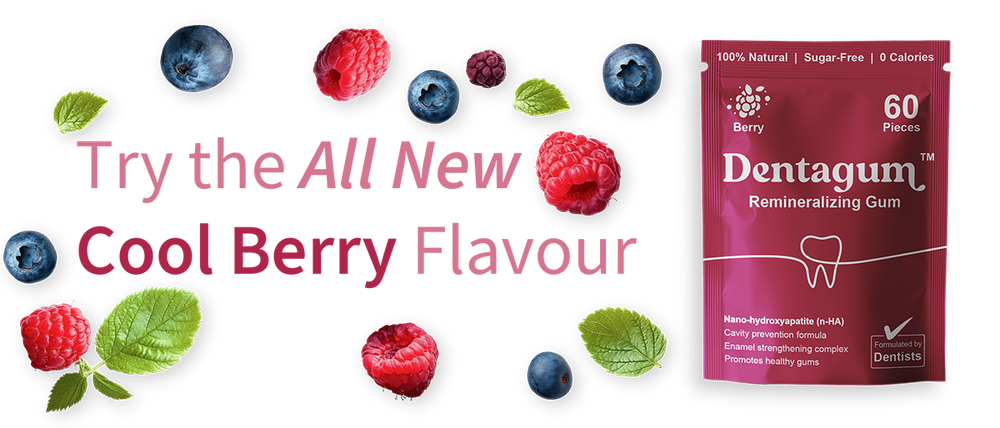
Explore our nano hydroxyapatite gum range, formulated to deliver a meaningful remineralizing dose during the minutes after eating, when your enamel needs it most.
References
- Wierichs RJ, Wolf TG, Campus G, Carvalho TS. "Efficacy of nano-hydroxyapatite on caries prevention: a systematic review and meta-analysis." Clinical Oral Investigations, 2022. https://www.ncbi.nlm.nih.gov/pmc/articles/PMC8979882/
- "The Remineralizing and Desensitizing Potential of Hydroxyapatite in Dentistry: A Narrative Review of Recent Clinical Evidence." MDPI, 2025. https://www.mdpi.com/2079-4983/16/9/325
- Paszynska E et al. "Caries-preventing effect of a hydroxyapatite toothpaste in adults: an 18-month double-blinded randomized clinical trial." BMC Oral Health, 2023.
- "Nano-hydroxyapatite in dental products: Better than fluoride?" Registered Dental Hygienists, 2024. https://www.rdhmag.com/patient-care/article/14276225/nano-hydroxyapatite-in-dental-products-better-than-fluoride
- EU Scientific Committee on Consumer Safety. Safety assessment of nano-hydroxyapatite in oral care cosmetics. Confirmed safe at concentrations up to 29.5%.
- Carifree. "Nano-Hydroxyapatite Toothpaste: Evidence-Based Guide." 2024. https://carifree.com/blog/nano-hydroxyapatite/
- "Home Oral Care with Biomimetic Hydroxyapatite vs. Conventional Fluoridated Toothpaste for the Remineralization and Desensitizing of White Spot Lesions: Randomized Clinical Trial." PMC, 2022. https://pmc.ncbi.nlm.nih.gov/articles/PMC9317292/
