
What Does the ADA Actually Say About Chewing Gum?
The American Dental Association has a specific, evidence-based position on chewing gum and oral health. Most people who've heard "sugar-free gum is good for you" don't know the mechanism behind that claim, the specific timing recommendation, or what distinguishes a gum the ADA endorses from one it doesn't. Here's the complete picture.

The American Dental Association's position on chewing gum is specific and evidence-based: "Chewing sugarless gum for 20 minutes following meals has been shown in scientific studies to help prevent tooth decay." The ADA also states: "If you cannot brush your teeth immediately after a meal, then chewing gum can help." The mechanism they endorse is saliva stimulation: chewing causes the salivary glands to produce saliva at 10 to 12 times the resting rate, which neutralizes and washes away acids produced by bacteria and food in the mouth. The ADA grants its Seal of Acceptance exclusively to sugar-free gum products that meet their safety and efficacy criteria. Sugar-containing gum does not qualify. The ADA is explicit that gum is not a substitute for twice-daily brushing and daily flossing, but is an endorsed adjunct for the post-meal window.
The American Dental Association is the most authoritative professional dental organization in the United States. When the ADA takes a position on a consumer oral health practice, it reflects a review of the scientific literature by the ADA Council on Scientific Affairs. Understanding what the ADA actually says, rather than a paraphrase or a summary, is useful for anyone making decisions about their oral care routine.
On the question of chewing gum, the ADA has a clear, specific, and affirmative position that most consumers are only vaguely aware of. This article covers exactly what the ADA says, why they say it, what the Seal of Acceptance means in practice, and what the ADA endorsement does and doesn't cover.
The ADA's Exact Position on Chewing Gum
The ADA's Oral Health Topics page on chewing gum contains several specific statements worth knowing precisely:
On post-meal use: "Chewing sugarless gum for 20 minutes following meals has been shown in scientific studies to help prevent tooth decay."
On the alternative to brushing: "If you cannot brush your teeth immediately after a meal, then chewing gum can help."
On the mechanism: The ADA explains that chewing gum causes the mouth to produce more saliva, which neutralizes and washes away the acids that are produced when food is broken down by bacteria in plaque. Saliva also carries calcium and phosphate to help strengthen tooth enamel. And chewing gum helps remove food particles from teeth.
On the caveat: The ADA is clear that sugar-free gum is not a replacement for brushing and flossing. It is an adjunct for periods when brushing isn't possible, specifically the post-meal window.
On sugar gum: The ADA explicitly distinguishes sugar-free gum from sugar-containing gum. The Seal of Acceptance applies only to sugar-free products. Sugar gum feeds the bacteria that produce the acid driving tooth decay.
"Chewing sugarless gum for 20 minutes following meals has been shown in scientific studies to help prevent tooth decay." This is the ADA's primary statement on gum, and it contains three specific pieces of information: the product type (sugarless), the duration (20 minutes), and the timing (following meals). All three matter. The ADA isn't endorsing gum chewed at random times, gum chewed for 2 minutes, or gum sweetened with sugar. The specific practice of 20 minutes of sugar-free gum after meals is what the scientific studies they're citing were testing.
The Mechanism the ADA Endorses: Why Saliva Is the Key
The ADA's endorsement isn't based on a vague health claim. It's based on a specific, well-understood physiological mechanism: saliva stimulation and its downstream effects on the post-meal oral environment.
Every time you eat, bacteria in your mouth metabolize food residue and produce lactic acid. This acid drops your oral pH below 5.5, the critical threshold at which enamel begins losing calcium and phosphate. Your saliva then buffers this acid through its bicarbonate system and pH gradually recovers over 20 to 40 minutes.
The problem is that at resting salivary flow (approximately 0.3 to 0.4 mL per minute), the acid buffering is slow. Chewing stimulates salivary flow to 3 to 4 mL per minute, 10 to 12 times the resting rate. At this stimulated rate, the bicarbonate buffering of post-meal acid is dramatically faster, the delivery of calcium and phosphate to enamel surfaces for remineralization is significantly amplified, and the mechanical washing of food debris from tooth surfaces is more thorough. The 20-minute post-meal window covers the period when this accelerated remineralization is most needed and most impactful.
The ADA Seal of Acceptance: What It Means and What It Requires

The ADA Seal of Acceptance is a voluntary program. Manufacturers submit their products and the supporting clinical evidence to the ADA Council on Scientific Affairs for review. The Council evaluates the evidence for the product's safety and the validity of any clinical claims. If the product meets the criteria, the ADA grants the Seal, which the manufacturer can then display on packaging and in marketing.
For chewing gum specifically, the Seal is available only to sugar-free products. A gum containing sucrose cannot receive the ADA Seal regardless of any other properties it may have. This is because the ADA's review of the evidence found that sugar-containing gum's contribution to cavity risk from the sucrose substrate outweighs any saliva stimulation benefit.
Products that have received the ADA Seal for chewing gum include several major commercial brands. The Seal indicates that the product has demonstrated it doesn't cause or promote tooth decay and provides the ADA-reviewed evidence for its safety and efficacy claims. Products without the Seal may still be safe and effective, but they haven't gone through the ADA review process.
The ADA maintains a searchable product database at ada.org where consumers can verify which specific products hold the Seal. The Seal appears on the product packaging and identifies the product as having met the ADA's criteria through their review process. When evaluating any oral health product claim, including for chewing gum, checking whether the product has submitted to the ADA Seal process and received approval is one of the most reliable available verification steps for consumers.
What the ADA Endorsement Does Not Cover
Being precise about the ADA's position means being equally clear about what it doesn't cover.
Gum as a replacement for brushing and flossing. The ADA is explicit: gum is not a substitute for the mechanical plaque removal that twice-daily brushing provides or for the interdental cleaning that daily flossing delivers. The ADA's endorsement of gum is specifically for the post-meal windows when brushing isn't immediately possible, not as an alternative to the standard twice-daily oral care routine.
Specific active ingredients beyond the saliva mechanism. The ADA's endorsement of sugar-free gum is based primarily on the saliva stimulation mechanism. The ADA does reference xylitol favorably, noting that some sugar-free gums contain xylitol, which has been shown in clinical studies to reduce S. mutans. But the ADA's broader endorsement is for sugar-free gum as a category based on the saliva mechanism, not a specific formulation endorsement for any particular active ingredient combination.
Gum as a treatment for existing decay. The ADA's endorsement is for cavity prevention in the context of a complete oral care routine. It is not a claim that gum treats existing cavities or reverses advanced decay. Professional dental assessment and treatment are required for existing decay.
Xylitol: What the ADA Specifically Says

Beyond the general endorsement of sugar-free gum, the ADA's guidance includes specific favorable commentary on xylitol. The ADA notes that some sugar-free gums use xylitol as a sweetener, and that xylitol has been shown in clinical studies to reduce the levels of acid-producing bacteria (S. mutans) in the mouth. This positions xylitol not merely as a non-harmful sweetener (the baseline that makes gum sugar-free) but as an ingredient with active oral health benefit.
The clinical evidence behind this ADA recognition is substantial. A 2025 systematic review found xylitol gum significantly reduced S. mutans in 12 of 14 clinical studies versus sorbitol gum controls. A 2024 systematic review of 10 xylitol chewing gum RCTs found all 10 showed statistically significant preventive effects against cavities. The ADA's reference to xylitol's clinical evidence reflects the weight of this research base.
How the ADA Position Applies to Different Gum Types
Why the ADA Position Matters for Consumers
The ADA's endorsement of sugar-free gum after meals is significant for consumers for several practical reasons.
It provides independent third-party validation for a habit that's easy to dismiss as trivial. Many people assume that anything you do passively and easily can't be meaningfully protective of health. The ADA's position, based on their review of the clinical literature, establishes that 20 minutes of post-meal gum chewing is a genuinely evidence-backed cavity prevention practice, not a wellness trend or a marketing claim from a gum manufacturer.
It clarifies what the evidence actually says about timing. The 20-minute post-meal recommendation isn't arbitrary. The clinical studies supporting the ADA's position were testing gum chewed after meals, during the specific window when post-meal acid is highest and saliva's buffering role is most critical. Chewing gum at random times throughout the day is meaningfully less effective than chewing it in the post-meal window that the ADA's evidence base reflects.
And it provides a clear product selection criterion. If gum is sweetened with sugar, it doesn't qualify for the ADA Seal and its net effect on cavity risk is negative. If it's sweetened with non-fermentable sweeteners like xylitol, erythritol, or sorbitol, it qualifies and provides the ADA-endorsed benefit. The Seal is a shortcut to confirming that a specific product has met the ADA's criteria through their review process.
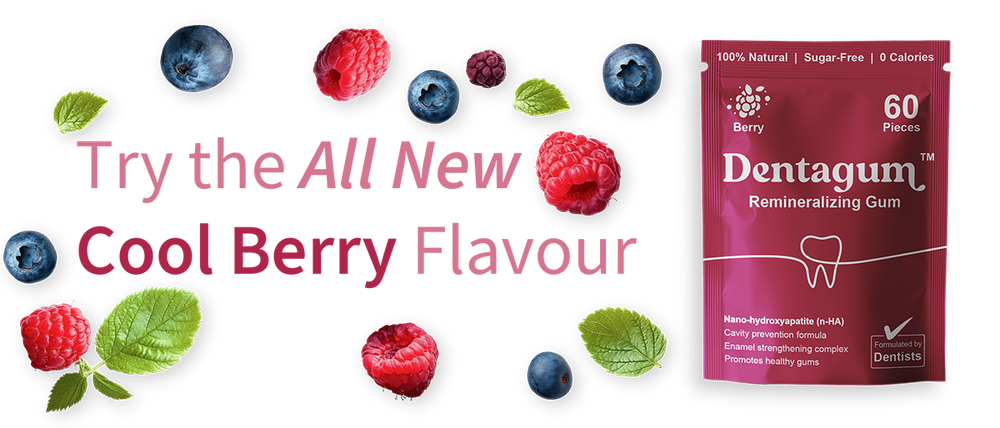
How Dentagum Aligns With the ADA's Position

Dentagum's formulation is built around the ADA's endorsed mechanism as its foundation. The 20-minute post-meal chewing session is exactly the timing the ADA specifies. The sugar-free, xylitol-primary sweetener profile means Dentagum meets the categorical criteria for the ADA Seal (xylitol, erythritol, no fermentable sugars). And the ADA specifically notes xylitol's additional active oral health benefit on top of the baseline saliva mechanism.
Beyond the ADA-endorsed baseline, Dentagum's formula includes nano-hydroxyapatite, which the 2023 Biomimetics meta-analysis of 44 clinical trials validated for enamel mineral delivery and sensitivity reduction. This goes beyond what the ADA's endorsement specifically covers, but it's additive to rather than contradictory of the ADA position: the same saliva mechanism the ADA endorses is amplified by a post-meal gum that also delivers direct mineral to enamel surfaces during the chewing session.
The ADA's position answers the "is this a legitimate oral health habit" question clearly and affirmatively. The clinical evidence on xylitol and nano-HAp answers the "is this the best version of that habit" question. Both answers point in the same direction.
Try Dentagum risk-free — 30-day guaranteeFrequently Asked Questions
What does the ADA say about chewing gum?
The ADA states that chewing sugarless gum for 20 minutes following meals has been shown in scientific studies to help prevent tooth decay. The ADA also states that if you cannot brush immediately after a meal, chewing gum can help. The mechanism they endorse is saliva stimulation: chewing produces saliva at 10 to 12 times the resting rate, which neutralizes post-meal acid, delivers calcium and phosphate to enamel, and washes food debris from tooth surfaces. The ADA grants its Seal of Acceptance only to sugar-free gum products that meet their safety and efficacy criteria.
Does the ADA endorse xylitol gum specifically?
The ADA endorses sugar-free gum broadly based on the saliva mechanism and specifically notes xylitol favorably. The ADA's guidance references that some sugar-free gums contain xylitol, which has been shown in clinical studies to reduce levels of acid-producing bacteria (S. mutans) in the mouth. This positions xylitol as an ingredient with active oral health benefit beyond the baseline saliva stimulation benefit that all sugar-free gum provides. The ADA's Seal of Acceptance is available to sugar-free xylitol gum products that submit their evidence for review.
What is the ADA Seal of Acceptance for gum?
The ADA Seal of Acceptance is a voluntary program through which manufacturers can submit their products and supporting clinical evidence to the ADA Council on Scientific Affairs for review. If the product meets the ADA's criteria for safety and efficacy, the Seal is granted. For chewing gum, the Seal is available exclusively to sugar-free products. It indicates that the specific product has passed the ADA's review process, not merely that it falls in the broadly endorsed category of sugar-free gum. Not all effective sugar-free gum products hold the Seal, as many manufacturers don't submit to the process, but products that do hold it have gone through independent professional review.
Why does the ADA recommend 20 minutes specifically?
The 20-minute recommendation reflects the duration tested in the clinical studies the ADA reviewed when developing their guidance. Post-meal saliva stimulation needs to be sustained long enough to meaningfully buffer the acid produced during and after eating, deliver calcium and phosphate to recovering enamel, and clear food debris from tooth surfaces. The clinical research that established the cavity-prevention benefit of post-meal sugar-free gum used 20-minute chewing sessions. Shorter sessions provide some benefit but don't capture the full effect documented in the research the ADA cites.
Is the ADA's gum recommendation new?
No. The ADA has recognized the cavity-preventive properties of sugar-free gum based on the saliva mechanism for decades. The evidence base behind the recommendation has grown substantially, and the ADA's specific language and product criteria have been updated to reflect current research. The core finding, that 20 minutes of sugar-free gum after meals helps prevent tooth decay through saliva stimulation, reflects a long-established body of evidence that the ADA has consistently recognized and communicated in their consumer guidance.
Can any dentist-approved gum replace brushing?
No. The ADA is explicit on this point: gum is not a substitute for twice-daily brushing with fluoride toothpaste and daily flossing. Brushing provides mechanical plaque disruption that saliva-stimulating gum cannot replicate. Flossing reaches the interdental spaces that neither brushing nor gum can access. The ADA's endorsement of sugar-free gum after meals is for the specific post-meal window when brushing isn't immediately possible, positioning gum as an adjunct to rather than a replacement for the standard oral care routine.

The Bottom Line
The American Dental Association's position on chewing gum is clear, specific, and grounded in a reviewed body of clinical evidence: chewing sugarless gum for 20 minutes after meals helps prevent tooth decay through a well-understood saliva stimulation mechanism. The ADA Seal of Acceptance is available only to sugar-free products. Xylitol is specifically noted favorably for its additional active bacterial reduction benefit. And gum is explicitly positioned as an adjunct to the complete oral care routine of twice-daily brushing, daily flossing, and regular dental visits, not as a replacement for any of those practices.
For anyone evaluating whether post-meal gum chewing is a legitimate oral health habit: the ADA, reviewing the same clinical literature that the research community has built over decades, has answered that question affirmatively. The habit the evidence supports is specific: sugar-free, ideally xylitol-sweetened, 20 minutes, after meals. That's the practice the ADA endorses and the clinical studies demonstrate.
Try Dentagum risk-free — 30-day guarantee at dentagum.coResearch Summary
- American Dental Association. "Chewing Gum." Oral Health Topics. Direct quotes: "Chewing sugarless gum for 20 minutes following meals has been shown in scientific studies to help prevent tooth decay." "If you cannot brush your teeth immediately after a meal, then chewing gum can help." Chewing causes mouth to produce more saliva, which neutralizes and washes away acids. Saliva carries calcium and phosphate to help strengthen enamel. ADA Seal available for sugar-free gum only. Gum not a substitute for brushing and flossing.
- ADA Council on Scientific Affairs. ADA Seal of Acceptance program. Voluntary submission by manufacturers. Review of safety and efficacy evidence. Sugar-free gum eligible; sugar-containing gum not eligible. Searchable product database at ada.org.
- Söderling E et al. BMC Oral Health, 2025. Xylitol gum significantly reduced S. mutans in 12/14 studies vs sorbitol gum controls. Supports ADA's favorable reference to xylitol's clinical evidence for bacterial reduction.
- Pienihäkkinen K et al. European Archives of Paediatric Dentistry, 2024. All 10 xylitol chewing gum RCTs showed statistically significant preventive effect vs control. 9 of 10 showed clinically significant preventive fraction. Supports the ADA's position that xylitol gum has cavity-preventive efficacy beyond saliva mechanism.
- Limeback H, Enax J, Meyer F. Biomimetics, 2023. 44 clinical trials. Nano-HAp clinical effectiveness for sensitivity reduction and enamel mineral delivery. Supports additional efficacy of nano-HAp in gum beyond ADA's baseline saliva endorsement.
References
- American Dental Association. "Chewing Gum." Oral Health Topics. https://www.ada.org/resources/ada-library/oral-health-topics/chewing-gum
- American Dental Association. "ADA Seal of Acceptance Program." https://www.ada.org/resources/ada-seal-of-acceptance
- Söderling E et al. "Specific Effects of Xylitol Chewing Gum on Mutans Streptococci Levels." BMC Oral Health, 2025. https://link.springer.com/article/10.1186/s12903-025-06602-1
- Pienihäkkinen K et al. "The Effect of Xylitol Chewing Gums and Candies on Caries Occurrence in Children: A Systematic Review." European Archives of Paediatric Dentistry, 2024. https://www.nature.com/articles/s41432-024-01018-2
- Limeback H, Enax J, Meyer F. "Clinical Evidence of Biomimetic Hydroxyapatite in Oral Care Products for Reducing Dentin Hypersensitivity." Biomimetics, 2023. https://pmc.ncbi.nlm.nih.gov/articles/PMC9844412/
