
Does Remineralizing Gum Actually Work? A Skeptic's Evidence Review
The honest answer has three tiers. Proven: chewing sugar-free gum after meals reduces caries in seven clinical trials (ADA-endorsed). Well-supported: xylitol kills S. mutans in 10 of 10 chewing gum RCTs (2024 systematic review); nano-HAp remineralizes enamel in a 44-trial meta-analysis and 18-month RCT. Emerging: gum-format-specific nano-HAp RCTs are limited because the product category is newer. Overclaimed: regrowing enamel, reversing cavities, replacing professional dental care. Remineralizing gum is not a scam. Some claims in this category are.

Quick Answer
The honest answer has three tiers. What is proven beyond reasonable doubt: chewing sugar-free gum after meals stimulates saliva that neutralizes post-meal acid and reduces caries incidence. This is confirmed in seven clinical trials and ADA-endorsed. What is well-supported with strong mechanistic and clinical evidence: xylitol suppresses Streptococcus mutans through a well-characterized mechanism, with significant effects confirmed in 10 of 10 chewing gum RCTs in a 2024 systematic review. Nano-hydroxyapatite remineralizes early enamel lesions, supported by a 2023 meta-analysis of 44 clinical trials and a 2025 RCT. What is genuinely uncertain: whether the remineralization effects of nano-HAp in gum format specifically translate to measurable long-term caries reduction, since most nano-HAp trials are on toothpaste, not gum. The product is not a scam. The ingredients have real mechanisms and real evidence. But some claims made by brands in this category outrun the available evidence, and a skeptical buyer deserves to know where the solid ground ends.
Last updated: July 2026 | Evidence reviewed against the 2024 Eur Arch Paediatr Dent xylitol systematic review, 2023 Biomimetics nano-HAp meta-analysis, 2024 Journal of Dentistry nano-HAp systematic review, 2025 EU SCCS safety opinion, and ADA chewing gum guidance
Remineralizing gum is a new-enough category that the marketing frequently outruns the published evidence, and skepticism is warranted. The category has real science behind its core mechanisms, but some brands make claims that are not fully substantiated at the gum-format level. This article works through the evidence tier by tier, separating what's proven from what's plausible from what's overclaimed.
Why Skepticism Is Warranted in This Category
Remineralizing gum sits at the intersection of two things that attract marketing excess: wellness trends and oral health anxiety. Brands in this space regularly claim to "rebuild enamel," "reverse cavities," "regrow tooth structure," and other outcomes that overstate what any gum can do. A healthy-ingredient list (nano-HAp, xylitol, propolis, mastic) does not automatically mean a product produces clinically meaningful outcomes, and a skeptical consumer is right to ask for more than ingredient labels.
The category is also genuinely new. Nano-hydroxyapatite as an oral care ingredient has serious science behind it from toothpaste research, but gum-specific randomized controlled trials are limited because the format is newer. This means that some claims extrapolate from toothpaste data to gum data, which is a legitimate inference given the shared mechanism but not the same as direct proof in the specific format.
The right framework for evaluation is not "does this ingredient work in any form?" but "does this product, at this dose, in this format, produce the claimed outcome?" Those are different questions, and being honest about which one the evidence answers is what distinguishes a legitimate review from marketing copy.
Tier 1: What Is Proven (Solid Clinical Evidence)
The mechanism at the foundation of any sugar-free gum claim is salivary stimulation, and this is the best-evidenced claim in the entire category. It is not a hypothesis, a mechanism, or an in vitro result. It is a directly observed clinical outcome confirmed across multiple human trials.
Chewing gum base stimulates salivary flow to 10 to 12 times the resting rate (ADA Oral Health Topics, Chewing Gum, citing Dawes 1996 in Crit Rev Oral Biol Med). Manning and Edgar (Br Dent J, 1993) confirmed that chewing gum after standard acidogenic challenges significantly reduced the plaque acid response and enhanced the potential for remineralization of experimental white spot lesions. Beiswanger et al. (JADA, 1998) conducted a randomized clinical trial in 1,402 children: those instructed to chew sugar-free gum for 20 minutes after each of three meals showed a statistically significant reduction in caries incidence over three years.
Seven clinical trials total have evaluated the impact of chewing gum on caries incidence (reviewed in Mandel, JADA, 2008). Six of the seven reported statistically significant decreases. The one that did not used only two pieces of gum per day with no instruction to chew them after meals. The ADA reviewed this evidence and granted its Seal of Acceptance specifically to sugar-free gum for post-meal use. The Seal requires demonstrated safety and efficacy from submitted laboratory and clinical studies.
Critically: the JADA review (Mandel 2008) confirmed that the benefit "is due to stimulating salivary flow rather than any chewing gum ingredient." This means the saliva-stimulation benefit is not dependent on nano-HAp, xylitol, or any active ingredient. It comes from the act of chewing any sugar-free gum. This is the bedrock of the whole category. Everything else in remineralizing gum is an addition to this established base.
Tier 1 Evidence: What the Science Has Conclusively Established
- Salivary stimulation: Chewing gum base stimulates flow to 10-12x resting rate. Directly measured in multiple salivary studies. Mechanism confirmed. Not disputed.
- Post-meal acid buffering: Manning and Edgar (Br Dent J, 1993): chewing gum after meals significantly reduces plaque acid response. Mechanism: bicarbonate-rich saliva neutralizes lactic acid. Replicated in multiple studies.
- Clinical caries reduction from chewing gum after meals: Beiswanger et al. (JADA, 1998): 1,402 children, RCT, 3 years: statistically significant caries reduction in gum-chewing group. Six of seven clinical trials show the same direction. ADA Seal of Acceptance granted on this evidence. Benefit attributed to saliva stimulation, not specific ingredients.
- Verdict: proven at the clinical level in humans. This part of the remineralizing gum claim is not marketing. It is established dental science backed by the most credible dental organization in the US.
Tier 2: What Is Well-Supported but Not Settled
Xylitol's Effect on S. mutans
Xylitol's mechanism is one of the most well-characterized antibacterial actions in dental research. Streptococcus mutans takes up xylitol through its phosphotransferase transport system expecting to metabolize it the way it metabolizes sugar. The five-carbon structure of xylitol prevents the next step in the metabolic pathway. The bacteria becomes trapped in a futile energy cycle: it expends ATP pumping xylitol back out, cannot stop the cycle, and eventually starves. Over time, repeated xylitol exposure selects against S. mutans in the oral biofilm because the bacteria least able to survive xylitol exposure die first.
The clinical evidence specifically for xylitol chewing gum is strong. A 2024 systematic review published in European Archives of Paediatric Dentistry (Pienihäkkinen et al.) reviewed 10 RCTs of xylitol chewing gum and found that all 10 reported statistically significant caries reduction compared to no gum or placebo polyol gum controls. The effect was clinically significant in studies with moderate-to-high baseline caries levels. The 2025 BMC Oral Health systematic review (Söderling and Pienihäkkinen) found xylitol gum reduced S. mutans counts in 12 of 14 studies compared to sorbitol controls. A meta-analysis (Journal of International Society of Preventive and Community Dentistry, 2022) found an overall preventive fraction of 17% for xylitol products, with a previous Deshpande and Jadad meta-analysis finding 58% preventive fraction specifically for xylitol chewing gum.
The honest complication: a 2024 JCED systematic review (Ortiz-Sáez et al.) examined 9 clinical trials and concluded that "the preventive effect of xylitol against dental caries cannot be confirmed" due to significant heterogeneity between trials in study design, populations, dosing, and evaluation periods. The 2024 JCED finding does not mean xylitol doesn't work; it means the published literature has enough variability that a pooled definitive number is elusive. Most individual well-controlled studies show significant effects. The uncertainty is in the systematic aggregate, not in the direction of the evidence.
The ADA position on xylitol specifically (as distinct from general sugar-free gum) acknowledges the evidence while noting it is more nuanced: products containing fluoride and xylitol appeared to have more effect on preventing caries than fluoride alone (Cochrane review 2015, cited by the Cochrane Impact report). The weight of the evidence supports xylitol as an active antibacterial agent rather than just a passive non-cariogenic sweetener. The dose matters: the clinical evidence points toward 5 to 10 grams per day in multiple exposures, not trace amounts.
Nano-Hydroxyapatite Remineralization

Nano-hydroxyapatite is the mineral that enamel is made of, produced at particle sizes (20 to 100 nm) small enough to penetrate the microporosities in early demineralized enamel and deposit mineral directly into the subsurface lesion. The mechanism is biomimetically sound: you are delivering the same mineral the tooth is made of in a form that can reach the damage.
The clinical evidence is meaningful but has important nuances a skeptic should know. The Limeback, Enax, and Meyer systematic review and meta-analysis published in Biomimetics (2023) analyzed 44 clinical trials and found hydroxyapatite in oral care products significantly reduced dentin hypersensitivity by 39.5% compared to placebo. This is the most cited positive finding in the nano-HAp literature. The Paszynska et al. 18-month double-blind RCT (Frontiers in Public Health, 2023) found fluoride-free nano-HAp non-inferior to standard 1,450 ppm fluoride toothpaste for cavity prevention in adults. A 2024 systematic review in the Journal of Dentistry found expanding clinical evidence that hydroxyapatite reduces caries risk. A 2025 World Journal of Dentistry review (Eisenhuth et al.) confirmed nano-HAp remineralizes both enamel and dentin and relieves dentin hypersensitivity in clinical applications.
The complication: a rigorous systematic review and meta-analysis (PMC8979882, published 2022) that set out to conclusively evaluate nano-HAp for caries prevention concluded that "the low number of clinical studies, the relatively short follow-up periods, the high risks of bias, and the limiting grade of evidence do not allow for conclusive evidence on the efficacy of nHA." Six of the included studies were funded or published by manufacturers of tested products. The 2024 ScienceDirect systematic review of nano-HAp plus fluoride for white spot lesions included only 14 qualifying studies out of 422, with a mix of in vivo, in situ, and in vitro designs, and concluded that extended use cannot be recommended based on the current systematic review alone due to the restricted number of studies.
Where does this leave the honest assessment? Nano-HAp works as a remineralizing agent: the mechanism is sound, multiple positive trials exist, and the 2025 EU Scientific Committee on Consumer Safety confirmed its safety for use in oral care products. The gap is in the strength of the evidence base relative to fluoride, which has decades of community water fluoridation trials and systematic reviews that nano-HAp cannot yet match. Nano-HAp should be viewed as an ingredient with real remineralization potential and strong safety evidence, currently in an early-to-intermediate phase of its clinical evidence base relative to established agents.

Tier 3: What Is Emerging or Format-Specific
The key format-specific limitation is that most nano-HAp clinical research has been conducted on toothpaste, not gum. The reason is practical: toothpaste has been available for decades, gum formulations with active nano-HAp are newer, and the research pipeline follows the product. The extrapolation from toothpaste to gum is mechanistically sound (both deliver nano-HAp to enamel surfaces with contact time), and there is one key advantage of gum over toothpaste for mineral delivery: longer contact time. A toothbrush session lasts two minutes; chewing gum stays in contact with teeth for 10 to 20 minutes per session. This extended contact time is a genuine delivery advantage, not a marketing claim. The open scientific question is whether the concentration of nano-HAp that can be formulated into gum, and the form in which it's released during chewing, produces equivalent mineral deposition to what toothpaste studies have demonstrated.
The mastic gum base itself has documented antibacterial and anti-inflammatory properties (Alwadi et al., Journal of Natural Medicine, 2023, 14 clinical studies). Propolis has broad-spectrum antimicrobial properties with some comparisons to chlorhexidine in the literature (PMC studies). These are legitimate supporting ingredients with their own evidence bases, but the clinical evidence for them is primarily from non-gum formats. Erythritol's inhibition of S. mutans adhesion is supported by research published in the International Journal of Dentistry.
This is not a reason to dismiss remineralizing gum. It is a reason to calibrate expectations: the strong evidence is for the base mechanism (saliva stimulation) and for the active ingredients individually (xylitol antibacterial action, nano-HAp remineralization). The product as a combined format is newer, and while the ingredients logically combine, the specific format's clinical outcomes have not been tested as extensively as any of the individual components.
What Gets Overclaimed
Honesty requires naming the claims that go beyond what the evidence supports:
No gum can rebuild structurally lost enamel. Enamel does not regenerate: there are no enamel-forming cells (ameloblasts) in adult teeth. Nano-HAp can fill in early microporosities in partially demineralized enamel (the initial phase of damage that precedes cavitation) but it cannot repair enamel that has been completely lost, and certainly cannot "regrow" tooth structure. Any brand claiming to regrow enamel or rebuild teeth is overstating what the product can do.
No gum can cure or treat cavities. A cavity is a cavity: once the enamel has been breached and decay has progressed to cavitation, remineralizing gum does not fix it. It addresses the conditions that lead to cavity formation (post-meal acid, bacterial load, inadequate saliva) and may slow early subsurface lesion progression, but it is not a treatment for existing cavities.
Remineralizing gum is not a replacement for brushing, flossing, or professional dental care. The ADA is explicit about this, and any honest brand is too. It fills the post-meal window that brushing cannot reach, and adds active ingredients between brushing sessions. It is an adjunct, not a replacement.
The specific 2- to 3-year caries reduction numbers sometimes cited by brands require careful scrutiny of the original study populations. Beiswanger's 3-year trial (JADA, 1998) showed a 17% to 28% reduction in new caries lesions in children with high cavity rates who chewed gum after each meal consistently. Extrapolating these numbers to any adult who chews gum occasionally is methodologically unsupported. The benefit is real; the magnitude depends heavily on baseline cavity risk and compliance.
The Key Studies a Skeptic Should Know

Rather than summarizing, this section gives you the actual citation and what it found so you can look it up. These are the studies that matter for evaluating this category.
Beiswanger BB et al. (JADA, 1998): 1,402 children in Puerto Rico, randomized, 3-year trial. Chewing sugar-free gum 20 minutes after each meal produced statistically significant reduction in caries incidence. This is the primary clinical proof that chewing gum after meals reduces cavities. The study used a sorbitol gum, not a functional remineralizing formula, confirming the saliva mechanism rather than any specific ingredient.
Manning and Edgar (Br Dent J, 1993): 10 subjects, crossover design. Both sugar-free and sugar-containing gum significantly reduced plaque acid response after acidogenic challenges. Sugar-free gum was more effective. Enhanced remineralization potential of experimental white spot lesions confirmed.
Limeback H, Enax J, Meyer F (Biomimetics, 2023): Systematic review and meta-analysis, 44 clinical trials. Hydroxyapatite in oral care products significantly reduced dentin hypersensitivity by 39.5% compared to placebo. This is the most cited and strongest nano-HAp clinical evidence.
Paszynska E et al. (Frontiers in Public Health, 2023): 18-month double-blind RCT in adults. Fluoride-free nano-HAp toothpaste non-inferior to 1,450 ppm fluoride toothpaste for cavity prevention. Format: toothpaste, not gum. Mechanism applicable to gum, format-specific evidence pending.
Pienihäkkinen K et al. (Eur Arch Paediatr Dent, 2024): Systematic review of xylitol chewing gum RCTs. 10 studies, 3,466 participants. All 10 showed statistically significant caries reduction versus no gum or placebo. Clinically significant in moderate-to-high baseline caries populations. Effect limited to chewing gum (not xylitol candies). Most persuasive study for the xylitol-in-gum claim specifically.
Söderling E, Pienihäkkinen K (BMC Oral Health, 2025): Systematic review, 14 studies. Xylitol gum significantly reduced S. mutans in 12 of 14 studies compared to sorbitol controls. Plaque reduction in 6 of 10 studies. This is the S. mutans mechanism confirmation.
Ortiz-Sáez B et al. (JCED, 2024): 9 clinical trials, PRISMA. "The preventive effect of xylitol against dental caries cannot be confirmed" due to heterogeneity. This is the counter-review. It does not say xylitol doesn't work; it says the published literature is too heterogeneous to pool into a definitive number.
PMC8979882 (2022): Systematic review on nano-HAp efficacy for caries prevention. Conclusion: "the low number of clinical studies, relatively short follow-up periods, high risks of bias, and limiting grade of evidence do not allow for conclusive evidence on the efficacy of nHA." Six studies funded by manufacturers. This is the critical review a skeptic should read alongside the positive findings.
EU SCCS (2025): Scientific Committee on Consumer Safety safety opinion on nano-hydroxyapatite. Confirmed minimal absorption and good safety profile for nano-HAp in oral care products. Safety is not in question; efficacy evidence is what requires ongoing scrutiny.
The Honest Evidence Summary for a Skeptic
- Saliva mechanism: 7 clinical trials, ADA endorsement, confirmed. NOT specific to nano-HAp brands. ANY sugar-free gum after meals provides this benefit.
- Xylitol antibacterial: 10/10 chewing gum RCTs significant (2024 review). Mechanism well-characterized. Counter-review (2024) notes heterogeneity. Weight of evidence: positive.
- Nano-HAp remineralization: 44-trial meta-analysis positive (2023). 18-month RCT positive (2023). Critical review notes low evidence level and industry funding concerns (2022). 2025 SCCS confirmed safety. EU SCCS and 2025 World J Dent review support remineralization and hypersensitivity relief. Emerging-to-established zone.
- Nano-HAp in gum specifically: Mechanism extrapolated from toothpaste evidence. Longer contact time is a genuine delivery advantage. Gum-specific long-term caries RCTs not yet published at scale.
- What the evidence does NOT support: Regrowing structurally lost enamel. Treating existing cavities. Replacing brushing, flossing, or professional care.
What to Look for When Buying

If you've read this far and want to know what separates a legitimate product from a brand that's riding the wellness trend without the substance, here's what matters:
Nano-hydroxyapatite at the nano particle size specifically (20 to 100 nm). Not "hydroxyapatite" without the nano qualifier. Standard hydroxyapatite particles are 50 to 500 times larger and cannot penetrate early enamel lesions. The nano designation is what enables the mechanism.
Xylitol as the primary sweetener, not a trace additive. The clinical evidence for xylitol's antibacterial effect is dose-dependent: the research points toward 5 to 10 grams per day across 3 to 5 exposures. Gums where xylitol appears second or third on the ingredient list, behind sorbitol, are delivering significantly less active xylitol and less of the antibacterial benefit.
Third-party safety testing with verifiable results. The gum goes in your mouth multiple times a day. Heavy metal testing matters. Claims without verifiable lab results (accessible at a named lab you can actually look up) are claims you're taking on faith.
Honest claims language. Brands that claim to "rebuild" enamel or "reverse" cavities are making claims the evidence doesn't support for any gum product. Brands that use compliance-first language ("designed to support," "helps remineralize," "supports enamel health") are working within what the evidence actually says.
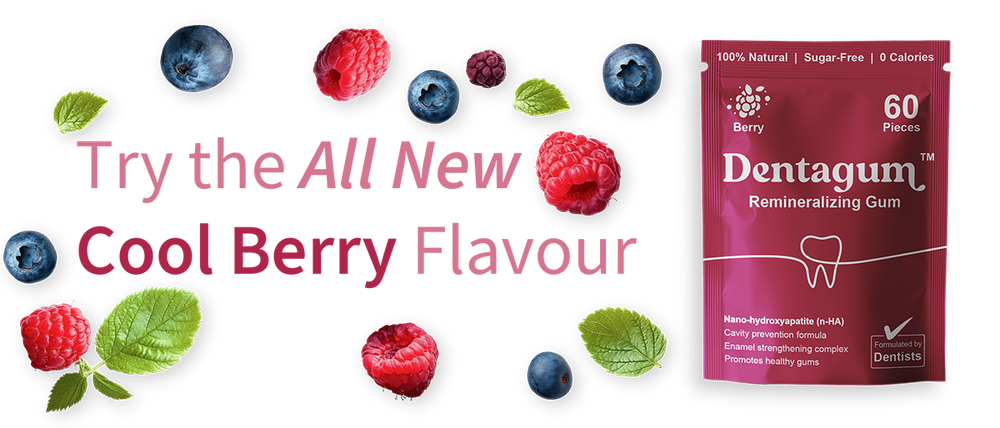
Dentagum uses 5% nano-HAp, organic xylitol as primary sweetener, Prop 65 heavy metal testing through Lightlabs (publicly accessible at lightlabs.com), and compliance-appropriate claims language. The product is not reviewed here to claim it is uniquely proven; it is reviewed to illustrate what transparent disclosure looks like in this category. See our article on remineralizing gum brands compared for how the category compares across these criteria.
Frequently Asked Questions
Is remineralizing gum a scam?
No, but the quality of products and claims varies substantially. The base mechanism (saliva stimulation reducing acid and supporting remineralization after meals) is confirmed in seven clinical trials and endorsed by the ADA. Xylitol's antibacterial effect on S. mutans is supported by 10 of 10 RCTs in a 2024 systematic review. Nano-HAp has a 44-trial meta-analysis (2023) supporting remineralization and hypersensitivity reduction. The legitimate concern is that some brands make claims that exceed what any gum product can do (regrowing enamel, reversing cavities), and some products use nano-HAp or xylitol at doses too low to be clinically meaningful. Evaluate the ingredient list, not the marketing language.
Has remineralizing gum been proven to prevent cavities?
Sugar-free gum chewed after meals has been directly proven to reduce caries incidence in seven clinical trials, with the benefit attributed to saliva stimulation (not any specific ingredient). This is the foundational clinical evidence for the entire category. Xylitol specifically has been shown to reduce caries in 10 of 10 chewing gum RCTs. Nano-HAp has been shown to remineralize early enamel lesions and reduce hypersensitivity in human trials. What has not yet been demonstrated at scale in published RCTs is whether remineralizing gum containing nano-HAp specifically produces greater caries reduction than plain sugar-free gum. This is the honest gap in the evidence. The ingredients work; the incremental benefit of the full formula over plain sugar-free gum in the gum format has not been definitively quantified.
What's the difference between remineralizing gum and regular sugar-free gum?
Regular sugar-free gum (Trident, Orbit) provides the base saliva stimulation benefit that seven clinical trials confirm. It usually contains sorbitol as the primary sweetener (partially fermentable, less antibacterial than xylitol) and no nano-HAp. Remineralizing gum adds: nano-HAp for direct enamel mineral delivery during chewing, clinical-dose xylitol that actively kills S. mutans rather than just not feeding it, and often additional antibacterial or anti-inflammatory ingredients. The base benefit is available from any sugar-free gum. The active ingredients add to it. Whether they add enough to justify the cost premium depends on your cavity risk and oral health profile.
What does the Cochrane review say about xylitol?
The Cochrane Oral Health review on xylitol (2015) found some evidence that products containing both fluoride and xylitol had more effect on preventing caries than fluoride alone. The 2024 European Archives of Paediatric Dentistry systematic review found all 10 xylitol chewing gum RCTs reported statistically significant caries reduction. A 2024 JCED review of 9 clinical trials was more cautious, concluding that "the preventive effect of xylitol against dental caries cannot be confirmed" due to heterogeneity between studies. The weight of chewing-gum-specific evidence is positive; the overall evidence pool is more mixed due to variability across study designs, populations, and dosing protocols.
Is nano-hydroxyapatite safe?
Yes, confirmed by the 2025 EU Scientific Committee on Consumer Safety (SCCS) opinion, which found minimal absorption and good safety for nano-HAp in oral care products. The safety question has been settled at the regulatory level. The ongoing research question is about efficacy strength relative to established alternatives like fluoride, not about harm.
Does remineralizing gum work for tooth sensitivity?
The evidence for nano-HAp specifically is strong here. The Limeback, Enax, and Meyer Biomimetics 2023 meta-analysis of 44 clinical trials found a 39.5% reduction in dentin hypersensitivity from hydroxyapatite in oral care products versus placebo. Dentin hypersensitivity is one of the best-evidenced outcomes for nano-HAp, in part because the mechanism (mineral occlusion of exposed dentin tubules) is directly testable and produces measurable results in the timeframes of typical clinical trials. If sensitivity is your primary concern, the evidence base is more solid than for caries prevention specifically.

Bottom Line
Remineralizing gum is not a scam. The core mechanism has seven clinical trials behind it and ADA endorsement. Xylitol at clinical doses kills S. mutans through a well-characterized mechanism supported by 10 of 10 chewing gum RCTs. Nano-HAp remineralizes early enamel lesions: a 44-trial meta-analysis confirms it, an 18-month RCT in adults confirms it, and the 2025 SCCS confirms it's safe. What is honest to acknowledge: the evidence base for nano-HAp is smaller than for fluoride; gum-format-specific RCTs are limited; and some claims made in this category (regrowing enamel, reversing cavities) are not supported by any gum product's evidence.
The hierarchy to keep in mind: (1) chewing any sugar-free gum after meals is proven. (2) Using xylitol as the primary sweetener at meaningful dose is well-supported for additional antibacterial benefit. (3) Nano-HAp adds remineralization and sensitivity reduction with strong ingredient-level evidence. The combination of all three in a well-formulated product represents the current best-available evidence for functional oral care gum. The skeptic who reads the studies and still buys this product is making an evidence-informed decision. The skeptic who doesn't needs to know they're still getting the base saliva benefit from any sugar-free gum. This article's goal is to help them tell the difference.
Try Dentagum: Evidence-First Formulation, 30-Day GuaranteeResearch Summary
This article is written for the skeptic and reviews both positive and critical evidence. Sources include: Beiswanger BB et al. JADA 1998 (1,402 children, RCT, 3-year, significant caries reduction from gum after meals; 17-28% reduction); Mandel ID. JADA 2008 (7 clinical trials reviewed; benefit attributed to saliva stimulation, not specific ingredients; 6 of 7 significant); Manning RH, Edgar WM. Br Dent J 1993 (plaque pH reduction and white spot remineralization potential from sugar-free gum after acidogenic challenges); ADA Oral Health Topics, Chewing Gum (Seal of Acceptance; 10-12x resting flow; 20 min after meals; sugar-free gum only); Pienihäkkinen K, Hietala-Lenkkeri A et al. Eur Arch Paediatr Dent 2024 (10 xylitol chewing gum RCTs; all 10 significant caries reduction; effect clinically significant at moderate-high baseline caries); Söderling E, Pienihäkkinen K. BMC Oral Health 2025 (xylitol gum reduced S. mutans 12/14 studies vs sorbitol); Ortiz-Sáez B et al. JCED 2024;16(10):e1307-e1315 (9 clinical trials; "preventive effect of xylitol against dental caries cannot be confirmed" due to heterogeneity); Journal of International Society of Preventive and Community Dentistry meta-analysis 2022 (17% overall preventive fraction for xylitol; 58% for xylitol chewing gum in Deshpande/Jadad earlier meta-analysis); Cochrane Impact report on xylitol 2015 (fluoride + xylitol more effective than fluoride alone); Limeback H, Enax J, Meyer F. Biomimetics 2023 (44 clinical trials; 39.5% dentin hypersensitivity reduction nano-HAp vs placebo); Paszynska E et al. Front Public Health 2023 (18-month double-blind RCT; nano-HAp non-inferior to fluoride toothpaste for caries prevention in adults); Eisenhuth G, Patil S, Tellez Freitas CM. World J Dent 2025;16(6):590-595 (review: nano-HAp remineralizes enamel and dentin; relieves dentin hypersensitivity; confirms clinical significance); Journal of Dentistry 2024 systematic review: expanding clinical evidence for hydroxyapatite reducing caries risk (cited via Enamio 2026 source); PMC8979882 2022 critical systematic review (low number of clinical studies; short follow-up; high risk of bias; 6 manufacturer-funded; "conclusive evidence not allowable"); ScienceDirect 2024 systematic review nano-HAp + fluoride for white spot lesions (14 of 422 studies qualifying; restricted conclusions); EU SCCS 2025 safety opinion on nano-HAp (minimal absorption; good safety confirmed for oral care); Alwadi et al. J Natural Med 2023 (mastic gum 14 clinical studies; antibacterial, anti-inflammatory, antimicrobial confirmed). All Dentagum product claims from ingredient-level published research; not Dentagum product trial claims.
References
- Beiswanger BB, Boneta AE, Mau MS, Katz BP, Proskin HM, Stookey GK. The effect of chewing sugar-free gum after meals on clinical caries incidence. JADA. 1998;129(11):1623-1626. [1,402 children, randomized, 3-year: statistically significant caries reduction from sugar-free gum 20 min after meals]
- Mandel ID. The role of saliva in maintaining oral homeostasis. JADA. 2008. [7 clinical trials reviewed; 6 of 7 significant; benefit attributed to saliva stimulation, not specific ingredients]
- Manning RH, Edgar WM. pH changes in plaque after eating snacks and meals, and their modification by chewing sugared- or sugar-free gum. Br Dent J. 1993;174(7):241-244. PubMed 8461202. [10 subjects, crossover; both gums reduced plaque acid response; sugar-free more effective; enhanced remineralization potential confirmed]
- American Dental Association. Chewing Gum. Oral Health Topics. ada.org. [Seal of Acceptance; 10-12x resting salivary flow; 20 min after meals; sugar-free gum only; gum is adjunct not substitute for brushing/flossing]
- Pienihäkkinen K, Hietala-Lenkkeri A, Arpalahti I, Söderling E. The effect of xylitol chewing gums and candies on caries occurrence in children: a systematic review with special reference to caries level at study baseline. Eur Arch Paediatr Dent. 2024;25:145-160. [10 xylitol chewing gum RCTs; all 10 statistically significant caries reduction; clinically significant at moderate-high baseline caries; effect not found for xylitol candies]
- Söderling E, Pienihäkkinen K. Specific effects of xylitol chewing gum on mutans streptococci, plaque, and caries. BMC Oral Health. 2025. [14 studies; xylitol gum reduced S. mutans 12/14 studies; plaque reduction 6/10 studies vs sorbitol controls]
- Ortiz-Sáez B et al. Is xylitol effective in the prevention of dental caries? A systematic review. JCED. 2024;16(10):e1307-e1315. PMC11559115. [9 clinical trials, PRISMA; heterogeneity between studies; "preventive effect of xylitol against dental caries cannot be confirmed conclusively"]
- Meta-analysis on the Effectiveness of Xylitol in Caries Prevention. J Int Soc Prev Community Dent. 2022;12(6). [Overall preventive fraction 17%; Deshpande/Jadad prior meta-analysis found 58% for xylitol chewing gum specifically]
- Cochrane Oral Health Group. Xylitol-containing products for preventing dental caries in children and adults. 2015. [Some evidence that fluoride + xylitol more effective than fluoride alone; reviewed in Cochrane Impact report]
- Limeback H, Enax J, Meyer F. Clinical Evidence of Biomimetic Hydroxyapatite in Oral Care Products for Reducing Dentin Hypersensitivity. Biomimetics. 2023. PMC9844412. [44 clinical trials; 39.5% dentin hypersensitivity reduction vs placebo; nano particle size central to effect]
- Paszynska E, Pawinska M, Grzebieluch W et al. Fluoride-free nano-hydroxyapatite as equally effective to standard fluoride toothpaste. Front Public Health. 2023. [18-month double-blind RCT; nano-HAp non-inferior to 1,450 ppm fluoride for caries prevention in adults; format: toothpaste]
- Eisenhuth G, Patil S, Tellez Freitas CM. Nano-hydroxyapatite for Dental Caries Prevention and Enamel Remineralization: A Review of Current Evidence. World J Dent. 2025;16(6):590-595. [Published July 19, 2025; confirms nano-HAp remineralizes enamel and dentin; relieves dentin hypersensitivity; clinical significance confirmed]
- Krieger MK et al. Efficacy of nano-hydroxyapatite on caries prevention: a systematic review and meta-analysis. PMC. PMC8979882. 2022. [Critical review; 5 in vivo + 5 in situ studies; "low number of clinical studies, short follow-up, high risk of bias"; 6 manufacturer-funded; "conclusive evidence not allowable"; under remineralizing conditions, nHA and NaF show same remineralizing potential]
- EU Scientific Committee on Consumer Safety (SCCS). Safety opinion on nano-hydroxyapatite for use in oral care products. 2025. [Minimal absorption; good safety profile confirmed; safety not in question]
- Alwadi MA et al. State-of-the-Art Review on Mastic Gum. J Natural Med. 2023. [14 clinical studies; antibacterial, anti-inflammatory, antimicrobial properties confirmed]
