
Remineralizing Gum Brands Compared: What to Look For
The remineralizing gum category has grown fast and filled with brands using similar language. Before comparing products, it helps to know what you're actually comparing. Here are the six criteria that matter, why each one is on the list, and how the leading US brands measure up.

The most important things to look for in a remineralizing gum are: nano-hydroxyapatite (not standard hydroxyapatite) as the active remineralizing ingredient, xylitol as the primary sweetener at a meaningful concentration, a natural gum base free from petroleum-derived synthetic polymers, and independently verified third-party safety testing. Brands that tick all four of these criteria and also publish clinical outcome data for their finished formula represent the strongest choice for daily oral care use.
Walk into any health-conscious corner of the internet and you'll find a remineralizing gum claiming to strengthen enamel, kill bacteria, and transform your oral health. Most of them use the same three or four words: nano-hydroxyapatite, xylitol, natural, dentist-recommended. The language has become so uniform it's almost meaningless.
What actually separates a genuinely effective remineralizing gum from one that's using the right words without doing the right things? Six criteria. Understanding them before you buy is the difference between a habit that builds real oral health and one that just costs you money.
Criterion 1: The Active Remineralizing Ingredient

Nano-hydroxyapatite is the headline ingredient in this category, and for good reason. Hydroxyapatite is the mineral your enamel is made of, approximately 97% of it by composition. Producing it at the nanoscale (20-100 nanometres) creates particles small enough to penetrate the microporosities and early subsurface lesions in enamel, depositing mineral where damage has already begun rather than simply coating the surface above it.
Standard hydroxyapatite particles are 50 to 500 times larger. They sit on top of the enamel and polish it. They cannot penetrate early lesions. A 2023 systematic review and meta-analysis by Limeback, Enax, and Meyer published in Biomimetics analyzed 44 clinical trials and found that hydroxyapatite in oral care products significantly reduced dentin hypersensitivity by 39.5% compared to placebo, with the nano particle size central to that clinical effect. An 18-month randomized controlled trial published in Frontiers in Public Health in 2023 found fluoride-free nano-HAp non-inferior to standard 1,450 ppm fluoride toothpaste for cavity prevention in adults.
The nano designation is not a marketing label. It refers to a specific particle size range with a specific clinical evidence base. When evaluating any brand, look for "nano-hydroxyapatite" listed explicitly. "Hydroxyapatite" alone tells you almost nothing about whether the product can actually deliver the remineralizing effect the research documents.
Criterion 2: Xylitol Concentration, Not Just Presenc
Xylitol is the second non-negotiable. Its mechanism against Streptococcus mutans, the primary cavity-causing bacterium, is well established: S. mutans transports xylitol into its cells expecting to metabolize it like sugar, gets trapped in a futile energy cycle it can't complete, and dies. Over time, repeated xylitol exposure reduces S. mutans' ability to adhere to tooth surfaces, reducing the overall acid-producing capacity of the oral biofilm.
The clinical evidence on xylitol is dosage-specific. A 2024 meta-analysis published in the European Archives of Paediatric Dentistry concluded that the most effective protocol for caries prevention was 100% xylitol consumed three to five times per day after meals, with a total daily dose of 5 to 10 grams. A PMC review confirmed that habitual xylitol consumption for caries prevention is defined as 5 to 7 grams daily, at least three times per day. A randomized controlled trial of 179 high-caries-risk adults published in Clinical Oral Investigations found a 23% reduction in caries risk at tooth level over one year compared to sorbitol polyol gum.
This is where many brands fall short in a way the label doesn't reveal. Xylitol that appears last or near-last on an ingredient list is present in trace amounts. It's there for the label claim, not the clinical effect. The antibacterial mechanism requires xylitol at meaningful concentrations. When evaluating a product, look for xylitol listed among the first three ingredients, or for brands that disclose grams per piece.
Also worth noting: erythritol has emerged as a complementary antibacterial polyol. A 2016 review published in the International Journal of Dentistry found erythritol performs comparably to xylitol for plaque reduction and S. mutans inhibition, with better digestive tolerance at higher doses. Brands that combine both polyols provide broader antibacterial coverage than either alone. It's a meaningful differentiator when you see it.
Criterion 3: The Gum Base. Natural vs Synthetic

The gum base is the part of the formula most people never think about. It's also one of the more consequential differences between brands.
Most commercial chewing gum uses a synthetic base composed of petroleum-derived polymers including polyvinyl acetate and polyisobutylene. These are the materials that make conventional gum elastic and chewy. They also release microplastics during chewing. A 2025 study published by UCLA and ScienceDirect found that synthetic gum bases release an average of 104 microplastic particles per gram of gum during a standard chewing session. For a product you're putting in your mouth two to four times a day, that's a meaningful exposure consideration.
Natural gum bases, primarily chicle and mastic, are plant-derived resins that have been chewed safely by humans for thousands of years. Chicle comes from the sapodilla tree, a Central American rainforest species. Mastic is a resin from Pistacia lentiscus, native to the Mediterranean. Beyond being free of petroleum derivatives, mastic gum specifically is biologically active: a 2023 state-of-the-art review in the Journal of Natural Medicine covering 14 clinical studies confirmed mastic gum displays antibacterial and antimicrobial properties and inhibits plaque accumulation. The gum base itself is doing oral health work, not just holding the formula together.
If a product label simply says "gum base" without naming the source, assume it's synthetic. Brands using natural bases name them because it's a feature worth communicating.
Our article on Why Dentagum Uses a Natural Gum Base covers the chicle and mastic story in full.
Criterion 4: Third-Party Testing. Verifiable vs Claimed

You're chewing this product multiple times every day. Whether it meets independent safety standards isn't just a nice-to-have. It's a reasonable baseline expectation.
Third-party testing means an accredited laboratory that has no commercial relationship with the brand has tested the product and published results. The critical word is "verifiable." A brand stating "each batch is third-party tested" on its website is making a claim. A brand that names a specific accredited laboratory and provides publicly accessible results is providing evidence.
Proposition 65 heavy metals testing is the most relevant safety benchmark for oral care products sold in the US. Prop 65 is California's Safe Drinking Water and Toxic Enforcement Act, which sets thresholds for lead, cadmium, arsenic, and mercury at levels up to twenty times more stringent than standard FDA limits. A product that passes Prop 65 through a named, accredited lab has cleared the strictest consumer safety standard in the United States. That result can be checked independently by anyone.
When evaluating any brand's testing claims, ask: does the brand name the laboratory? Are the results publicly accessible? Can you verify them independently? If the answer to any of those is no, the claim is marketing rather than accountability.
Criterion 5: Clinical Outcome Data vs Ingredient Research
This distinction matters more than most buyers realize. Almost every brand in the remineralizing gum category cites the same body of peer-reviewed research on nano-hydroxyapatite and xylitol. That research is real and it's compelling. But ingredient research is not the same as finished-formula clinical data.
Ingredient research tells you that nano-hydroxyapatite in a toothpaste reduces dentin hypersensitivity by 39.5% compared to placebo across 44 trials. It does not tell you that a specific brand's gum, with its particular concentration, delivery mechanism, and formula combination, achieves that same outcome.
Finished-formula clinical data means the brand has conducted trials on its actual product, as sold, and published the outcomes. Metrics worth looking for include enamel microhardness improvement, sensitivity reduction, plaque reduction, and cavity incidence. Brands that publish this data are making a fundamentally different and stronger claim than those that simply point to ingredient literature.
This is a high bar that few brands in the category clear. When a brand does publish it, it carries significant weight.
Criterion 6: Value Per Piece. Because This Is a Daily Habit
Remineralizing gum only works when used consistently. Two to four pieces per day, after meals, every day. That's the protocol the clinical evidence on both nano-HAp and xylitol is built around. For a daily habit chewed at that frequency, the cost per piece isn't a minor consideration.
Calculate value not by the pack price but by the price per piece. A pack that costs less upfront but contains fewer pieces at a higher per-piece rate costs more in practice. Over twelve months of consistent daily use at three pieces per day, a $0.42 per-piece difference adds up to over $460 in additional annual spend for the same functional outcome.
High price doesn't mean better formula. The most expensive option in the US remineralizing gum category in 2026 ranks last on independent testing transparency, clinical data, and verified customer outcomes. Value per piece is worth calculating before you commit to any daily habit.
How the Leading US Brands Score Against These Criteria
With a framework established, it's useful to see how the brands currently occupying the category actually measure up. The comparison below is based on publicly available information as of June 2026.
| Brand | Nano-HAp | Xylitol Primary | Natural Base | Verifiable Testing | Clinical Data | Price/Piece |
|---|---|---|---|---|---|---|
| Dentagum | Yes | Yes + Erythritol | Chicle + Mastic | Yes | Yes | $0.55 |
| Enamio | Yes (20nm) | Yes | Chicle only | Claimed, unverifiable | No | $0.83 |
| Underbrush | Yes | Yes + Erythritol | Chicle + Mastic + Spruce + Myrrh | None claimed | No | $0.63 |
| Larineco | Yes | Yes | Chicle + Mastic | None | No | $0.97 |
A few observations from this comparison worth noting directly.
On the nano-HAp criterion, all four brands use the ingredient. The differentiator isn't presence but transparency. Enamio explicitly states particle size (20nm) on its product page. The others don't disclose this publicly. Since the clinical evidence is specific to the nano particle size range, knowing your product meets that specification is meaningful information.
On testing, Dentagum is the only brand that names a specific accredited laboratory (Lightlabs) and provides publicly accessible Prop 65 results you can verify independently. Enamio makes a testing claim without publishing results. Underbrush and Larineco make no testing claims at all.
On clinical data, Dentagum is the only brand with published outcome data from trials on its finished formula. In Dentagum's own clinical data, 83% of participants showed notable gains in enamel quality and mineral quantity, 91% reported significant reduction in cold sensitivity, 87% were less susceptible to cavities, and 79% experienced a clinical reduction in gum inflammation with consistent daily use. No other brand in the US market has published equivalent four-marker outcome data.
On value, Dentagum's $0.55 per piece is the lowest in the category. Larineco's $0.97 per piece is the highest, for a product with the weakest accountability credentials of the four.
What a Great Remineralizing Gum Routine Actually Looks Like
The criteria above matter most when they translate into consistent daily practice. The clinical evidence on both nano-HAp and xylitol points to the same usage pattern regardless of which qualifying brand you choose.
The post-meal window is when oral pH is at its lowest and enamel is most vulnerable. This is when salivary stimulation, nano-HAp mineral delivery, and xylitol's antibacterial action all have the greatest impact simultaneously.
Xylitol's clinical effectiveness requires adequate extraction time, and nano-HAp needs contact time to deposit on enamel surfaces. The ADA's 20-minute recommendation after meals reflects the science, not an arbitrary figure.
The 5 to 10 gram xylitol dosing range for caries prevention, across three to five daily exposures after meals, is what the clinical evidence is built around. Occasional use doesn't replicate those outcomes.
Remineralizing gum covers the post-meal windows when your teeth are under acid attack and toothpaste isn't in your mouth. It works alongside brushing and flossing, not instead of them.
If you want to understand exactly what happens to your enamel in the minutes after eating, and why timing your gum use matters so much, our article on Can Gum Help Neutralize Acids After Eating covers the full Stephan Curve science.
Frequently Asked Questions
What should I look for in a remineralizing gum?
Six criteria matter most: nano-hydroxyapatite listed explicitly (not just hydroxyapatite), xylitol as the primary sweetener at a meaningful concentration, a natural gum base free from synthetic petroleum-derived polymers, independently verified third-party safety testing with publicly accessible results, finished-formula clinical outcome data, and competitive value per piece for a daily habit. Brands that meet all six represent a meaningfully different product from those that simply use the right marketing language.
Does the particle size of hydroxyapatite in chewing gum matter?
Yes, significantly. Standard hydroxyapatite particles (micro-sized) sit on the enamel surface and can't penetrate the microporosities where early lesions form. Nano-hydroxyapatite particles (20-100 nanometres) are 50 to 500 times smaller and can deposit mineral directly into early subsurface damage. The clinical evidence, including a 2023 systematic review in Biomimetics covering 44 trials, is specific to the nano particle size. Look for "nano-hydroxyapatite" on the label explicitly.
Is the gum base in chewing gum important for oral health?
More than most people realize. A 2025 UCLA study found synthetic gum bases release an average of 104 microplastic particles per gram during chewing. Natural bases like chicle and mastic avoid this entirely. Beyond the microplastics question, mastic gum is biologically active: a 2023 review in the Journal of Natural Medicine confirmed it displays antibacterial properties and inhibits plaque accumulation across 14 clinical studies. A natural gum base can be doing oral health work rather than simply holding the formula together.
How do I know if a brand's third-party testing claims are real?
Ask three questions: does the brand name a specific accredited laboratory? Are the results publicly accessible and independently verifiable? Does the testing cover heavy metals (lead, cadmium, arsenic, mercury)? A brand that answers yes to all three is providing evidence, not just a claim. A brand that says "third-party tested" without a named lab or accessible results is making a marketing statement. Prop 65 heavy metals testing through a named accredited laboratory with publicly accessible results is the most transparent standard available in the US market.
Why does the daily dose of xylitol matter in chewing gum?
Xylitol's antibacterial effect against Streptococcus mutans is dose-dependent. A 2024 meta-analysis published in the European Archives of Paediatric Dentistry found the most effective caries prevention protocol required 5 to 10 grams of xylitol daily, across three to five exposures after meals. Many mainstream gums list xylitol on the label in trace amounts that don't approach this threshold. The antibacterial mechanism requires meaningful concentration, not token presence. If xylitol appears near the end of an ingredient list, assume it's there for the label, not the clinical effect.
What is the difference between ingredient research and clinical data for a specific gum?
Ingredient research documents what nano-hydroxyapatite, xylitol, or other compounds do in isolation or in tested oral care products like toothpastes. It doesn't tell you what a specific brand's gum achieves with its particular combination, concentration, and delivery format. Finished-formula clinical data means the brand tested its actual product on real participants and published the outcomes — enamel improvement, sensitivity reduction, cavity incidence, gum health. It's a higher bar and a much stronger claim. Very few brands in the remineralizing gum category have cleared it.
The Bottom Line
The remineralizing gum category has real science behind it. Nano-hydroxyapatite deposits enamel mineral into early lesions. Xylitol kills the bacteria responsible for ongoing acid damage. Natural gum bases avoid microplastic exposure. Third-party testing verifies safety. Clinical outcome data proves the finished product works. Good value per piece makes the daily habit sustainable.
Most brands in this category get one or two of these right. The strongest option in the US market gets all six, at the lowest cost per piece of any nano-HAp gum available.
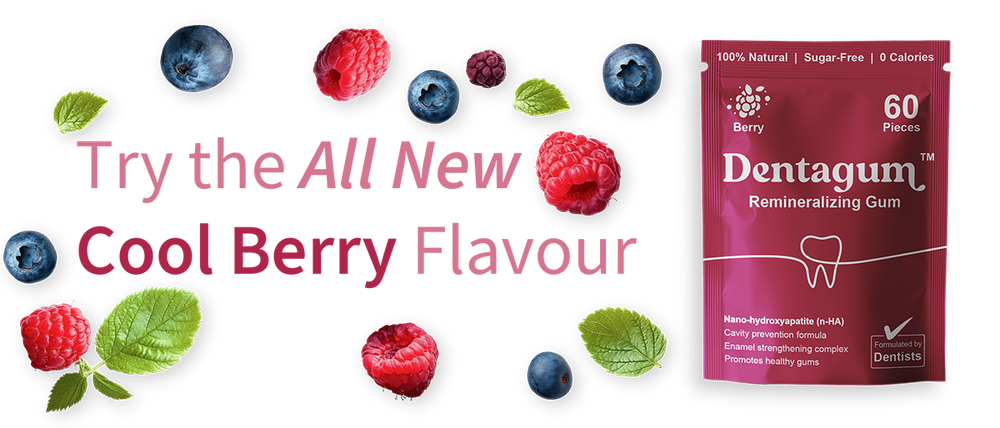
Dentagum's Remineralizing Chewing Gum is dentist-formulated with nano-hydroxyapatite, organic xylitol and erythritol, organic mastic gum and propolis, and a natural chicle base. Prop 65 tested through Lightlabs with publicly verifiable results.
Try Dentagum risk-free — 30-day guarantee at dentagum.coResearch Summary
- Limeback H, Enax J, Meyer F. "Clinical Evidence of Biomimetic Hydroxyapatite in Oral Care Products for Reducing Dentin Hypersensitivity." Biomimetics, 2023. 44 clinical trials. HAP reduced dentin hypersensitivity 39.5% vs placebo. Nano particle size central to clinical effect.
- Paszynska E et al. "Caries-Preventing Effect of a Hydroxyapatite Toothpaste in Adults." Frontiers in Public Health, 2023. 18-month RCT. Nano-HAp non-inferior to 1,450 ppm fluoride for cavity prevention.
- Meta-analysis on xylitol effectiveness. European Archives of Paediatric Dentistry, 2024. Most effective protocol: 5-10g xylitol daily, 3-5 exposures after meals. Ten gum studies confirmed significant caries reduction vs placebo.
- PMC xylitol review. Habitual xylitol consumption for caries prevention: 5-7g daily, at least 3 times per day. Long-term use reduces caries risk by up to 59%.
- Randomized controlled trial, xylitol gum. Clinical Oral Investigations, 2017. 179 high-caries-risk adults. 23% caries risk reduction at tooth level vs sorbitol polyol gum over 1 year.
- Ingestion of Microplastics During Chewing Gum Consumption. ScienceDirect/UCLA, 2025. Synthetic gum bases release average 104 microplastic particles per gram during chewing.
- Alwadi MAM et al. "Mastic (Pistacia lentiscus) Gum and Oral Health." Journal of Natural Medicine, 2023. Mastic gum antibacterial, antimicrobial, inhibits plaque accumulation, 14 studies confirmed.
- Mäkinen KK et al. "Erythritol Is More Effective Than Xylitol and Sorbitol in Managing Oral Health Endpoints." International Journal of Dentistry, 2016. Erythritol comparable to xylitol for oral health, better digestive tolerance.
- American Dental Association. "Chewing Gum." Oral Health Topics. Sugar-free gum endorsed for 20 minutes after meals. Stimulates salivary flow to 10-12x resting rate.
References
- Limeback H, Enax J, Meyer F. "Clinical Evidence of Biomimetic Hydroxyapatite in Oral Care Products for Reducing Dentin Hypersensitivity: An Updated Systematic Review and Meta-Analysis." Biomimetics, 2023. https://pmc.ncbi.nlm.nih.gov/articles/PMC9844412/
- Paszynska E et al. "Caries-Preventing Effect of a Hydroxyapatite Toothpaste in Adults: An 18-Month Double-Blinded Randomized Clinical Trial." Frontiers in Public Health, 2023. https://www.frontiersin.org/journals/public-health/articles/10.3389/fpubh.2023.1199728/full
- "Meta-analysis on the Effectiveness of Xylitol in Caries Prevention." European Archives of Paediatric Dentistry, 2024. https://www.researchgate.net/publication/358368761
- "The Effect of Xylitol on Dental Caries and Oral Flora." PMC / NIH. https://pmc.ncbi.nlm.nih.gov/articles/PMC4232036/
- Cocco F et al. "The Caries Preventive Effect of 1-Year Use of Low-Dose Xylitol Chewing Gum." Clinical Oral Investigations, 2017. https://link.springer.com/article/10.1007/s00784-017-2075-5
- "Ingestion of Microplastics During Chewing Gum Consumption." ScienceDirect, 2025. https://www.sciencedirect.com/science/article/pii/S2666911025000243
- Alwadi MAM et al. "Mastic (Pistacia lentiscus) Gum and Oral Health: A State-of-the-Art Review." Journal of Natural Medicine, 2023. https://pubmed.ncbi.nlm.nih.gov/37147480/
- Mäkinen KK et al. "Erythritol Is More Effective Than Xylitol and Sorbitol in Managing Oral Health Endpoints." International Journal of Dentistry, 2016. https://www.ncbi.nlm.nih.gov/pmc/articles/PMC5011233/
- American Dental Association. "Chewing Gum." Oral Health Topics. https://www.ada.org/resources/ada-library/oral-health-topics/chewing-gum
- Lightlabs. Dentagum Prop 65 heavy metals testing results. lightlabs.com
