
The Best Chewing Gum for Dry Mouth: What Actually Helps
Dry mouth isn't just uncomfortable. It quietly removes the saliva your teeth depend on for protection, and the damage builds over time. Here's what the clinical evidence says about chewing gum for dry mouth, which ingredients actually help, and what to look for.

The best chewing gum for dry mouth is sugar-free gum containing xylitol. Chewing stimulates salivary flow mechanically, while xylitol reduces the cavity-causing bacteria that proliferate when saliva is low. A 2023 systematic review and meta-analysis published in BMC Oral Health confirmed that gum chewing leads to objective improvements in salivary flow rates and subjective relief from xerostomia in elderly and medically compromised patients. For added enamel protection, choose a gum that also contains nano-hydroxyapatite to compensate for the remineralization that reduced saliva can no longer provide on its own.
If you regularly wake up with a sticky, dry mouth, struggle to swallow during meals, or find that your breath never quite feels fresh no matter how often you brush, you're not imagining things. Dry mouth is a real clinical condition with real consequences for your teeth. And it's far more common than most people realize.
The good news is that chewing gum, specifically the right kind, is one of the most clinically supported non-prescription tools for managing it. Here's what the research actually says, and what to look for in a product.
What Dry Mouth Actually Is (and Why It Matters for Your Teeth)

Dry mouth, clinically called xerostomia, is the subjective feeling of oral dryness caused by reduced or absent salivary flow. It's not just an inconvenience. Saliva is your mouth's primary defense system: it buffers acid after meals, delivers calcium and phosphate to enamel for remineralization, suppresses harmful bacteria through antimicrobial proteins, and physically washes away food debris. When it's gone or reduced, all of those protective functions fail simultaneously.
The consequences accumulate quickly. Without adequate saliva, oral pH stays lower for longer after eating. The bacteria responsible for tooth decay, particularly Streptococcus mutans, thrive in that dry, acidic environment. Enamel loses minerals faster than it can recover. People with chronic dry mouth often develop what dentists call rampant caries, a rapid and aggressive pattern of decay that can affect teeth that were previously healthy. The Merck Manual's professional edition explicitly notes that "long-standing xerostomia can result in severe tooth decay and oral candidiasis."
If you have dry mouth, managing it isn't just about comfort. It's about protecting your teeth from damage that can become irreversible.
How Common Is Dry Mouth? The Numbers Are Striking
Sources: ADA (2026), USC Ostrow School of Dentistry, Adolfsson et al. Acta Odontologica Scandinavica (2022)
According to the American Dental Association, xerostomia affects approximately 22% of the global population. That climbs to 30% in adults over 65 and up to 40% in those over 80. But the most striking numbers come from medication data. Research from the USC Ostrow School of Dentistry found that xerostomia prevalence jumps to 37% in older adults taking just one medication, 62% with two medications, and 78% with three or more.

A 2022 study published in Acta Odontologica Scandinavica that measured xerostomia in primary care patients found an overall prevalence of 43.6%. Medication was the strongest predictor, regardless of age or gender. Patients on five or more medications had a 71.2% prevalence rate.
The medication classes most commonly associated with dry mouth include antidepressants, antipsychotics, antihistamines, blood pressure medications, diuretics, and drugs for urinary incontinence. A 2025 review in European Psychiatry found xerostomia prevalence of 30-50% with the antidepressant amitriptyline alone. If you're on regular medication and experiencing dry mouth, the two are almost certainly connected.
Why Chewing Gum Is One of the Best Non-Prescription Solutions
Chewing gum works for dry mouth through a mechanism that's simple, well-understood, and backed by decades of research: mechanical stimulation of the salivary glands.
When you chew, the jaw movement and oral muscle activity signals your salivary glands to produce saliva. The American Dental Association notes that this can stimulate salivary flow to 10 to 12 times the resting rate. For someone whose saliva is already depleted, that temporary surge provides real relief: moisture, acid buffering, antimicrobial proteins, and remineralizing minerals all flood back into the oral environment during and after chewing.
A 2023 systematic review and meta-analysis published in BMC Oral Health specifically investigated gum chewing as an intervention for xerostomia in elderly and medically compromised patients. The researchers concluded that gum chewing leads to objective improvements in salivary flow rates and provides subjective relief from dry mouth symptoms. A referenced Cochrane Collaboration review of topical therapies for dry mouth also concluded that chewing gum increased saliva production in patients with residual secretory capacity.
The key phrase there is "residual secretory capacity." Chewing gum stimulates the salivary glands mechanically, so it works best when those glands still have some function. For most medication-induced dry mouth, the glands are suppressed rather than permanently damaged, which means gum is a genuinely effective tool. For conditions like Sjogren's syndrome or radiation-induced damage where gland function is severely compromised, results are more limited and a dentist's guidance is important.
If you want to understand more about how saliva functions as your mouth's natural defense system, our guide How Saliva Helps Protect Your Teeth Naturally covers the full mechanism.
Why the Sweetener in Your Gum Matters Enormously
Not all sugar-free gum is equal for dry mouth management. The sweetener is the difference between a gum that simply stimulates saliva and one that actively protects your teeth while doing it.
Xylitol: The Gold Standard

People with dry mouth are at dramatically higher risk of cavities. Saliva normally suppresses Streptococcus mutans, the primary cavity-causing bacterium, through antimicrobial proteins and by maintaining a healthy oral pH. Without it, S. mutans populations can grow unchecked. This is why dentists often see rampant decay in patients with chronic dry mouth despite good brushing habits.
Xylitol addresses this directly. S. mutans transports xylitol into its cells expecting to metabolize it like sugar. It can't. The bacterium gets trapped in a futile energy cycle, becomes exhausted, and dies. A 2025 systematic review in BMC Oral Health found xylitol gum significantly reduced S. mutans counts in 12 of 14 clinical studies reviewed. For dry mouth patients, this isn't just a bonus. It's a critical layer of protection that the lost saliva can no longer provide.
The Merck Manual explicitly lists xylitol-containing gum as a useful symptomatic treatment for xerostomia, and sugar-free chewing gum is cited as a management strategy for medication-induced dry mouth across multiple clinical references.
What to Avoid
Never use regular sugary gum for dry mouth. Sugar feeds the exact bacteria that dry mouth already allows to proliferate. It's the worst possible combination: a dry, acidic environment loaded with S. mutans and then a direct supply of the substrate they thrive on.
Sorbitol-based gum is a step up from sugar, but sorbitol can be partially fermented by oral bacteria. It's meaningfully weaker than xylitol for cavity prevention and has no antibacterial mechanism. For dry mouth patients specifically, where cavity risk is already elevated, sorbitol gum provides the salivary stimulation benefit but misses the antibacterial protection that xylitol delivers.
Why Remineralization Matters Even More When You Have Dry Mouth
Here's the compounding problem that most dry mouth articles don't explain clearly enough. Saliva doesn't just keep your mouth moist. It actively delivers calcium and phosphate ions to your enamel surfaces, constantly topping up the minerals that acid exposure removes throughout the day. This process is called remineralization, and it's running continuously in a healthy mouth.
When saliva is reduced, this mineral delivery slows or stops. Enamel that would normally recover from a meal's acid challenge doesn't get the minerals it needs. Each day ends with a small net deficit. Over months and years, that deficit accumulates into thinned enamel, sensitivity, and the rampant decay pattern that dentists associate with chronic xerostomia.
This is where nano-hydroxyapatite becomes particularly important for dry mouth patients. Nano-HAp is a synthetic form of the mineral enamel is made of, produced in nanoparticle sizes that can physically deposit into the microporosities and early lesions in enamel. Where saliva normally provides this mineral delivery, nano-HAp in a chewing gum delivers it directly during the chewing window, compensating for what reduced salivary flow can no longer do on its own.
You can read the full science behind this in our detailed guide on What Is Nano Hydroxyapatite and Why Is It in Oral Care.
For dry mouth patients, the combination of xylitol (to address the elevated bacterial risk) and nano-hydroxyapatite (to address the reduced remineralization) is more relevant than it is for someone with normal salivary function. Both ingredients are compensating for something that your saliva would normally provide but can't.
What to Look for in a Gum for Dry Mouth
Sugar-free with xylitol as the primary sweetener
Non-negotiable. Xylitol must be listed prominently, ideally as the first or second sweetener. If sorbitol leads the ingredient list, the antibacterial benefit is significantly reduced. If there's sugar anywhere in the formula, put it back.
Nano-hydroxyapatite for remineralization support
For dry mouth patients specifically, this is worth prioritising. Your saliva's mineral delivery is compromised, and nano-HAp fills that gap during the chewing window. Look for "nano-hydroxyapatite" listed explicitly, not just "hydroxyapatite," as the nano particle size is what enables enamel penetration.
A natural gum base
You're chewing this multiple times a day for extended periods. A natural chicle or mastic gum base avoids the petroleum-derived synthetic polymers found in most commercial gum. Mastic gum in particular brings documented antibacterial properties to the formula, which matters when your oral bacterial balance is already compromised by low saliva.
No aspartame or artificial sweeteners
Dry mouth patients are already using gum therapeutically, not recreationally. A clean ingredient profile matters more here than it does for occasional chewers.
How and When to Use Gum for Dry Mouth
Meals are when oral pH drops and bacterial activity peaks. For dry mouth patients, the already-reduced salivary response makes this window even more critical. Chewing immediately after eating stimulates what saliva you have and adds the protective ingredients in the gum on top.
The salivary stimulation benefit and the nano-HAp contact time both require sustained chewing. A piece of gum chewed for two minutes and discarded delivers a fraction of the benefit. If you're using gum therapeutically for dry mouth, the duration matters.
Unlike someone chewing occasionally for fresh breath, dry mouth patients benefit from consistent use across the day. At your desk, in your bag, in the car. The habit works best when it's within reach at every meal and snack.
Chewing gum stimulates saliva mechanically, but your salivary glands need adequate hydration to produce it. Sipping water regularly throughout the day supports salivary function and gives the gum more to work with.
Chewing gum is a meaningful supportive measure, not a medical treatment for dry mouth. If you're experiencing chronic xerostomia, your dentist can assess the cause, evaluate your cavity risk, and recommend targeted interventions including prescription fluoride, saliva substitutes, or a referral to the prescribing physician if medications are the driver.
Our article on Can Gum Help Neutralize Acids After Eating covers the full post-meal science in depth, including the Stephan Curve and why timing your chewing matters so much.
How Dentagum Fits into a Dry Mouth Routine

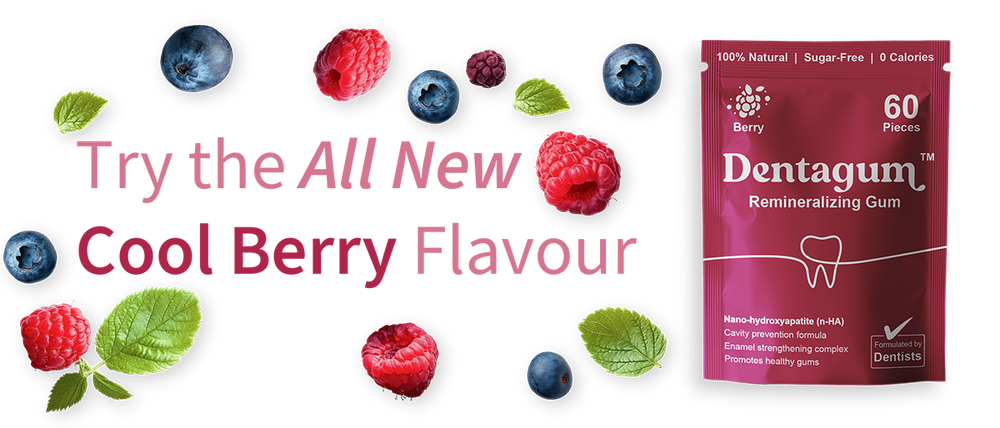
Dentagum's Remineralizing Chewing Gum combines organic xylitol and organic erythritol as a dual antibacterial sweetener system, nano-hydroxyapatite for enamel mineral support, and organic mastic gum and natural propolis for additional antibacterial and anti-inflammatory coverage. The organic chicle and mastic gum base avoids synthetic polymer bases entirely.
For dry mouth patients, the formula addresses three of the main consequences of reduced saliva at once: the elevated bacterial risk (xylitol, erythritol, propolis, mastic gum), the reduced remineralization (nano-hydroxyapatite, eggshell powder), and the loss of the physical cleansing action saliva provides (calcium bentonite clay, saliva stimulation from chewing).
In Dentagum's own clinical data, 91% of participants reported significant reduction in cold sensitivity with consistent daily use, and 79% experienced a clinical reduction in gum inflammation. Both of these outcomes are particularly relevant for dry mouth patients, where sensitivity and gum irritation from a dry oral environment are common complaints.
Try Dentagum risk-free — 30-day guaranteeOther Things That Help with Dry Mouth
Chewing gum is one tool in a broader management approach. A few others worth knowing about:
Saliva substitutes and mouth sprays provide immediate moisture relief, particularly useful at night when chewing gum isn't practical. They don't stimulate saliva production but coat oral tissues to reduce discomfort.
Breathing through your nose rather than your mouth, particularly during sleep, significantly reduces overnight oral dryness. Mouth breathing evaporates saliva rapidly, and many people with dry mouth are making it worse overnight without realizing it. Our article on What Mouth Breathing Is Doing to Your Oral Health covers this in detail.
Limiting caffeine and alcohol reduces their diuretic effect on overall hydration and the drying effect both have on oral mucosa.
Reviewing your medications with your doctor. In some cases, switching to an alternative within the same drug class, adjusting timing of doses, or changing to a lower dose can reduce xerostomia without compromising therapeutic benefit. This is always worth discussing if dry mouth is significantly affecting your quality of life or dental health.
Frequently Asked Questions
Does chewing gum actually help with dry mouth?
Yes, with good clinical support. A 2023 systematic review and meta-analysis published in BMC Oral Health found that gum chewing leads to objective improvements in salivary flow rates and subjective relief from xerostomia in elderly and medically compromised patients. The American Dental Association confirms that chewing stimulates salivary flow to 10 to 12 times the resting rate. The effect is most significant in people whose salivary glands are suppressed rather than permanently damaged, which covers most medication-induced dry mouth.
What is the best sweetener in gum for dry mouth?
Xylitol. People with dry mouth are at elevated cavity risk because the saliva that normally suppresses Streptococcus mutans is reduced. Xylitol specifically kills S. mutans through a metabolic disruption, adding antibacterial protection that saliva would normally provide. A 2025 systematic review in BMC Oral Health found xylitol gum significantly reduced S. mutans in 12 of 14 clinical studies. Sorbitol-based gum provides the chewing stimulation but lacks xylitol's antibacterial mechanism. Avoid any gum containing sugar entirely.
How common is dry mouth from medications?
Very common. The American Dental Association notes xerostomia affects approximately 22% of the global population overall, rising to 30% in adults over 65 and up to 40% in those over 80, primarily due to medication use. Research from the USC Ostrow School of Dentistry found xerostomia prevalence of 37% in older adults taking one medication, 62% with two, and 78% with three or more. A 2022 Swedish primary care study found an overall prevalence of 43.6%, with medication as the strongest predictor regardless of age or gender.
Why do people with dry mouth get more cavities?
Saliva does three critical things for cavity prevention: it buffers acid after meals, delivers calcium and phosphate to enamel for remineralization, and suppresses Streptococcus mutans through antimicrobial proteins. When saliva is reduced, all three mechanisms are compromised simultaneously. Oral pH stays lower for longer, enamel doesn't get the minerals it needs to repair, and cavity-causing bacteria are no longer kept in check. This is why rampant, rapidly progressing decay is a well-documented consequence of chronic dry mouth.
How long should you chew gum for dry mouth relief?
Ten to twenty minutes per session, after meals. The salivary stimulation benefit requires sustained chewing, and for gums containing nano-hydroxyapatite, the contact time with enamel is what allows the mineral to deposit. Chewing for two to three minutes and discarding delivers significantly less benefit than the full recommended duration. Aim for at least two sessions daily, immediately after your main meals, as a minimum habit.
Can chewing gum replace saliva substitutes for dry mouth?
They serve different purposes and work best together. Chewing gum actively stimulates your own saliva production and provides active ingredients like xylitol and nano-hydroxyapatite during the chewing window. Saliva substitutes coat oral tissues to provide moisture relief, particularly useful overnight when chewing isn't practical. For most people with medication-induced dry mouth, xylitol gum after meals combined with a saliva spray or gel at night is a more complete approach than either alone.
The Bottom Line
Dry mouth is a genuine dental health risk, not just a comfort issue. The clinical evidence for chewing gum as a management tool is solid: it stimulates salivary flow, relieves dry mouth symptoms, and with the right ingredients, actively compensates for what reduced saliva can no longer do.
What makes gum effective for dry mouth isn't the chewing alone. It's the xylitol that kills the bacteria your saliva would normally suppress. It's the nano-hydroxyapatite that delivers the enamel minerals your saliva would normally provide. And it's the consistency of using it after every meal, when your oral environment needs support the most.
If you're managing dry mouth from medication or another cause, it's worth talking to your dentist about a complete care plan. In the meantime, choosing the right gum is one of the highest-value daily habits you can build.
Try Dentagum risk-free — 30-day guarantee at dentagum.coResearch Summary
- Dodds MWJ, Ben Haddou M, Day JEL. "The Effect of Gum Chewing on Xerostomia and Salivary Flow Rate in Elderly and Medically Compromised Subjects: A Systematic Review and Meta-Analysis." BMC Oral Health, 2023. Confirmed objective improvements in salivary flow and subjective xerostomia relief from gum chewing.
- American Dental Association. "Xerostomia." Oral Health Topics, reviewed 2026. Xerostomia affects ~22% globally; 30% in adults over 65; up to 40% in adults over 80. Primarily medication-driven.
- Adolfsson A et al. "Prevalence of Dry Mouth in Adult Patients in Primary Health Care." Acta Odontologica Scandinavica, 2022. Overall prevalence 43.6% in primary care; 71.2% in patients on five or more medications. Medication strongest predictor.
- Maldonado-Puebla RA et al. "Xerostomia Induced by Psychiatric Medications." European Psychiatry, 2025. Sugar-free chewing gum cited as management strategy for SSRI-induced xerostomia. Amitriptyline prevalence 30-50%.
- Merck Manual Professional Edition. "Xerostomia." Updated 2026. Xylitol-containing gum listed as useful symptomatic treatment for xerostomia.
- USC Ostrow School of Dentistry. Medication and dry mouth data: 37% prevalence with 1 medication, 62% with 2, 78% with 3 or more in older adult populations.
- Söderling E et al. "Specific Effects of Xylitol Chewing Gum on Mutans Streptococci Levels." BMC Oral Health, 2025. Xylitol gum reduced S. mutans in 12 of 14 clinical studies — critical for elevated-risk dry mouth patients.
References
- Dodds MWJ, Ben Haddou M, Day JEL. "The Effect of Gum Chewing on Xerostomia and Salivary Flow Rate in Elderly and Medically Compromised Subjects: A Systematic Review and Meta-Analysis." BMC Oral Health, 2023. https://pmc.ncbi.nlm.nih.gov/articles/PMC10280939/
- American Dental Association. "Xerostomia." Oral Health Topics, reviewed 2026. https://www.ada.org/resources/ada-library/oral-health-topics/xerostomia
- Adolfsson A et al. "Prevalence of Dry Mouth in Adult Patients in Primary Health Care." Acta Odontologica Scandinavica, 2022. https://pubmed.ncbi.nlm.nih.gov/35617454/
- Maldonado-Puebla RA et al. "Xerostomia Induced by Psychiatric Medications: Prevalence, Impact, and Management." European Psychiatry, 2025. https://www.ncbi.nlm.nih.gov/pmc/articles/PMC12437780/
- Merck Manual Professional Edition. "Xerostomia." Updated January 2026. https://www.merckmanuals.com/professional/dental-disorders/
- USC Ostrow School of Dentistry. "Dry Mouth: Medications and their Effects on Saliva." https://ostrowonline.usc.edu/medications-that-cause-dry-mouth/
- Söderling E et al. "Specific Effects of Xylitol Chewing Gum on Mutans Streptococci Levels." BMC Oral Health, 2025. https://link.springer.com/article/10.1186/s12903-025-06602-1
- American Dental Association. "Chewing Gum." Oral Health Topics. https://www.ada.org/resources/ada-library/oral-health-topics/chewing-gum
