
Nano-Hydroxyapatite vs Fluoride: The Honest Comparison Backed by Research
Fluoride has 75-plus years of evidence and full ADA backing. Nano-hydroxyapatite has been shown non-inferior to fluoride in three independent randomized controlled trials and carries no swallowing risk. Both are legitimate. This article covers how they actually work differently, where each has the edge, the safety comparison that matters in practice, and whether you can use them together.

Nano-hydroxyapatite and fluoride are both clinically supported ingredients for preventing cavities and strengthening enamel, but they work through fundamentally different mechanisms and have different strengths. Fluoride converts the outer enamel surface into a more acid-resistant mineral called fluorapatite and has over 75 years of clinical evidence behind it. Nano-hydroxyapatite delivers the exact mineral enamel is made from, directly rebuilding it from the inside out, and carries no swallowing risk. Three independent randomized controlled trials, including an 18-month double-blind RCT published in Frontiers in Public Health (2023), found fluoride-free nano-hydroxyapatite non-inferior to standard 1,450 ppm fluoride toothpaste for cavity prevention in adults. Nano-HAp is the most evidence-backed fluoride-free option available. Fluoride has the longer track record. For most healthy adults, the clinical evidence now supports either as a primary remineralizing choice.
This is one of the most searched questions in oral care right now, and it deserves a genuinely honest answer rather than brand advocacy in either direction. The answer is more nuanced than most articles make it, because the two ingredients are not trying to do exactly the same thing in the same way.
This article covers the mechanism of each ingredient, what the clinical research actually shows, where each performs better, the safety differences that matter in practice, and how to choose between them based on your situation. No ingredient has a monopoly on the science. Both have legitimate clinical support. The decision comes down to your specific oral health context, your age and cavity risk, and your personal preferences about what you put in your mouth daily.
1. What Each Ingredient Actually Is
Before comparing them, it helps to understand what you are actually dealing with.
Fluoride is the ionic form of fluorine, a naturally occurring element found in soil, water, and certain foods. In oral care products, it typically appears as sodium fluoride, stannous fluoride, or sodium monofluorophosphate. Fluoride has been added to toothpaste since the 1960s and to US drinking water since 1945. At standard toothpaste concentrations (1,000 to 1,450 ppm in over-the-counter products, up to 5,000 ppm in prescription strength), it has a well-documented and extensive body of clinical evidence. It is not a mineral your body makes naturally.
Nano-hydroxyapatite is a synthetic form of hydroxyapatite (Ca10(PO4)6(OH)2), the calcium phosphate mineral that comprises roughly 97% of tooth enamel and about 70% of bone. It is not foreign to the body: it is the same compound your body produces biologically to build and repair mineralized tissue. The "nano" designation refers to particle sizes of 20 to 100 nanometres, which is small enough to penetrate the microscopic pores and early lesions in enamel rather than simply sitting on the surface. This distinction matters: standard hydroxyapatite particles (50 to 500 times larger) cannot do this. Nano-hydroxyapatite was first developed in Japan in the 1980s and has been used in oral care there for over 40 years.
2. How They Work: Two Different Approaches

This is where the comparison gets genuinely interesting, because fluoride and nano-HAp protect teeth through distinct biological pathways.
How fluoride works
Fluoride works primarily at the surface of enamel through a chemical conversion process. When fluoride ions are present during remineralization, they replace hydroxyl groups in the hydroxyapatite crystal lattice to form a related but different mineral: fluorapatite (Ca10(PO4)6F2). Fluorapatite is more acid-resistant than natural hydroxyapatite: while hydroxyapatite begins dissolving at a pH of around 5.5, fluorapatite does not begin to dissolve until pH drops to around 4.5. This lower solubility threshold means that when bacteria produce acid after meals, fluorapatite-coated enamel is less likely to lose mineral at the typical post-meal pH range.
Fluoride also accelerates remineralization by attracting calcium and phosphate ions to the tooth surface, and at higher concentrations it has antibacterial properties that reduce the acid output of cavity-causing bacteria. Modern research indicates that fluoride's benefits come primarily from this topical surface contact rather than from being ingested and incorporated into developing teeth.
How nano-hydroxyapatite works
Nano-HAp works through direct mineral deposition rather than surface conversion. When nano-HAp particles contact enamel, they adsorb onto and integrate directly into the enamel crystal structure, filling subsurface micropores and early demineralized zones with the same mineral the enamel is made from. This is a biomimetic approach: it works by replacing what was lost rather than creating a chemically modified surface layer.
Because nano-HAp particles are the right size to enter enamel microporosities, they can reach subsurface lesions that fluoride's surface chemistry cannot effectively address. Nano-HAp has also been shown to occlude dentinal tubules, the channels that, when open, cause tooth sensitivity by transmitting thermal and tactile stimuli to the nerve. This is the mechanism behind nano-HAp's documented sensitivity-reduction effect.
Nano-HAp also reduces S. mutans adhesion to tooth surfaces rather than killing bacteria broadly. It does not disrupt the oral microbiome the way broad-spectrum antimicrobials do.
3. The Clinical Evidence, Compared Honestly
This is where intellectual honesty matters most, because both ingredient camps have a tendency to overstate what the evidence shows.
Fluoride's evidence base
Fluoride has by far the longer and broader evidence base. Seventy-five-plus years of population studies, randomized controlled trials, and clinical experience have established its effectiveness at reducing cavities. Community water fluoridation has been estimated by the CDC to reduce tooth decay by about 25% across the population. The ADA, CDC, and WHO all support fluoride as the primary evidence-backed cavity prevention tool. The scale and duration of this evidence base is simply not comparable to anything else in dentistry.
This track record matters. Fluoride's evidence did not come from a few studies in a narrow population: it spans generations, countries, and populations with varying dietary habits and baseline cavity rates. That kind of longitudinal real-world evidence is extremely difficult to replicate quickly.
Nano-hydroxyapatite's evidence base
Nano-HAp has a newer but now substantial evidence base. The key is understanding what the studies actually measured and for whom.
The anchor study is the randomized controlled trial by Paszynska, Enax, Meyer, Amaechi, Limeback, and colleagues, published as a fully peer-reviewed paper in Frontiers in Public Health (2023). This was an 18-month, double-blind, multicenter trial in adults aged 18 to 45. The primary endpoint was the percentage of subjects showing no increase in their overall DMFS score (Decayed, Missing, Filled Surfaces index). Result: no increase in DMFS was observed in 89.3% of participants in the nano-HAp group versus 87.4% in the fluoride group. The nano-HAp toothpaste was not statistically inferior to the 1,450 ppm fluoride toothpaste. The authors note this is the third clinical trial to demonstrate non-inferiority of fluoride-free nano-HAp toothpaste, not just the first. Figures from ingredient research.
A separate 18-month RCT by Schlagenhauf and colleagues, published in the Journal of Clinical Medicine (2023), found the same result in an orthodontic population: hydroxyapatite toothpaste was non-inferior to fluoride toothpaste for cavity prevention in adolescents and young adults undergoing fixed-appliance orthodontic treatment. This is a notably high-risk population for white spot lesions and early caries. Figures from ingredient research.
On the sensitivity side, the systematic review and meta-analysis by Limeback, Enax, and Meyer published in Biomimetics (2023) analyzed 44 clinical trials and 22 RCTs on nano-HAp and dentin hypersensitivity, finding a significant reduction in sensitivity compared to placebo, with the nano particle size central to the clinical effect. Figures from ingredient research.
What the evidence does not yet show: large-scale, decades-long population studies comparable to what exists for fluoride. The RCT evidence is real and rigorous, but it is 18-month trials in bounded populations, not generational epidemiology. This is an honest limitation of nano-HAp's evidence base, and any brand or writer who glosses over it is doing readers a disservice.
The Frontiers in Public Health 2023 RCT enrolled adults described as having a low to moderate cavity risk. At least one dental practice analysis specifically notes that the non-inferiority finding may not generalize to high-risk populations, such as people with active gum disease, very dry mouth, or a history of many cavities. For those groups, fluoride's longer track record as the established standard remains the more cautious clinical choice. Discuss with your dentist if you are uncertain about your cavity risk level.
All figures from ingredient-level research, not Dentagum product trials.
4. Where Each Ingredient Has an Advantage

A genuine comparison requires acknowledging that each ingredient outperforms in specific contexts, rather than declaring an overall winner.
Where fluoride has the clearer edge
High cavity-risk populations. People with active decay, very dry mouth, gum recession exposing root surfaces, or a history of frequent cavities are the group where fluoride's long evidence base and its track record across diverse risk levels matter most. Most clinical guidelines for high-risk patients are built around fluoride. Using a higher-concentration prescription fluoride toothpaste (5,000 ppm) in this group has much stronger support than switching to nano-HAp.
Acid-resistance at lower pH. Fluorapatite's lower critical pH (4.5 vs 5.5 for hydroxyapatite) is a real advantage in highly acidic oral environments. For people who consume large amounts of acidic food and drinks and whose post-meal pH regularly drops well below 5.5, fluoride's converted enamel surface provides more protection at the lower end of that range.
Established institutional backing. If your dentist is calibrating your treatment based on clinical guidelines, those guidelines are built around fluoride. Until major dental bodies formally position nano-HAp as equivalent, staying with fluoride is the path of least resistance for anyone who prefers to align with institutional guidance.
Where nano-HAp has the clearer edge
Subsurface remineralization. Fluoride's chemistry is limited to the enamel surface: once acid works through the fluorapatite layer and creates a subsurface lesion, fluoride cannot effectively reach into it to rebuild the mineral there. Nano-HAp's particle size allows it to enter early subsurface lesions and deposit mineral directly where the damage is. For someone working to arrest early-stage white spot lesions or subsurface demineralization, this matters.
Tooth sensitivity. The direct tubule-occlusion mechanism gives nano-HAp a meaningful advantage for sensitivity relief. The 44-trial meta-analysis (Limeback et al., Biomimetics 2023) demonstrated significant sensitivity reduction; the evidence specifically links this to the nano particle size enabling physical occlusion of exposed dentinal channels rather than simply surface-hardening. Figures from ingredient research.
Safety when swallowed. Nano-HAp is the same mineral teeth and bones are made from. If young children swallow it, they are consuming the same calcium phosphate their body uses to build their own bones and teeth. There is no fluorosis risk and no poison-control warning on the tube. For parents of young children who have not reliably learned to spit, this is a meaningful practical advantage, not a marketing claim.
Oral microbiome friendliness. Fluoride at higher concentrations kills bacteria broadly, including beneficial species. Nano-HAp reduces S. mutans adhesion without killing bacteria indiscriminately, preserving the balance of the oral microbiome in a way that broad-spectrum antimicrobials do not.
5. The Safety Comparison
Both ingredients are safe when used as directed. The differences are most relevant at the edges: for young children who swallow toothpaste, and for people with concerns about long-term ingestion.
Fluoride's safety profile is well-established for topical use. The risk is almost entirely with ingestion during tooth development. Excess fluoride in young children can cause dental fluorosis, usually appearing as white spots or streaking on permanent teeth. In severe cases it causes pitting. Swallowing a whole tube of high-concentration fluoride toothpaste can cause acute toxicity and is a pediatric emergency. The ADA recommends a rice-grain amount for children under 3 and a pea-sized amount for ages 3 to 6, specifically because of the swallowing risk. Topical use in correctly dosed amounts by adults who spit is considered safe with no significant concerns.
Nano-HAp's safety profile reflects its biological nature. The EU Scientific Committee on Consumer Safety confirmed nano-hydroxyapatite safe for use in oral care at concentrations up to 29.5%. Because it is the same mineral that enamel and bone are composed of, there is no known toxicity risk from the quantities used in oral care products, even if swallowed. There is no fluorosis equivalent. The FDA requires no poison-control warning for nano-HAp products. For young children, people who habitually swallow toothpaste, and anyone with concerns about chronic low-level fluoride ingestion, this is a genuine difference in the risk profile.
6. Who Should Use Which
Rather than a blanket recommendation, here is a framework for thinking about which makes sense for your situation. Discuss your specific oral health status with your dentist before making changes to your routine, especially if you have a history of cavities or active dental problems.
Fluoride is the more conservative choice if you: have a history of frequent cavities or active decay, have very dry mouth or significant gum recession, are at high caries risk as determined by your dentist, prefer to stay aligned with ADA and CDC guidelines until nano-HAp's evidence base matures further, or are a healthy adult who has no particular concerns about topical fluoride use.
Nano-HAp is a well-supported choice if you: have a low to moderate cavity risk and a reasonably good oral hygiene routine, have tooth sensitivity that has not fully responded to fluoride products, want to avoid fluoride for personal or philosophical reasons and want the strongest evidence-backed alternative, have young children who swallow toothpaste and want to eliminate fluorosis risk, or are in states like Utah and Florida where water fluoridation has ended and you want additional remineralizing protection.
Either is reasonable if you: are a healthy adult with low cavity risk who brushes consistently, uses gum or other products after meals, and sees a dentist regularly. The Frontiers in Public Health 2023 RCT found comparable results for this group specifically.
This is general guidance, not personalized dental advice. Consult your dentist about your specific cavity risk and situation.
7. Can You Use Both?

Yes, and for some people it makes a lot of sense. Fluoride and nano-HAp work through distinct, complementary mechanisms, so using both does not cause interference. Research has actually found synergistic effects in some in vitro studies: the calcium phosphate delivered by nano-HAp combined with fluoride's conversion chemistry can produce remineralization that outperforms either ingredient alone.
A practical approach many dentists now suggest: use a fluoride toothpaste for twice-daily brushing (where the fluoride provides established surface-level protection), and add nano-HAp at other points in your routine, such as in a remineralizing gum after meals. This gives you the institutional backing of fluoride at the brushing moments and the subsurface mineral delivery and sensitivity benefit of nano-HAp during the post-meal windows when you cannot brush. The two approaches serve different oral-care moments rather than competing for the same one.
8. Nano-HAp in Chewing Gum: A Different Use Case
Most of the clinical comparison between fluoride and nano-HAp has been conducted on toothpastes. But nano-HAp in chewing gum serves a distinct and additive role that the toothpaste comparison does not fully capture.
Toothpaste is applied twice a day, typically in the morning and at night. It is not designed for the post-meal windows when most enamel damage actually occurs: the 20 to 40 minutes after every meal when bacterial acid production peaks and the pH in your mouth drops below 5.5. Brushing immediately after eating is also harmful, because it scrubs softened enamel. So there is a gap in the standard routine that no toothpaste, regardless of its active ingredient, fully covers.
Chewing gum after meals addresses this gap through three simultaneous mechanisms: saliva stimulation (which buffers the acid and delivers calcium and phosphate to enamel), xylitol (which kills S. mutans through a targeted metabolic mechanism), and nano-HAp (which deposits mineral directly into enamel at the moment it is most softened and most receptive to mineral uptake). This is not a toothpaste-replacement strategy. It is a between-brushing strategy that targets the specific window toothpaste does not reach. You can read more about how this gap works in our explainer on what happens during enamel demineralization.
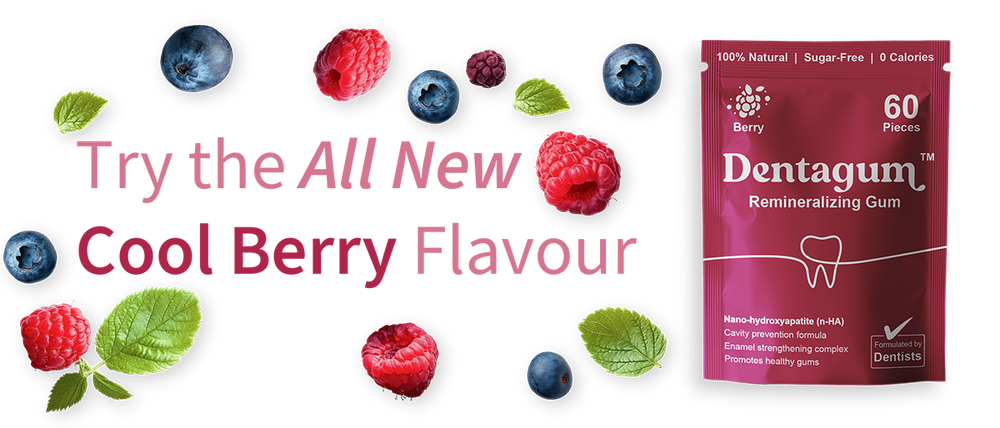
Dentagum Remineralizing Chewing Gum is built around this between-brushing use case, delivering nano-hydroxyapatite at 5% concentration (about 90mg per piece) alongside organic xylitol, in a natural chicle and mastic gum base. It works whether you are using fluoride toothpaste (where it complements), or whether you have gone fluoride-free (where it covers the post-meal mineral delivery that fluoride toothpaste would otherwise provide). The detailed evidence behind every Dentagum ingredient is covered in our article Dentagum ingredients: every one explained with the science.
Most "fluoride vs nano-HAp" discussions assume you are choosing a toothpaste. But for many people interested in nano-HAp, the most practical entry point is chewing gum after meals: a use case that operates in a different time window, at a different contact duration, and addresses a different oral-care gap than brushing. The comparison changes when you consider nano-HAp's role across the whole day rather than just during the two-minute brush window.
9. Frequently Asked Questions
Is nano-hydroxyapatite as effective as fluoride for preventing cavities?
For adults with low to moderate cavity risk, the clinical evidence now supports this. Three independent randomized controlled trials, including an 18-month double-blind RCT published in Frontiers in Public Health (2023), found fluoride-free nano-HAp non-inferior to standard 1,450 ppm fluoride toothpaste for cavity prevention. For high-risk patients (frequent cavities, active decay, very dry mouth), fluoride's longer evidence base and track record in diverse risk populations makes it the more established conservative choice. Discuss your specific cavity risk with your dentist. Figures from ingredient research.
What is the main difference between how fluoride and nano-hydroxyapatite work?
Fluoride converts the outer enamel surface into fluorapatite, a more acid-resistant mineral that dissolves only at pH 4.5 rather than the usual 5.5. It works at the surface. Nano-hydroxyapatite deposits the same mineral enamel is already made from, including into subsurface micropores and early lesions that surface chemistry cannot reach. Fluoride modifies enamel. Nano-HAp rebuilds it. Both achieve similar cavity-prevention outcomes in clinical trials for low-to-moderate risk adults, through these distinct pathways.
Is nano-hydroxyapatite safer than fluoride?
For swallowing risk specifically, yes. Nano-HAp is the same mineral that teeth and bones are made from, with no known toxicity and no fluorosis risk, even if swallowed. Fluoride requires careful dosing for young children to avoid dental fluorosis from repeated swallowing, and fluoride toothpaste in the US carries a poison-control warning. For adults who brush and spit correctly, both are safe for topical use. The safety difference is most practically relevant for children under 6 and for anyone who habitually swallows toothpaste.
Does nano-hydroxyapatite work better than fluoride for sensitive teeth?
The evidence suggests nano-HAp has a more direct and stronger sensitivity-reduction effect. Its mechanism is physical: nano-sized particles occlude the dentinal tubules (the channels that transmit pain signals when exposed). A systematic review and meta-analysis of 44 clinical trials (Limeback, Enax, and Meyer, Biomimetics 2023) found significant sensitivity reduction with nano-HAp, with the nano particle size identified as central to the effect. Fluoride's sensitivity benefit is more indirect, via surface hardening. For people with significant tooth sensitivity, nano-HAp is often the preferred choice. Figures from ingredient research.
Can I use fluoride toothpaste and nano-hydroxyapatite together?
Yes. They work through different mechanisms and do not interfere with each other. Some research has found synergistic effects in vitro. A practical approach is to use fluoride toothpaste for brushing (surface protection, institutional backing) and nano-HAp in a remineralizing gum or rinse after meals (subsurface mineral delivery in the post-meal window that brushing does not cover). The two products are not competing: they address different oral-care moments across the day.
Why do dentists still recommend fluoride if nano-hydroxyapatite is equivalent?
Several reasons. Fluoride has 75-plus years of population-level evidence and the active endorsement of the ADA, CDC, and WHO. Clinical guidelines in most dental schools and practices are built around this track record. Nano-HAp's non-inferiority has now been shown in three RCTs, but the broader clinical literature and institutional guidelines will take time to catch up. Individual dentists who follow the research closely are increasingly aware of nano-HAp's evidence base; the institutional catch-up is slower. This does not make either ingredient wrong: it reflects the normal pace of evidence translation into guidelines.

The Bottom Line
Fluoride has 75-plus years of population-level evidence and the backing of every major dental body. Nano-hydroxyapatite has been used in Japan for over 40 years, has been shown non-inferior to fluoride in three independent RCTs for low-to-moderate risk adults, has a direct mechanistic advantage for subsurface remineralization and sensitivity, and carries no swallowing risk. These are not competing products in the sense that one is right and one is wrong. They address different mechanisms, serve different contexts, and can complement each other well.
For healthy adults with routine cavity risk and good oral hygiene habits, the clinical evidence now supports either as a primary choice, with your personal preferences and circumstances guiding the decision. For children, the swallowing-safety advantage of nano-HAp is real and practically significant. For the post-meal windows that neither toothpaste formula reaches, a nano-HAp remineralizing gum addresses a gap that the toothpaste comparison entirely misses. Read the full evidence on our nano-HAp guide at everything you need to know about nano-hydroxyapatite, or see how the fluoride debate is currently unfolding in our article on what the 2026 changes actually mean for your teeth.
Shop Dentagum Remineralizing Gum — 30-Day GuaranteeResearch Summary
- Paszynska E, Enax J, Meyer F, Amaechi BT, Limeback H, et al. Frontiers in Public Health (2023). 18-month double-blind RCT (NCT04756557), 189 adults aged 18-45. Nano-HAp toothpaste non-inferior to 1,450 ppm fluoride toothpaste for DMFS index: 89.3% no increase (nano-HAp) vs 87.4% (fluoride). This is the third RCT to show non-inferiority. doi:10.3389/fpubh.2023.1199728. Figures from ingredient research.
- Schlagenhauf U et al. Journal of Clinical Medicine (2023, PMC10393266). 18-month RCT in adolescents/young adults in orthodontic treatment. Nano-HAp non-inferior to fluoride toothpaste for cavity prevention in this high-risk WSL population. Figures from ingredient research.
- Limeback H, Enax J, Meyer F. Biomimetics (2023). doi:10.3390/biomimetics8010023. Systematic review and meta-analysis of 44 clinical trials and 22 RCTs. Nano-HAp significantly reduces dentin hypersensitivity; nano particle size central to clinical effect. Figures from ingredient research.
- EU Scientific Committee on Consumer Safety. Nano-hydroxyapatite confirmed safe in oral care at concentrations up to 29.5%.
- CDC. Community water fluoridation estimated to reduce tooth decay by about 25% across children and adults. 75-plus years of population evidence. ADA, CDC, WHO all formally endorse fluoride as primary cavity prevention tool.
- Fluorapatite vs hydroxyapatite acid-resistance: fluorapatite critical pH approximately 4.5 vs hydroxyapatite 5.5. Source: Dentalcare.com CE Course (dental professional continuing education, updated 2023); Great Oral Health (2025).
- Mechanism: fluoride replaces hydroxyl groups in enamel crystal lattice during remineralization, forming fluorapatite. Nano-HAp adsorbs into enamel microporosities and subsurface lesions with direct mineral deposition. Source: multiple mechanism reviews cited above.
References
- Paszynska E, Pawinska M, Enax J, Meyer F, et al. Caries-preventing effect of a hydroxyapatite-toothpaste in adults: a 18-month double-blinded randomized clinical trial. Front Public Health. 2023;11:1199728. doi:10.3389/fpubh.2023.1199728
- Schlagenhauf U et al. Microcrystalline hydroxyapatite is not inferior to fluorides in clinical caries prevention: a randomized, double-blind, non-inferiority trial. J Clin Med. 2023. PMC10393266.
- Limeback H, Enax J, Meyer F. Clinical Evidence of Biomimetic Hydroxyapatite in Oral Care Products for Reducing Dentin Hypersensitivity: An Updated Systematic Review and Meta-Analysis. Biomimetics. 2023;8(1):23. doi:10.3390/biomimetics8010023
- Limeback H, Enax J, Meyer F. Biomimetic hydroxyapatite and caries prevention: a systematic review and meta-analysis. Can J Dent Hyg. 2021;55:148-159. PubMed 34925515.
- EU Scientific Committee on Consumer Safety. Opinion on Hydroxyapatite (nano) in cosmetic products. European Commission.
- American Dental Association. Fluoride: Topical and Systemic Supplements. ada.org/resources/ada-library/oral-health-topics/fluoride-topical-and-systemic-supplements
- Centers for Disease Control and Prevention. Community Water Fluoridation: Overview and evidence summary. cdc.gov
- Dentalcare.com. The Caries Process and Fluoride's Mechanism of Action. CE Course 670. Updated 2023.
- Enax J, Meyer F, Fabritius H-O, Amaechi BT. Modes of action and clinical efficacy of particulate hydroxyapatite in preventive oral health care. Open Dent J. 2019;13:274-287.
- Limeback H, Meyer F, Enax J. Tooth Whitening with Hydroxyapatite: A Systematic Review. Dent J. 2023;11(2):50. doi:10.3390/dj11020050
