
What Happens During Enamel Demineralization?
Every time you eat or drink, your enamel loses minerals. It's a normal process with a natural recovery cycle built in. Here's what actually happens during demineralization, how remineralization works, and what happens when the balance tips the wrong way.

Enamel demineralization sounds clinical and complicated. It isn't. It's something that happens in your mouth after every meal, every coffee, and every acidic drink you consume. Most of the time your body handles it automatically. The trouble starts when the process runs faster than your body can reverse it, and when that happens repeatedly over months and years, the damage becomes permanent.
Understanding what demineralization actually is, why it happens, and how remineralization counters it gives you a clearer picture of what your oral health routine is actually defending against, and why timing and ingredients matter as much as they do.
What Enamel Is and Why It Can't Repair Itself

Enamel is the outermost layer of your tooth, covering the crown above the gumline. It's the hardest substance in the human body, composed almost entirely of a mineral called hydroxyapatite arranged in tightly packed crystal rods. This crystalline structure gives enamel its strength and its ability to withstand years of grinding, biting, and acid exposure.
The catch is that enamel contains no living cells. Once it forms during tooth development, the cells responsible for producing it are gone. There are no enamel-forming cells left in an adult tooth to generate new enamel from scratch. This is why enamel damage is classified as permanent when it reaches a certain depth. You can't grow it back.
What you can do is support the natural mineral exchange process that replenishes lost minerals in early-stage damage before that threshold is crossed. That process is remineralization, and it's the biological mechanism that remineralizing products are designed to support.
What Demineralization Actually Is

Demineralization is the process by which mineral ions are removed from the hydroxyapatite crystals that make up your enamel. It's driven by acid, and acid is something your mouth produces or encounters constantly.
When bacteria in your dental plaque metabolize sugars and fermentable carbohydrates from food, they produce lactic acid, butyric acid, and acetic acid as byproducts. These acids accumulate in the plaque biofilm sitting against your tooth surfaces. Meanwhile, acidic foods and drinks introduce their own external acids directly to the enamel surface. Coffee, citrus fruit, soft drinks, wine, sparkling water, and even some fermented foods all contribute.
Both pathways lower your oral pH. And when pH drops below 5.5, a critical threshold first established by research in the 1940s and confirmed consistently ever since, the fluid environment surrounding your teeth becomes undersaturated with respect to tooth mineral. At that point, calcium and phosphate ions begin leaving the enamel crystal structure and dissolving into the surrounding fluid. The crystals don't shatter. They dissolve, gradually, from the surface inward.
A 2022 chapter published by IntechOpen on demineralization and remineralization dynamics confirmed that "demineralization is the process of removing mineral ions from hydroxyapatite crystals in hard tissues, such as enamel, which can lead to dental caries if left unchecked." The degree of demineralization depends on variables including available calcium and phosphate, salivary pH levels, and the duration of acid exposure.
How Fast Does It Happen?
Faster than most people expect. After sugar or carbohydrate exposure, plaque pH can drop below the critical threshold of 5.5 within 2 to 5 minutes. Depending on diet, salivary function, and bacterial composition, it can crash as low as pH 4.0 or below.
The duration of that acid challenge is where the real risk accumulates. A single Stephan Curve, the pattern of pH drop and recovery after eating, typically keeps enamel below the safe threshold for 20 to 40 minutes before saliva's natural buffering systems restore pH to a safe range. That's 20 to 40 minutes of active mineral loss after every meal, every snack, every acidic drink.
Frequency compounds the damage. If you eat breakfast, have a mid-morning coffee, snack at your desk, eat lunch, have an afternoon drink, and graze through the evening, your enamel may spend the majority of the day below or hovering near the critical pH. Each exposure adds to a cumulative mineral deficit that builds quietly over months and years.
Research published in the Erbil Dental Journal in 2022 confirmed significant correlations between pH levels in the range of 4.6 to 7.0 and measurable demineralization and remineralization of enamel, and noted that responses to pH fluctuations vary from person to person based on individual salivary function, bacterial composition, and diet.
The Stages of Demineralization: From Invisible to Irreversible
Demineralization doesn't announce itself immediately. It progresses through recognizable stages, and the earlier it's identified and addressed, the better the outcome.
Stage 1: Subsurface Mineral Loss
The earliest stage of demineralization happens beneath the enamel surface, in the subsurface layer. The outermost surface may still appear intact while mineral loss is occurring underneath. At this stage there are no visible symptoms. No sensitivity. No color change. No pain. The damage is real but invisible to the naked eye.
This is the stage where remineralization is most effective. Saliva, fluoride, and remineralizing ingredients like nano-hydroxyapatite can deliver minerals into the subsurface lesion and reverse the damage before it progresses. A 2022 systematic review published in PMC described this stage as the window when "early lesions can be covered and remineralized by the deposition of calcium phosphate."
Stage 2: White Spot Lesions
As subsurface mineral loss deepens and widens, the first visible sign appears: a white spot lesion. These are areas of enamel that appear chalky, opaque, or matte compared to the surrounding healthy tooth. They develop because the porous demineralized enamel scatters light differently than intact mineral structure, creating a visible color difference.
White spot lesions are significant because, according to a review published by IntechOpen, for demineralization to become visible it must have reached a minimum depth of 300 to 500 micrometres. By the time you can see it, "a considerable amount of damage to sound tooth structure has already begun."
The encouraging fact is that white spot lesions are still reversible at this stage. They represent demineralized but not yet cavitated enamel. With consistent remineralization support, the mineral content in the affected area can be partially or fully restored and the lesion can arrest or reverse. A 2023 study confirmed that "WSL is reversible in its early stages if remineralization mechanisms are initiated."
Stage 3: Cavitation
If demineralization continues unchecked past the white spot stage, the structural integrity of the enamel eventually fails. The porous subsurface lesion collapses, the surface breaks through, and a cavity forms. At this point the damage is no longer reversible through remineralization. The physical structure is gone. Dental intervention is required to stop further progression and restore the tooth.
This is the point that demineralization is trying to avoid reaching. The entire logic of remineralizing oral care is to keep the balance tipped toward mineral gain rather than mineral loss, so that early-stage damage never reaches the point where intervention is the only option.
What Remineralization Is and How It Works

Remineralization is the natural counterpart to demineralization. When oral pH rises back above 5.5 after an acid challenge, the environment surrounding your teeth shifts from undersaturated to supersaturated with respect to tooth mineral. Calcium and phosphate ions in saliva begin depositing onto the enamel surface, reintegrating into the crystal structure and repairing the microscopic gaps left by demineralization.
A 2024 paper from the University of Duisburg-Essen published in Dentistry Journal described the process: "The natural remineralization of enamel is of major importance for oral health. In principle, early erosions induced by acidic beverages and foods as well as initial caries lesions can be covered and remineralized by the deposition of calcium phosphate." The paper also noted that while remineralization appears conceptually simple, it's actually a highly complex process under real-world conditions, dependent on ion concentrations, salivary flow, pH, and the presence or absence of proteins and other salivary components.
The key word in all of this is early. Remineralization works on subsurface lesions and early white spot lesions. It doesn't rebuild cavitated enamel. The repair window is real but not unlimited.
Why the Balance Tips Toward Damage

For most people, the demineralization-remineralization cycle is roughly balanced most of the time. Saliva does a remarkable job of buffering acid, delivering minerals, and supporting natural repair. The problem is that several very common factors tip the balance toward net mineral loss.
Eating frequency. Three meals a day creates three Stephan Curves. Six snacks create six. Each one involves 20-40 minutes below the critical pH threshold. The more frequently you eat, the more cumulative time your enamel spends under acid attack.
Acidic drink habits. Sipping coffee, soft drinks, or juice over an extended period creates a near-continuous acid challenge rather than a single recoverable event. The enamel never gets a full recovery window between sips.
Reduced saliva production. More than 400 commonly prescribed medications list dry mouth as a side effect. Dehydration, stress, aging, and conditions like Sjögren's syndrome all reduce salivary flow. Less saliva means weaker buffering, slower acid clearance, and slower mineral delivery for remineralization.
Bacterial composition. People with higher populations of Streptococcus mutans and other acid-producing bacteria in their plaque produce more acid per sugar exposure and drive pH lower. This is why two people with identical diets can have very different cavity rates.
Mouth breathing. Particularly during sleep, mouth breathing dries the oral environment, reduces saliva's effectiveness, and extends the low-pH window after evening meals.
When these factors combine, the natural remineralization capacity of saliva is outpaced. That's when preventive habits and remineralizing products become genuinely important rather than optional.
How Remineralizing Products Support the Natural Cycle
Remineralizing products don't create a new biological process. They support and amplify an existing one.
Saliva delivers calcium and phosphate ions to enamel naturally. Nano-hydroxyapatite delivers the same mineral in concentrated nanoparticle form, small enough to penetrate the microporosities and subsurface lesions where early damage occurs. Where saliva's ion delivery is diffuse and continuous, nano-HAp delivers a targeted mineral payload during the specific window it's applied.
A 2023 systematic review and meta-analysis by Limeback, Enax, and Meyer published in Biomimetics analyzed 44 clinical trials and found hydroxyapatite significantly reduced dentin hypersensitivity by 39.5% compared to placebo. Studies measuring hydroxyapatite specifically in gum format found hypersensitivity reductions of 6% to 80% compared to placebo, depending on the individual and duration of use. An 18-month randomized controlled trial published in Frontiers in Public Health in 2023 found fluoride-free nano-HAp non-inferior to standard 1,450 ppm fluoride toothpaste for cavity prevention over the full study period.
The timing of remineralizing product use matters as much as the ingredient itself. The post-meal window, the 20-40 minutes when pH is recovering from an acid challenge, is when remineralization conditions are improving and mineral deposition is most likely to occur. Using a remineralizing gum immediately after eating delivers nano-HAp to enamel surfaces during exactly that window, when the biological conditions for repair are at their most favorable.
What Symptoms Tell You Demineralization Is Occurring
Most early demineralization produces no symptoms at all, which is why it so often goes unaddressed until it reaches a more advanced stage. But a few signs are worth paying attention to.
Increased sensitivity. As enamel thins through repeated demineralization cycles, the dentinal tubules beneath it become closer to the surface and eventually exposed. Sensitivity to cold, heat, or sweet foods is often the first noticeable symptom of meaningful enamel loss. It shouldn't be ignored or simply managed with desensitizing toothpaste without addressing the underlying cause.
Visible white spots. Chalky or opaque patches on the enamel surface, particularly on the front teeth or the smooth surfaces of molars, are white spot lesions. If you can see them, demineralization has been occurring for some time.
Transparency at the edges. The biting edges of front teeth become translucent or slightly see-through as enamel thins. This is a sign of gradual but significant mineral loss over time.
Increased roughness. Early enamel erosion can make tooth surfaces feel slightly rough or grainy rather than smooth. Saliva normally maintains a smooth surface through constant mineral exchange.
If you notice any of these signs, your dentist can assess the extent of the damage and recommend whether remineralization strategies are sufficient or whether restorative treatment is needed.
How Chewing Remineralizing Gum Fits Into This Picture
Brushing twice a day addresses plaque removal and delivers remineralizing ingredients during a two-minute window morning and evening. That leaves the rest of the day, including every post-meal acid challenge, without active support.
Chewing a remineralizing gum for 10-20 minutes after meals fills that gap in three ways simultaneously. The chewing action stimulates saliva production, increasing the natural buffering and mineral delivery that accelerates pH recovery. The xylitol in a well-formulated gum reduces the Streptococcus mutans population responsible for producing post-meal acid in the first place. And the nano-hydroxyapatite delivers enamel mineral directly to tooth surfaces during the chewing window, when pH is recovering and remineralization conditions are improving.
These three mechanisms don't compete. They work together toward the same outcome: tipping the daily demineralization-remineralization balance back toward net mineral gain.
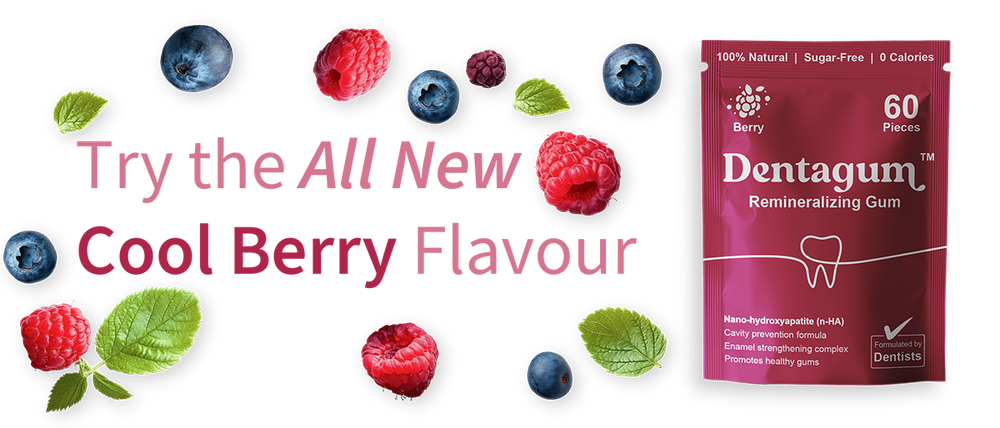
Dentagum's Remineralizing Chewing Gum combines nano-hydroxyapatite, organic xylitol, and organic erythritol with mastic gum, natural propolis, and organic eggshell powder in a chicle-based formula designed for exactly this window. In Dentagum's own clinical data, 83% of participants showed notable gains in enamel quality and mineral quantity, and 87% were less susceptible to cavities compared to non-users with consistent daily use. Try it risk-free with a 30-day guarantee at dentagum.co.
Frequently Asked Questions
What is enamel demineralization?
Enamel demineralization is the process by which mineral ions, primarily calcium and phosphate, are removed from the hydroxyapatite crystal structure of tooth enamel when oral pH drops below 5.5. It happens after every meal and acidic drink exposure as bacteria produce acid or dietary acids contact the enamel directly. In small, infrequent doses the body recovers naturally through saliva. When acid exposure is frequent or prolonged, cumulative mineral loss builds into enamel thinning, sensitivity, white spot lesions, and eventually cavities.
Can enamel demineralization be reversed?
Early-stage demineralization, including subsurface lesions and white spot lesions, can be reversed or arrested through remineralization when caught in time. Calcium and phosphate ions from saliva, fluoride, and remineralizing ingredients like nano-hydroxyapatite can reintegrate into early lesions and restore mineral density. Once enamel has physically broken down into a cavity, remineralization can no longer repair it. The repair window is real but not unlimited, which is why early intervention matters.
What causes enamel demineralization?
The primary driver is acid, from two sources. Bacteria in dental plaque metabolize sugars and produce lactic and other acids that lower oral pH. Acidic foods and drinks lower pH directly. When either source drops oral pH below the critical threshold of 5.5, mineral loss begins. Factors that accelerate demineralization include frequent eating and snacking, habitual acidic drink consumption, reduced saliva production (from medications, dehydration, or conditions like dry mouth), and high populations of acid-producing bacteria.
What are the signs of enamel demineralization?
Early demineralization produces no visible symptoms, which is why it often goes unnoticed until significant damage has occurred. The first visible sign is white spot lesions: chalky, opaque patches on the enamel surface that appear because porous demineralized enamel scatters light differently from healthy enamel. Other signs include increased tooth sensitivity to cold, heat, or sweet foods, transparency at the biting edges of front teeth, and a slightly rough or grainy tooth surface. A dentist can detect subsurface demineralization before it becomes visible using clinical examination tools.
How does remineralizing gum help with enamel demineralization?
Remineralizing gum supports enamel repair through three overlapping mechanisms. Chewing stimulates saliva flow, which buffers post-meal acid and accelerates pH recovery. Xylitol in the formula reduces the acid-producing bacteria responsible for ongoing pH suppression after meals. Nano-hydroxyapatite delivers enamel's own mineral in nanoparticle form to tooth surfaces during the chewing window, when pH is recovering and remineralization conditions are improving. The combination addresses both the acid challenge and the mineral repair in the same 10-20 minute post-meal window.
How long does it take for remineralization to repair early enamel damage?
Remineralization is a gradual, ongoing process rather than a single repair event. With consistent daily use of remineralizing products, improvement in enamel microhardness and mineral content is measurable within weeks in clinical studies. Visible white spot lesions may take months of consistent remineralization support to meaningfully improve. The key variables are the depth of the existing lesion, the consistency of remineralizing product use, and the reduction of ongoing acid exposure. Early intervention produces the best outcomes.
The Bottom Line
Enamel demineralization is not a sign that something has gone catastrophically wrong. It's a normal part of how your teeth interact with food, drink, and oral bacteria every day. The problem is when the natural recovery cycle can't keep pace with the frequency and intensity of acid exposure your enamel faces in modern life.
The good news is that early-stage demineralization is reversible. Subsurface lesions and white spot lesions can arrest and recover with consistent remineralizing support. The window for that recovery is real, but it requires action before damage reaches the cavitation stage where no amount of remineralization can help.
Supporting the natural mineral cycle is straightforward in practice: reduce the frequency of acid exposure where you can, support saliva's natural buffering role, and use remineralizing products during the post-meal window when your enamel is in recovery mode. That's what the right remineralizing gum is designed to do.
Dentagum's Remineralizing Chewing Gum is dentist-formulated with nano-hydroxyapatite, organic xylitol, and mastic gum, designed to be chewed for 10-20 minutes after meals. Try it risk-free with a 30-day guarantee at dentagum.co.
RESEARCH SUMMARY
- IntechOpen. "Demineralization and Remineralization Dynamics and Dental Caries." 2022. Dental caries results from repeated cycles of demineralization and remineralization at the biofilm-tooth interface. Demineralization is the removal of mineral ions from hydroxyapatite crystals. The degree depends on available calcium, phosphate, and salivary pH.
- Enax J et al. "The Remineralization of Enamel from Saliva: A Chemical Perspective." Dentistry Journal, 2024. University of Duisburg-Essen. Natural remineralization is of major importance for oral health. Calcium and phosphate ions in saliva form hydroxyapatite on enamel surface. The process is far more complex than simple crystallization under in vivo conditions.
- Dimensions of Dental Hygiene. "Managing Enamel Demineralization." 2022. Enamel begins to demineralize when oral pH drops below 5.5. Hydroxyapatite is prone to acid dissolution when pH falls below the critical threshold.
- IntechOpen. "White Spot Lesions and Remineralization." Subsurface demineralization manifests as white spot lesions. For demineralization to be visible it must have a minimum depth of 300-500 μm, implying considerable damage has already begun. WSLs are reversible in early stages if remineralization mechanisms are initiated.
- PMC. "Analysis of Dental Enamel Remineralization: A Systematic Review." 2023. Demineralization process begins with superficial decalcification, making enamel surface porous and giving it a chalky appearance. White spot lesions are the first clinical sign before caries evolves into cavitated lesions.
- StatPearls / NCBI. "Remineralization of Initial Carious Lesions." 2023. Dental caries is the most prevalent chronic disease worldwide. Disease progression or reversal depends on which factors prevail: pathological (fermentable carbohydrates, cariogenic bacteria, decreased salivary flow) vs protective (saliva, fluoride, remineralizing agents).
- Erbil Dental Journal. "Experimental Studies on pH Levels That Affect Demineralization and Remineralization." 2022. Significant correlations between pH levels 4.6 to 7.0 and demineralization/remineralization of enamel. Responses to pH fluctuations vary from person to person.
- Limeback H, Enax J, Meyer F. Biomimetics, 2023. 44 clinical trials. HAP significantly reduced dentin hypersensitivity by 39.5% vs placebo. HAP in gum reduced hypersensitivity by 6-80% vs placebo.
- Paszynska E et al. Frontiers in Public Health, 2023. Nano-HAp toothpaste non-inferior to 1,450 ppm fluoride for cavity prevention over 18 months.
References
- "Demineralization and Remineralization Dynamics and Dental Caries." IntechOpen, 2022. https://www.intechopen.com/chapters/82497
- Enax J et al. "The Remineralization of Enamel from Saliva: A Chemical Perspective." Dentistry Journal, 2024. https://www.ncbi.nlm.nih.gov/pmc/articles/PMC11592461/
- "Managing Enamel Demineralization." Dimensions of Dental Hygiene, 2022. https://dimensionsofdentalhygiene.com/article/managing-enamel-demineralization/
- "White Spot Lesions and Remineralization." IntechOpen. https://www.intechopen.com/chapters/79515
- "Analysis of Dental Enamel Remineralization: A Systematic Review of Technique Comparisons." PMC, 2023. https://pmc.ncbi.nlm.nih.gov/articles/PMC10135549/
- "Remineralization of Initial Carious Lesions." StatPearls / NCBI Bookshelf, 2023. https://www.ncbi.nlm.nih.gov/books/NBK573067/
- Muhammad SA, Ahmed BM. "Experimental Studies on the pH Levels That Affect Demineralization and Remineralization of Human Tooth Enamel." Erbil Dental Journal, 2022. https://edj.hmu.edu.krd/index.php/journal/article/view/160
- Limeback H, Enax J, Meyer F. "Clinical Evidence of Biomimetic Hydroxyapatite in Oral Care Products for Reducing Dentin Hypersensitivity: An Updated Systematic Review and Meta-Analysis." Biomimetics, 2023. https://pmc.ncbi.nlm.nih.gov/articles/PMC9844412/
- Paszynska E et al. "Caries-Preventing Effect of a Hydroxyapatite Toothpaste in Adults: An 18-Month Double-Blinded Randomized Clinical Trial." Frontiers in Public Health, 2023. https://www.frontiersin.org/journals/public-health/articles/10.3389/fpubh.2023.1199728/full
