
Everything You Need to Know About Nano-Hydroxyapatite
It started with NASA. It became the gold standard in Japan. Now it's showing up in toothpastes, gums, and rinses across the world. Here's everything you need to know about nano-hydroxyapatite, the ingredient that rebuilds your enamel using the same mineral your teeth are made of.

Nano-hydroxyapatite is one of those ingredients that sounds complicated but is built on a beautifully simple idea: your teeth are made of a specific mineral, so what if you used that exact mineral to repair them?
That idea was first explored by NASA scientists in the 1970s. It became the foundation of Japanese oral care for over four decades. And it's now at the centre of one of the most significant shifts in preventive dentistry in the world: the move toward biomimetic oral care, products that work with your tooth's own biology rather than coating it with something foreign.
This is the complete guide. By the end of it, you'll understand exactly what nano-hydroxyapatite is, how it works at the molecular level, what the clinical evidence says, how it compares to fluoride, who benefits most, and why the gum format is one of the most intelligent delivery methods available.
What Is Nano-Hydroxyapatite?
Hydroxyapatite is a naturally occurring calcium phosphate mineral. It's the primary structural component of your teeth and bones. Approximately 97% of your tooth enamel and around 70% of your dentin is composed of hydroxyapatite. Your body uses it constantly, throughout life, to maintain the mineral density of your teeth and skeleton.
Nano-hydroxyapatite is a synthetically produced form of this mineral, manufactured at the nanoscale. The "nano" designation refers to particle size: each particle measures between 20 and 100 nanometres in diameter. To put that in perspective, a human hair is approximately 80,000 to 100,000 nanometres wide. A nano-HAp particle is roughly 5,000 times smaller.
That scale is not incidental. It's the entire point.
Standard hydroxyapatite particles are 50 to 500 times larger than the nano form. They sit on top of the enamel surface when applied topically. Nano-sized particles are small enough to penetrate the microporosities and subsurface lesions in enamel, depositing mineral where early damage has already occurred rather than simply coating the surface above it. The particle size is what determines whether the ingredient can actually repair enamel or just polish it.
Where It Came From: NASA, Japan, and Four Decades of Evidence

The story of nano-hydroxyapatite in oral care starts with an unlikely source.
In the early 1970s, NASA scientist Bernard Rubin was working on ways to help astronauts maintain bone and tooth density during extended missions in microgravity environments. Weightlessness causes significant mineral loss from bones and teeth, and Rubin's research led to the development of a synthetic hydroxyapatite compound that could replace those lost minerals. The compound worked. NASA confirmed its effectiveness, and the technology was patented.
A few years later, a Japanese entrepreneur named Shuji Sakuma was reviewing a list of available NASA patents. The hydroxyapatite patent caught his attention. Sakuma purchased the rights through his company, Sangi Co. Ltd., and spent the next several years working with dental researchers to develop the world's first commercial enamel-restorative toothpaste. Sangi launched Apadent in Japan in 1980.
What followed was decades of clinical validation. In 1985, researchers at Tokyo Medical and Dental University conducted a one-year study of 1,026 children using nano medical hydroxyapatite. The results showed significantly lower incidence of new caries compared to control groups. A separate three-year study at Asahi University involving 181 children showed caries reduction of 36% to 56%. By 1993, Japan's Ministry of Health, Labour and Welfare officially recognized nano-hydroxyapatite as an anti-cavity agent, the same regulatory status fluoride holds. Sangi has since sold more than 160 million tubes of its hydroxyapatite toothpaste globally.
While the rest of the world spent those decades relying almost exclusively on fluoride, Japan built a forty-year evidence base for an alternative that rebuilds teeth rather than chemically modifying them. That evidence base is now driving the global adoption of nano-HAp that's happening today.
How Nano-Hydroxyapatite Works

The mechanism of nano-HAp is elegantly straightforward once you understand the mineral cycle your teeth are in every day.
Every time you eat or drink, bacteria in your dental plaque metabolize sugars and produce acid. That acid lowers your oral pH. When pH drops below 5.5, the environment surrounding your teeth becomes undersaturated with respect to tooth mineral, and hydroxyapatite crystals in your enamel begin releasing calcium and phosphate ions into the surrounding fluid. This is demineralization. It happens after every meal.
The natural recovery process, driven by saliva, works by delivering calcium and phosphate back to the enamel surface when pH rises again. Saliva is supersaturated with these ions, and when conditions are right, they reintegrate into the enamel crystal structure. This is remineralization, and under healthy conditions, the cycle is roughly balanced.
Nano-HAp accelerates and amplifies the remineralization side of that cycle through three distinct mechanisms.
Direct mineral deposition. Nano-HAp particles bond to demineralized enamel surfaces and physically deposit into the microporosities and early subsurface lesions where mineral loss has occurred. A 2022 scoping review published in the International Journal of Environmental Research and Public Health confirmed that nano-HAp "forms a protective layer on the external surface of dentin, resulting in the occlusion of dentin tubules by mineral hydroxyapatite, thus reducing dentinal permeability." Where saliva delivers ions in solution, nano-HAp delivers pre-formed mineral particles directly to damaged sites.
Crystal growth support. Once nano-HAp particles deposit on or near the enamel surface, they act as nucleation sites for further crystal growth. Calcium and phosphate from saliva can build onto the existing nano-HAp deposits, creating a compounding remineralization effect over time rather than a single replacement event.
Dentinal tubule occlusion. In teeth with sensitivity, exposed dentinal tubules are the structural cause of pain. These microscopic channels run from the dentin surface toward the tooth nerve, and fluid movement inside them in response to heat, cold, or pressure triggers the pain signal. Nano-HAp particles are precisely sized to physically enter and occlude these channels, forming hydroxyapatite plugs that block the fluid movement and reduce the sensitivity response at its source.
What the Clinical Evidence Shows
The evidence base for nano-hydroxyapatite has expanded substantially over the past five years and now spans hundreds of clinical studies across multiple countries, patient populations, and delivery formats.
For Cavity Prevention
A landmark 18-month double-blinded randomized clinical trial published in Frontiers in Public Health in 2023 compared a fluoride-free nano-HAp toothpaste directly against standard 1,450 ppm fluoride toothpaste for cavity prevention in adults. The study was designed as a non-inferiority trial, asking whether nano-HAp could match fluoride rather than just outperform a placebo. It could. Nano-HAp protected adults from new cavities at a comparable rate to fluoride over the full 18 months of the study.
A 2022 systematic review and meta-analysis from the University of Bern, published in Clinical Oral Investigations, reviewed 10 in vivo and in situ controlled clinical trials and supported nano-HAp's efficacy for reducing the initiation of early caries lesions and remineralizing existing ones.
A 2025 narrative review published in the Journal of Functional Biomaterials reviewed clinical trials from the past five years and concluded that HAp "seems to be a safe and effective alternative to fluoride, especially for children or individuals at risk of overexposure," with similar efficacy to fluoride in caries prevention and additional advantages in managing hypersensitivity and molar-incisor hypomineralization.
For Sensitivity Relief
The evidence for nano-HAp on dentin hypersensitivity is among the strongest in the entire clinical literature on the ingredient.
A 2023 systematic review and meta-analysis by Limeback, Enax, and Meyer published in Biomimetics analyzed 44 clinical trials on hydroxyapatite in oral care products and sensitivity outcomes. The findings were striking: hydroxyapatite significantly reduced dentin hypersensitivity by an average of 39.5% compared to placebo, and 23% compared to fluoride controls. Studies specifically evaluating hydroxyapatite in gum format found sensitivity reductions of 6% to 80% depending on individual baseline severity and duration of use.
Most desensitizing agents work by blocking the nerve signal from reaching the brain, using compounds like potassium nitrate. Nano-HAp works differently: it physically seals the dentinal tubules that trigger the pain response in the first place. The mechanism is structural rather than pharmaceutical, and the effect builds with continued use as more mineral deposits into the tubules over time.
For White Spot Lesions
White spot lesions are the first visible sign of enamel demineralization. They appear when subsurface mineral loss has reached sufficient depth, typically 300 to 500 micrometres, to change how the enamel scatters light, producing that chalky, opaque appearance. They're reversible at this stage if remineralization support is consistent.
Multiple clinical trials have evaluated nano-HAp specifically for white spot lesion reversal, including in orthodontic patients where white spots around brackets are a particularly common problem. Results consistently show meaningful improvement in lesion opacity and surface microhardness with sustained nano-HAp use. The ingredient delivers mineral into the subsurface lesion body, not just the outermost enamel layer, which is what distinguishes it from fluoride in this application: fluoride's effects are primarily limited to the outermost 50 micrometres of enamel.
Nano-Hydroxyapatite vs Fluoride: An Honest Comparison
This comparison deserves careful handling. Neither ingredient is categorically superior. They work through different mechanisms, suit different needs, and the evidence for each reflects decades of clinical research conducted under very different regulatory and cultural contexts.
Mechanism: Fluoride works by chemically reacting with calcium and phosphate at the enamel surface to form fluorapatite, a mineral that's more acid-resistant than natural hydroxyapatite. It modifies enamel's chemistry to make it harder to dissolve. Nano-HAp replenishes the same mineral enamel is already made of, physically depositing into lesions and weak spots. It doesn't change the chemistry of your enamel. It restores its structure.
Cavity prevention: Head-to-head, the evidence now consistently shows comparable outcomes for cavity prevention between nano-HAp and fluoride at recommended concentrations. The 2023 18-month RCT showed non-inferiority. Multiple systematic reviews support this conclusion.
Sensitivity: Nano-HAp outperforms fluoride for sensitivity relief in most clinical comparisons. The 2023 meta-analysis found a 23% greater reduction in hypersensitivity with hydroxyapatite compared to fluoride controls across 44 trials.
Safety for children: Fluoride toothpaste requires age-specific dosing and supervision because swallowing too much carries real risk. The FDA requires a poison control warning on all fluoride toothpaste sold in the US. Nano-HAp is non-toxic when swallowed in small amounts. A 2024 systematic review described it as "an ideal substitute for fluoride in toothpaste for young children" specifically because of this ingestion safety profile.
Regulatory status: In Japan, nano-HAp has been an officially recognized anti-cavity agent since 1993, the same regulatory standing as fluoride. The EU Scientific Committee on Consumer Safety confirmed nano-HAp safe in oral care products in 2023. In the US, the FDA has not yet approved nano-HAp as an anti-cavity agent, because its OTC monograph for cavity prevention recognizes only fluoride. The FDA did recently approve an anti-sensitivity product based on hydroxyapatite, representing the first US regulatory recognition of the ingredient. The clinical case is strong and growing. The US regulatory process hasn't caught up yet.
Fluoride hesitancy: For people who want to reduce fluoride exposure, whether because of personal preference, concern about fluorosis risk in children, or broader ingredient consciousness, nano-HAp provides a clinically supported alternative rather than simply an unproven natural swap.
The honest summary: for most adults with average cavity risk, both are effective. Nano-HAp offers advantages for sensitivity, for young children, and for anyone who prefers a fluoride-free approach. Fluoride remains the stronger evidence-backed choice for high-risk individuals based on its longer regulatory track record.
Who Benefits Most from Nano-Hydroxyapatite

People with Tooth Sensitivity
This is where nano-HAp's evidence is most consistent and most clinically meaningful. If sensitivity to cold, heat, or sweet foods is affecting your quality of life, nano-HAp's tubule-sealing mechanism addresses the structural cause rather than just managing the nerve signal. Most people with moderate sensitivity notice improvement within two to four weeks of consistent daily use.
Children and Families
The ingestion safety profile makes nano-HAp particularly well-suited to households with young children who can't reliably spit. There's no concern about fluorosis, no poison control warning, and no age-specific dosing anxiety. For parents who want effective cavity prevention without the ingestion risk of fluoride, nano-HAp is the most clinically credible alternative available.
People Avoiding Fluoride
For anyone who has already moved toward fluoride-free oral care in their toothpaste or mouthwash, nano-HAp provides the remineralizing backbone that makes fluoride-free routines clinically viable rather than just clean-label marketing.
Orthodontic Patients
White spot lesions around orthodontic brackets are one of the most common and frustrating outcomes of fixed orthodontic treatment. Plaque accumulates around brackets, acid exposure is prolonged, and enamel demineralization occurs in a pattern that's directly visible once the braces come off. Nano-HAp used consistently throughout treatment has shown meaningful protective effects for this application in multiple clinical studies.
People with Dry Mouth
Saliva is the primary natural remineralizing agent for your teeth. When saliva production is reduced due to medications, systemic conditions, or aging, the natural remineralization cycle is impaired. Nano-HAp delivers calcium and phosphate directly to enamel without relying on adequate salivary flow, making it a particularly useful ingredient for this population.
Anyone Building a Preventive Oral Care Routine
Even without sensitivity or specific risk factors, nano-HAp supports the long-term mineral balance of your enamel. Used consistently after meals, in a gum format that maximizes contact time, it contributes daily to the remineralization side of the mineral cycle that modern diets consistently challenge.
Why the Gum Format Is One of the Best Delivery Methods

Nano-HAp has been studied and used most extensively in toothpaste. But the gum format has a structural advantage that toothpaste can't match: contact time.
Toothpaste stays in your mouth for two minutes, twice a day. A well-formulated gum chewed for 10 to 20 minutes after meals gives nano-HAp particles sustained access to tooth surfaces at the moment when they're most needed: the post-meal window when oral pH is recovering from an acid challenge and enamel is in the early stages of remineralization.
The chewing action compounds this benefit. Chewing stimulates saliva production to 10 to 12 times the resting flow rate, according to the ADA. That saliva increases the bicarbonate buffering that neutralizes post-meal acid, accelerating the pH recovery that makes remineralization possible. It also delivers more calcium and phosphate to work alongside the nano-HAp particles being released from the gum.
The post-meal timing is particularly important for a second reason. Research shows that nano-HAp's remineralizing effect increases significantly when pH is below neutral, meaning the active acid recovery period after eating is precisely when the ingredient performs best. A gum chewed during exactly that window is delivering nano-HAp when the biological conditions for enamel repair are most favorable.
A 2023 systematic review found hydroxyapatite in gum format specifically reduced dentin hypersensitivity by 6% to 80% compared to placebo, confirming that the delivery mechanism is clinically effective and not simply theoretical.
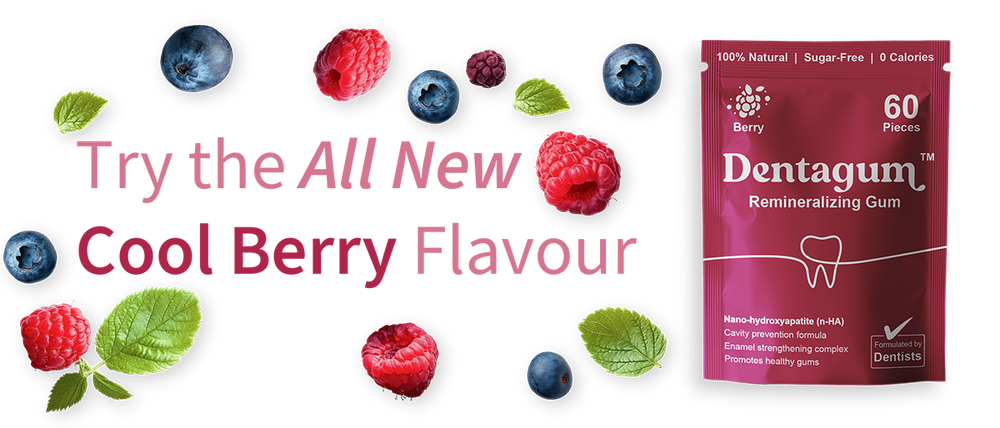
Dentagum's Remineralizing Chewing Gum delivers nano-hydroxyapatite alongside organic xylitol, organic mastic gum, natural propolis, and organic eggshell powder in an organic chicle base. Chewed for 10 to 20 minutes after meals, every ingredient in the formula works during the specific window that nano-HAp's clinical evidence points toward. In Dentagum's own clinical data, 83% of participants showed notable gains in enamel quality and mineral quantity, and 91% reported significant reduction in cold sensitivity with consistent daily use. Try it risk-free with a 30-day guarantee at dentagum.co.
Safety: What the Evidence Says
Nano-hydroxyapatite has a strong safety record across four decades of commercial use and hundreds of clinical studies.
It is biocompatible by nature, because it's the same mineral your teeth and bones are made of. Your body recognizes it and doesn't treat it as a foreign substance. It's non-toxic when swallowed in small amounts. A 2023 analysis of 15 clinical trials on nano-HAp reported zero adverse effects across all studies.
The European Commission's Scientific Committee on Consumer Safety confirmed in 2023 that nano-hydroxyapatite is safe in oral care products at concentrations up to 10% in toothpaste and 0.465% in mouthwash. The FDA has not yet established concentration guidelines specific to nano-HAp in oral care beyond its recent anti-sensitivity product approval, though it's used in commercially available products as a generally recognized safe ingredient.
One nuance worth acknowledging honestly: there are ongoing scientific discussions about the distinction between nano-sized and micro-sized hydroxyapatite particles, and whether nanoparticle-specific concerns about absorption or long-term accumulation warrant further study. The current clinical evidence, spanning 40 years of human use in Japan and extensive European regulatory review, does not support concern at normal oral care exposure levels. The European SCCS review in 2023 specifically evaluated the nanoparticle nature of the ingredient and confirmed safety within its recommended concentrations. That's the appropriate standard for a well-researched ingredient with a lengthy human use history.
How to Use Nano-Hydroxyapatite Effectively
Nano-HAp's effectiveness depends on three things: the right product, the right timing, and the right duration.
Product: Ensure the product lists nano-hydroxyapatite explicitly, not just "hydroxyapatite." Standard particle-size hydroxyapatite is too large to penetrate enamel microporosities and produce the remineralizing effect the clinical evidence documents. The nano designation is what matters.
Timing for gum: Immediately after meals and drinks, before oral pH has fully recovered. This places nano-HAp in contact with enamel during the post-meal acid window when remineralization conditions are improving and the ingredient performs most effectively.
Duration for gum: Ten to twenty minutes. That's the window the clinical evidence on both saliva stimulation and nano-HAp contact time is built around. Shorter chewing sessions deliver a fraction of the potential benefit.
Timing for toothpaste: Twice daily brushing, at the standard two-minute duration. The toothpaste and gum formats complement rather than compete: toothpaste covers the morning and evening routine, gum covers the post-meal windows in between.
Consistency: Nano-HAp works cumulatively. The mineral deposits build over time with repeated exposures. Daily consistent use over weeks and months produces the improvements in enamel microhardness and sensitivity reduction that clinical studies measure. Occasional use doesn't replicate those outcomes.
Frequently Asked Questions
What is nano-hydroxyapatite made of?
Nano-hydroxyapatite is a synthetically produced form of calcium phosphate, the same mineral that makes up approximately 97% of your tooth enamel and 70% of your bone. It's manufactured at the nanoscale, with particles measuring 20 to 100 nanometres, which allows it to penetrate the microporosities in enamel rather than simply coating the surface. It's biocompatible, non-toxic, and chemically identical to the mineral your teeth are already made of.
Is nano-hydroxyapatite better than fluoride?
Neither is categorically better. They work through different mechanisms. Fluoride chemically modifies enamel's surface to form a more acid-resistant mineral. Nano-HAp replenishes the same mineral enamel is already made of, depositing into lesions and weak spots. For cavity prevention, clinical evidence shows comparable outcomes between the two. For sensitivity relief, nano-HAp consistently outperforms fluoride. For young children and anyone with ingestion concerns, nano-HAp's non-toxic profile is a meaningful advantage. For high-risk individuals, fluoride's longer regulatory track record may make it the stronger clinical choice.
Is nano-hydroxyapatite safe?
Yes, with a strong evidence base. It's been commercially used in Japan since 1980, confirmed safe by the European Commission's Scientific Committee on Consumer Safety in 2023, and has reported zero adverse effects across 15 clinical trials reviewed in a 2023 systematic analysis. It's non-toxic when swallowed in small amounts, making it suitable for children and anyone who prefers products without ingestion risk. The FDA has not yet established concentration guidelines for nano-HAp in oral care products, though it recently approved an anti-sensitivity product based on the ingredient.
How long does nano-hydroxyapatite take to work?
For sensitivity, most people notice improvement within two to four weeks of consistent daily use as the dentinal tubule occlusion builds up. For remineralization of early enamel lesions and white spot improvement, clinical studies typically measure meaningful results over three to six months. The effects are cumulative: daily consistent use builds on itself, while occasional use doesn't replicate the outcomes that clinical studies document.
Why is nano-hydroxyapatite in chewing gum?
The gum format provides sustained contact time with tooth surfaces: 10 to 20 minutes compared to the two minutes of toothpaste. This gives nano-HAp particles significantly more opportunity to deposit on enamel and into early lesions. Chewing also stimulates saliva production, which buffers post-meal acid and creates better remineralization conditions. Using nano-HAp gum immediately after meals places the ingredient in contact with enamel during the post-meal acid recovery window, when research shows the remineralizing effect is most active.
Does the particle size of hydroxyapatite matter?
Yes, significantly. Standard hydroxyapatite particles are 50 to 500 times larger than nano-sized particles and cannot penetrate enamel microporosities or subsurface lesions. They sit on the surface rather than entering the areas where early mineral loss occurs. Nano-hydroxyapatite's clinical evidence is specific to particles in the 20 to 100 nanometre range. When evaluating products, look for "nano-hydroxyapatite" listed explicitly rather than simply "hydroxyapatite."
The Bottom Line
Nano-hydroxyapatite is not a trend ingredient. It's a fifty-year-old technology with a forty-year commercial track record in Japan, a growing body of rigorous clinical evidence, regulatory recognition across multiple continents, and a mechanism of action built on the simplest possible logic: your teeth are made of this mineral, so using it to repair them is the most biomimetically intelligent approach available.
The evidence supports it for cavity prevention at rates comparable to fluoride, for sensitivity reduction that outperforms fluoride in most clinical comparisons, for white spot lesion reversal, and for orthodontic enamel protection. The safety profile is clean across decades of human use. The gum format delivers it at the moment and with the contact time that makes it most effective.
If you're building a preventive oral care routine that goes beyond twice-daily brushing, nano-hydroxyapatite gum used consistently after meals is one of the most evidence-aligned additions you can make.
Dentagum's Remineralizing Chewing Gum is dentist-formulated with nano-hydroxyapatite, organic xylitol, and mastic gum. Try it risk-free with a 30-day guarantee at dentagum.co.
References
- Naim J, Sen S. "The Remineralizing and Desensitizing Potential of Hydroxyapatite in Dentistry: A Narrative Review of Recent Clinical Evidence." Journal of Functional Biomaterials (MDPI), 2025. https://pmc.ncbi.nlm.nih.gov/articles/PMC12470856/
- NASA Spinoff. "Semiconductor Research Leads to Revolution in Dental Care." January 2024. https://spinoff.nasa.gov/Semiconductor_Research_Leads_to_a_Revolution_in_Dental_Care
- Registered Dental Hygienists. "Nano-Hydroxyapatite in Dental Products: Better Than Fluoride?" https://www.rdhmag.com/patient-care/article/14276225/nano-hydroxyapatite-in-dental-products-better-than-fluoride
- European Commission Scientific Committee on Consumer Safety. "Hydroxyapatite (Nano) Final Opinion." 2023.
- Limeback H, Enax J, Meyer F. "Clinical Evidence of Biomimetic Hydroxyapatite in Oral Care Products for Reducing Dentin Hypersensitivity: An Updated Systematic Review and Meta-Analysis." Biomimetics, 2023. https://pmc.ncbi.nlm.nih.gov/articles/PMC9844412/
- Paszynska E et al. "Caries-Preventing Effect of a Hydroxyapatite Toothpaste in Adults: An 18-Month Double-Blinded Randomized Clinical Trial." Frontiers in Public Health, 2023. https://www.frontiersin.org/journals/public-health/articles/10.3389/fpubh.2023.1199728/full
- Anil A et al. "Nano-Hydroxyapatite (nHAp) in the Remineralization of Early Dental Caries: A Scoping Review." International Journal of Environmental Research and Public Health, 2022. https://pmc.ncbi.nlm.nih.gov/articles/PMC9102186/
- Oral Science / Sangi Co. Ltd. Historical data on nano medical hydroxyapatite clinical studies, 1985 Tokyo Medical and Dental University and Asahi University studies. https://www.oralscience.com/en/ingredients/mhap/
- Carifree. "Nano-Hydroxyapatite Toothpaste: Evidence-Based Guide." 2026. https://carifree.com/blog/nano-hydroxyapatite/
