
Is Nano-Hydroxyapatite Safe? What Research Shows
Is nano-hydroxyapatite actually safe, or is that just marketing reassurance? Here's what the EU's own toxicology review found, including the one nuance most articles skip.

Yes, nano-hydroxyapatite is considered safe for oral care use by the leading regulatory review on the subject. The EU's Scientific Committee on Consumer Safety concluded in its March 2023 final opinion that rod-shaped nano-hydroxyapatite is safe at concentrations up to 10% in toothpaste, based on an extensive toxicology review. Japan's government reached a similar conclusion decades earlier, officially recognizing it as an anti-cavity agent in 1993. If swallowed, the particles dissolve harmlessly in stomach acid into calcium and phosphate, the same minerals your body processes every day. The one real caveat: the safety finding applies specifically to rod-shaped particles, not needle-shaped ones, a distinction worth understanding rather than skipping past.
Search "is nano-hydroxyapatite safe" and you will find two very different kinds of answers. One camp treats it as an obvious yes with a bit of marketing polish. The other treats the word "nano" as inherently alarming, sometimes citing a supposed European ban that does not actually exist in the form people describe. Neither extreme is particularly useful if you actually want to know what is going on.
So this guide sticks to what the research and the regulators have actually said, in the order they said it, including the one nuance that gets left out of almost every reassuring answer online. If you are also weighing where hydroxyapatite fits into a broader daily routine, our guide on what the ADA actually says about chewing gum covers the complementary saliva-based side of oral care.
What the safety question is actually about
Hydroxyapatite itself is not a novel or exotic substance. It is the mineral that already makes up roughly 97% of your tooth enamel and a large share of your bone structure. Nobody worries about hydroxyapatite existing in your body, because it already does. The actual safety question is narrower and more specific: is it safe to manufacture that same mineral at a nanoscale particle size, 20 to 100 nanometres, and put it in a product you use in your mouth every day?
That is a legitimate question to ask, because nanomaterials in general do get evaluated differently than their full-size counterparts. Particle size can change how a material interacts with cells and tissue. The good news is that this exact question has already been asked, formally, by a government regulatory body, and answered with real toxicology data behind it.
A calm, sourced answer to a safety question is more convincing than an enthusiastic one. This is a place where showing the actual regulatory findings, caveats included, matters more than a confident headline.
What EU regulators found, in detail
The European Commission's Scientific Committee on Consumer Safety, known as the SCCS, is the body that formally evaluates cosmetic ingredient safety for the EU. Hydroxyapatite nanoparticles came under its review starting in 2015, and the process took years, multiple rounds of data requests, and two prior opinions before reaching a conclusion. That is not unusual for the SCCS, and it does not indicate the ingredient is especially dangerous. It reflects how thoroughly nanomaterial safety reviews are conducted in the EU regulatory system generally.
On March 23, 2023, the SCCS published its final opinion. Based on the toxicology data submitted, including genotoxicity studies specifically added to address earlier data gaps, the committee concluded that hydroxyapatite (nano) is safe when used at concentrations up to 10% in toothpaste and up to 0.465% in mouthwash.
Most commercial nano-hydroxyapatite toothpastes on the market use concentrations at or below 10%, meaning they fall comfortably within the range the SCCS reviewed and approved. Note that the SCCS was later asked to evaluate a higher 29.5% concentration proposed by industry, a separate and ongoing question that is distinct from the 10% figure already confirmed safe.
The one caveat: shape, not just size

Here is the detail that most reassuring articles skip entirely, and it is worth understanding rather than glossing over. The SCCS's safety conclusion is not a blanket approval of all nano-hydroxyapatite. It applies specifically to particles with a defined shape profile: rod-shaped particles, where at least 95.8% (by particle count) have an aspect ratio under 3, and the remainder do not exceed an aspect ratio of 4.9. The particles also need to be uncoated and not surface-modified.
Separately, the SCCS reviewed needle-shaped nano-hydroxyapatite and reached a different conclusion: it flagged needle-shaped particles as a potential concern due to their toxic effects and stated they should not be used in cosmetic products. This is almost certainly the source of the "Europe banned hydroxyapatite" headlines that circulate online, and it is a partial, misleading version of the actual finding. Europe did not ban hydroxyapatite. It restricted one specific particle shape while explicitly approving another at a defined concentration.
Rod-shaped nano-hydroxyapatite, the form used in most toothpaste, is approved up to 10%. Needle-shaped nano-hydroxyapatite is flagged as a safety concern and should not appear in cosmetic products. These are two different materials with two different conclusions, not one blanket verdict.
For a consumer, the practical takeaway is straightforward even if the underlying science is technical: reputable oral care brands using nano-hydroxyapatite are working with the rod-shaped form the SCCS evaluated and approved. The distinction matters for regulators and manufacturers far more than it changes anything about how you use the product day to day. If you want to see how this criterion fits into a broader checklist for evaluating any remineralizing gum brand, our guide to what to look for in a remineralizing gum brand covers the full picture.
Is it safe to swallow?

This is the question that comes up constantly, especially from parents, and the research here is genuinely reassuring rather than merely marketed as such. A review published in Frontiers in Dental Medicine examining hydroxyapatite as a remineralization agent for children found that oral administration of hydroxyapatite is safe when swallowed, because the particles dissolve in stomach acid into calcium and phosphate ions, the same minerals your body already processes from food every day.
That gastric dissolution is the key mechanism, and it is the reason hydroxyapatite does not carry anything resembling fluoride's dose-dependent toxicity profile. Fluoride requires careful dosing in young children specifically because there is a real toxicity threshold: swallow too much over time during tooth development and you risk dental fluorosis, the permanent white-spotting condition the ADA's age-specific dosage guidance exists to prevent. Hydroxyapatite has no equivalent established toxicity threshold at the concentrations used in oral care products.
Children under six are estimated to swallow a substantial portion of the toothpaste they use, simply because their swallowing reflex is still developing. Products where accidental swallowing carries no established toxicity threshold remove a genuine source of parental worry.
One point of scientific nuance worth including for completeness: some laboratory cell studies have observed that hydroxyapatite exposure can raise calcium levels within cells, and that excessive calcium in the body, hypercalcemia, is a real condition with its own risks. This finding comes from controlled laboratory conditions rather than real-world toothpaste use, and no published clinical research has linked normal toothpaste-level hydroxyapatite use to hypercalcemia or any other systemic effect. It is included here because a genuinely balanced answer surfaces the caveats that exist in the literature, not just the ones that are convenient.
Japan's decades-long track record

Regulatory conclusions carry more weight when there is a long track record behind them, and hydroxyapatite has one of the longer ones in oral care. Japan's Sangi Company launched the first commercial hydroxyapatite toothpaste in 1980, using rights originally developed from NASA research into synthetic hydroxyapatite for astronaut bone and tooth mineral loss. It took over a decade of continued use and data collection before Japan's government took the next regulatory step.
In 1993, Japan's Ministry of Health, Labour and Welfare formally recognized hydroxyapatite as an anti-cavity agent under the country's quasi-drug system, a designation reserved for ingredients proven to provide a genuine medicinal effect at specified concentrations. That recognition followed over a decade of real-world use and data, not a rushed approval. Hydroxyapatite oral care products have remained on the Japanese market continuously since, without a subsequent safety reversal.
Where things stand in the US
In the interest of a complete and honest picture, it is worth stating plainly where US regulation currently sits, because it differs from both the EU and Japan. The FDA has not approved any hydroxyapatite toothpaste as a drug in the United States, and hydroxyapatite toothpaste does not currently carry the ADA Seal of Acceptance. This does not reflect a safety finding against the ingredient. Toothpaste with active therapeutic claims is regulated in the US in a way that requires a specific approval pathway, and no hydroxyapatite product has yet gone through that particular process here, unlike the fluoride formulas that have held that pathway for decades.
In practice, that means hydroxyapatite oral care products sold in the US are marketed as cosmetic products rather than drugs, which is a regulatory classification distinction, not a statement about the underlying safety evidence, which comes primarily from the EU review and the broader peer-reviewed literature already covered above.
How it compares to fluoride on safety
Since the two ingredients are constantly compared, here is the safety picture side by side.
| Factor | Nano-hydroxyapatite | Fluoride |
|---|---|---|
| Established toxicity threshold | None identified at oral care concentrations | Yes, dose-dependent (fluorosis risk) |
| Outcome if swallowed | Dissolves into calcium and phosphate | Absorbed systemically, requires dosing limits |
| Age-specific dosing required | No | Yes, ADA guidance by age |
| Major regulatory review | EU SCCS, final opinion 2023 | Decades of established regulatory history |
| US regulatory status | Cosmetic classification, no FDA drug approval yet | FDA-approved as an anti-cavity drug ingredient |
Neither ingredient is unsafe when used as directed. The practical difference is that fluoride's long-established efficacy comes with a genuine dosing consideration for young children, while nano-hydroxyapatite removes that specific concern at the cost of a shorter formal approval history in some regions, including the US.
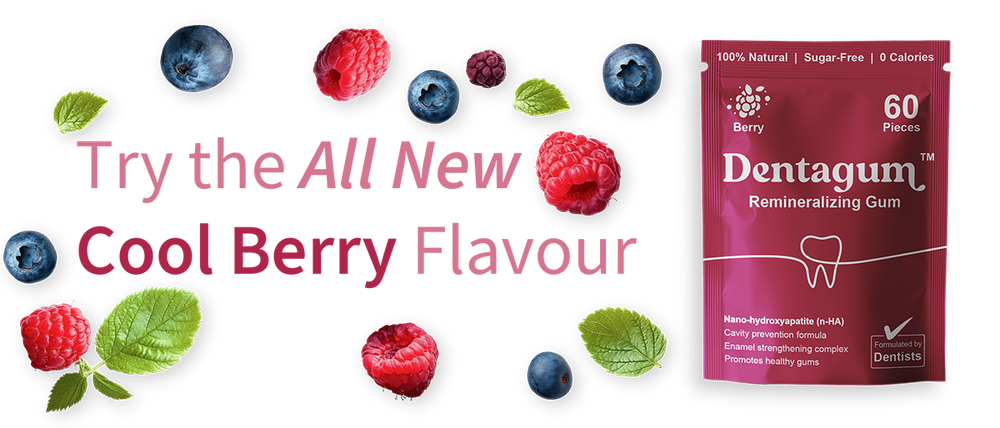
The same safety profile that makes nano-hydroxyapatite toothpaste a reasonable choice twice daily is why it also works well in a remineralizing gum for the hours in between. Dentagum's Remineralizing Chewing Gum uses nano-hydroxyapatite alongside organic xylitol, delivering the same non-toxic-if-swallowed mineral during the after-meal window when brushing isn't an option.

Frequently asked questions
No. The EU's SCCS approved rod-shaped nano-hydroxyapatite for use up to 10% in toothpaste in its March 2023 final opinion. It separately flagged needle-shaped nano-hydroxyapatite as a concern and said that specific shape should not be used in cosmetic products. Most commercial toothpastes use the approved rod-shaped form.
Yes. Research shows the particles dissolve in stomach acid into calcium and phosphate, the same minerals the body processes from food. Unlike fluoride, there is no established toxicity threshold for swallowed hydroxyapatite at oral care concentrations, which is one reason it is often recommended for young children still learning not to swallow toothpaste.
No hydroxyapatite product has yet gone through the FDA's specific approval pathway for anti-cavity drug ingredients in the US, unlike fluoride, which has held that status for decades. This is a regulatory classification question rather than a reflection of a safety finding against the ingredient, and hydroxyapatite products are sold in the US as cosmetics.
They are structurally different particle geometries with different safety findings. Rod-shaped particles, defined by a specific aspect ratio, were found safe by the EU SCCS up to 10% in toothpaste. Needle-shaped particles were flagged as a potential toxicity concern and are not approved for cosmetic use. Reputable oral care brands use the approved rod-shaped form.
Since 1980, when Japan's Sangi Company launched the first commercial hydroxyapatite toothpaste. Japan's government formally recognized it as an anti-cavity agent in 1993, and it has remained continuously available on the Japanese market since, without a subsequent safety reversal.
The Bottom Line
Nano-hydroxyapatite has a genuine safety record behind it, not just marketing reassurance. The EU's SCCS approved rod-shaped particles up to 10% in toothpaste after a multi-year toxicology review, Japan has recognized it as an anti-cavity agent since 1993, and swallowed particles dissolve harmlessly into calcium and phosphate. The one nuance worth knowing is that the approval is shape-specific, not universal, and that reputable brands use the approved rod-shaped form.
The safety case holds up, caveats included.
Try Dentagum risk-free, 30-day guarantee at dentagum.coResearch Summary
- SCCS/1648/22 Final Opinion. European Commission Scientific Committee on Consumer Safety, March 23, 2023. Rod-shaped nano-hydroxyapatite safe up to 10% in toothpaste, 0.465% in mouthwash; needle-shaped particles flagged as a concern.
- Frontiers in Dental Medicine (2022). Hydroxyapatite as remineralization agent for children's dental care. Oral administration safe when swallowed; particles dissolve in gastric acid to calcium and phosphate.
- Japan Ministry of Health, Labour and Welfare, 1993 quasi-drug approval of hydroxyapatite as an anti-cavity agent, following commercial use since 1980 (Sangi Co. Ltd).
- Paszynska E, et al. 18-month RCT, Frontiers in Public Health, 2023. Confirmed favorable tolerability alongside cavity-prevention non-inferiority to fluoride.
References
- Scientific Committee on Consumer Safety. "SCCS/1648/22 Final Opinion on Hydroxyapatite (nano)." European Commission, March 23, 2023. https://health.ec.europa.eu/system/files/2023-03/sccs_o_269.pdf
- "Hydroxyapatite as Remineralization Agent for Children's Dental Care." Frontiers in Dental Medicine, 2022. https://www.frontiersin.org/journals/dental-medicine/articles/10.3389/fdmed.2022.859560/full
- NASA Spinoff. "Semiconductor Research Leads to a Revolution in Dental Care." https://spinoff.nasa.gov/Semiconductor_Research_Leads_to_a_Revolution_in_Dental_Care
- Paszynska E, et al. "Caries-preventing effect of a hydroxyapatite-toothpaste in adults: a 18-month double-blinded randomized clinical trial." Frontiers in Public Health, 2023.
- Opinion of the SCCS, revision on hydroxyapatite (nano) in cosmetic products. PubMed, 2018 (background on needle-shaped particle concerns). https://pubmed.ncbi.nlm.nih.gov/30125613/
