
Hydroxyapatite Toothpaste vs Gum: Do You Need Both?
Your toothpaste has nano-hydroxyapatite, so is remineralizing gum redundant? Not quite. They cover different hours and different mechanisms. Here's who needs both.

You do not have to choose between hydroxyapatite toothpaste and remineralizing gum, because they solve different problems at different times. Toothpaste delivers nano-hydroxyapatite during your two daily brushing sessions. Gum covers the hours in between, especially the 30 to 40 minute acid window after meals when you usually cannot brush. An 18-month randomized trial in Frontiers in Public Health (2023) found hydroxyapatite toothpaste non-inferior to 1,450 ppm fluoride toothpaste for cavity prevention in adults, and the ADA endorses sugar-free gum after meals for exactly the window brushing misses. Used together, they cover the full day rather than competing.
If you have started paying attention to what is actually in your oral care products, you have probably landed on nano-hydroxyapatite. It is the ingredient behind the fastest-growing toothpastes in the category, and it is showing up in a newer format too: functional chewing gum. Which raises a fair question. If your toothpaste already contains nano-hydroxyapatite, is remineralizing gum redundant? Or does the gum do something the paste cannot?
The short version is that they are not competitors. They are two delivery systems for overlapping goals, and the reason to use both comes down to one thing most people never think about: timing. This guide breaks down what each one actually does, where the paste falls short, where the gum falls short, and how to decide whether you need one or both.
The same ingredient, two very different jobs
Nano-hydroxyapatite is the same material whether it is in a paste or a piece of gum. Hydroxyapatite is the mineral your enamel is mostly made of, roughly 97% of it by composition. Producing it at the nanoscale, around 20 to 100 nanometres, makes the particles small enough to settle into the microscopic pores and early acid-weakened spots on enamel and deposit mineral where damage has started.

So the active ingredient is not what separates paste from gum. The delivery is. Toothpaste is a concentrated, twice-a-day application you rinse and spit. Gum is a lower-dose, longer-contact application you use throughout the day, and it brings a second mechanism the paste does not have: it makes your mouth produce saliva. That difference is the whole story, and it is why the honest answer to "do I need both" is usually yes.
Only nano-sized particles (20 to 100 nm) penetrate early enamel lesions. Standard hydroxyapatite particles are 50 to 500 times larger, so they sit on the surface and polish rather than repair. When comparing any product, paste or gum, look for "nano-hydroxyapatite" specifically.
What hydroxyapatite toothpaste actually does
Hydroxyapatite toothpaste has the deeper clinical record of the two formats, and it is genuinely strong. The headline study is an 18-month double-blinded randomized controlled trial published in Frontiers in Public Health in 2023, which set out to test whether a fluoride-free hydroxyapatite toothpaste could prevent cavities as well as a standard 1,450 ppm fluoride toothpaste in adults.
The result: across 171 adults who completed the study per protocol, 89.3% of the hydroxyapatite group showed no increase in decayed, missing, or filled surfaces, compared with 87.4% of the fluoride group. The hydroxyapatite toothpaste was statistically non-inferior to fluoride. In plain terms, it held its own against the most proven cavity-prevention agent in dentistry.
Proportion of adults with no new cavity surfaces over 18 months: hydroxyapatite toothpaste vs 1,450 ppm fluoride toothpaste. The difference was not statistically significant (Frontiers in Public Health, 2023, n=171 per protocol).
On top of cavity prevention, hydroxyapatite has a well-documented effect on sensitivity. A 2023 systematic review and meta-analysis by Limeback, Enax, and Meyer, published in Biomimetics and covering 44 clinical trials, found that hydroxyapatite in oral care products reduced dentin hypersensitivity by 39.5% versus placebo. So a good nano-hydroxyapatite toothpaste does two important things well: it supports enamel against decay and it calms sensitivity.
Where toothpaste is limited
Here is the catch, and it has nothing to do with the ingredient. It is about how often you use it. You brush twice a day, morning and night, for two or three minutes each time. That is excellent for the moments you brush. But your teeth are not only under threat at 7am and 10pm.

Every time you eat or drink something, bacteria in your mouth turn the residue into acid, and your oral pH drops below 5.5, the point where enamel starts losing minerals. That acid attack lasts roughly 30 to 40 minutes after each meal or snack. If you eat three meals and snack twice, that is five separate acid windows a day, and your toothpaste is only present for two of them. The middle of the day, when most of your eating actually happens, is uncovered.
What remineralizing gum actually does
Remineralizing gum is built for exactly those uncovered windows. It works through two mechanisms at once, and only one of them overlaps with toothpaste.
The first mechanism is saliva. This is the one paste cannot replicate. The American Dental Association states that chewing stimulates salivary flow to 10 to 12 times the resting rate. Resting saliva trickles at roughly 0.3 to 0.4 mL per minute; chewing pushes that to around 3 to 4 mL per minute. That surge of saliva does the heavy lifting after a meal: it dilutes and washes away food debris, and its bicarbonate buffers the acid, pulling your pH back up out of the danger zone faster than it would recover on its own. This is precisely why the ADA says that if you cannot brush after a meal, chewing sugar-free gum for 20 minutes helps prevent tooth decay.
Chewing raises saliva flow to 10 to 12 times the resting rate (ADA). Saliva is your body's built-in acid buffer and mineral carrier. Toothpaste cannot trigger it. This is the single biggest reason gum and paste are complementary rather than redundant.
The second mechanism is the active ingredients the gum carries. A good remineralizing gum delivers nano-hydroxyapatite and xylitol directly into that saliva-rich environment. The nano-hydroxyapatite supplies enamel-building mineral at the exact moment acid has just stripped some away. The xylitol does something separate and useful: Streptococcus mutans, the main cavity-causing bacterium, absorbs xylitol expecting sugar, cannot metabolize it, and gets stuck in a futile energy cycle that kills it over time. A 1990s study using a pH microelectrode found that a xylitol gum regimen kept plaque pH significantly higher than no gum, sucrose gum, or sorbitol gum at 2, 10, 20, 30, and 60 minutes after a sugar rinse.
Where gum is limited
Gum has its own ceiling. It cannot physically clean between your teeth the way brushing and flossing do. It does not scrub biofilm off tooth surfaces. And the dose of active ingredient per piece is smaller than a full brushing with paste. Gum is a maintenance and protection tool for the daytime, not a deep clean. Which is the whole point: it is not trying to be toothpaste.
The gap neither one closes alone

Put the two limitations side by side and the logic becomes obvious. Toothpaste is powerful but only present twice a day. Gum is present all day but is a lighter-touch tool. The place they meet is the after-meal window, and that is the gap that quietly drives a lot of adult tooth decay.
Think about a normal day. You brush at 7am. You do not brush again until 10pm. In between you have lunch, an afternoon coffee, maybe a snack. Each of those is a 30 to 40 minute stretch where acid is actively pulling minerals out of your enamel and nothing in your routine is doing anything about it. Toothpaste already happened hours ago. Toothpaste will not happen again for hours. That is the window gum was made for.
Delivering a little nano-hydroxyapatite and a lot of saliva right after acid exposure is more useful than delivering a large dose hours earlier or later. Contact time at the right moment is what protects enamel between brushings.
Side by side: paste vs gum
Here is how the two formats compare across the factors that actually matter for a daily routine.
| Factor | Hydroxyapatite toothpaste | Remineralizing gum |
|---|---|---|
| When used | Twice daily (morning, night) | After meals and drinks, 2 to 4 times daily |
| Delivers nano-hydroxyapatite | Yes, higher dose | Yes, lower dose, more often |
| Stimulates saliva | No | Yes, 10 to 12x resting rate |
| Buffers post-meal acid | Only if you brush right then | Yes, this is its core job |
| Cleans between teeth | Partial (with brushing) | No |
| Removes surface biofilm | Yes | Lifts debris only |
| Covers the midday window | No | Yes |
| Best described as | The foundation | The between-brushing layer |
So do you actually need both?
For most people, yes, and not because more products is automatically better. It is because they cover different hours and different mechanisms. If you only use toothpaste, your enamel is unprotected through the entire middle of the day when most of your eating happens. If you only used gum, you would miss the concentrated clean and the between-teeth work that only brushing and flossing provide.
Here is a simple way to think about who needs what:
Nano-hydroxyapatite or fluoride, twice a day, is the foundation of any routine. Nothing replaces brushing.
If you eat lunch away from home, drink coffee through the day, snack between meals, or simply cannot brush after every meal, the after-meal window is where gum adds protection you currently have none.
Dry mouth, frequent snacking, orthodontic appliances, and coffee habits all lengthen or multiply your daily acid exposure. Those are the profiles where the between-brushing layer matters most.
The honest framing is this: toothpaste and gum are not two answers to the same question. Toothpaste answers "how do I clean and strengthen my teeth twice a day." Gum answers "how do I protect my enamel during the hours I am not brushing." You need an answer to both.
How to combine them without overthinking it
You do not need a complicated system. The routine that follows the evidence is straightforward.
Keep brushing twice a day with a nano-hydroxyapatite toothpaste, morning and night. After brushing at night, the "spit, do not rinse" approach leaves a thin layer of active ingredient on your teeth overnight. That covers your two anchor points.
Then, during the day, chew a piece of remineralizing gum after meals and acidic drinks, for 10 to 20 minutes, when brushing is not an option. That is the window the ADA specifically endorses, and it is where the saliva surge and the nano-hydroxyapatite do the most good. Two to four pieces a day is a sensible range for most people.
That is the entire system. Paste for the deep, twice-daily work. Gum for the protective layer in between. If you want to go deeper on the after-meal science, our guide to how gum helps neutralize acids after eating walks through the acid-and-saliva cycle in detail, and what the ADA actually says about chewing gum covers the official position.
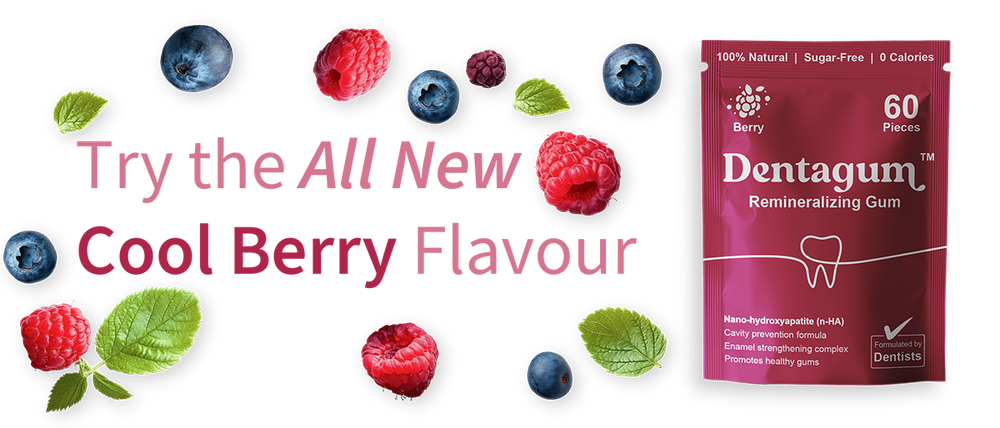
Dentagum's Remineralizing Chewing Gum is built for the between-brushing layer specifically. It combines nano-hydroxyapatite, organic xylitol, and mastic gum in a single chew, designed to work during the 10 to 20 minutes after eating when saliva is high and your enamel is recovering from acid. It is not a toothpaste replacement. It is the daytime half of the routine most people are missing.

Frequently asked questions
No. Gum cannot clean between teeth, remove biofilm the way brushing does, or deliver the concentrated dose a full brushing provides. It is designed for the hours between brushings, not to replace them. Keep brushing twice daily and use gum after meals when you cannot brush.
No, because the value of the gum is not only the ingredient, it is the timing and the saliva. Your toothpaste is only present twice a day. Gum delivers nano-hydroxyapatite plus a 10 to 12x saliva surge during the after-meal acid window, which toothpaste cannot cover unless you happen to brush right then.
In adults, the evidence is strong. An 18-month randomized controlled trial published in Frontiers in Public Health in 2023 found a fluoride-free hydroxyapatite toothpaste non-inferior to 1,450 ppm fluoride toothpaste for cavity prevention, with 89.3% of the hydroxyapatite group showing no new cavity surfaces versus 87.4% for fluoride.
Yes. They are compatible. If you prefer a fluoride toothpaste, you can still add a nano-hydroxyapatite gum for the after-meal window. The gum's job is saliva stimulation and daytime mineral delivery, which works alongside either type of toothpaste.
Two to four times a day, after meals and acidic drinks, for 10 to 20 minutes per session, is the range most oral care guidance supports. That matches the after-meal acid windows where the protection is most useful, and stays well within comfortable xylitol intake.
The Bottom Line
Hydroxyapatite toothpaste and remineralizing gum are not rivals. Toothpaste is the twice-daily foundation, proven non-inferior to fluoride for adults and strong on sensitivity. Gum is the between-brushing layer that covers the after-meal acid windows toothpaste physically cannot reach, adding a saliva surge no paste can trigger. If your day includes lunches out, coffee, and snacks, using both is how you protect your enamel across the whole day instead of just twice.
Keep the paste. Add the gum for everything in between.
Try Dentagum risk-free, 30-day guarantee at dentagum.coResearch Summary
- Paszynska E, Pawinska M, Enax J, et al. Caries-preventing effect of a hydroxyapatite-toothpaste in adults: an 18-month double-blinded randomized clinical trial. Frontiers in Public Health, 2023. Found hydroxyapatite toothpaste non-inferior to 1,450 ppm fluoride (89.3% vs 87.4% of subjects with no DMFS increase, n=171 per protocol).
- Limeback H, Enax J, Meyer F. Systematic review and meta-analysis of 44 clinical trials. Biomimetics, 2023. Hydroxyapatite reduced dentin hypersensitivity by 39.5% versus placebo.
- American Dental Association, Oral Health Topics: Chewing Gum. Chewing stimulates salivary flow to 10 to 12 times the resting rate; sugar-free gum for 20 minutes after meals helps prevent tooth decay.
- PubMed (1993), xylitol chewing gum and plaque acidogenicity. Xylitol gum kept plaque pH significantly higher than no gum, sucrose gum, and sorbitol gum at 2, 10, 20, 30, and 60 minutes after a sucrose rinse.
- Anil A, Ibraheem WI, Meshni AA, et al. Nano-hydroxyapatite in the remineralization of early dental caries: a scoping review. Int J Environ Res Public Health, 2022. Maps nHAp remineralization potential across dentifrice literature.
References
- Paszynska E, et al. "Caries-preventing effect of a hydroxyapatite-toothpaste in adults: a 18-month double-blinded randomized clinical trial." Frontiers in Public Health, 2023. https://www.frontiersin.org/journals/public-health/articles/10.3389/fpubh.2023.1199728/full
- Limeback H, Enax J, Meyer F. Systematic review and meta-analysis on hydroxyapatite in oral care. Biomimetics, 2023.
- American Dental Association. "Chewing Gum." ADA Oral Health Topics. https://www.ada.org/resources/ada-library/oral-health-topics/chewing-gum
- "Effect of chewing xylitol chewing gum on salivary flow rate and the acidogenic potential of dental plaque." PubMed, 1993. https://pubmed.ncbi.nlm.nih.gov/8448775/
- Anil A, et al. "Nano-Hydroxyapatite (nHAp) in the Remineralization of Early Dental Caries: A Scoping Review." Int J Environ Res Public Health, 2022. https://www.ncbi.nlm.nih.gov/pmc/articles/PMC9102186/
- "Salivary flow rate and pH during prolonged gum chewing in humans." PubMed, 2003. https://pubmed.ncbi.nlm.nih.gov/12950965/
