
Dental Gum Explained: What Makes a Gum "Dental"?
Any gum can call itself "dental." Here's the four-point checklist that actually separates a functional dental gum from one just borrowing the word.

"Dental gum" is not a regulated or legally defined term, which means any gum can call itself that regardless of formula. What actually earns the label, in a meaningful rather than marketing sense, comes down to four checkable criteria: a sweetener present at a clinically effective dose (xylitol research points to 5 to 10 grams per day across three or more exposures), active ingredients with real evidence behind them rather than just a "may support" claim, a disclosed gum base rather than the vague catch-all "gum base" the FDA permits, and independent third-party testing with a public certificate of analysis. The ADA Seal of Acceptance is the closest thing to an official standard, but it only covers sugar-free status and a narrow efficacy claim, not the full picture. Very few gums marketed as "dental" actually meet all four criteria.
Walk down the gum aisle, or scroll a DTC storefront, and you will see "dental gum" used loosely enough to mean almost anything: a gum with a mint in the name, a gum that mentions teeth once in its marketing copy, a gum that simply is not candy. None of that tells you whether the product does anything meaningfully different from a stick of regular sugar-free gum. This guide breaks the term down into something you can actually check against a label, rather than a vibe a brand is going for.
- Why "dental gum" isn't a regulated term
- Criterion 1: The sweetener, at a real dose
- Criterion 2: Active ingredients with actual evidence
- Criterion 3: A disclosed gum base
- Criterion 4: Independent third-party testing
- Where the ADA Seal fits, and its limits
- The full checklist
- Frequently asked questions
Why "dental gum" isn't a regulated term
Unlike "organic" or "gluten-free," which carry legal definitions a manufacturer must meet to use the label, nothing stops a company from printing "dental gum" on packaging regardless of formula. The FDA regulates chewing gum as a food product, and separately reviews specific health claims, but it has not defined a "dental gum" category with attached requirements. That gap is exactly why the term shows up on products with wildly different formulas: some genuinely built around oral health research, others using the phrase the same way a cereal box uses "heart healthy."
Since the label itself guarantees nothing, the only reliable approach is checking the actual formula against criteria that do have research and regulatory weight behind them, which is what the rest of this guide walks through.
Criterion 1: The sweetener, at a real dose

Sugar-free is table stakes, not a differentiator. The sweetener that actually matters for a "dental" claim is xylitol, and even then, only above a specific dose. A substantial body of clinical research points to a minimum of 5 to 6 grams of xylitol per day, delivered across at least three separate exposures, as the threshold for a measurable cavity-prevention effect. Below that line, the benefit largely disappears: one dose-comparison study found that participants consuming only 3.44 grams per day showed no reduction in cavity-causing bacteria compared to a control group, while the effect became apparent around 7 grams per day.
Most xylitol gum contains roughly 1 to 1.5 grams per piece, which means hitting the effective range requires somewhere around 4 to 6 pieces spread across the day, not one piece after lunch. A genuinely "dental" gum should make that math checkable, either by disclosing xylitol content per piece directly or by giving clear usage guidance that lines up with the dosing research, rather than just listing xylitol as an ingredient without quantity.
Many gums marketed on their xylitol content use it as a secondary sweetener behind sorbitol or maltitol, present in amounts far below the researched threshold. Checking the ingredient order and, where available, the actual gram count per piece is the only way to tell the difference between a functional dose and a marketing mention.
Criterion 2: Active ingredients with actual evidence
A sweetener alone earns "sugar-free," not "dental." The second criterion is whether the gum contains active ingredients with real, citable research behind their specific mechanism, delivered in the gum at a meaningful concentration. Nano-hydroxyapatite, at true nanoscale particle size and a concentration in the researched 3 to 10% range, is the clearest example with a growing clinical trial record. Other actives with genuine evidence include CPP-ACP for calcium-phosphate delivery and specific antibacterial agents like mastic gum, which carries a systematic review of 14 studies confirming antimicrobial and anti-plaque properties.
The distinction that matters here is between an ingredient with a plausible mechanism and an ingredient with actual trial data. Plenty of gums list botanical extracts or trendy actives with limited or no dental-specific research, banking on general wellness appeal rather than oral health evidence.
Criterion 3: A disclosed gum base

This is the criterion most "dental gum" products fail silently, because almost nobody reads it. In the US, the FDA permits 46 different substances to be grouped under the single ingredient listing "gum base," with no requirement to disclose which ones, or in what proportion, a manufacturer actually uses. Most conventional gum bases rely on synthetic, petroleum-derived polymers, including polyvinyl acetate and polyisobutylene, chemically related to materials used in plastics and industrial adhesives, all legally hidden behind that one catch-all term.
A gum built with a natural base, typically chicle, mastic resin, or similar plant-derived materials, is capable of naming its base ingredients specifically rather than hiding behind the umbrella term. That specificity is itself a meaningful signal, since a brand with nothing to hide in its base composition generally says so directly. This has become a more pointed issue recently, with a 2025 pilot study finding that chewed synthetic gum sheds measurable microplastic particles per gram during normal use, an area of active ongoing research.
Criterion 4: Independent third-party testing

The final criterion is verification, not formulation. A gum can list the right sweetener at the right dose, the right actives, and a disclosed base, and still be worth checking against independent lab results, since ingredient lists describe intent, not necessarily what ends up in the finished product. Third-party testing through an ISO/IEC 17025-accredited laboratory, the international standard for testing and calibration competence, is the benchmark here. These labs test for heavy metals (lead, cadmium, arsenic, mercury) via ICP-MS, and can verify that a finished batch matches its label claims for identity, purity, and composition.
A publicly accessible Certificate of Analysis (COA) from a named, ISO 17025-accredited lab is the concrete artifact of this criterion. A vague claim of being "lab tested" without a named lab or accessible results does not meet the same bar.
Where the ADA Seal fits, and its limits
The ADA Seal of Acceptance is the closest thing to an official third-party standard in this category, and it is worth understanding what it actually verifies. To earn it, a manufacturer submits safety and efficacy data to the ADA Council on Scientific Affairs, which reviews the evidence against predetermined criteria; if the product qualifies, the Seal is granted for a five-year period. For chewing gum specifically, the Seal is available only to sugar-free products, and the underlying efficacy claim it certifies is narrow: that the gum, chewed for 20 minutes after meals, stimulates saliva flow at 10 to 12 times the resting rate in a way that has been shown to help prevent cavities.
That is a real, meaningful certification, but it is also narrower than most people assume. The ADA Seal does not evaluate gum base composition, does not require nano-hydroxyapatite or other remineralizing actives, and does not independently verify heavy metal testing beyond baseline safety data. A gum can be an excellent, ADA-accepted product on saliva stimulation grounds while saying nothing about base transparency or active ingredient depth, and conversely, a gum can meet every other criterion in this guide without having pursued the ADA process, since it is voluntary and involves a submission fee.
The full checklist
Putting it together, here is what actually separates a functionally "dental" gum from one borrowing the word.
| Criterion | What to check |
|---|---|
| Sweetener | Xylitol as the primary sweetener, at a dose that supports reaching 5-10g/day across 3+ pieces |
| Active ingredients | Named actives (e.g. nano-hydroxyapatite, CPP-ACP, mastic) with citable clinical or mechanistic research |
| Gum base | Specifically named base ingredients, not just the catch-all "gum base" listing |
| Testing | Publicly accessible COA from a named ISO 17025-accredited lab |
| ADA Seal (optional, not required) | A useful additional signal on saliva stimulation and sugar-free status, but not a complete verification of the other three criteria |
Very few products on shelf clear all four. Most clear one or two, usually the sweetener and a vague "clinically studied" claim, while staying quiet on base composition and testing. Our full breakdown of what to look for in a remineralizing gum brand goes deeper into how different products stack up against a similar framework, and our 7-point buyer's checklist extends this into a full purchasing guide.
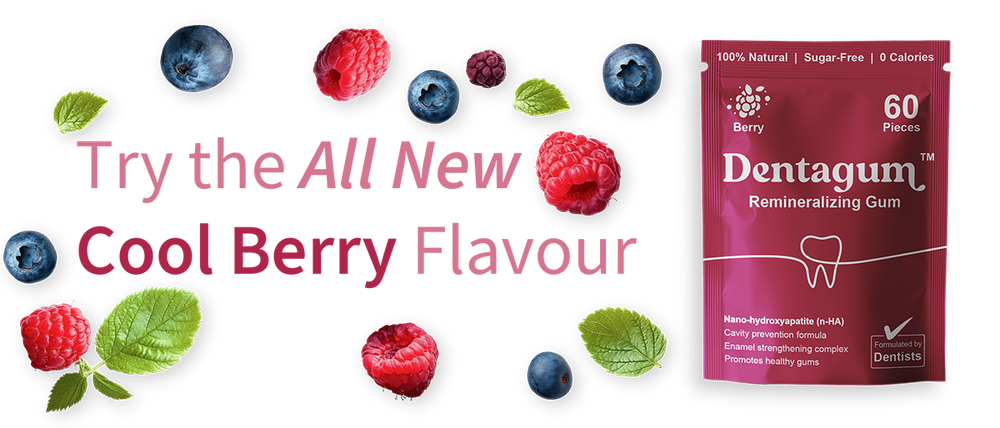
Dentagum's Remineralizing Chewing Gum is built to meet all four criteria directly: xylitol as the primary sweetener at a meaningful per-piece dose, nano-hydroxyapatite and mastic gum as named, evidenced actives, a disclosed chicle-mastic gum base rather than an unspecified synthetic one, and third-party testing through Light Labs, an ISO/IEC 17025-accredited, US-based laboratory, with results available on request.
Frequently asked questions
No. Unlike terms such as "organic," nothing legally defines what a "dental gum" must contain. Any manufacturer can use the phrase regardless of formula, which is why checking the actual ingredients against specific criteria matters more than the label itself.
Not entirely. The ADA Seal certifies that a sugar-free gum meets specific safety and efficacy criteria around saliva stimulation and cavity prevention when chewed after meals. It does not evaluate gum base transparency, require specific remineralizing actives, or independently verify heavy metal testing beyond baseline data.
It is legal, but it obscures composition. The FDA permits 46 different substances, many of them synthetic petroleum-derived polymers, to be listed collectively as "gum base" without disclosing which ones or in what amount a specific product uses. A brand willing to name its base ingredients specifically is giving you more information than the law requires.
Clinical research points to a minimum of 5 to 6 grams per day across at least three exposures for a measurable cavity-prevention effect, with the strongest effect size around 7 to 10 grams per day. Since most gum contains roughly 1 to 1.5 grams of xylitol per piece, that generally means 4 to 6 pieces spread across the day, not a single piece.

The Bottom Line
"Dental gum" is a marketing term, not a regulated one, so the label alone tells you nothing. What actually earns it, checkably, is a xylitol dose in the researched effective range, active ingredients with real evidence rather than a vague claim, a specifically disclosed gum base instead of the FDA's catch-all listing, and independent third-party testing with a public certificate of analysis. The ADA Seal is a useful additional signal but covers only a narrow slice of that picture. Check the formula, not the word on the front of the pack.
Four criteria, checkable on any label. That's the real definition.
See Dentagum's full formula and testing at dentagum.coResearch Summary
- ADA Council on Scientific Affairs: Seal of Acceptance program requirements for sugar-free chewing gum, covering safety and efficacy data submission, 5-year renewal cycle.
- ADA Oral Health Topics, Chewing Gum: sugar-free gum stimulates salivary flow to 10-12x resting rate; only sugar-free gum eligible for the Seal.
- Dose-comparison xylitol research: 3.44 g/day showed no reduction in S. mutans; effect became measurable around 7 g/day.
- Journal of International Society of Preventive and Community Dentistry (2022) meta-analysis: effective xylitol dosing at 5-10 g/day across 3-5 exposures for caries prevention.
- FDA gum base regulations: 46 permitted substances groupable under "gum base" with no individual disclosure requirement.
- ISO/IEC 17025 accreditation standard: international benchmark for laboratory testing and calibration competence, covering heavy metal analysis via ICP-MS and certificate of analysis generation.
References
- American Dental Association. "Acceptance Program Requirements: Sugar-free Chewing Gums to Help Prevent Cavities." ADA Council on Scientific Affairs, 2025. https://www.ada.org/-/media/project/ada-organization/ada/ada-org/files/resources/research/seal/2025/sugar-free-chewing-gum-2025.pdf
- American Dental Association. "Chewing Gum." ADA Oral Health Topics. https://www.ada.org/resources/ada-library/oral-health-topics/chewing-gum
- American Dental Association. "ADA Seal of Acceptance." https://www.ada.org/resources/research/science/ada-seal-of-acceptance
- "Meta-analysis on the Effectiveness of Xylitol in Caries Prevention." Journal of International Society of Preventive and Community Dentistry, 2022. https://pmc.ncbi.nlm.nih.gov/articles/PMC9022379/
- "Research Findings on Xylitol and the Development of Xylitol Vehicles to Address Public Health Needs." PMC. https://pmc.ncbi.nlm.nih.gov/articles/PMC3812061/
- "Gum base." Wikipedia, summarizing FDA-permitted gum base substance categories. https://en.wikipedia.org/wiki/Gum_base
- ISO/IEC 17025 laboratory accreditation standard documentation and heavy metal testing methodology (ICP-MS), multiple accredited laboratory sources.
