
What Is Nano-Hydroxyapatite? A Beginner's Guide
Nano-hydroxyapatite sounds technical but the idea is simple: it's the mineral your teeth are already made of, shrunk small enough to repair them. Here's the full beginner's breakdown.

Nano-hydroxyapatite is a lab-made version of the exact mineral your tooth enamel is already made of, engineered into particles just 20 to 100 nanometres wide. Because the particles are so small, they settle into the microscopic pores and early weak spots on your enamel and rebuild it from the inside, rather than just sitting on the surface. A 2023 systematic review in Biomimetics covering 44 clinical trials found it reduced tooth sensitivity by 39.5% compared to placebo, and an 18-month adult trial in Frontiers in Public Health found it performed as well as fluoride at preventing cavities.
If you have shopped for toothpaste in the last couple of years, you have probably seen "nano-hydroxyapatite" on a label and had no idea what it actually meant. It sounds technical. It is technical. But the underlying idea is simple enough to explain in one sentence: it is the same mineral your teeth are made of, shrunk down small enough to repair them.
This guide breaks nano-hydroxyapatite down from scratch. No prior chemistry knowledge required. By the end you will know what it is, why the "nano" part matters so much, how it actually repairs enamel, whether it is safe, and where it shows up in real oral care products today.
- What nano-hydroxyapatite actually is
- Your teeth are already made of this
- What "nano" means and why size is the whole story
- How nano-hydroxyapatite repairs enamel
- Is nano-hydroxyapatite safe?
- Nano-hydroxyapatite vs standard hydroxyapatite
- Where you find it in oral care today
- Frequently asked questions
What nano-hydroxyapatite actually is
Hydroxyapatite is a naturally occurring mineral made of calcium and phosphate. It is not exotic or synthetic in origin. It is the actual substance that makes up roughly 97% of your tooth enamel by weight, and it is also a major component of your bones. Nano-hydroxyapatite, often shortened to nHA or nHAp, is a lab-produced version of that same mineral, manufactured at an extremely small particle size so it can be used in toothpaste, gum, and other oral care products.
The reason scientists make it this small is not cosmetic. It is functional. At full size, hydroxyapatite particles are far too large to do anything useful once you put them in your mouth. Shrunk down to the nanoscale, they become small enough to physically get inside the damaged parts of your enamel, which is the whole reason this ingredient has become such a big deal in oral care over the last decade.
Nano-hydroxyapatite is your enamel's own mineral, rebuilt in a lab at a particle size small enough to repair the enamel it came from.
Your teeth are already made of this
It helps to understand what enamel actually is before getting into how nano-hydroxyapatite interacts with it. Tooth enamel is the hardest substance in the human body, and it earns that title because it is almost entirely mineral. Roughly 96 to 97% of enamel by weight is hydroxyapatite crystal, with the remaining few percent made up of water and a small amount of organic protein.
Your saliva also naturally contains calcium and phosphate ions, the same building blocks hydroxyapatite is made from, and your mouth is constantly running a low-grade repair cycle using them. Every time you eat something acidic, minerals get pulled out of your enamel's surface. Every time your saliva has the chance to work, some of that mineral gets redeposited. Nano-hydroxyapatite in a toothpaste or gum is not introducing something foreign into that cycle. It is supplying more of the exact raw material the cycle already runs on, in a form your enamel can actually use.
What "nano" means and why size is the whole story
A nanometre is one billionth of a metre. Nano-hydroxyapatite particles typically measure 20 to 100 nanometres across. To put that in perspective, that is roughly the same scale as the natural mineral crystals your enamel is already built from, which is precisely why the particles fit so well into damaged enamel.

Standard hydroxyapatite, the kind that has been used in bone grafts and some dental materials for decades, is nothing like this small. Its particles typically run from about 1 micron up to 50 microns, meaning 1,000 to 50,000 nanometres. That makes standard hydroxyapatite 50 to 500 times larger than the nano version.
That size gap is not a minor technical detail. It determines whether the particles can actually do anything to your enamel. Enamel that has started to demineralize develops microscopic pores and subsurface weak spots, far too small to see, but real gaps in the mineral structure. Standard hydroxyapatite particles are too big to enter those gaps. They sit on top of the enamel surface, where they can smooth and polish it, but they cannot get inside.
Nano-sized particles are small enough to slip into those same microscopic pores and deposit mineral directly where the damage started. That is the mechanical difference between a product that polishes your enamel and one that can genuinely help rebuild its early damage from within.
The clinical evidence for hydroxyapatite in oral care is specific to the nano particle size range. When you are comparing products, "hydroxyapatite" alone tells you very little. Look for "nano-hydroxyapatite" stated explicitly.
How nano-hydroxyapatite repairs enamel
The process is straightforward once you understand the particle size piece. When nano-hydroxyapatite comes into contact with weakened enamel, whether from a toothpaste, a gum, or saliva carrying it, the particles move into the tiny pores and cracks on the enamel surface. Once there, they integrate with the existing mineral structure, effectively patching the gaps at a microscopic level.
This has two measurable effects that show up consistently in the clinical literature. First, it can help reduce the visible and structural signs of early enamel damage, sometimes described as improved enamel microhardness. Second, and this is the effect with the strongest evidence behind it, it plugs the microscopic tubules in exposed dentin that are responsible for sharp sensitivity to cold, heat, and sweet foods. A 2023 systematic review and meta-analysis by Limeback, Enax, and Meyer, published in Biomimetics and covering 44 clinical trials, found that hydroxyapatite in oral care products reduced dentin hypersensitivity by 39.5% compared to placebo, with the nano particle size identified as central to that effect.
On the cavity-prevention side, an 18-month double-blinded randomized controlled trial published in Frontiers in Public Health in 2023 compared a fluoride-free nano-hydroxyapatite toothpaste directly against a standard 1,450 ppm fluoride toothpaste in 189 adults. The result was non-inferiority: 89.3% of the hydroxyapatite group showed no increase in decayed, missing, or filled tooth surfaces over the study period, compared with 87.4% of the fluoride group. Statistically, the two performed the same.
Is nano-hydroxyapatite safe?

Yes, based on the current evidence, and this is one of the more reassuring parts of the nano-hydroxyapatite story. It has a long track record: Japan's Sangi Company launched the first commercial hydroxyapatite toothpaste back in 1980, and the ingredient has been used in oral care products across Japan, Europe, and increasingly the United States for decades since. That history was built on an even earlier discovery: NASA scientist Bernard Rubin first identified the crystal-growing process that led to synthetic hydroxyapatite in the 1960s and 70s, while researching a way to help astronauts counteract bone and tooth mineral loss in zero gravity.
Unlike fluoride, which is toxic if swallowed in large enough quantities and requires careful dosing for young children, nano-hydroxyapatite is non-toxic if swallowed. That makes it a common recommendation for children, pregnant people, and anyone who wants to avoid fluoride exposure without giving up an evidence-backed remineralizing ingredient. Published safety reviews on nano-hydroxyapatite in oral care products have not identified significant adverse effects at the concentrations typically used in toothpaste and gum.
Nano-hydroxyapatite supports early-stage remineralization. It cannot regrow enamel that has already broken down into a cavity, and it is not a substitute for brushing, flossing, or seeing a dentist regularly.
Nano-hydroxyapatite vs standard hydroxyapatite
Since these two get confused constantly, here is the comparison laid out directly.
| Factor | Nano-hydroxyapatite | Standard hydroxyapatite |
|---|---|---|
| Particle size | 20 to 100 nanometres | 1,000 to 50,000 nanometres |
| Can enter enamel micro-pores | Yes | No, too large |
| Primary action | Deposits mineral into early lesions | Sits on surface, polishes |
| Clinical trial evidence | Strong (39.5% sensitivity reduction, 44 trials) | Limited for oral care specifically |
| Common uses | Toothpaste, gum, mouthwash | Bone grafts, some dental cements |
Where you find it in oral care today

Nano-hydroxyapatite has mostly shown up in toothpaste, and that remains the biggest category by far. A good nHA toothpaste delivers a concentrated dose during your twice-daily brushing, and the evidence behind that format is the deepest of any nHA product type.
More recently, the same ingredient has started appearing in functional chewing gum. The logic is straightforward: toothpaste only reaches your teeth twice a day, but the acid attacks that demineralize enamel happen every time you eat or drink something acidic, which for most people is five or more times daily. Gum delivers a smaller dose of nano-hydroxyapatite, but it does so during the after-meal window when saliva flow is already high from chewing and your enamel is actively trying to recover. For a deeper look at how that combination works, see our comparison of what remineralizing gum actually does and our guide on what to look for in a remineralizing gum brand.
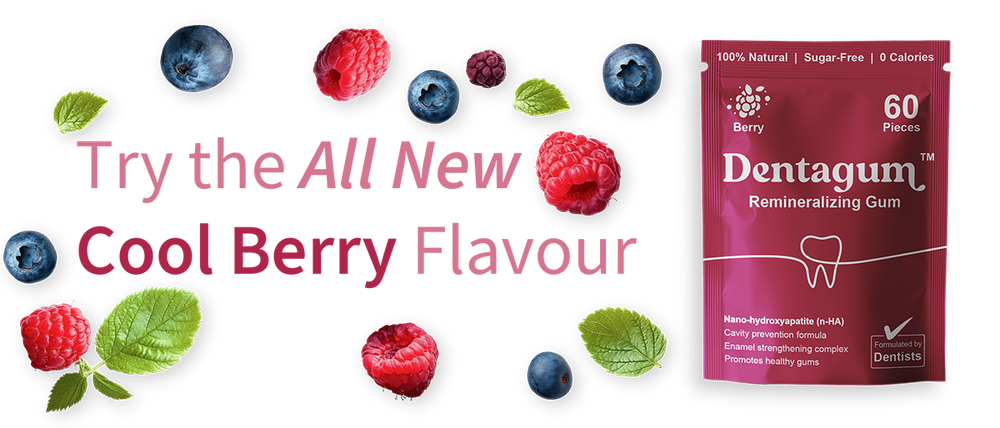
Dentagum's Remineralizing Chewing Gum delivers nano-hydroxyapatite alongside organic xylitol and mastic gum, designed to work during the 10 to 20 minutes after eating when your enamel is most receptive to repair. It is built to complement a nano-hydroxyapatite toothpaste, not replace it.
Frequently asked questions
It is a synthetic version of a naturally occurring mineral. Hydroxyapatite itself is entirely natural, it makes up most of your tooth enamel and bones, but the nano-sized particles used in oral care are manufactured in a lab to achieve the precise particle size the clinical benefit depends on.
Neither is definitively better across the board. Fluoride has a longer, deeper evidence base overall. But an 18-month randomized controlled trial in adults found nano-hydroxyapatite toothpaste non-inferior to a standard 1,450 ppm fluoride toothpaste for cavity prevention, and nano-hydroxyapatite has the added advantage of being non-toxic if swallowed, which fluoride is not at high doses.
Sensitivity improvements are often noticeable within a few weeks of consistent use. Enamel remineralization is a slower, cumulative process that builds over weeks to months with regular use alongside good oral hygiene, rather than producing an overnight change.
It can support remineralization of very early enamel demineralization, sometimes visible as white spot lesions, before a true cavity has formed. Once decay has progressed into an actual cavity with a physical hole, nano-hydroxyapatite cannot reverse it, and a dentist visit is needed.
Yes, and its non-toxic-if-swallowed profile is one reason it is often recommended for young children who have not yet mastered spitting out toothpaste, unlike fluoride formulas which require careful dosing and supervision in that age group.

The Bottom Line
Nano-hydroxyapatite is your enamel's own mineral, rebuilt at a particle size small enough to get inside early enamel damage and rebuild it from within. The evidence behind it is real: a 39.5% reduction in sensitivity across 44 clinical trials, and cavity-prevention performance statistically equal to fluoride in an 18-month adult trial. It shows up most often in toothpaste, and increasingly in gum designed for the acid-exposure windows toothpaste cannot reach.
The mineral is the same. The delivery is what's evolving.
Try Dentagum risk-free, 30-day guarantee at dentagum.coResearch Summary
- Limeback H, Enax J, Meyer F. Systematic review and meta-analysis of 44 clinical trials. Biomimetics, 2023. Hydroxyapatite reduced dentin hypersensitivity by 39.5% versus placebo, nano particle size central to the effect.
- Paszynska E, et al. 18-month double-blinded randomized clinical trial, 189 adults. Frontiers in Public Health, 2023. Fluoride-free hydroxyapatite toothpaste non-inferior to 1,450 ppm fluoride toothpaste for cavity prevention.
- Anil A, Ibraheem WI, Meshni AA, et al. Nano-hydroxyapatite in the remineralization of early dental caries: a scoping review. Int J Environ Res Public Health, 2022.
- NASA Spinoff, "Semiconductor Research Leads to a Revolution in Dental Care." Documents Bernard Rubin's original 1960s-70s crystal research at NASA's Electronics Research Center and its licensing to Sangi Co. Ltd.
References
- Limeback H, Enax J, Meyer F. Systematic review and meta-analysis on hydroxyapatite in oral care products for reducing dentin hypersensitivity. Biomimetics, 2023. https://pmc.ncbi.nlm.nih.gov/articles/PMC9844412/
- Paszynska E, et al. "Caries-preventing effect of a hydroxyapatite-toothpaste in adults: a 18-month double-blinded randomized clinical trial." Frontiers in Public Health, 2023. https://www.frontiersin.org/journals/public-health/articles/10.3389/fpubh.2023.1199728/full
- Anil A, et al. "Nano-Hydroxyapatite (nHAp) in the Remineralization of Early Dental Caries: A Scoping Review." Int J Environ Res Public Health, 2022. https://www.ncbi.nlm.nih.gov/pmc/articles/PMC9102186/
- NASA Spinoff. "Semiconductor Research Leads to a Revolution in Dental Care." https://spinoff.nasa.gov/Semiconductor_Research_Leads_to_a_Revolution_in_Dental_Care
