
Coffee, Wine, and Tea Stains: How to Protect Your Smile All Day
Coffee, tea, and red wine stain teeth through acid-softening and chromogen binding working together. Black tea is the biggest staining culprit in controlled studies, red wine delivers a triple threat of anthocyanins, tannins, and acid, and coffee's CGA and melanoidin content makes it consistently damaging. The intervention window between the last sip and the moment chromogens permanently bind is real and addressable. This guide covers what actually works in that window, including why adding milk to tea genuinely helps and how chewing gum after each drink closes the staining window through saliva stimulation.

Quick Answer
Coffee, tea, and red wine stain teeth through a two-part mechanism: the acid in each drink temporarily softens and increases the porosity of enamel, and the chromogens and tannins in the liquid then bind more readily to the more vulnerable surface. Black tea and red wine are the biggest culprits in controlled staining studies, with red wine delivering a triple threat of anthocyanin pigments, tannins, and acid simultaneously. The most effective prevention strategy addresses both parts of the problem: neutralize the acid and clear the chromogens before they have time to bind. Chewing remineralizing gum after staining drinks does both, using saliva stimulation to dilute and mechanically clear chromogens from tooth surfaces and to buffer the acid that creates the porous conditions those chromogens exploit. For established staining that already exists, gum alone is not sufficient, and a whitening treatment is the right tool.
Last updated: June 2026 | Reviewed against current dental staining research, enamel chemistry literature, and clinical guidance on chromogen prevention
If you drink coffee in the morning, tea in the afternoon, and wine with dinner, your teeth are dealing with staining pressure across most of your waking hours. The good news is that staining is not inevitable, and the window between when a chromogen enters your mouth and when it permanently binds to your enamel is long enough to intervene. The bad news is that most people don't intervene at all.
This guide covers exactly how each drink stains your teeth, why the acid-softening effect matters as much as the pigment itself, and the daily habits that interrupt the staining process in the critical window when intervention still makes a difference.
How Drinks Actually Stain Your Teeth
Tooth staining from beverages is not a simple matter of dark liquid touching white teeth. The chemistry is more specific and more preventable than that suggests.
Every tooth is coated in the acquired enamel pellicle: a thin protein film that forms within minutes of saliva contacting the enamel surface. This pellicle is protective, reducing friction and providing some barrier function, but it is also the primary site where dietary staining compounds attach. Chromogens, the color-producing pigment compounds in coffee, tea, and wine, bind to the pellicle layer. Tannins, the astringent polyphenols found in all three beverages, act as adhesion bridges that help chromogens stick to the pellicle more tenaciously than they otherwise would.
Once chromogens are incorporated into the pellicle, they become extrinsic stains: surface discoloration sitting on or just below the enamel surface. Over repeated daily exposure across weeks and months, this layer accumulates into the yellow-brown or gray discoloration that most regular coffee, tea, and wine drinkers eventually notice.
The process has a critical early window. Freshly deposited chromogens on the pellicle are more accessible and more removable than those that have been incorporated over days of accumulation. Mechanical clearance through saliva flow, rinsing, or chewing can dislodge them before they bond permanently. This is where daily habits make the most meaningful difference: not removing established stains, but preventing the fresh ones from establishing in the first place.
The Staining Mechanism in Three Steps
- Step 1 (Acid softening): The acidic beverage temporarily lowers oral pH, softening enamel and increasing its surface porosity, making it more receptive to chromogen absorption
- Step 2 (Chromogen binding): Color-producing pigments (chromogens) from the drink contact the acquired enamel pellicle; tannins act as molecular bridges, helping chromogens adhere more strongly
- Step 3 (Accumulation): Over days and weeks, the bound layer builds up into visible extrinsic discoloration. Early-stage chromogens on the pellicle are clearable; established stains require whitening treatment.
- The intervention window: Between step 1 and step 3, there is time to clear chromogens with saliva stimulation and mechanical clearance before they become permanent
Coffee: Acid and Chromogens Together

Coffee's staining power comes from two distinct chemical pathways operating simultaneously, which is why it is so persistent despite being less tannic than black tea.
The first pathway is chromogenic. Coffee contains chlorogenic acids (CGAs), melanoidins (dark-colored compounds formed during roasting), and other chromogens that adhere strongly to the enamel pellicle. Research published in the Italian Journal of Food Science (Larnani et al., 2024, "Effects of Tea and Coffee on Tooth Discoloration") confirmed this staining pattern. Arabica coffee, with higher CGA concentrations, produces greater staining than Robusta varieties in controlled studies.
The second pathway is acid-mediated. Coffee is acidic, with pH typically ranging from 4.5 to 5.5 depending on the roast and brew method. When you drink coffee, oral pH drops below the enamel demineralization threshold of 5.5, temporarily softening the surface. A ScienceDirect study (2024, "Whitening Efficacy of Toothpastes on Coffee-Stained Teeth") described this dual mechanism directly: the acids erode the enamel surface and chromogens bind to pellicles on the enamel surface simultaneously. The softened, more porous enamel absorbs chromogens more readily than healthy mineralized enamel.
Sipping a coffee slowly over an hour is more damaging than drinking the same amount quickly, because the sustained acid exposure prevents saliva from buffering pH back to safe levels and restoring enamel hardness between sips. The chromogens keep arriving on a surface that is continuously acid-softened and therefore continuously more vulnerable.
Tea: The Surprising Staining Champion
Black tea is frequently identified in controlled staining research as the highest-staining common beverage, ahead of coffee, and this surprises most people who have assumed the opposite.
A study published in European Journal of Dentistry (Sarembe et al., PMC9683888, 2022), testing 11 beverages including diet coke, white wine, red wine, lager, black tea, coffee, black tea with milk, coffee with milk, ginger and lemon infusion, and water, found that black tea and red wine produced the highest staining. The staining from black tea was also found to be the most mechanically resistant, meaning it adheres more tenaciously to the enamel surface than other beverage stains.
The reason is tannin concentration. Black tea contains the highest tannin levels of any commonly consumed beverage. Tannins are polyphenols that perform two functions in the staining process: they contribute their own color and they act as binding agents that help other chromogens adhere more strongly to the enamel pellicle. The theaflavins that give black tea its characteristic color and bitterness are particularly potent chromogens. Green tea stains are subtler but still present, often giving a grayish rather than yellow-brown cast.
The Sarembe study also found a meaningful result for milk: adding milk to tea "considerably modified the stain layer and the adhesion to the tooth surface." This is consistent with research on milk protein casein binding to tea polyphenols: the proteins bind to the tannins and chromogens before they can reach the pellicle, reducing the staining compounds available to attach to teeth. People who drink tea with milk stain less than those who drink it black, for a genuine biochemical reason, not just dilution.
Red Wine: The Triple Threat
Red wine is the most chemically aggressive of the three common staining beverages because it delivers three staining mechanisms simultaneously. Colgate's clinical guidance describes it directly: red wine combines deep anthocyanin pigments, acids, and tannins, making it a triple threat.

Anthocyanins are the pigments that give red grapes their color: intensely purple-red compounds that bind strongly to tooth surfaces. Tannins in red wine, as with tea, increase the adhesion of these pigments. And red wine is acidic, with pH typically around 3.3 to 3.5, well below the 5.5 enamel demineralization threshold. The acid softens and increases enamel porosity at the same time the anthocyanins and tannins are arriving, creating maximally favorable conditions for staining.
Red wine produces a distinctive gray stain rather than the yellow-brown of coffee or tea, because anthocyanins produce a different chromatic signature than chlorogenic acids or theaflavins. The gray cast is often more noticeable and harder to disguise than the yellow-brown from other beverages.
The acidic pH of red wine also creates an additional consideration: drinking wine causes short-term enamel softening that makes the teeth more vulnerable to staining from any subsequent chromogen source. Eating cheese alongside wine, a practice supported by University of Rochester research, does more than balance the flavor: dairy proteins and the calcium in cheese help neutralize acid and replace minerals in enamel, reducing the porosity that makes wine staining so effective.
Why Acid Makes Staining Worse

The acid-softening effect deserves more attention than it typically receives in staining discussions, because it explains a counterintuitive phenomenon: the same drinks that stain also create conditions that make staining worse.
When a beverage with pH below 5.5 contacts enamel, the acid dissolves a thin layer of the hydroxyapatite mineral structure, temporarily increasing enamel surface porosity. The pores and microstructural channels in the softened enamel are more accessible to chromogen molecules than those of fully mineralized enamel. The acid creates the entry points that the chromogens then use.
A patent-cited source on red wine staining described this mechanism precisely: the acid pH of red wine demineralizes teeth, causing enamel to become softened and eroded; with less enamel, teeth have increased porosity, allowing light-absorbing chromogens to enter and bind. A ScienceDirect 2024 study on coffee-stained enamel stated the same dual mechanism: the acids erode the enamel surface while chromogens simultaneously bind to the pellicle.
The practical implication: restoring enamel hardness quickly after acid exposure reduces the window during which chromogens can exploit the softened surface. Stimulated saliva buffers the acid and delivers calcium and phosphate ions for remineralization. Any intervention that accelerates this pH recovery, whether rinsing with water or chewing gum to stimulate saliva, reduces the duration of acid-softened enamel and the staining advantage that the softened surface gives to chromogens.
This is also why brushing immediately after acidic drinks is counterproductive for both staining prevention and enamel health: brushing on acid-softened enamel removes mineral from the already-vulnerable surface. The recommended interval of 30 to 60 minutes before brushing allows saliva to reharden the enamel. Chewing gum in that interval actively accelerates the hardening process through saliva stimulation.
The Daily Staining Window (and How to Close It)
Consider a typical daily pattern: morning coffee, afternoon tea, and occasional wine with dinner. Each drink creates a staining window that persists until the chromogens are physically cleared from tooth surfaces and the acid is neutralized by saliva.
Without any intervention, that window stays open until saliva naturally buffers the acid and clears the chromogens, which can take 30 to 40 minutes for the acid effect alone. In practice, for people who sip a coffee or tea over an hour or more, the window stays open for the entire duration of the drink and for 30 to 40 minutes after the last sip. Multiple sipping sessions across a day can mean that enamel is in an acid-softened, chromogen-exposed state for several hours of most days.
The cumulative effect of this across weeks, months, and years produces the gradual yellowing and graying that most regular coffee, tea, and wine drinkers notice. Each individual session creates a relatively small amount of incremental staining. The accumulated total is visible.
What Actually Prevents Staining Day to Day
Prevention is most effective when it happens in the first 20 to 30 minutes after a staining drink, before chromogens have fully bonded to the pellicle. Here are the interventions with the best evidence and practical feasibility.
Rinse With Water Immediately After
Rinsing with plain water after coffee, tea, or wine dilutes the chromogen and acid concentration in the mouth and provides some mechanical clearance. It is not sufficient on its own because it doesn't stimulate saliva or provide acid buffering, but it is the fastest possible intervention. Thirty seconds of vigorous rinsing reduces the chromogen load available to bind to the pellicle.
Drink Quickly Rather Than Sipping Slowly
Duration of contact matters as much as quantity. Sipping coffee or tea over an hour creates sustained acid-softened enamel conditions throughout the drink. Consuming the same amount over ten minutes creates one acidic window that saliva can then buffer. For staining and enamel erosion both, the drinking pattern matters more than most people realize.
Consider Adding Milk to Tea and Coffee
The Sarembe et al. (2022) study found that adding milk to both tea and coffee "considerably modified the stain layer and the adhesion to the tooth surface." The mechanism is casein protein in milk binding to the polyphenols (tannins and chromogens) in tea and coffee before they can reach the pellicle. The protein-bound compounds pass through the digestive system rather than adhering to teeth. This is particularly effective for tea, which has the highest tannin content of the staining beverages.
Use a Straw for Cold Coffee and Iced Tea
A straw directs the liquid past the front surfaces of the teeth that are most visible. It reduces direct contact between the staining beverage and the most cosmetically significant enamel surfaces. This is most practical for cold brew coffee, iced tea, and chilled beverages where straw use is socially normal.
Chew Sugar-Free Remineralizing Gum After
This is the most effective preventive intervention for people who want something that addresses both the acid problem and the chromogen-clearance problem simultaneously. More on this in the section below.
Wait 30 to 60 Minutes Before Brushing
Brushing on acid-softened enamel removes mineral from the surface and increases micro-roughness, which paradoxically makes subsequent staining worse by creating more surface area for chromogen adhesion. Waiting allows saliva to buffer the pH and begin remineralizing the enamel before the mechanical abrasion of brushing. Chewing gum in this window accelerates the pH recovery.
How Gum After Staining Drinks Works
Chewing remineralizing gum in the 20 minutes after a staining drink addresses both mechanisms of staining prevention at once.
The chewing motion stimulates salivary flow through the masticatory reflex, producing elevated saliva output that is more alkaline than resting saliva and has higher buffering capacity. This stimulated saliva performs three things simultaneously: it physically washes the oral cavity, diluting and carrying away chromogens before they fully bind to the pellicle; it buffers the acid from the drink back toward neutral pH, reducing the duration of acid-softened enamel and the enhanced chromogen absorption that softness enables; and it delivers calcium and phosphate ions that begin remineralizing the enamel surface, restoring its mineral density and reducing porosity.

The ADA explicitly endorses sugar-free gum after meals and acidic drinks for saliva stimulation and acid buffering. A 2025 clinical study using 3D colorimetric analysis found that chewing xylitol-containing gum produced a 14.8% reduction in plaque scores after just 15 minutes, compared to 3.9% with natural saliva alone. Plaque is the substrate through which chromogens accumulate: reducing it directly reduces the staining surface available to subsequent chromogen exposure.
Xylitol also reduces dental plaque accumulation over time through its antibacterial mechanism against Streptococcus mutans. Wu et al. (Frontiers in Nutrition, 2022) found 20% plaque reduction over two weeks of xylitol gum at 6.2g per day. The less plaque present on tooth surfaces, the less surface area available for chromogen binding and accumulation.
Nano-hydroxyapatite in the gum contributes by filling the microporosities that acid exposure creates in enamel, restoring surface smoothness and reducing the porous entry points that chromogens exploit. A smoother, more fully mineralized enamel surface is both less staining-susceptible and more optically bright.
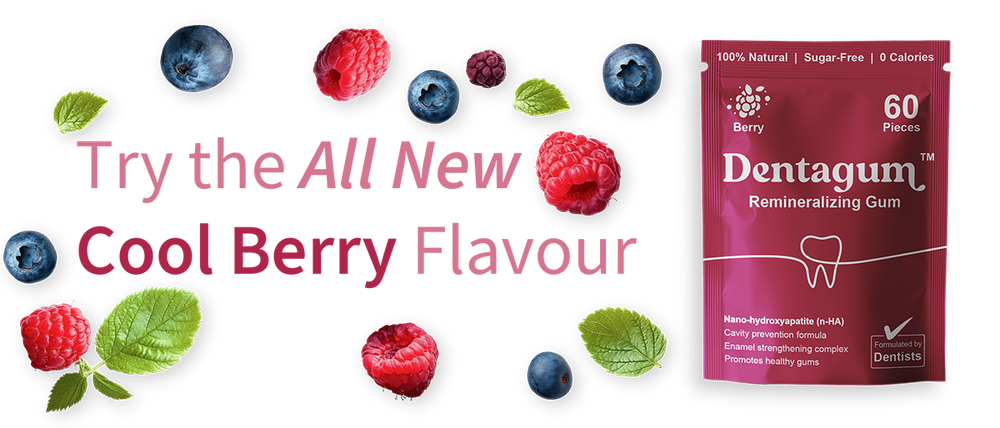
The combined effect: chewing Dentagum after each staining drink stimulates the saliva that clears chromogens, buffers the acid that creates staining-favorable conditions, reduces the plaque substrate over which staining accumulates, and supports enamel remineralization that closes the porosity that staining exploits. For a deeper look at how nano-HAp and xylitol work at the enamel level, see our article on does remineralizing gum whiten teeth and our guide on what nano-hydroxyapatite is.
What Remineralizing Gum Does After Each Staining Drink
- Saliva stimulation (chewing reflex): Elevated saliva flow mechanically clears chromogens from tooth surfaces before they bond permanently to the pellicle
- Acid buffering (saliva bicarbonate system): Alkaline stimulated saliva neutralizes the pH drop from the drink, reducing the duration of acid-softened enamel and the enhanced chromogen absorption it enables
- Plaque reduction (xylitol, 20% reduction in 2 weeks at 6.2g/day): Less plaque means less substrate for chromogen accumulation between cleanings
- Enamel surface repair (nano-HAp): 20-100nm particles fill acid-created microporosities in enamel, reducing the entry points chromogens exploit and restoring optical smoothness
- Timing: Chew immediately after the last sip. The 20-minute chewing window addresses the staining risk before chromogens have time to bond
Figures from ingredient-level research. Not Dentagum product trials.
For Existing Stains: What to Do
The interventions above are preventive. They protect against new stain accumulation and help maintain clean teeth between professional visits. They do not remove established discoloration from years of coffee, tea, or wine drinking that has already incorporated into the enamel and dentin.
For that, two options exist. Professional cleaning removes the surface layer of plaque and accumulated extrinsic stain through mechanical polishing and scaling. Regular professional visits (at least twice per year) are the most effective maintenance tool for managing chromogen accumulation, because they reset the baseline before it progresses too far.
For discoloration that has penetrated deeper into enamel or is intrinsic, whitening treatment is the appropriate tool. PAP+ (phthalimidoperoxycaproic acid) is a peroxide-free oxidizing agent that breaks down chromophore molecules inside enamel without the sensitivity profile of traditional peroxide-based treatments. Dentagum Purple Whitening Strips use PAP+ alongside nano-hydroxyapatite for enamel support and violet color correction for immediate optical brightness. For context on how the strips work and whether peroxide-free or peroxide-based strips are appropriate for your situation, see our articles on how PAP+ whitening works and a comparison of PAP+ versus hydrogen peroxide strips.
The most effective long-term approach is combining both: whitening treatment to reset the baseline and daily remineralizing gum habits to slow the rate at which the baseline degrades from new stain accumulation. Prevention maintains what whitening establishes.
Frequently Asked Questions
Which stains teeth more: coffee or tea?
Black tea, in most controlled staining studies. Sarembe et al. (2022), testing 11 beverages in an in vitro staining model, found black tea and red wine produced the highest staining, and black tea stain was the most mechanically resistant (hardest to remove). Coffee stains are significant, with chlorogenic acids and melanoidins as the primary chromogens, but black tea's high tannin content makes its stains particularly tenacious. The addition of milk significantly modifies the stain layer for both tea and coffee by binding chromogens before they reach tooth surfaces.
Why does acid in coffee and wine make staining worse?
When a beverage with pH below 5.5 contacts enamel, it temporarily softens the surface by dissolving the outer mineral layer. Softened enamel is more porous than fully mineralized enamel, and chromogens (the pigment compounds in coffee, tea, and wine) enter and bind more readily through those pores. The acid-softening effectively creates better adhesion conditions for the chromogens arriving simultaneously. Both coffee (pH 4.5-5.5) and red wine (pH 3.3-3.5) demonstrate this dual mechanism.
Does rinsing with water after coffee actually help?
Yes, modestly. Rinsing with water after coffee, tea, or wine dilutes chromogen concentration and provides mechanical clearance before chromogens fully bind to the pellicle. It does not buffer the acid or stimulate saliva at the level that chewing gum does, but it is effective as a rapid first-response intervention, especially when other options are not available. Thirty seconds of vigorous rinsing reduces the chromogen load available to bind to enamel surfaces.
Why shouldn't I brush right after drinking coffee or wine?
Coffee and wine are both acidic and temporarily soften enamel. Brushing on acid-softened enamel removes mineral from the compromised surface through abrasion, accelerating erosion rather than preventing staining. It can also increase micro-roughness of the enamel surface, which paradoxically makes subsequent staining worse. Waiting at least 30 minutes allows saliva to buffer the pH and begin remineralizing the softened layer before introducing the mechanical abrasion of brushing. Chewing gum in this interval actively accelerates the pH recovery process.
Does adding milk to tea or coffee reduce staining?
Yes, meaningfully. Casein protein in milk binds to the polyphenols (tannins and chromogens) in tea and coffee before they can adhere to the tooth pellicle. The protein-polyphenol complexes pass through the digestive system rather than accumulating on teeth. The Sarembe et al. (2022) study confirmed that adding milk to both tea and coffee "considerably modified the stain layer and the adhesion to the tooth surface." Higher-fat milk provides more protein and therefore more protection, though any milk or cream reduces the staining potential compared to drinking the beverage black.
What is the best habit to protect teeth from daily staining drinks?
Chewing sugar-free remineralizing gum with xylitol and nano-HAp in the 20 minutes after each staining drink. It stimulates saliva to clear chromogens before they bind, buffers the acid that softens enamel and increases chromogen absorption, reduces plaque that provides the substrate for staining accumulation, and supports enamel remineralization that closes the porosity acid creates. It requires nothing beyond the gum itself and works during the same time period people typically can't brush. For established staining that already exists, a whitening treatment is additionally needed to reset the baseline.
Bottom Line
Coffee, tea, and red wine stain through a two-part mechanism: acid softens and opens up enamel, and chromogens and tannins bind to the now-more-porous surface. The staining window between the last sip of your drink and the moment chromogens permanently bond to your enamel is real and addressable, but most people leave it completely unaddressed every single day. Rinsing with water, drinking quickly rather than sipping slowly, adding milk to tea and coffee, and chewing remineralizing gum after each staining drink all work in this window. Gum is the most comprehensive intervention because it addresses both the acid and the chromogen sides of the mechanism simultaneously through stimulated saliva.
For staining that has already established itself from years of daily exposure, a whitening treatment is the right reset, and daily gum habits maintain the result once you have it. Prevention keeps what whitening earns.
Try Dentagum: After Every Coffee, Tea, and WineResearch Summary
This article draws on beverage staining research, enamel chemistry, and chromogen mechanism literature. Key sources include: Sarembe S et al., "The Impact on Dental Staining Caused by Beverages in Combination with Chlorhexidine Digluconate," European Journal of Dentistry, 2022, PMC9683888 (11 beverage in vitro staining study; black tea highest staining; most mechanically resistant; milk considerably modifies stain layer and adhesion); Larnani et al., "Effects of Tea and Coffee on Tooth Discoloration," Italian Journal of Food Science 36, no. 4, 2024 (coffee CGAs and theaflavins as primary staining agents; Arabica vs. Robusta staining difference); ScienceDirect 2024, "Whitening Efficacy of Toothpastes on Coffee-Stained Teeth" (dual mechanism: acids erode enamel, chromogens bind to pellicle simultaneously); Colgate clinical guidance on red wine staining (triple threat: anthocyanins, tannins, acid; pH 3.3-3.5); Enamel acid-softening mechanism confirmed across multiple sources including dental care clinical literature; Wu YF et al., Frontiers in Nutrition, 2022 (xylitol gum 20% plaque reduction); Iancu OM et al., PMC12562772, 2025 (3D colorimetric study; 14.8% plaque reduction after 15 min xylitol gum vs. 3.9% saliva alone); Limeback, Enax, Meyer, Biomimetics, 2023 (nano-HAp, 44 trials); milk protein casein mechanism from university and clinical dentistry sources. All Dentagum ingredient statistics are from ingredient-level published research and are not claims about the Dentagum product formula.
References
- Sarembe S, Kiesow A, Pratten J, Webster C. The Impact on Dental Staining Caused by Beverages in Combination with Chlorhexidine Digluconate. Eur J Dent. 2022;16(4):911-918. PMC9683888. [11 beverages; black tea and red wine highest staining; black tea stain most mechanically resistant; milk considerably modified stain layer and adhesion for tea and coffee]
- Larnani M et al. Effects of Tea and Coffee on Tooth Discoloration. Italian Journal of Food Science. 2024;36(4):64. [Theaflavins as primary tea staining compounds; CGAs and melanoidins in coffee; Arabica higher staining than Robusta due to CGA concentration]
- ScienceDirect. Whitening Efficacy of Toothpastes on Coffee-Stained Teeth: An Enamel Surface Analysis. 2024. DOI: 10.1016/j.jdent.2024.104866. [Dual mechanism: acids erode enamel surface; chromogens bind to enamel pellicle simultaneously]
- Colgate Oral Health. How to Avoid Red Wine Teeth. colgate.com. April 2025. [Triple threat: anthocyanins, tannins, acid; pH 3.3-3.5; enamel porosity increases chromogen entry; cheese and dairy reduce acid effects]
- Today's RDH. Stain, Stain, Go Away: 8 Causes of Extrinsic Tooth Staining. January 2025. [Acidic beverages increase enamel roughness (decalcification/erosion); direct extrinsic stains attach to acquired pellicle; tannins in coffee, tea, red wine as major contributing factors]
- Auburn Bay Dental Clinic. Top Teeth-Staining Foods. September 2025. [Theaflavins in black tea; chlorogenic acids in coffee; tannin role as adhesion bridge; acid-softening compound effect]
- O2H Tea. Does Tea Stain Teeth? May 2026. [Tannin mechanism in black tea; pH 4.9-5.5; acid softening increases enamel porosity; three-step staining process]
- Wu Y-F, Salamanca E, Chen I-W et al. Xylitol-Containing Chewing Gum Reduces Cariogenic and Periodontopathic Bacteria in Dental Plaque. Front Nutr. 2022;9:882636. DOI: 10.3389/fnut.2022.882636 [20% plaque reduction over 2 weeks at 6.2g xylitol/day]
- Iancu OM et al. Effects of Chewing Gum on Plaque Index: A 3-Dimensional Colorimetric Analysis. PMC. 2025. PMC12562772. [14.8% plaque reduction after 15 min xylitol gum vs. 3.9% with natural saliva; 34 healthy adults]
- Jin Y et al. HAp coating diffuses light reflections on tooth surface, making teeth appear brighter. Referenced in PeerJ 2023 nano-HAp whitening study. 2013.
- Danville Family Dental. Does Black Coffee Damage Tooth Enamel? September 2025. [Sipping pattern effect on enamel acid softening; chew xylitol gum after coffee recommendation]
- Methods of reducing red wine stains on teeth. US Patent 9987203. [Acid pH of red wine demineralizes teeth, causing increased porosity and chromogen entry; gum mechanism via saliva dilution]
- Limeback H, Enax J, Meyer F. Clinical Evidence of Biomimetic Hydroxyapatite in Oral Care Products for Reducing Dentin Hypersensitivity. Biomimetics. 2023. PMC9844412. [44 clinical trials; nano-HAp enamel surface remineralization and optical effects]
