
Is Hydroxyapatite Good for Your Teeth? Full Look
Most "is hydroxyapatite good for your teeth" answers are brand-written. Here's the evidence pulled together in one place, remineralization, sensitivity, plaque, and safety.

Yes, and the evidence behind it is genuinely strong across several different measures. Nano-hydroxyapatite remineralizes early enamel damage, with an 18-month adult trial finding it statistically non-inferior to fluoride for cavity prevention. A 44-trial meta-analysis found it reduces tooth sensitivity by 39.5% compared to placebo. Multiple studies show it reduces bacterial biofilm coverage on tooth surfaces, and a randomized trial found daily use reduced new plaque formation. It carries a strong safety profile, reviewed and approved by the EU's safety regulators and used in Japan since the 1980s, with the added benefit of being non-toxic if swallowed. Its evidence is specific to early-stage enamel damage rather than treating an existing cavity, but within that scope, this is one of the more thoroughly evidenced ingredients in modern oral care.
"Is hydroxyapatite good for your teeth" turns up a lot of answers written by companies selling it, which makes the genuine evidence harder to see clearly. That is not automatically a reason for suspicion, ingredients used in commercial products often do have real research behind them, but it does mean a reader has to work harder to separate the marketing framing from the underlying data. This guide pulls together what has actually been measured across remineralization, sensitivity, plaque, and safety, in one place, with sources, so the case for nano-hydroxyapatite stands on its own rather than on marketing enthusiasm.
It remineralizes early enamel damage

This is the core benefit, and it holds up well under scrutiny. Nano-hydroxyapatite deposits mineral directly into the microscopic pores of early, non-cavitated enamel lesions, because its particles are small enough, 20 to 100 nanometres, to physically enter the damage rather than just sit on the surface. Standard, full-size hydroxyapatite particles are 50 to 500 times larger and simply cannot do this; they polish the surface without reaching the actual defect underneath.
Clinical trial data backs the nano-scale version up with hard numbers rather than just plausible chemistry. A randomized trial tracking 546 early lesions found x-ray-confirmed remineralization in over a third of cases with nano-hydroxyapatite treatment alone, rising to nearly seven in ten when combined with a second remineralizing approach. Separately, scanning electron microscopy studies have confirmed the mechanism directly, showing a new, chemically bonded mineral layer forming on demineralized enamel within minutes of treatment, and lab studies consistently show 15 to 25% enamel hardness recovery after treatment. For the complete evidence review on this specific benefit, see our guide on whether nano-hydroxyapatite really rebuilds enamel.
It meaningfully reduces sensitivity
Sensitivity relief has some of the strongest evidence of any nano-hydroxyapatite benefit. A systematic review and meta-analysis by Limeback, Enax, and Meyer, published in Biomimetics in 2023 and covering 44 clinical trials, found hydroxyapatite in oral care products reduced dentin hypersensitivity by 39.5% compared to placebo. The mechanism is straightforward: nano-hydroxyapatite particles physically occlude the microscopic dentinal tubules responsible for transmitting the sharp pain triggered by cold, heat, or sweet foods.
It fights plaque and biofilm formation
This benefit gets far less attention than remineralization, but the research behind it is real and worth knowing. An in situ study testing 5% hydroxyapatite nanoparticle solutions on enamel, titanium, ceramic, and resin surfaces found a genuine reduction in biofilm coverage across every material tested, without disrupting overall bacterial viability, an important distinction from harsher antibacterial rinses like chlorhexidine that can disrupt the mouth's microbial balance more broadly. A separate randomized clinical trial by Harks and colleagues, published in PLoS One in 2016, found that daily use of a microcrystalline hydroxyapatite dentifrice reduced de novo plaque formation compared to a control, measured directly in real patients rather than a lab model, alongside improvements in clinical periodontal health parameters.
Less plaque accumulation means less acid production at the source, which supports the same enamel-protective goal as direct mineral deposition, just from a different angle. The two benefits reinforce each other rather than operating independently, since bacteria embedded in biofilm are what produce the acid that remineralization is constantly working to counteract.
It's worth noting, in the interest of a complete picture, that a 2025 systematic review found nano-hydroxyapatite's antibiofilm efficacy still an active area of ongoing research, with results varying somewhat by study design and particle formulation. The plaque-reduction evidence is real and growing, even if it is not yet as extensively mapped as the remineralization data above.
It carries a strong, reviewed safety profile

Good-for-your-teeth claims mean little if the ingredient carries hidden risk, and this is where nano-hydroxyapatite's track record adds real weight to the case. The EU's Scientific Committee on Consumer Safety completed a multi-year toxicology review, starting in 2015 and including additional genotoxicity studies requested specifically to close earlier data gaps, and in March 2023, confirmed rod-shaped nano-hydroxyapatite safe at concentrations up to 10% in toothpaste. Separately, Japan has used hydroxyapatite in oral care since 1980, when the Sangi Company launched the first commercial product, and formally recognized it as an anti-cavity agent in 1993, a track record spanning over four decades without a safety reversal.
Unlike fluoride, nano-hydroxyapatite carries no established toxicity threshold if swallowed, since it dissolves harmlessly into calcium and phosphate, the same minerals your body processes from food daily. This is a genuine, practical advantage for children still learning not to swallow toothpaste, and for anyone who simply prefers to remove that category of concern entirely rather than manage it through careful dosing. For the full safety review, including the one nuance worth understanding about particle shape, see our detailed breakdown of whether nano-hydroxyapatite is safe.
It matches fluoride in adult clinical trials
For anyone weighing nano-hydroxyapatite against the established standard, the direct comparison holds up well. An 18-month double-blinded randomized controlled trial in adults aged 18 to 45 found nano-hydroxyapatite toothpaste statistically non-inferior to 1,450 ppm fluoride toothpaste for cavity prevention, meaning the two performed the same within the study's predefined statistical margin, not that one edged out the other by a meaningful amount.
Similar non-inferiority findings have also appeared in adolescents and in situ models, meaning this result is not an isolated finding from a single trial but a pattern that holds across independent research groups.
What it does not do
In the interest of keeping this an honest look rather than an unqualified sales pitch, nano-hydroxyapatite's evidence is specific to early-stage enamel demineralization, the chalky white spots and microscopic porosity that precede a cavity. It cannot regrow enamel that has already broken down into a true cavity with a physical hole, the same way it cannot replace a chipped or fractured tooth, since that requires laying down entirely new structure rather than redepositing mineral into existing structure. It is also not currently FDA-approved as a drug ingredient or carrying the ADA Seal in the US, a regulatory gap that reflects the approval pathway fluoride has held for decades rather than a finding against nano-hydroxyapatite's underlying evidence.
Within its actual scope, early lesions, sensitivity, and biofilm support, the case is strong and well-replicated across independent research groups. Outside that scope, once a lesion has cavitated, a dentist is still necessary, and no amount of consistent toothpaste or gum use changes that.
Extending the benefit through gum delivery
Given everything above, timing is the one variable that still limits toothpaste's benefit: it only reaches your teeth twice a day, while acid exposure from meals, snacks, and drinks happens far more often, typically five or more times daily for most people. Chewing gum extends nano-hydroxyapatite's delivery into the after-meal window, precisely when saliva flow is already elevated from the act of chewing itself and your enamel is actively trying to recover from the day's acid exposure. This is not a separate or competing benefit from everything covered above, it is the same remineralization, sensitivity, and biofilm mechanisms extended into the hours a toothbrush cannot reach.
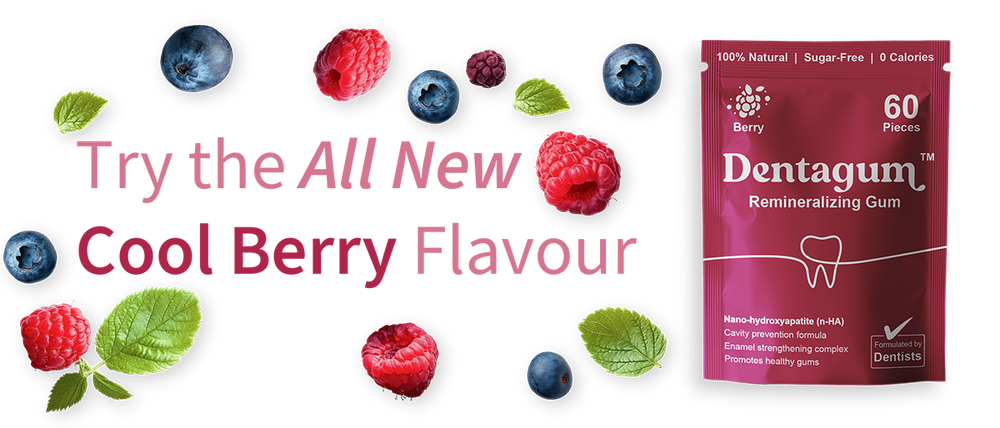
Dentagum's Remineralizing Chewing Gum delivers nano-hydroxyapatite alongside organic xylitol and mastic gum, built specifically for the 10 to 20 minutes after eating when toothpaste is not an option but your enamel's recovery window is most active. It is designed to complement a nano-hydroxyapatite or fluoride toothpaste, extending the same benefits covered throughout this guide into the hours brushing cannot reach.

Frequently asked questions
The evidence is real and independently reproduced across multiple research groups: remineralization confirmed via x-ray in clinical trials, a 39.5% sensitivity reduction across 44 trials, measurable biofilm reduction in both lab and patient studies, and non-inferiority to fluoride in an 18-month adult trial. This goes well beyond marketing claims into genuine, replicated clinical data.
Yes. Multiple studies have found nano-hydroxyapatite reduces biofilm coverage on tooth surfaces without disrupting the mouth's broader bacterial balance, and a randomized clinical trial found daily use reduced new plaque formation in real patients, in addition to its remineralizing and sensitivity benefits.
The main limitation is scope, not safety: it works on early-stage enamel damage, not an existing cavity, and it does not yet carry the ADA Seal or FDA drug approval in the US, though this reflects a regulatory pathway gap rather than a finding against its safety or efficacy.
Twice-daily brushing with a nano-hydroxyapatite toothpaste covers the concentrated dose during your normal routine; adding a nano-hydroxyapatite gum after meals extends the same benefit into the hours between brushings, when acid exposure is actually happening and a toothbrush is not an option.
The Bottom Line
Hydroxyapatite is good for your teeth, and the evidence backing that up is broader than most single-benefit summaries suggest: real remineralization confirmed on dental x-rays, a documented 39.5% reduction in sensitivity, measurable plaque and biofilm reduction, a thoroughly reviewed safety profile, and performance matching fluoride directly in adult trials. Its scope is early-stage enamel damage, not an existing cavity, but within that scope, this is one of the best-evidenced ingredients in modern oral care.
The evidence holds up from every angle it's been tested.
See how Dentagum delivers it at dentagum.coResearch Summary
- Randomized clinical trial, n=92 patients, 546 lesions: nano-hydroxyapatite gel produced x-ray-confirmed remineralization in 36.5% of early lesions at 1 year.
- Limeback, Enax, Meyer, Biomimetics 2023: meta-analysis of 44 trials found 39.5% reduction in dentin hypersensitivity versus placebo.
- In situ biofilm study (Nanomaterials, 2021): 5% hydroxyapatite nanoparticle solutions reduced biofilm coverage across enamel, titanium, ceramic, and resin surfaces without disrupting bacterial viability.
- Harks et al., PLoS One, 2016: randomized trial found daily microcrystalline hydroxyapatite dentifrice reduced de novo plaque formation.
- SCCS/1648/22 Final Opinion (2023): rod-shaped nano-hydroxyapatite confirmed safe up to 10% in toothpaste after multi-year toxicology review.
- Paszynska E, et al., Frontiers in Public Health, 2023: 18-month adult RCT found nano-hydroxyapatite toothpaste non-inferior to 1,450 ppm fluoride toothpaste.
References
- "Effect of nano-hydroxyapatite and ozone on approximal initial caries: a randomized clinical trial." PMC. https://www.ncbi.nlm.nih.gov/pmc/articles/PMC7341873/
- Limeback H, Enax J, Meyer F. Systematic review and meta-analysis on hydroxyapatite in oral care. Biomimetics, 2023.
- "Hydroxyapatite-Based Solution as Adjunct Treatment for Biofilm Management: An In Situ Study." Nanomaterials, 2021. https://doi.org/10.3390/nano11092452
- Harks I, Jockel-Schneider Y, Schlagenhauf U, et al. "Impact of the daily use of a microcrystal hydroxyapatite dentifrice on de novo plaque formation and clinical/microbiological parameters of periodontal health." PLoS One, 2016;11(7):e160142.
- Scientific Committee on Consumer Safety. "SCCS/1648/22 Final Opinion on Hydroxyapatite (nano)." European Commission, March 23, 2023.
- Paszynska E, et al. "Caries-preventing effect of a hydroxyapatite-toothpaste in adults: a 18-month double-blinded randomized clinical trial." Frontiers in Public Health, 2023.
- "Antimicrobial and Antibiofilm Properties of Hydroxyapatite/Nano-Hydroxyapatite in Preventing Dental Caries: A Systematic Review." PMC, 2025. https://www.ncbi.nlm.nih.gov/pmc/articles/PMC12182413/
