
Enamel Remineralization: How Teeth Repair Naturally
Why can't teeth heal like skin or bone? Because enamel has no living cells at all. Here's the elegant saliva chemistry your body uses instead.

Your body repairs early enamel damage through a purely chemical process called remineralization, not a biological one. This is not a technicality: enamel contains zero living cells once a tooth erupts, so unlike skin, bone, or nearly every other tissue, it has no cellular repair route available at all. The only defense is your saliva, which stays supersaturated with calcium and phosphate specifically so it can redeposit mineral into weakened enamel. Special salivary proteins called statherin and proline-rich proteins keep that supersaturated saliva from spontaneously turning into rock inside your mouth, instead directing controlled mineral deposition to exactly where enamel needs it. Chewing amplifies this entire system by sharply increasing saliva flow, which is the direct mechanism behind why a remineralizing gum works.
Most explanations of "how teeth repair themselves" skip the most interesting part of the story: the actual physiology of why your body has to solve this problem so differently than it solves every other repair job. This guide goes into that mechanism specifically, the cellular biology of why enamel is unlike the rest of your body, the biochemistry that makes saliva-based repair possible at all, and exactly where chewing fits into amplifying a system your body already runs constantly, whether or not you ever think about it.
Why enamel can't heal like the rest of your body
When you cut your skin or break a bone, your body sends living cells to the site of injury to rebuild it. Bone is a genuinely living tissue, roughly 70% mineral and 30% collagen, water, and living cells, threaded through with blood vessels that deliver everything a repair crew needs. Enamel works nothing like this. It is about 96% mineral by weight, with almost no protein, no cells, and no blood supply reaching it at all.
The reason traces back to how enamel is built in the first place. Specialized cells called ameloblasts lay down enamel during tooth development, and then, critically, they die once the tooth erupts through the gum. No replacement cells ever take their place. This means mature enamel has no cellular regeneration route available, structurally, ever again, for the rest of your life. Compare this to dentin, the layer just beneath enamel, which does retain some living cells (odontoblasts) capable of a limited, slow repair response, laying down what is called tertiary dentin in reaction to irritation. Even that response cannot reach through the enamel layer above it. Enamel is entirely on its own.
This is the physiological reason remineralization exists at all as a concept. It is not a bonus feature or an alternative healing method. It is the only mechanism available, because the cellular one that repairs virtually every other tissue in your body was never an option for enamel in the first place.
The clever chemistry that makes repair possible

Given that enamel cannot call in living cells, the entire repair burden falls on saliva, and the chemistry saliva uses to pull this off is genuinely elegant. Saliva is kept supersaturated with calcium and phosphate ions relative to enamel's mineral content, meaning it holds more dissolved mineral than a stable solution normally would. That supersaturation is exactly what makes redeposition onto enamel possible.
Here is the problem that creates: a solution that supersaturated should, by basic chemistry, spontaneously crystallize, precipitating calcium phosphate everywhere, not just where you need it. Your mouth does not turn to stone, and the reason is a small set of specialized salivary proteins, most importantly statherin and a family of acidic proline-rich proteins (PRPs). These proteins bind to calcium phosphate and actively inhibit spontaneous, uncontrolled crystal formation, while still allowing controlled, targeted deposition onto enamel surfaces that actually need it. Statherin in particular has an unusually high binding affinity for hydroxyapatite, letting it act with real precision.
Saliva needs to be concentrated enough with minerals to repair enamel, but not so uncontrolled that it calcifies indiscriminately. Statherin and proline-rich proteins are the regulatory system that threads that needle, which is also, not coincidentally, why saliva without these proteins functioning properly is linked to both under-mineralization and excessive calculus buildup.
This is a level of biochemical sophistication most explanations of "remineralization" skip entirely, and it is worth appreciating: your saliva is not just wet. It is a precisely regulated mineral delivery system, purpose-built for exactly this job. Statherin alone is a remarkably small molecule, just 43 amino acids, yet it carries an unusually high binding affinity for hydroxyapatite specifically, allowing a tiny quantity of protein to exert outsized control over where and how mineral gets laid down. Alongside statherin, a broader group of salivary proteins, including cystatins and histatins, contribute additional layers of regulation and antimicrobial defense, meaning the system protecting your enamel is not a single mechanism but a coordinated set of molecular tools working together.
Research has found that variation in salivary statherin and calcium levels correlates with differences in dental calculus formation between individuals, meaning this regulatory system genuinely differs from person to person, and likely helps explain why some people are naturally more prone to tartar buildup or cavities than others, independent of brushing habits alone.
The remineralization cycle, step by step
With that chemistry established, here is what actually happens over the course of an ordinary day. Oral bacteria metabolize sugars and starches from food, producing acid as a byproduct. That acid lowers your mouth's pH, and once it drops below approximately 5.5, calcium and phosphate ions begin dissolving out of your enamel's crystal structure faster than they redeposit, a process called demineralization.
As food clears and bacterial acid production slows, saliva's buffering capacity, largely from its bicarbonate content, neutralizes the acid and raises pH back toward neutral. Once conditions favor it again, the calcium and phosphate ions already dissolved in your supersaturated saliva, guided by statherin and PRPs, redeposit onto the weakened enamel surface, this is remineralization. This cycle runs dozens of times daily, essentially every time you eat or drink anything. You are not deficient in this system by default. You are running it constantly, whether you think about it or not.
What tips the balance toward repair

Since the same cycle runs constantly, the outcome over time depends on which side, demineralization or remineralization, gets more net time and resources. A few factors shift that balance meaningfully: how often you expose your mouth to acid-producing food (more frequent exposure means less net recovery time), how much saliva you produce and how effectively it buffers (affected by hydration, medication, and certain health conditions), and whether adequate calcium, phosphate, and vitamin D are available in your diet to keep saliva's mineral reserves stocked.
For the full practical breakdown of how to influence each of these levers day to day, including diet specifics and daily habits, see our complete guide on how to remineralize teeth.
How chewing amplifies your body's own system

This is where mechanical chewing enters the physiology directly, rather than as a separate add-on habit. Chewing stimulates the salivary glands, pushing flow from a resting rate of roughly 0.3 to 0.4 mL per minute up to 3 to 4 mL per minute or more. Since saliva is the entire delivery mechanism for the calcium, phosphate, statherin, and PRPs described above, more saliva flow directly means more of the raw material and regulatory machinery reaching your enamel during the window it matters most.
A remineralizing gum works within exactly this existing biology rather than introducing something foreign to it. Adding nano-hydroxyapatite to that saliva surge supplies additional bioavailable mineral directly into the system your body already runs, at the moment saliva flow, and therefore delivery capacity, is at its highest. Our guide on what the ADA says about chewing gum covers the official guidance behind this mechanism in more detail.
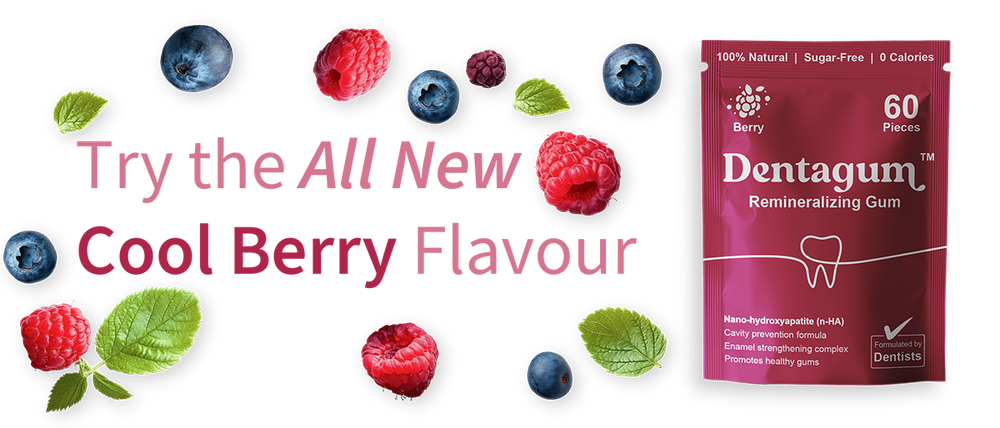
Dentagum's Remineralizing Chewing Gum works by amplifying this natural mechanism: chewing drives the same statherin-regulated saliva surge your body already produces, while nano-hydroxyapatite adds bioavailable mineral into that flow, right during the post-meal window when demineralization is most active.
The limits of this natural system
Because this entire system is chemical rather than cellular, it has a hard boundary. Remineralization can redeposit mineral into enamel that has softened or developed microscopic porosity, restoring density and hardness to existing structure. It cannot regrow enamel that has physically broken away into a cavity, because that would require laying down new structural material the way ameloblasts once did, and no living cells remain to do that job. This is the same acellular limitation covered above, simply showing up as a practical ceiling on what saliva chemistry alone can achieve.
This also explains why dental fillings exist as a category of treatment at all, rather than dentists simply prescribing better remineralization habits for every case. A filling is not competing with your body's natural repair system; it is stepping in specifically where that system has no mechanism to reach, replacing lost structure with an external material because no internal one is available. Understanding this distinction is genuinely useful: it means the goal of good oral hygiene is not to avoid ever needing a dentist, but to keep as much decay as possible within the range your own physiology can still repair.
Frequently asked questions
Enamel contains no living cells once a tooth erupts. The ameloblasts that build it die off at that point and are never replaced, so unlike skin or bone, there is no cellular repair mechanism available at all. The only repair route is the chemical process of remineralization, powered entirely by saliva.
Specific salivary proteins, primarily statherin and acidic proline-rich proteins, actively inhibit spontaneous, uncontrolled crystal formation while still allowing controlled, targeted mineral deposition onto enamel that needs it. This regulatory system is what keeps supersaturated saliva useful rather than simply turning to stone.
Chewing genuinely stimulates saliva flow, sometimes to 10 times the resting rate, and saliva is the entire delivery mechanism for the minerals and regulatory proteins involved in remineralization. This is a real, well-documented physiological effect, not a marketing claim layered on top of the biology.
No. Remineralization restores mineral density to enamel that has softened but remains structurally intact. It cannot regrow enamel that has physically broken away into a cavity, since that would require the same cellular construction process that built the enamel originally, and no living cells remain in mature enamel to perform it.

The Bottom Line
Your body repairs enamel through a purely chemical process because it has no other option: enamel contains no living cells once a tooth erupts. Saliva, kept supersaturated with calcium and phosphate and precisely regulated by proteins like statherin, is the entire repair mechanism available. Chewing amplifies this existing system by sharply increasing saliva flow, which is the real physiological reason a remineralizing gum works, supporting a process your body is already running, not replacing it with something new.
Not healing. Chemistry. And a genuinely elegant kind.
See how Dentagum supports this process at dentagum.coResearch Summary
- Salivary statherin and acidic proline-rich protein research: these proteins inhibit spontaneous calcium phosphate precipitation while permitting controlled deposition onto enamel, maintaining saliva's supersaturated but stable state.
- Enamel physiology research: mature enamel is roughly 96% mineral with no living cells or blood supply; ameloblasts die at tooth eruption and are never replaced, unlike bone's ~70% mineral, cell- and collagen-rich composition.
- Dentin repair research: unlike enamel, dentin retains living odontoblasts capable of limited tertiary dentin formation in response to irritation, though this cannot reach through enamel.
- ADA and salivary flow research: chewing stimulates saliva flow to roughly 10x the resting rate, directly increasing delivery of calcium, phosphate, and regulatory proteins to enamel.
- Amelogenin and enamel matrix protein research: amelogenin templates hydroxyapatite crystal formation during development, a process with no active counterpart in mature, erupted enamel.
References
- Schlesinger DH, Hay DI. "Complete covalent structure of a proline-rich phosphoprotein, PRP-2, an inhibitor of calcium phosphate crystal growth from human parotid saliva." PubMed. https://pubmed.ncbi.nlm.nih.gov/3710693/
- "Salivary Statherin - An Overview." EC Dental Science, 2022. https://ecronicon.net/assets/ecde/pdf/ECDE-21-01861.pdf
- "Dental Calculus Deposition: Correlation With Salivary Statherin and Calcium Levels." PMC. https://pmc.ncbi.nlm.nih.gov/articles/PMC12780543/
- "Why Don't Teeth Heal Like Skin And Other Body Parts?" ScienceABC. https://www.scienceabc.com/humans/why-dont-teeth-heal-like-skin-and-other-body-parts
- American Dental Association. "Chewing Gum." ADA Oral Health Topics. https://www.ada.org/resources/ada-library/oral-health-topics/chewing-gum
- "Amelogenin and Enamel Regeneration: The Matrix Protein That Templates Hydroxyapatite." Panacea Bio Chem. https://amelogenin.com/
