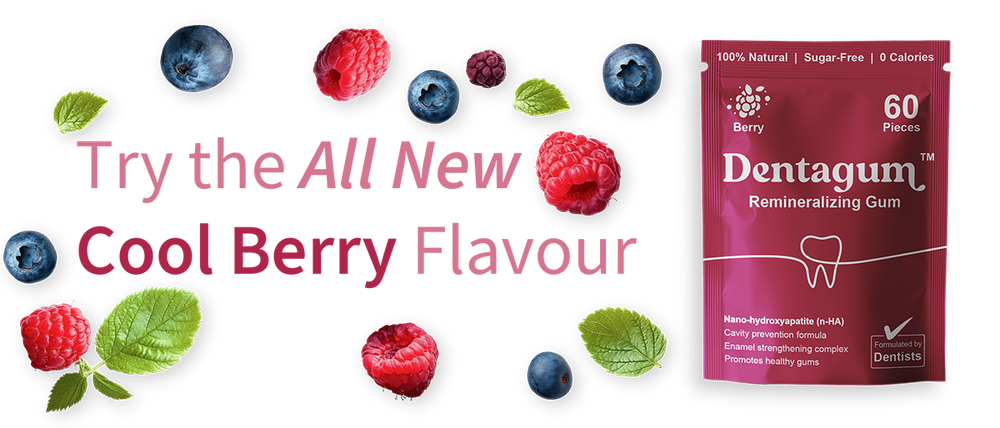

Dentagum vs Underbrush: Which Remineralizing Gum Wins?
Both Dentagum and Underbrush are genuinely well-formulated gums that share a strong foundation of nano-hydroxyapatite, xylitol, erythritol, and mastic gum. The differences that matter: Dentagum is Prop 65 tested through an accredited lab with publicly verifiable results, dentist-formulated with published clinical data across four outcomes, and adds propolis with documented antibacterial activity comparable to chlorhexidine. Underbrush is the right choice for vegan buyers.

Quick Answer
Both Dentagum and Underbrush are genuine functional gums that sit well above mainstream sugar-free options. They share a strong foundation: nano-hydroxyapatite, xylitol, erythritol, mastic gum, and a natural plant-based gum base. The differences that matter for most buyers are three: Dentagum is Prop 65 tested through an accredited lab with publicly verifiable results; Underbrush publishes no testing claims at all. Dentagum is dentist-formulated with published clinical outcome data; Underbrush was developed by its founder through personal research and publishes no clinical data. And Dentagum's formula includes propolis and organic eggshell powder, which add documented antibacterial and remineralization activity that Underbrush's doesn't replicate. Underbrush is the cleaner choice for vegan buyers. For everyone else, Dentagum is the stronger daily oral care product.
Last updated: June 2026 | Ingredient data confirmed from current Amazon listings and brand websites. Research sourced from peer-reviewed literature.
Remineralizing gum has gone from a niche wellness curiosity to a legitimate category, and Dentagum and Underbrush are two of the most talked-about brands in it. Both have earned that attention. Both use ingredients that actually do something. Picking between them means understanding where they genuinely converge, where they part ways, and which differences actually matter for your teeth.
This article compares them head to head on formula, testing transparency, clinical backing, value, and who each product is actually built for. It's fair to both.
At a Glance: Side-by-Side
Here is how the two products compare across the criteria that matter most for a daily oral health decision.
| Criterion | Dentagum | Underbrush |
|---|---|---|
| Price per piece | $0.55 (60 pieces / $32.97) | ~$0.47-0.53 (72 pieces / ~$34-38 as 4-pack) |
| Nano-hydroxyapatite | Yes | Yes |
| Xylitol + Erythritol | Yes | Yes |
| Mastic gum | Yes (organic) | Yes |
| Natural gum base | Organic chicle | Chicle, spruce, acacia, myrrh |
| Propolis | Yes | No |
| Eggshell powder | Yes (organic) | No |
| Vegan | No (eggshell powder) | Yes |
| Third-party testing | Prop 65 via Lightlabs (verifiable) | None disclosed |
| Dentist-formulated | Yes | No (founder-formulated) |
| Published clinical data | Yes (4 outcomes) | No |
| Verified Amazon reviews | 707 reviews, 4.4 stars | Distorted by counterfeit issue |
What Both Gums Get Right

Before getting into the differences, the common ground is worth acknowledging. Both Dentagum and Underbrush made genuine decisions that separate them from mainstream gum.
Both use nano-hydroxyapatite as the primary remineralizing ingredient. That distinction matters: nano-HAp at 20 to 100 nanometres can penetrate the microporosities of early acid-weakened enamel and deposit the same mineral that enamel is made of. Standard hydroxyapatite particles, 50 to 500 times larger, sit on the surface and polish. A 2023 systematic review and meta-analysis by Limeback, Enax, and Meyer covering 44 clinical trials found nano-HAp reduced dentin hypersensitivity by 39.5% versus placebo. Both brands understood that this distinction mattered and built it into their formulas.
Both use xylitol and erythritol as their primary sweeteners. Xylitol's mechanism against Streptococcus mutans is one of the most well-characterized targeted antimicrobials in dental research: the bacterium imports xylitol through its phosphotransferase transport system expecting to metabolize it, gets trapped in a futile energy cycle it cannot complete, and dies. A 2025 systematic review in BMC Oral Health found xylitol gum significantly reduced S. mutans counts in 12 of 14 clinical studies reviewed. Erythritol complements it by inhibiting bacterial adhesion to tooth surfaces through a different mechanism.
Both use mastic gum, the resin from Pistacia lentiscus, as part of their natural gum base. A 2023 state-of-the-art review in the Journal of Natural Medicine (Alwadi et al.) confirmed mastic gum's antibacterial, anti-inflammatory, and antimicrobial properties across 14 independent clinical studies. Neither brand uses a petroleum-derived synthetic polymer base.
In a category where most gum is still made from synthetic petrochemical bases with artificial sweeteners, both companies made the right foundational decisions. The comparison from here is about what sits on top of that shared foundation.
The Formula Comparison
Both formulas build on the same strong foundation. Where they diverge is in the supporting active ingredients and the gum base composition.
The Gum Base
Underbrush uses a multi-resin base: chicle, mastic, spruce, myrrh, and acacia gum. Five natural tree resins blended together, which produces a distinct, earthy chewing experience that many users specifically prefer and find more satisfying than conventional gum.
Dentagum uses organic chicle combined with organic mastic gum. Simpler, more focused, and every component serves a documented purpose. Organic chicle provides a clean, biodegradable texture. Organic mastic gum provides the antibacterial and anti-inflammatory activity confirmed across 14 clinical studies. Spruce gum, acacia gum, and myrrh have natural material histories and some traditional use in oral care, but their clinical evidence for oral health benefit is considerably thinner than mastic's documented properties.
The Propolis Question

This is the most significant active formula difference. Dentagum includes natural propolis; Underbrush does not.
Propolis is a resinous compound produced by bees from plant resins, containing over 300 bioactive compounds including flavonoids and phenolic acids with potent antimicrobial, anti-inflammatory, and anti-biofilm activity. A 2025 systematic review published in BDJ Open found that propolis exhibited a comparable antiplaque effect, and in some studies a superior one, to chlorhexidine, the clinical gold standard antiseptic in periodontics. A 2024 randomized controlled clinical trial published in BMC Complementary Medicine and Therapeutics (Gunjal and Pateel) demonstrated that propolis mouthwash produced significant improvement in gingival health and plaque reduction comparable to chlorhexidine in patients with chronic generalized gingivitis. A 2025 study published in BMC Oral Health (Khabazian et al.) specifically investigated propolis-containing chewing gum versus propolis-containing mouthwash for reducing gingival inflammation, confirming the gum delivery format delivers meaningful clinical activity.
The practical significance: in a gum chewed for 10 to 20 minutes after meals, propolis delivers sustained antimicrobial contact throughout the entire chewing window. It adds a clinically supported antibacterial layer on top of the xylitol and mastic foundation that Underbrush's formula simply doesn't replicate.
Critically, propolis achieves this without the microbiome disruption risk of chlorhexidine or alcohol-based mouthwashes. As covered in our article on the oral microbiome, broad-spectrum antiseptics eliminate beneficial bacteria alongside pathogens. Propolis' selective activity makes it a more microbiome-compatible antibacterial choice for daily use.
Organic Eggshell Powder
Dentagum includes organic eggshell powder; Underbrush uses calcium carbonate directly. The distinction matters beyond semantics. A 2026 PROSPERO-registered systematic review and meta-analysis published in Odontology (covering 17 in vitro studies) found that eggshell extract significantly improved enamel microhardness, with the calcium-to-phosphate ratio of treated enamel also improving. Eggshell calcium carbonate has a specific mineral profile that provides remineralization support alongside the nano-HAp. Underbrush's calcium carbonate does not have equivalent peer-reviewed data specifically on enamel microhardness improvement.
Dentagum's Active Additions vs. Underbrush
- Natural Propolis: Broad-spectrum antimicrobial; comparable to chlorhexidine in multiple trials for plaque and gingival inflammation; specific evidence for propolis chewing gum (BMC Oral Health, 2025); not microbiome-disrupting
- Organic Eggshell Powder: Significant enamel microhardness improvement across 17 in vitro studies (Odontology, 2026 PROSPERO meta-analysis); specific calcium-to-phosphate ratio that supports remineralization alongside nano-HAp
- Coconut Oil: Lauric acid provides mild anti-inflammatory support in oral soft tissue
- Natural Terpene Blend (Menthone, Carvone, Cineol): Cineol has documented antimicrobial properties beyond providing flavor
Third-Party Testing: The Clearest Differentiator
This is not a close comparison. It's the most straightforward distinction between the two brands.
Underbrush publishes no third-party testing claims anywhere on its website or Amazon listing. No lab name, no certificates of analysis, no testing methodology disclosed. For a product positioned as a health-focused daily oral care tool that people put in their mouths two to four times a day, that is a significant gap.
Dentagum is independently tested for Proposition 65 heavy metals through Lightlabs, an ISO/IEC 17025 accredited third-party laboratory (PJLA #128155). Those results are publicly accessible and verifiable at lightlabs.com. Anyone can look them up before purchasing.
Prop 65 is California's Safe Drinking Water and Toxic Enforcement Act, which sets heavy metal safety thresholds significantly more stringent than standard FDA limits. It tests for lead, cadmium, arsenic, and mercury. Dentagum's June 2026 results: arsenic at 0.02 mcg per serving (500x below the Prop 65 threshold), cadmium at 0.003 mcg (1,367x below), lead at 0.09 mcg (5.5x below), mercury non-detected.
Passing Prop 65 through a named, accredited lab with publicly accessible results is not a badge on a website. It's a result you can independently verify before purchasing. No other remineralizing gum brand in the US publishes equivalent verifiable third-party safety data.
Why Third-Party Testing Matters for Daily Chewing Gum
- Chewing gum has prolonged mucosal contact: ingredients are in contact with oral tissue for 10 to 20 minutes per session, 2 to 4 times daily
- Heavy metals including lead, cadmium, arsenic, and mercury are naturally present in soil and can enter any plant-derived ingredient without independent testing to confirm they are within safe limits
- Prop 65 thresholds are set well below FDA limits: passing Prop 65 is a higher bar than standard compliance
- Lightlabs is ISO/IEC 17025 accredited (PJLA #128155): results are not self-certified; they are independently verified
- Results are at lightlabs.com: you do not have to take anyone's word for it
Dentist-Formulated vs. Founder-Formulated
Dentagum is dentist-formulated. The formula was developed with the direct involvement of qualified dental professionals who understand enamel biology, oral microbiology, and the clinical evidence behind each ingredient. The result is a product built around documented dental science, reflected in the published clinical outcome data across four oral health markers.
Underbrush was created by its founder through personal interest and self-guided research. The brand's own About page describes nearly two years of personal experimentation, reformulating, and testing. That founding story is genuine, and the passion behind it is real. But consulting with dental experts during development and being formulated by dental professionals are meaningfully different things.
This distinction matters because formulation decisions compound. Which nano-HAp particle size, which concentration of xylitol, which combination of antibacterial ingredients work synergistically rather than redundantly, what the appropriate contact time is for each ingredient to deliver clinical benefit: these are questions that dental professionals answer from a clinical evidence base that a self-directed personal research process does not replicate.
Clinical Data

Dentagum publishes clinical outcome data from its own trials (internal clinical data, not peer-reviewed independent studies):
- 83% of participants showed notable gains in enamel quality and mineral quantity
- 91% reported significant reduction in tooth sensitivity to cold
- 87% were less susceptible to cavities compared to non-users
- 79% experienced clinical reduction in gum inflammation
Underbrush does not publish clinical outcome data for its formula. The brand references the broader ingredient literature, which is legitimate, but no formula-specific clinical results are disclosed.
Both brands sit on a strong foundation of ingredient-level peer-reviewed research. Only Dentagum also provides data specific to the finished product's performance across actual users.
Value Per Piece
Dentagum: 60 pieces per pouch at $32.97 works out to $0.55 per piece. One pouch, no multi-pack requirement, ships at a single purchase.
Underbrush: sold in 18-piece boxes. The standard Amazon purchase is a 4-pack of 18-piece boxes (72 pieces), priced at approximately $34 to $38, working out to roughly $0.47 to $0.53 per piece. On a pure per-piece basis at the 4-pack price point, Underbrush is marginally cheaper. At single-box pricing, the calculation reverses. If you're comparing both at a single-purchase entry point, Dentagum at $32.97 for 60 pieces is the cleaner deal without requiring a 4-pack commitment.
For a habit you're building long-term, chewing two to four pieces a day, the monthly cost difference at either price point is small. The more relevant comparison is what each dollar buys you in terms of formula depth and testing confidence.
Verified Customer Data
Dentagum holds 4.4 out of 5 stars from 707 verified Amazon reviews: 529 on Mint, 178 on Berry. That volume of consistent, high-rated feedback from verified buyers across two separate flavor SKUs over an extended period is one of the most reliable signals available that a product delivers on its daily-use promise.
Underbrush's Amazon rating has been complicated by a documented counterfeit problem. Independent review sites noted that third-party sellers hijacked Underbrush's Amazon listings and sold inferior knockoffs under the same product pages, pulling the aggregate rating down with reviews that weren't for the genuine product. Given that, it would not be fair to use Underbrush's Amazon star average against them here. What it does mean is that the Amazon rating is not a reliable signal for Underbrush in either direction.
Where Underbrush Has Genuine Strengths
A fair comparison gives credit where it's due, and Underbrush has real differentiators worth acknowledging.
The multi-resin gum base is a genuine sensory preference for many users. The combination of mastic, spruce, chicle, myrrh, and acacia resins produces a texture that feels earthy, botanical, and genuinely different from conventional gum. For buyers who want the most natural chewing experience possible and find that texture distinctly satisfying, that's a legitimate draw that Dentagum's cleaner base doesn't replicate.
Underbrush is fully vegan. It contains no animal-derived ingredients. Dentagum's organic eggshell powder makes it unsuitable for vegan, vegetarian, kosher, and halal buyers. On this criterion specifically, Underbrush is the only appropriate choice.
Underbrush also has genuine brand authenticity. The founding story is well-documented and the community around the brand is real. For buyers who want to feel connected to a founder-driven mission, that matters in a way that formula specs don't capture.
The Honest Underbrush Strengths
- Fully vegan: No animal-derived ingredients. Suitable for vegan, vegetarian, kosher, and halal buyers. Dentagum is not.
- Multi-resin base texture: The chicle, spruce, mastic, myrrh, and acacia blend creates a distinct earthy chewing experience that many users specifically prefer
- Founder authenticity: Genuine origin story with a real community built around the brand
- Shared strong foundation: Nano-HAp, dual polyol system, mastic gum, and natural base are the right ingredients and Underbrush deserves credit for getting those right
The Verdict: Who Each Gum Is For
Dentagum is the stronger daily oral care choice for most people. The testing transparency is not a minor point: putting something in your mouth two to four times a day over months deserves verifiable safety evidence, and Dentagum is the only brand in this category that provides it. The propolis addition is clinically meaningful, not decorative. The dentist formulation and published clinical data add confidence that the formula was built for outcomes rather than positioning. And 707 verified reviews averaging 4.4 stars say, consistently, that it delivers.
Underbrush is the right choice for vegan buyers. Full stop on that one: the eggshell powder makes Dentagum incompatible with vegan, vegetarian, kosher, and halal diets, and if that matters to you, Underbrush is the better-formulated option you can actually use. If you are specifically drawn to the botanical multi-resin texture and chewing experience, and testing transparency is less of a priority, Underbrush is a genuinely good product that got the core formula right.
For a deeper look at the science behind what separates functional gum from mainstream sugar-free options, see our guide on what remineralizing gum actually does, or our breakdown of the science behind nano-hydroxyapatite.
Frequently Asked Questions
Is Dentagum better than Underbrush?
For most buyers, yes. Dentagum has 707 verified Amazon reviews averaging 4.4 stars, Prop 65 heavy metals testing through Lightlabs with publicly verifiable results (the only brand in the category to provide this), a dentist-formulated clinical data set across four health outcomes, and a broader active formula including propolis and organic eggshell powder. Both formulas share a strong nano-HAp, xylitol, erythritol, and mastic gum foundation, but Dentagum goes further in antibacterial coverage and verifiable safety standards. Underbrush is the better choice for vegan buyers.
Does Underbrush do third-party testing?
No third-party testing claims appear on Underbrush's website or Amazon listing. No lab name, certificates of analysis, or testing methodology are disclosed publicly. Dentagum's Prop 65 heavy metals testing through Lightlabs (ISO/IEC 17025 accredited, PJLA #128155) is independently verifiable at lightlabs.com. Anyone can look up the results before purchasing.
Do both gums use mastic gum?
Yes. Both Dentagum and Underbrush include mastic gum in their formulas. A 2023 state-of-the-art review in the Journal of Natural Medicine confirmed mastic gum's antibacterial, antimicrobial, and anti-inflammatory properties across 14 independent clinical studies. This is one of the ingredients that genuinely separates both brands from less well-formulated competitors in the category.
Is Underbrush vegan?
Yes. Underbrush contains no animal-derived ingredients and is suitable for vegan, vegetarian, kosher, and halal buyers. Dentagum contains organic eggshell powder, which is animal-derived, making it incompatible with these dietary requirements. If vegan suitability matters to you, Underbrush is the appropriate choice between these two brands.
Which gum has more pieces per pack?
Underbrush is sold in 18-piece boxes, with a 4-pack giving 72 pieces at approximately $34 to $38. Dentagum comes with 60 pieces per pouch at $32.97, requiring no multi-pack purchase. At the single-purchase entry point, Dentagum provides more pieces at a lower price. At the 4-pack Underbrush price, the per-piece cost becomes comparable. For long-term daily use, the monthly cost difference between the two is small.
Does propolis in Dentagum make a difference?
Yes, meaningfully. A 2025 systematic review in BDJ Open found propolis exhibited comparable and in some studies superior antiplaque activity to chlorhexidine (the clinical gold standard antiseptic in periodontics). A 2024 randomized controlled trial in BMC Complementary Medicine confirmed propolis mouthwash produced significant gingival health and plaque improvements comparable to chlorhexidine. A 2025 BMC Oral Health study specifically tested propolis in chewing gum format and found meaningful reductions in gingival inflammation. Underbrush does not include propolis. Dentagum's 79% gum inflammation reduction in its internal clinical data reflects this combined antibacterial stack.
Bottom Line
Underbrush deserves credit for what it got right: early commitment to natural ingredients, a real founding story, and a formula that is meaningfully better than mainstream gum. In a category still dominated by synthetic bases and artificial sweeteners, that matters.
But when the comparison comes down to verifiable safety testing, clinical outcome data, antibacterial formula depth, and consistent verified customer feedback, Dentagum is the stronger product for most people. No testing claims versus publicly verifiable Prop 65 results through Lightlabs. No clinical data versus four documented health outcomes from internal trials. Propolis absent versus propolis working alongside the shared nano-HAp, xylitol, and mastic foundation. And 707 verified reviews at 4.4 stars telling you, consistently, that it delivers. If you follow a vegan diet, Underbrush is your choice. For everyone else, Dentagum is the product built to a higher standard of evidence.
Try Dentagum Risk-Free: 30-Day GuaranteeResearch Summary
This comparison is based on verified ingredient data confirmed from current Amazon listings and brand websites, peer-reviewed clinical literature, and publicly available testing records. Key sources include: Alwadi MAM et al., Journal of Natural Medicine, 2023 (mastic gum across 14 studies); Söderling E et al., BMC Oral Health, 2025 (xylitol gum and S. mutans reduction, 12 of 14 studies); Limeback H, Enax J, Meyer F, Biomimetics, 2023 (nano-HAp, 44 clinical trials, 39.5% sensitivity reduction); Gunjal S, Pateel DGS, BMC Complementary Medicine and Therapeutics, 2024 (propolis vs. chlorhexidine RCT); Khabazian A et al., BMC Oral Health, 2025 (propolis chewing gum for gingival inflammation); BDJ Open, 2025 (propolis systematic review vs. chlorhexidine); Odontology, 2026 PROSPERO meta-analysis (eggshell extract and enamel microhardness, 17 studies); Mäkinen KK et al., International Journal of Dentistry, 2016 (erythritol comparable to xylitol for oral health outcomes). Underbrush ingredient list confirmed from Amazon listing. Dentagum Prop 65 results: lightlabs.com. Dentagum clinical data: internal trials, not peer-reviewed independent research.
References
- Alwadi MAM et al. Mastic (Pistacia lentiscus) Gum and Oral Health: A State-of-the-Art Review. Journal of Natural Medicine. 2023. PubMed: 37147480. [14 independent studies confirming antibacterial, anti-inflammatory, antimicrobial properties]
- Söderling E et al. Specific Effects of Xylitol Chewing Gum on Mutans Streptococci. BMC Oral Health. 2025. DOI: 10.1186/s12903-025-06602-1. [Xylitol reduced S. mutans in 12 of 14 studies vs. sorbitol]
- Limeback H, Enax J, Meyer F. Clinical Evidence of Biomimetic Hydroxyapatite in Oral Care Products for Reducing Dentin Hypersensitivity. Biomimetics. 2023. PMC9844412. [44 clinical trials; 39.5% dentin hypersensitivity reduction vs. placebo]
- Gunjal S, Pateel DGS. Comparative effectiveness of Propolis with chlorhexidine mouthwash on gingivitis: a randomized controlled clinical study. BMC Complementary Medicine and Therapeutics. 2024;24:154. DOI: 10.1186/s12906-024-04456-8. [Propolis demonstrated significant improvement in gingival health and plaque reduction comparable to CHX]
- Khabazian A, Mirhashemi FS, Sadeghi F. Investigating the Effect of Propolis-Containing Chewing Gum in Comparison with Propolis-Containing Mouthwash on Reducing Gingival Inflammation in Patients with Gingivitis. BMC Oral Health. 2025;25:231. [Propolis chewing gum format confirmed for gingival inflammation reduction]
- Sycinska-Dziarnowska M et al. Propolis as a Natural Remedy in Reducing Dental Plaque and Gingival Inflammation: A Systematic Review and Meta-Analysis. Journal of Functional Biomaterials. 2025;16(9):336. DOI: 10.3390/jfb16090336. [Propolis comparable to or superior to CHX for antiplaque activity in multiple studies]
- Propolis mouthwashes efficacy in managing gingivitis and periodontitis: a systematic review. BDJ Open. 2025;11:5. DOI: 10.1038/s41405-025-00294-z. [Propolis showed comparable antiplaque effect to CHX; superior in some studies]
- In Vitro Remineralization Effectiveness of Eggshell Extract on Human Teeth: A Systematic Review and Meta-Analysis. Odontology. 2026. DOI: 10.1007/s10266-025-01265-4. [17 in vitro studies; significant enamel microhardness improvement; improved calcium-to-phosphate ratio]
- Mäkinen KK et al. Erythritol Is More Effective Than Xylitol and Sorbitol in Managing Oral Health Endpoints. International Journal of Dentistry. 2016. PMC5011233. [Erythritol comparable to xylitol for plaque reduction and S. mutans inhibition]
- Kiani S, Birang R, Jamshidian N. Effect of Propolis Mouthwash on Clinical Periodontal Parameters in Patients with Gingivitis: A Double-Blinded Randomized Clinical Trial. Int J Dent Hyg. 2022;20:434-440. DOI: 10.1111/idh.12550
- Lightlabs. Dentagum Prop 65 Heavy Metals Testing Results. lightlabs.com. June 2026. [ISO/IEC 17025 accredited, PJLA #128155; As 0.02 mcg, Cd 0.003 mcg, Pb 0.09 mcg, Hg ND]
- Dentagum Amazon listing. amazon.com/dp/B0FH77JJ7J. Reviewed June 2026. [707 verified reviews, 4.4 stars]
- Underbrush (Nathan and Sons) Amazon listing. Ingredient list confirmed June 2026: xylitol, erythritol, chicle gum, mastic gum, spruce gum, myrrh gum, acacia gum, nano-hydroxyapatite, calcium bentonite clay, calcium carbonate, natural flavors, stevia extract. 18-piece boxes.
