
Xylitol for Teeth: Benefits, Research, and How to Use It
Xylitol is a natural sugar alcohol with a specific, well-researched mechanism for reducing Streptococcus mutans, the primary cavity-causing bacterium. Unlike fluoride, which strengthens enamel against acid attack, xylitol targets the bacterial population that produces the acid in the first place. A 2025 systematic review found xylitol significantly reduced S. mutans in 12 of 14 clinical studies. Here's the complete picture: the mechanism, the research, the effective dose, and the best delivery forms.

Xylitol is a naturally occurring sugar alcohol with a specific, well-documented mechanism for reducing Streptococcus mutans (S. mutans), the primary cavity-causing bacterium. S. mutans transports xylitol into its cells through the same phosphotransferase system it uses for sucrose, expecting to metabolize it for energy. It cannot. The bacterium expends energy in a futile transport-and-expulsion cycle and eventually dies. Beneficial oral bacteria lack this vulnerability. A 2025 systematic review (Söderling et al., BMC Oral Health) found xylitol significantly reduced S. mutans in 12 of 14 clinical studies. Effective doses in clinical research range from approximately 5 to 10 grams per day, distributed across three to five exposures. The most effective delivery forms are those with sustained oral contact: chewing gum and lozenges outperform toothpaste and mouthwash because they keep xylitol in contact with the oral environment for longer. Figures from ingredient research.
1. What Xylitol Is
Xylitol is a five-carbon sugar alcohol (a polyol) found naturally in small amounts in many fruits and vegetables, including plums, strawberries, and birch bark. It has approximately the same sweetness as sucrose (table sugar) but provides about 40% fewer calories, metabolizes differently in the human body (not requiring insulin for initial metabolism), and has a glycemic index of approximately 7 compared to sucrose's 65. These properties made it attractive initially as a sweetener for diabetics and for dental-safe confectionery.
Its dental benefits were discovered somewhat accidentally during Finnish research in the 1970s, when a study comparing sugar-containing candy to xylitol-containing candy found that children consuming the xylitol candy had dramatically lower rates of new cavities than those consuming sugar candy. Subsequent decades of research characterized the specific mechanism: xylitol does not merely fail to feed cavity-causing bacteria the way sugar-free sweeteners like sorbitol do. It actively kills them through a targeted metabolic mechanism that leaves beneficial bacteria unharmed.
This distinction is critical to understanding why xylitol's oral health evidence base is stronger than that of other sugar-free sweeteners. Sorbitol, maltitol, erythritol, and other polyols used in sugar-free products are generally caries-neutral: they don't feed S. mutans because the bacteria cannot metabolize them efficiently. Xylitol goes further: it actively reduces the S. mutans population through the mechanism described in the next section.
Many sugar-free gums, mints, and dental products use sorbitol as their primary sweetener and include xylitol as a minor secondary ingredient. Products labeled "contains xylitol" may have very little of it. Sorbitol is caries-neutral but does not provide xylitol's active antibacterial benefit. For meaningful dental benefit, xylitol should be the primary sweetener listed first in the ingredient list, at concentrations sufficient to deliver the 5 to 10 grams per day that clinical research has used. Checking whether xylitol or sorbitol is listed first is the most important label-reading skill for dental xylitol products.
2. How Xylitol Kills Cavity-Causing Bacteria

The mechanism by which xylitol reduces S. mutans is specific, well-characterized at the molecular level, and explains why it works when other sugar-free sweeteners do not produce the same effect.
S. mutans is the primary cariogenic (cavity-causing) bacterium because of its efficient metabolism of dietary sugars. It uses a phosphoenolpyruvate-dependent phosphotransferase system (PTS) to transport sugars (primarily sucrose and glucose) into the cell, simultaneously phosphorylating them for immediate metabolic use. The end product is lactic acid, which lowers oral pH below the critical 5.5 threshold at which enamel demineralization occurs.
Xylitol enters the S. mutans cell through the same PTS transport system that the bacterium uses for fructose. The bacterium transports xylitol in, expecting a metabolizable sugar. It cannot metabolize xylitol. The phosphorylated xylitol (xylitol-5-phosphate) that forms inside the cell is a dead-end metabolite: it accumulates in the cell, cannot be further processed, and must be expelled. The bacterium's phosphatase enzymes dephosphorylate it and expel it back out. The bacterium then transports it back in, phosphorylates it again, expels it again. This futile cycle continues, consuming ATP (the cell's energy currency) without producing any energy return. The bacterium starves of energy while also being physically inhibited from transporting useful sugars through the same system now occupied with xylitol cycling. Over time, the S. mutans cells die.
The elegance of this mechanism from an oral health perspective: beneficial oral bacteria (Streptococcus salivarius, Lactobacillus species, and others that support a healthy oral microbiome) do not have the same fructose-PTS vulnerability. They either do not transport xylitol at all, or metabolize small amounts harmlessly. Xylitol's antibacterial action is selectively targeted at the specific pathogenic species responsible for cavity formation, without disrupting the beneficial bacterial populations that protect against periodontal disease and support overall oral microbiome health.
This selectivity is what separates xylitol from broad-spectrum oral antiseptics like chlorhexidine: chlorhexidine is highly effective at reducing total bacterial load including S. mutans, but also disrupts beneficial bacteria and produces staining, taste alteration, and dysbiosis with prolonged use. Xylitol reduces S. mutans specifically, protecting the broader microbiome balance.
3. What the Research Shows
Xylitol has one of the most extensively studied evidence bases of any oral care ingredient. The clinical literature spans over five decades, multiple countries, diverse patient populations, and a wide range of delivery forms and dosing protocols.
The 2025 systematic review
The most comprehensive recent summary of the xylitol evidence base is Söderling et al. (BMC Oral Health, 2025), a systematic review of clinical studies examining xylitol's effect on S. mutans levels. The review found xylitol significantly reduced S. mutans in 12 of 14 clinical studies reviewed. The two studies that did not find a significant effect used lower doses or less effective delivery forms. Across the studies that found significant effects, the magnitude of S. mutans reduction was clinically meaningful: not marginal improvements in bacterial counts, but substantial reductions in the pathogenic species most directly responsible for caries formation. Figures from ingredient research.
The Turku Sugar Studies (foundational)
The Turku Sugar Studies (Finland, 1972 to 1976) were the foundational clinical research that established xylitol's dental benefits. Participants consumed a diet where all sucrose was replaced either by fructose or by xylitol for two years. The xylitol group experienced a 85% reduction in new cavities compared to the sucrose group, and also fewer cavities than the fructose group. The mechanism investigations that followed these studies established the S. mutans PTS mechanism described above.
Cavity prevention in children
Multiple randomized controlled trials have examined xylitol's effect on cavity rates in children. The Ylivieska study (Finland) found that children whose mothers received xylitol gum intervention from shortly after birth to when their children were approximately two years old had significantly lower S. mutans colonization and lower cavity rates in their children compared to control groups. This research demonstrated that xylitol's S. mutans-reducing effect can have transgenerational implications: reducing maternal S. mutans reduces mother-to-child transmission of the bacterium.
Limitations and honest caveats
Not all xylitol research is equally positive, and two important caveats deserve acknowledgment. First, the evidence for xylitol as a direct cavity-prevention agent is strongest in populations with high caries risk and frequent sugar exposure; the incremental benefit in populations with already-low caries rates and good fluoride exposure is smaller. Second, the 2015 Cochrane review on xylitol for caries prevention concluded that while there was some evidence for benefit in chewing gum form, the overall evidence quality was limited by study heterogeneity and risk of bias. The 2025 Söderling review and subsequent research have added to the evidence base, but the Cochrane conclusion reflects an appropriately cautious view of what is and isn't firmly established. Xylitol's mechanism is well-understood and its antibacterial effect on S. mutans is consistently demonstrated; whether it translates to significantly fewer cavities across all populations and dosing situations is somewhat more variable in the evidence.
4. How Much Xylitol You Need
Dose is the most commonly misunderstood aspect of xylitol's dental benefits. Many products contain xylitol in amounts far below the threshold where clinical benefit has been demonstrated.
The range used in clinical research showing significant S. mutans reduction is typically 5 to 10 grams of xylitol per day. This is not a single exposure: it is distributed across multiple contacts throughout the day, ideally three to five separate exposures. The distribution across multiple daily contacts matters because xylitol's mechanism requires sustained presence in the oral environment to exert the futile cycling effect across the S. mutans population. A single large daily dose is less effective than multiple smaller exposures.
To put this in practical terms: a standard piece of xylitol gum typically contains 1 to 2 grams of xylitol. Five pieces throughout the day delivers 5 to 10 grams, within the effective dose range. A product containing 0.1 grams per piece, regardless of how prominently xylitol is featured in its marketing, is not delivering a clinically meaningful dose regardless of how many pieces are consumed in a typical session.
Checking the nutrition information or ingredient quantities on xylitol-containing products is the most practical way to assess whether a product is likely to deliver a therapeutically relevant dose. Products that list xylitol first in the sweetener ingredients and provide dosing information in grams are the most transparent about their clinical dose delivery.
5. Best Delivery Forms for Maximum Benefit

Not all xylitol products deliver equal oral health benefit. The two factors that determine effectiveness are dose (how much xylitol per use) and contact time (how long xylitol stays in contact with the oral environment). These factors explain why certain delivery forms consistently outperform others in the clinical literature.
Chewing gum is the gold standard delivery form. When you chew xylitol gum, several things happen simultaneously: mechanical chewing stimulates saliva production (which buffers the oral acid environment and delivers minerals to enamel), the xylitol in the gum is continuously dissolved and delivered to the oral environment throughout the chewing session, and the extended contact time (10 to 20 minutes) allows the xylitol to exert its futile-cycle mechanism on S. mutans across a meaningful portion of the oral bacterial population. The ADA endorses chewing sugar-free gum for 20 minutes after meals specifically for the cavity-prevention benefit via saliva stimulation. Xylitol gum does this and simultaneously delivers the targeted antibacterial action against S. mutans.
Lozenges and pastilles are the second most effective delivery form. They dissolve slowly over five to fifteen minutes, maintaining xylitol contact with the oral environment for a useful duration. They are a practical alternative for situations where gum is inappropriate (dental work, jaw conditions, preference).
Xylitol toothpaste provides xylitol benefit during the two to three minutes of brushing, but the short contact time limits the mechanism's effectiveness compared to gum or lozenges. Xylitol toothpaste is most useful as part of a broader xylitol routine rather than as a standalone intervention. The enamel-mineral benefit of nano-hydroxyapatite or fluoride in the toothpaste is typically the more significant functional contribution of this product category.
Whitening strips containing xylitol represent an underappreciated delivery form. A 30 to 60 minute whitening session with a strip containing xylitol in the gel formula provides sustained xylitol contact with the tooth and gum surfaces throughout the session. For the 14 days of a whitening treatment course, this is 14 sessions of extended xylitol exposure alongside the whitening benefit. The contact time is excellent; the limitation is that the amount of xylitol in a strip gel formula is less straightforwardly characterizable than in a gum where the xylitol content per piece is stated on the packaging.
6. Xylitol vs Fluoride: Different Mechanisms, Both Useful
A common question in the oral care space is whether xylitol and fluoride are competing approaches or complementary ones. The answer is clearly complementary, because they address different stages of the caries process through distinct mechanisms.
Fluoride's mechanism acts primarily at the enamel level. Fluoride ions incorporate into hydroxyapatite during remineralization, forming fluorapatite (Ca10(PO4)6F2), a more acid-resistant mineral form than the original hydroxyapatite (Ca10(PO4)6(OH)2). Fluoride makes enamel better able to withstand acid attack and speeds the remineralization process that restores mineral density after demineralization. Fluoride does not kill S. mutans, though at high concentrations it has some antibacterial properties. Its primary role is making enamel more resilient to the acid that bacteria produce.
Xylitol's mechanism acts at the bacterial level. It reduces the S. mutans population, which reduces the amount of lactic acid produced in the first place. Less acid means less demineralization, which means less work for fluoride and remineralization to counteract. Xylitol addresses the source of the acid; fluoride addresses the enamel's resistance to the acid.
Used together, they provide complementary, additive protection: xylitol reduces the bacterial population that produces acid, and fluoride strengthens the enamel against whatever acid is still produced. The combination is consistently more protective than either alone, and there are no compatibility concerns between them: fluoride and xylitol in the same product (xylitol-fluoride toothpaste) or in different products used in the same routine work synergistically.
Nano-hydroxyapatite adds a third layer to this picture: it delivers enamel mineral directly (the same mineral enamel is made from) to support the remineralization process at the mineral supply level, complementing both fluoride's acid resistance enhancement and xylitol's acid reduction. All three together represent a genuinely comprehensive approach to enamel mineral health.
7. Xylitol and Enamel Remineralization
Beyond its direct antibacterial action, xylitol contributes to enamel remineralization through a secondary mechanism: the elevated salivary calcium associated with xylitol consumption.
When xylitol enters the oral environment, saliva flow is stimulated (via the chewing action for gum, or via the sweet taste stimulus for lozenges). Stimulated saliva has a higher calcium and phosphate concentration than resting saliva. Higher salivary calcium and phosphate concentrations support remineralization because the driving force for mineral deposition into enamel microporosities is the concentration gradient between the supersaturated saliva and the partially demineralized enamel surface.
Additionally, some research has found that xylitol forms complexes with calcium ions that increase their bioavailability to the enamel surface. Xylitol-calcium complexes may deliver calcium to the enamel surface more efficiently than free calcium ions in saliva. This is the proposed mechanism behind the finding that xylitol can enhance remineralization beyond what its antibacterial action alone would produce.
The practical consequence: xylitol used after meals is addressing the caries risk cascade at two points simultaneously. It is reducing S. mutans (reducing acid production), and it is stimulating the calcium-rich saliva that drives remineralization of the enamel that has just been exposed to the post-meal acid environment. The post-meal window is the highest-risk window for both demineralization and remineralization: xylitol during this window intervenes at both stages.
8. Xylitol and Gum Health
The connection between xylitol and gum health is less directly studied than the S. mutans and caries connection, but the indirect pathway is logical and supported by the available research.
Periodontal pathogens (the bacteria responsible for gum disease, including Porphyromonas gingivalis, Tannerella forsythia, and Treponema denticola) are distinct from S. mutans and are not subject to the same xylitol-PTS mechanism. Xylitol does not directly kill the primary periodontal pathogens through the same futile transport cycle.
The gum health benefit of xylitol is more indirect. By reducing S. mutans and the overall fermentable carbohydrate exposure in the oral environment, xylitol reduces the plaque biofilm that forms the ecological foundation for periodontal pathogens. A healthier, less cariogenic oral microbiome is also generally a less periodontopathogenic one. Additionally, the elevated saliva flow stimulated by xylitol gum chewing washes periodontal pathogens away from the gumline and delivers antimicrobial salivary proteins to the gingival margin.
Some studies have found reductions in gingival bleeding and plaque scores with xylitol use, but this evidence is less robust and consistent than the S. mutans evidence. The ADA endorsement is specifically for caries prevention, not periodontal disease prevention. The gum health benefit of xylitol is real but should be understood as indirect and supplementary to the more directly supported antibacterial and remineralization benefits.
9. Xylitol in Dentagum Products

Xylitol is a functional active in both Dentagum products, and the delivery form in each case is optimized for the oral wellness window each product occupies.
Dentagum Remineralizing Chewing Gum
The remineralizing chewing gum is Dentagum's post-meal oral wellness product, and xylitol is one of its primary functional actives alongside nano-hydroxyapatite. The gum format is the gold-standard delivery form for xylitol's dental benefits: 20 minutes of chewing after a meal delivers xylitol at sustained concentration throughout the highest-risk window for both demineralization and bacterial acid production.
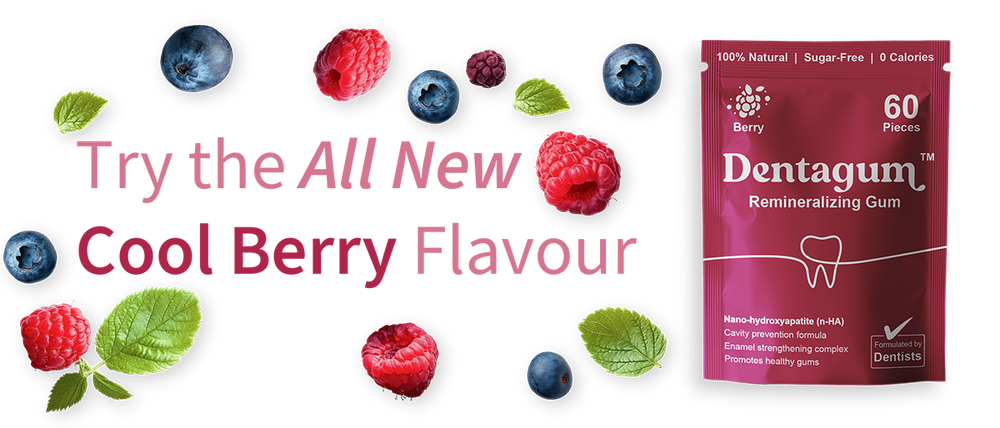
The combination of xylitol and nano-hydroxyapatite in the gum formula addresses the caries cascade at three simultaneous points: xylitol reduces S. mutans (less acid production), nano-hydroxyapatite delivers enamel mineral during the session (active remineralization), and the chewing-stimulated saliva increases calcium, phosphate, and antimicrobial protein delivery to the oral environment. The gum is available in Mint, Cool Berry, Watermelon, and Cool Mango flavors, each formulated around the same functional core.
Explore Dentagum Remineralizing GumDentagum Purple Whitening Strips

Xylitol is included in Dentagum's whitening strip gel formula as part of the broader oral wellness ingredient stack alongside PAP+ (the whitening active), nano-hydroxyapatite (enamel mineral support), potassium nitrate (sensitivity protection), niacinamide (gum tissue support), hydrolyzed collagen, and probiotics.
The whitening strip format is an underappreciated xylitol delivery form. Each 30 to 60 minute session provides sustained xylitol contact with tooth and gum surfaces throughout the treatment. For the full 14-day whitening course, this is 14 extended daily exposures of xylitol alongside all the other oral wellness benefits the formula delivers. The whitening strip is doing cosmetic work (PAP+ stain removal and violet color correction) and oral wellness work (enamel mineral support, sensitivity protection, antibacterial coverage, gum tissue support) simultaneously in each session.
The xylitol in the strips is not the primary antibacterial dose delivery (the remineralizing gum is better positioned for that role at the post-meal window), but it provides meaningful additional antibacterial exposure during the whitening session, contributing to the cumulative daily S. mutans reduction alongside any xylitol gum use in the routine.
Explore Dentagum Purple Whitening Strips10. Frequently Asked Questions
What does xylitol do for your teeth?
Xylitol reduces Streptococcus mutans, the primary cavity-causing bacterium, through a targeted metabolic mechanism. S. mutans transports xylitol into its cells through the same system it uses for fermentable sugars, cannot metabolize it, expends energy in a futile transport cycle, and dies. Beneficial bacteria are not affected. A 2025 systematic review found xylitol significantly reduced S. mutans in 12 of 14 clinical studies. The reduced bacterial population produces less lactic acid, which reduces enamel demineralization. Xylitol also stimulates saliva flow that supports remineralization. Figures from ingredient research.
How much xylitol do you need per day for dental benefits?
Clinical research showing significant S. mutans reduction has used doses ranging from approximately 5 to 10 grams per day, distributed across three to five separate exposures throughout the day. A single large daily dose is less effective than multiple smaller exposures because the mechanism requires sustained presence across multiple post-meal windows. A typical piece of xylitol gum contains 1 to 2 grams; five pieces through the day covers the clinical range. Products where xylitol is listed after sorbitol or other sweeteners may not deliver meaningful doses regardless of labeling.
Is xylitol gum better than xylitol toothpaste?
For xylitol's antibacterial dental benefit, yes. Chewing gum provides the two factors that determine xylitol effectiveness: adequate dose and extended contact time. A 10 to 20 minute gum session keeps xylitol in continuous oral contact at meaningful concentration, maximizing the futile transport cycle effect on S. mutans. Toothpaste provides xylitol during two to three minutes of brushing, which is useful but less contact time than gum. Toothpaste's primary functional contribution to enamel health is fluoride or nano-hydroxyapatite, not xylitol. The ADA specifically endorses chewing sugar-free gum after meals for cavity prevention, the same window where xylitol gum's benefits are maximized.
Does xylitol help with cavities?
Yes, primarily by reducing the bacterial source of the acid that causes cavities rather than by directly protecting enamel. By reducing S. mutans populations through the futile PTS transport mechanism, xylitol reduces lactic acid production in the oral environment. Less acid means less demineralization, which means fewer cavities developing. The Turku Sugar Studies found an 85% reduction in new cavities in the xylitol group versus the sucrose group over two years. Multiple subsequent RCTs have found significant cavity-prevention effects. The 2025 Söderling systematic review found significant S. mutans reduction (the primary mechanism of cavity prevention) in 12 of 14 studies. Figures from ingredient research.
Is xylitol better than fluoride for teeth?
They work through different mechanisms and are complementary rather than competitive. Fluoride acts at the enamel level: it strengthens enamel mineral and enhances remineralization. Xylitol acts at the bacterial level: it reduces the S. mutans population that produces the acid fluoride is defending against. Used together, they provide additive protection. Fluoride reduces the damage acid does to enamel; xylitol reduces the amount of acid produced. There are no compatibility concerns; xylitol-fluoride products are well-studied and appropriate for daily use.
Is xylitol safe for daily use?
Yes for humans at typical oral care doses. Xylitol is generally recognized as safe (GRAS) by the FDA, approved as a food additive by the EU (E967), and has been used in dental and food products for over five decades without documented human safety concerns at oral care doses. One important exception: xylitol is highly toxic to dogs. Even small amounts can cause severe hypoglycemia and liver failure in dogs. Xylitol-containing products should be kept entirely out of reach of dogs. For humans, the primary dose-dependent effect of very high xylitol consumption (well above typical oral care doses, generally above 40 to 50 grams per day) is laxative effect (loose stools), but this is not a concern at the 5 to 10 gram per day doses used for dental benefit.
Why is xylitol in whitening strips?
In whitening strips, xylitol provides antibacterial coverage during the treatment session. Each 30 to 60 minute strip session keeps xylitol in sustained contact with tooth and gum surfaces, giving the futile transport mechanism time to act on S. mutans during the whitening window. For a 14-day whitening course, this means 14 extended daily xylitol exposures alongside the whitening benefit. In a multi-benefit formula like Dentagum Purple Whitening Strips, xylitol contributes the antibacterial dimension while PAP+ whitens, nano-hydroxyapatite supports enamel mineral, potassium nitrate protects against sensitivity, niacinamide supports gum tissue, and probiotics support the oral microbiome. Each ingredient addresses a different aspect of oral wellness in the same session.
The Bottom Line
Xylitol is the oral care ingredient with the best-characterized targeted antibacterial mechanism: it kills S. mutans specifically and selectively through a futile metabolic transport cycle, without disrupting beneficial bacteria. A 2025 systematic review found significant S. mutans reduction in 12 of 14 clinical studies. Effective use requires the right dose (5 to 10 grams per day) distributed across multiple exposures, and the right delivery form: chewing gum and lozenges outperform toothpaste and mouthwash because extended oral contact time is necessary for the mechanism to exert meaningful effect on the bacterial population.
In the oral wellness framework, xylitol works best alongside nano-hydroxyapatite (which addresses enamel mineral status) and fluoride (which strengthens enamel against acid). Each targets a different stage of the caries cascade: xylitol reduces the bacteria producing acid, fluoride strengthens enamel against the acid, and nano-HAp actively rebuilds the mineral that acid attacks. Dentagum's remineralizing chewing gum delivers xylitol and nano-HAp together at the post-meal window where both are most effective. Dentagum's Purple Whitening Strips deliver xylitol as part of a seven-ingredient oral wellness formula during each whitening session, so the cosmetic treatment is also doing antibacterial work. Figures from ingredient research.
Explore Dentagum Remineralizing Gum Explore Dentagum Purple Whitening StripsResearch Summary
- Söderling E et al. BMC Oral Health, 2025. Systematic review: xylitol significantly reduced S. mutans in 12 of 14 clinical studies. doi:10.1186/s12903-025-06602-1. Figures from ingredient research.
- Turku Sugar Studies (Finland, 1972-1976). Foundational xylitol caries research. Xylitol group: approximately 85% fewer new cavities vs sucrose group over 2 years. Established PTS mechanism investigation.
- Ylivieska study (Finland). Maternal xylitol gum use reduced S. mutans transmission to children. Children of xylitol group mothers had significantly lower S. mutans colonization and cavity rates.
- Cochrane review, xylitol for caries prevention (2015). Some evidence for benefit in chewing gum form; overall evidence quality limited by study heterogeneity. Appropriately cautious position on all-population benefit.
- ADA endorsement. Chewing sugar-free gum for 20 minutes after meals for cavity prevention via saliva stimulation. Specifically supports gum as the most evidence-based delivery form for post-meal oral care benefit.
- Xylitol-PTS mechanism. Well-characterized at molecular level. Fructose-PTS transport of xylitol, phosphorylation to dead-end xylitol-5-phosphate, futile cycling, ATP depletion, S. mutans death. Beneficial bacteria unaffected due to lack of same vulnerability.
- Xylitol-calcium complexes. Proposed mechanism for enhanced remineralization beyond antibacterial action. Xylitol may increase bioavailability of calcium ions to enamel surface via complex formation.
- PMC8659594. Nano-HAp: approximately 40% enamel microhardness recovery in approximately 30 minutes in vitro. Complementary to xylitol in remineralization support. Figures from ingredient research.
