
Why More People Are Choosing Fluoride-Free Gum
Fluoride has been the gold standard in cavity prevention for decades. So why are millions of people actively looking for something different? Here's what's behind the shift, and what the science says actually works instead.

Fluoride-free oral care is one of the fastest-growing segments in the dental market, and the shift isn't driven by a lack of awareness. It's driven by people asking more specific questions about what they're putting in their mouths every day, and finding that credible, well-researched alternatives now exist. Remineralizing gum sits at the centre of that trend.
This article looks at what's actually behind the demand, what the science says about fluoride-free alternatives like nano-hydroxyapatite, and whether choosing fluoride-free means compromising on results.
The Numbers Behind the Shift
The scale of consumer movement away from fluoride is hard to ignore at this point.
Fluoride-free oral care products grew at 16% monthly from late 2023 into early 2024, compared to just 2.4% growth for fluoridated alternatives over the same period. The global fluoride-free toothpaste market was valued at $1.2 billion in 2024 and is projected to reach $2.5 billion by 2033, growing at a compound annual growth rate of 8.5%. North America leads the market with a 31.8% revenue share, and the remineralizing non-fluoride segment specifically led by formulation type in 2025.
This isn't a fringe trend. Millennials and Gen Z are driving most of the demand, and their reasons are consistent: preference for natural ingredients, concern about ingredient safety, and a growing expectation that oral care products be transparent about what they contain and why.
Why People Are Rethinking Fluoride
It's worth being clear about something upfront: fluoride works. Decades of clinical evidence support its role in cavity prevention, and the vast majority of dental professionals still recommend it. Choosing fluoride-free is a personal decision, not a medically necessary one for most people.
That said, the concerns driving the shift aren't without basis.
Dental fluorosis is the most commonly cited worry. It occurs when children consume too much fluoride during the years when teeth are developing, causing white spots or streaking on the enamel. It's largely cosmetic in mild cases, but it's real, and it's the reason pediatric dosing guidelines for fluoride toothpaste are age-specific and closely controlled.
Ingestion concerns in young children are the practical everyday version of that worry. Young children swallow toothpaste rather than spitting it out. Fluoride toothpaste isn't toxic in the small amounts used for brushing, but parents of toddlers and young children are understandably more comfortable with a product that carries no ingestion risk at all.
Fluorosis and overexposure risk at a population level have prompted regulatory responses in some countries. The NHS in the UK reported a 12% reduction in fluoride-based toothpaste sales in 2023 following stricter regulations on fluoride content in children's products.
General ingredient consciousness is the broader cultural shift underneath all of this. Consumers who scrutinize labels on food, skincare, and supplements are naturally going to ask the same questions about what they brush with twice a day. For some of them, fluoride clears that bar easily. For others, knowing that clinically validated alternatives now exist changes the calculation.
What Fluoride-Free Remineralization Actually Means
Fluoride prevents cavities by bonding with calcium and phosphate at the enamel surface to form fluorapatite, a more acid-resistant version of the natural enamel mineral. It's effective, well-understood, and backed by an enormous body of long-term evidence.
The alternative that's gained the most clinical traction is nano-hydroxyapatite (nano-HAp or nHA). Unlike fluoride, which modifies enamel's chemical structure to make it more resistant, nano-hydroxyapatite replenishes the same mineral that enamel is already made of. About 97% of your tooth enamel is hydroxyapatite. Nano-HAp delivers more of it in nanoparticle form, small enough to fill in the microscopic gaps and early lesions in your enamel directly.
A 2025 narrative review published in the Journal of Functional Biomaterials reviewed 15 clinical trials on hydroxyapatite in oral care and concluded that HAp is "a safe and effective alternative to fluoride, especially for children or individuals at risk of overexposure," with similar efficacy to fluoride in caries prevention and additional advantages for managing sensitivity.
An 18-month double-blinded randomized clinical trial published in Frontiers in Public Health in 2023 compared a 10% nano-HAp toothpaste directly against a standard 1,450 ppm fluoride toothpaste in adults. The two performed comparably for cavity prevention over the full 18 months. That's the kind of head-to-head clinical data that moves ingredients from "promising" to "credible alternative."
The EU Scientific Committee on Consumer Safety has confirmed nano-hydroxyapatite is safe in oral care products at concentrations up to 29.5%. It's non-toxic if swallowed in small amounts, which is a practical advantage for households with young children and an important part of why it's been the dominant oral care ingredient in Japan since the 1980s.
Why Gum Is a Particularly Useful Format for Fluoride-Free Oral Care
Most people think about fluoride-free oral care in the context of toothpaste. But gum is an interesting format for a specific reason: contact time.
Toothpaste stays in your mouth for roughly two minutes. Gum stays for ten to twenty. For a remineralizing ingredient like nano-hydroxyapatite, that extra contact time allows the particles to deposit on enamel surfaces and into the early lesions they're designed to repair. More time means more opportunity for the mineral exchange to happen.
Gum also stimulates saliva production during chewing. Saliva is your mouth's natural acid buffer, delivering calcium and phosphate to enamel and neutralizing the post-meal acid that drives demineralization. A remineralizing gum that combines nano-HAp with saliva stimulation works through two complementary mechanisms at once, and it does it during the window after meals when your enamel is most vulnerable and toothpaste isn't an option.
For people who've already switched to fluoride-free toothpaste, a fluoride-free remineralizing gum extends that philosophy into the rest of the day in a format that's practical to actually use.
Xylitol: The Other Fluoride-Free Workhorse
Nano-hydroxyapatite gets most of the attention in the fluoride-free conversation, but xylitol deserves a mention here because it works through a completely different mechanism and the two complement each other well.
Xylitol reduces the population of Streptococcus mutans in the mouth, the primary cavity-causing bacteria, by creating a futile metabolic cycle that drains the bacteria of energy and leads to cell death. Less S. mutans means less acid production after meals. Less acid means less enamel erosion over time. A 2025 systematic review published in BMC Oral Healthfound that xylitol gum significantly reduced mutans streptococci counts in 12 of 14 clinical studies compared to sorbitol gum.
Neither xylitol nor nano-HAp is fluoride. But used together in a gum format, they address the two core mechanisms that drive tooth decay: the bacterial environment and the mineral integrity of the enamel itself.
Is Fluoride-Free Right for Everyone?
Honest answer: not necessarily. The decision depends on your individual oral health situation, your risk profile, and your personal preferences.
People with a high cavity risk, a history of frequent decay, or significantly compromised enamel may find that fluoride's long track record and high-risk-use evidence make it the stronger choice for their circumstances. Fluoride is still what most dentists recommend as a first-line cavity prevention agent, and that recommendation is evidence-based.
But for people with generally good oral health who want to reduce their fluoride exposure, for parents of young children who want to eliminate ingestion risk, for people with sensitivity who find that nano-HAp's tubule-sealing mechanism works better for them, and for anyone who simply prefers ingredient-conscious products, fluoride-free remineralizing gum is a clinically supported option rather than a compromise.
The most important thing is not which ingredient you use, but whether your oral care routine is consistent, covers the windows in the day when your enamel needs support, and is complemented by regular dental check-ups. Your dentist is the right person to help you decide what makes sense for your specific situation.
What to Look for in a Fluoride-Free Remineralizing Gum
The fluoride-free market has grown fast, and not everything labeled "natural" or "clean" actually delivers remineralizing benefit. Here's what separates a genuinely useful product from one that's just trading on the trend.
Nano-hydroxyapatite (nHA): The ingredient with the strongest clinical evidence for fluoride-free remineralization. Check that it's listed explicitly, and that it's nano-sized. Standard hydroxyapatite particles are too large to penetrate enamel microporosities effectively.
Organic xylitol: A meaningful addition for bacterial reduction and cavity prevention. Look for organic sourcing if clean ingredients matter to you.
A natural gum base: Most commercial gum uses a petroleum-derived synthetic base. Chicle, derived from the sapodilla tree, is the natural alternative with a much cleaner ingredient profile.
No sugar: A non-negotiable. Any sugar in the formula directly counteracts the remineralizing and antibacterial benefits.
Third-party testing: Brands that invest in third-party testing are making a verifiable commitment to what's actually in the product.
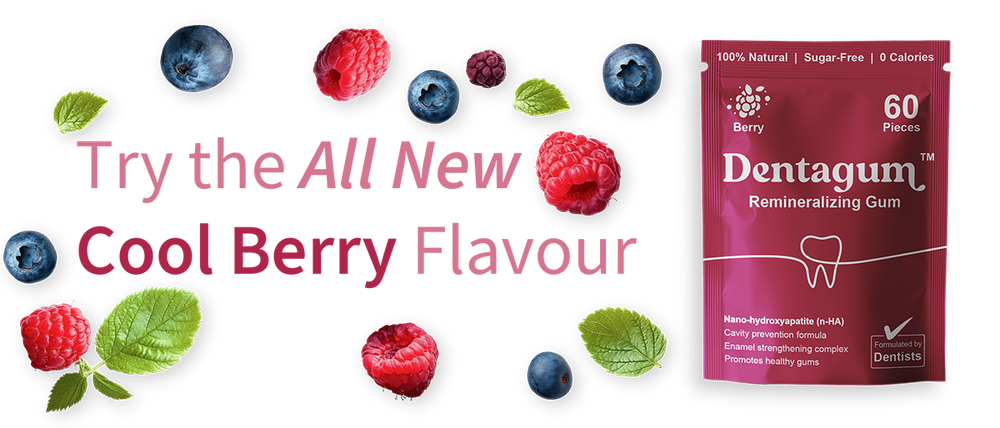
Dentagum's Remineralizing Chewing Gum combines nano-hydroxyapatite and organic xylitol in a chicle-based, sugar-free formula alongside mastic gum, natural propolis, organic eggshell powder, and calcium bentonite clay. It's dentist-formulated, 3rd-party tested, and designed to be chewed for 10-20 minutes after meals. In Dentagum's own clinical data, 83% of participants showed notable gains in enamel quality and mineral quantity with consistent daily use. Try it risk-free with a 30-day guarantee at dentagum.co.
Frequently Asked Questions
Is fluoride-free gum as effective as fluoride gum for preventing cavities?
When the fluoride-free gum contains nano-hydroxyapatite, the clinical evidence suggests comparable effectiveness for most people. An 18-month randomized controlled trial published in Frontiers in Public Health in 2023 found that a 10% nano-HAp product performed comparably to standard 1,450 ppm fluoride toothpaste for cavity prevention in adults. For high-risk individuals, fluoride's stronger body of long-term evidence still makes it the recommended choice.
Why are people choosing fluoride-free oral care?
The main reasons are concern about dental fluorosis risk in children, preference for natural or clean-label ingredients, ingestion safety for young children, and the growing clinical evidence supporting fluoride-free alternatives like nano-hydroxyapatite. The shift is most pronounced among Millennials and Gen Z consumers who apply the same ingredient scrutiny to oral care as they do to food and skincare.
What does fluoride-free remineralizing gum actually do?
It delivers remineralizing minerals, primarily nano-hydroxyapatite, directly to the tooth surface during the chewing window after meals. The nanoparticles deposit on enamel and fill microscopic lesions, while chewing stimulates saliva that naturally buffers post-meal acid. Xylitol in the formula also reduces acid-producing bacteria over time.
Is fluoride-free gum safe for children?
Nano-hydroxyapatite is non-toxic when swallowed in small amounts, which makes it a practical choice for young children who can't reliably spit. A 2024 systematic review described it as an ideal substitute for fluoride in toothpaste for young children for this reason. That said, gum in general should be used with supervision for young children, and you should check the appropriate age guidance on any specific product.
What ingredients should I look for in fluoride-free remineralizing gum?
Nano-hydroxyapatite is the primary remineralizing ingredient to look for. Organic xylitol adds meaningful antibacterial benefit. A natural chicle gum base is preferable to synthetic petroleum-derived alternatives. The formula should be sugar-free, and third-party testing is a useful trust signal.
Does fluoride-free mean less effective oral care?
Not necessarily. For people with average cavity risk, fluoride-free products containing nano-hydroxyapatite have demonstrated comparable results to fluoride in recent clinical trials. Effectiveness depends on the specific ingredients, their concentrations, and how consistently you use the product. A fluoride-free routine that you stick to beats a fluoride routine you don't.
The Bottom Line
The move toward fluoride-free oral care is backed by real shifts in consumer priorities, growing clinical evidence for alternatives, and a broader cultural preference for ingredient transparency. It's not anti-science. It's a response to science catching up with consumer demand.
Nano-hydroxyapatite is the ingredient doing the most heavy lifting in the fluoride-free space, and the clinical case for it has strengthened considerably over the last few years. For anyone already thinking about making the switch, or simply curious about what's driving the trend, remineralizing gum is one of the more practical formats to explore. It fits into daily life, works during the post-meal window when teeth need the most support, and pairs nano-HAp's structural remineralization with xylitol's bacterial reduction in a single habit.
Dentagum's Remineralizing Chewing Gum is dentist-formulated with nano-hydroxyapatite, organic xylitol, and mastic gum, designed to fit into your routine after meals. Try it risk-free with a 30-day guarantee at dentagum.co.
RESEARCH SUMMARY
- Naim J, Sen S. "The Remineralizing and Desensitizing Potential of Hydroxyapatite in Dentistry: A Narrative Review of Recent Clinical Evidence." Journal of Functional Biomaterials (MDPI), 2025. Reviewed 15 clinical studies. Key finding: HAp is a safe and effective alternative to fluoride with similar efficacy in caries prevention, plus additional advantages for sensitivity.
- Fluoride-Free Toothpaste Market Research, multiple sources (2024-2026). Fluoride-free oral care sales grew 16% monthly from late 2023 to early 2024, compared to 2.4% growth for fluoridated products. Global market valued at $1.2 billion in 2024, projected to reach $2.5 billion by 2033 at a CAGR of 8.5%.
- Market Research (2025). North America dominated with 31.8% revenue share. The remineralizing non-fluoride segment led the market by formulation type in 2025. Sensitivity was the leading application segment.
- Paszynska E et al. "Caries-Preventing Effect of a Hydroxyapatite Toothpaste in Adults: An 18-Month Double-Blinded Randomized Clinical Trial." Frontiers in Public Health, 2023. A 10% nano-HAp toothpaste performed comparably to 1,450 ppm fluoride toothpaste for cavity prevention in adults over 18 months.
- Wierichs RJ et al. "Efficacy of Nano-Hydroxyapatite on Caries Prevention: A Systematic Review and Meta-Analysis." Clinical Oral Investigations, 2022. University of Bern. Supported fluoride-free nano-HAp as a meaningful remineralization agent.
- EU Scientific Committee on Consumer Safety: confirmed nano-hydroxyapatite safe in oral care products at concentrations up to 29.5%.
References
- Naim J, Sen S. "The Remineralizing and Desensitizing Potential of Hydroxyapatite in Dentistry: A Narrative Review of Recent Clinical Evidence." Journal of Functional Biomaterials (MDPI), 2025. https://pmc.ncbi.nlm.nih.gov/articles/PMC12470856/
- Paszynska E et al. "Caries-Preventing Effect of a Hydroxyapatite Toothpaste in Adults: An 18-Month Double-Blinded Randomized Clinical Trial." Frontiers in Public Health, 2023.
- Wierichs RJ et al. "Efficacy of Nano-Hydroxyapatite on Caries Prevention: A Systematic Review and Meta-Analysis." Clinical Oral Investigations, 2022. https://pmc.ncbi.nlm.nih.gov/articles/PMC8979882/
- Söderling E et al. "Specific Effects of Xylitol Chewing Gum on Mutans Streptococci Levels, Plaque Accumulation and Caries Occurrence: A Systematic Review." BMC Oral Health, 2025. https://link.springer.com/article/10.1186/s12903-025-06602-1
- EU Scientific Committee on Consumer Safety. Safety assessment of nano-hydroxyapatite in oral care cosmetics. Confirmed safe at concentrations up to 29.5%.
- Fluoride-Free Toothpaste Market Analysis. Multiple market research sources, 2024-2026. Market valued at $1.2 billion in 2024, projected $2.5 billion by 2033.
