
Why Chewing Gum After Meals Is One of the Best Habits You Can Build
Every time you eat, your enamel spends 30 to 40 minutes losing mineral while bacteria feast on your meal. Most people do nothing during that window. The ADA has a specific recommendation for it. Here's why chewing the right gum after meals is one of the highest-return oral health habits you can build.

Chewing sugar-free gum for 20 minutes after meals is one of the highest-return oral health habits available because it covers the post-meal window that twice-daily brushing leaves completely unaddressed. Every eating event drops your oral pH below the 5.5 enamel critical threshold and starts a 30 to 40 minute recovery window where enamel loses mineral and bacteria are at peak activity. Chewing gum stimulates salivary flow to 10 to 12 times the resting rate, dramatically accelerating that pH recovery. The American Dental Association endorses it explicitly. A gum with xylitol actively kills the bacteria driving the acid. A gum with nano-hydroxyapatite deposits enamel mineral during the window. The habit costs zero additional time and works in every situation where a toothbrush can't.
Most people have two oral care moments in their day: morning brush and evening brush. Between those two moments, which might be 14 or 15 waking hours apart, they eat three meals, drink two coffees, have a snack or two, and do absolutely nothing about the acid attack that follows each one.
That gap is where most cavity formation actually happens. And the habit that fills it takes zero extra time, requires no equipment, works everywhere, and is explicitly endorsed by the American Dental Association.
This article makes the full case for why chewing gum after meals is worth building into a daily habit, with the mechanism, the clinical evidence, and exactly what to look for in a gum to ensure you're getting the genuine benefit rather than just a breath mint with extra steps.
The Window Most People Don't Know About
Understanding why the post-meal habit matters requires understanding what happens to your teeth every time you eat. The mechanism was first described by researcher Robert Stephan in 1944 and has been consistently confirmed ever since. It's called the Stephan Curve.

Within minutes of eating anything containing fermentable carbohydrates, the bacteria in your mouth metabolize the food residue and produce lactic acid. Your oral pH drops below 5.5, the critical threshold at which enamel begins losing calcium and phosphate. The surface layer of enamel softens. Bacteria continue producing acid for as long as food substrate is present. Your saliva then begins buffering the acid through its bicarbonate system, and pH gradually recovers over 20 to 40 minutes.
During that entire recovery period, your enamel is in a net demineralization state. Mineral is leaving. Bacteria are active. And unless you do something to intervene, the Stephan Curve runs its full course completely unsupported.
Now multiply that by a typical day: breakfast, coffee, lunch, afternoon snack, dinner. That's five or more separate Stephan Curves, each running 20 to 40 minutes. At a 30-minute average, that's over two hours of daily enamel vulnerability across a typical eating day. A standard brush-twice-daily routine covers maybe 4 minutes of those 14-plus waking hours with any active protection.
Enamel mineral loss is cumulative. Each Stephan Curve removes some mineral. If the recovery window runs with active support (elevated salivary flow, mineral delivery), remineralization partially compensates. If it runs without support, the net daily balance skews toward demineralization. Over years of uncovered post-meal windows compounding against partially covered ones, the cumulative effect is measurable enamel thinning, increased cavity risk, and elevated sensitivity. The post-meal window is not a minor detail. It's where the majority of daily enamel status is determined.
The ADA's Specific Recommendation
The American Dental Association doesn't hedge on this. From their Oral Health Topics page on chewing gum: "If you cannot brush your teeth immediately after a meal, then chewing gum can help." And further: chewing sugarless gum for 20 minutes following meals has been shown in scientific studies to help prevent tooth decay.
This is a specific, time-defined, evidence-based recommendation for exactly the window most people's routines don't cover. The ADA isn't saying gum is a substitute for brushing. They're saying: for the period after meals when brushing isn't happening, there is a specific intervention with documented efficacy, and it's 20 minutes of sugar-free gum.
The mechanism the ADA cites is saliva. Chewing stimulates the salivary glands to produce 10 to 12 times the resting flow rate. That surge of saliva buffers post-meal acid through its bicarbonate system, delivers calcium and phosphate to enamel surfaces for remineralization, washes food debris from tooth surfaces and gumline areas, and carries antimicrobial proteins including lysozyme, lactoferrin, and secretory IgA that directly inhibit cariogenic bacteria.
All of this happens in 20 minutes, during which you can be doing anything else. Working, commuting, watching something, cleaning up after a meal. The habit requires no additional time because it runs inside time you were already going to spend doing something else.
Why Most People Skip This Window (And Why It's Not Their Fault)
The post-meal oral care window has been largely ignored in public health messaging because it doesn't fit the existing framework that most people have for oral care. That framework is: oral care happens in the bathroom, with a toothbrush, at the start and end of the day. Everything else is optional or excessive.
That framework was built around the tools and knowledge available when oral hygiene campaigns were first established. Chewing gum as an evidence-based oral care intervention is a relatively recent formalization, even if the mechanism (saliva stimulation) has been understood for decades. Most people have never been told by a dentist that there's something they should specifically be doing after every meal when they can't brush.
The result is a widespread habit gap that's entirely understandable: the information wasn't provided, the tool wasn't positioned as a medical tool, and the framework for when oral care happens has never included the moments after meals. Most people's oral care routine is exactly as complete as it was designed to be by the information they received. The post-meal window just wasn't in the design.
In Dentagum's own clinical data, 87% of participants using the Remineralizing Chewing Gum consistently reported being less susceptible to cavities with daily use. 83% showed notable gains in enamel quality and mineral quantity. These outcomes reflect consistent post-meal use across the recovery windows that the formula is designed to address, not occasional use or use as a breath freshener.
What Makes Post-Meal Gum Different From Gum as a Breath Freshener

Most people's relationship with chewing gum is entirely about breath. You eat something with garlic, you reach for gum. You're about to talk to someone, you reach for gum. The gum is a social tool, not a health tool, and its success is measured by how long the fresh flavor lasts.
Post-meal gum as an oral health intervention is a completely different use case. The flavor is incidental. What matters is the 20 minutes of chewing that produces the saliva stimulation and active ingredient delivery. A gum that you chew for 2 minutes and spit out when the flavor fades is doing a fraction of the protective work of a gum you chew for the full 20-minute window. The mechanism requires sustained contact time, not an initial flavor burst.
This is why the tool needs to be selected differently from how people currently select gum. Most commercial gum is selected entirely on flavor preference and convenience. Post-meal oral health gum should be selected on three criteria: sweetener (xylitol, not sorbitol or aspartame), active ingredients (nano-hydroxyapatite for remineralization), and gum base quality (natural chicle/mastic over synthetic polymers for sustained chewability that supports the full session duration).
The Three-Layer Benefit of a Well-Formulated Post-Meal Gum
A gum with xylitol, nano-HAp, and a natural base does three distinct things simultaneously during the post-meal window, each addressing a different component of the acid attack.
Layer 1: Saliva stimulation buffers the dietary acid
This is the mechanism the ADA cites. Chewing stimulates salivary flow to 10 to 12 times the resting rate. The bicarbonate in that saliva buffers the post-meal acid, compressing the Stephan Curve recovery from 30 to 40 minutes down to significantly less time. The saliva also physically washes food debris from tooth surfaces and delivers calcium and phosphate for remineralization. This benefit applies to any sugar-free gum and is why even basic sugar-free gum provides some post-meal benefit.
Layer 2: Xylitol kills the bacteria producing additional acid
When a meal contains any sugars or fermentable carbohydrates, S. mutans and other cariogenic bacteria metabolize them and produce lactic acid on top of the dietary acid. Xylitol is transported into S. mutans cells where it creates a futile energy cycle that kills the bacterium. A 2025 systematic review in BMC Oral Health found xylitol gum significantly reduced S. mutans in 12 of 14 clinical studies versus sorbitol controls. Over weeks of daily post-meal use, this progressively reduces the bacterial population that drives acid production, meaning each subsequent post-meal window starts with fewer bacteria to manage.
Layer 3: Nano-hydroxyapatite deposits enamel mineral during the recovery window
The post-meal recovery window, when enamel has just lost mineral and the pH is recovering, is when enamel surfaces are most receptive to mineral deposition. Nano-HAp particles at 20 to 100 nanometres physically enter the microporosities left by the acid exposure and deposit mineral directly into the enamel structure. A 2023 systematic review and meta-analysis in Biomimetics covering 44 clinical trials confirmed that contact time during chewing is the key variable in nano-HAp's clinical effectiveness. The 20-minute post-meal window is the optimal delivery period for exactly this reason.
Why This Habit Compounds Over Time

The post-meal gum habit produces benefits that accumulate with daily use in ways that most oral care interventions don't. Understanding this accumulation is what makes the habit worth committing to rather than using occasionally.
The xylitol effect on S. mutans is progressive. Each post-meal session reduces the bacterial population slightly. Over weeks of consistent daily use, studies show a measurable reduction in cariogenic bacteria in both plaque and unstimulated saliva. The frequency RCT published in BMC Oral Health found statistically significant S. mutans reduction at 3 to 4 times per day after 5 weeks. That population reduction changes the baseline bacterial environment that every subsequent post-meal window starts from. The habit makes itself progressively easier to maintain because the bacterial challenge it's managing gets smaller over time.
The nano-HAp effect on enamel is similarly cumulative. Each session deposits mineral into exposed areas and microporosities. Over weeks and months, the progressive filling of exposed tubules reduces sensitivity. The gradual remineralization of early white spot lesions and enamel microporosities reduces the surface area available for acid attack. Early lesions that haven't progressed to cavities can be partially reversed. The enamel that emerges from months of consistent post-meal remineralizing gum use is meaningfully better mineralized than the enamel that started the habit.
And the habit's protective effect on dental treatment costs compounds in the most financially concrete way: each cavity prevented is $200 to $300 in filling costs saved, plus the associated appointment time, potential sensitivity, and the ongoing management cost of that filled tooth over a lifetime. The habits that prevent the first cavity are worth exponentially more than the habits that manage the consequences of many.
How to Build the Habit So It Actually Sticks
The post-meal gum habit has an unusually strong adoption profile because the trigger is a specific, recurring, observable event (finishing eating) and the action requires no special location, equipment, or time allocation. It's one of the most structurally favorable habits available from a behavior change perspective.
The implementation is simple: put gum where you eat, not where you brush. A pouch at the dining table or kitchen counter. One in the desk drawer for work lunches. One in a jacket pocket or bag for eating out. The tool needs to be at the location where the trigger fires, not in the bathroom where it's associated with a different part of your oral care routine.
Attach the action to the physical completion of eating. Closing the container, pushing away the plate, paying the restaurant bill: these are the natural endpoints of a meal and the right moment to begin chewing. Not when you remember 20 minutes later. Not before you've finished eating. The moment the meal ends is when the post-meal acid window opens and the gum habit should begin.
For the first week, a small visual reminder at the eating location helps. A sticky note on the fridge or desk saying "gum after lunch" is enough. After 5 to 7 repetitions at the same trigger, the habit fires automatically without conscious decision. The reminder can come down.
What to Look for in a Post-Meal Gum
Not trace amounts at the end of a long ingredient list. Not a blend where sorbitol is the primary sweetener and xylitol appears in small quantities. The antibacterial effect requires xylitol to be the main sweetener present. Sorbitol provides the saliva stimulation benefit but has no active mechanism against S. mutans.
Listed explicitly on the label. This is the ingredient that adds the mineral delivery component beyond what saliva's calcium and phosphate provide naturally. Not all functional gums include it. It's what separates a gum that buffers acid and one that also actively remineralizes enamel during the buffer.
The WHO classified aspartame as possibly carcinogenic in 2023. Better alternatives exist. Xylitol and erythritol provide sweetness with documented oral health benefits. Monk fruit and stevia are also neutral choices. There's no reason to use aspartame in a gum when it's being used as an oral health tool rather than just a flavor delivery vehicle.
Synthetic gum bases (polyvinyl acetate, polyisobutylene) are petroleum-derived polymers that you're chewing for 20 minutes. Natural chicle and mastic bases provide the same chewing function from plant-derived sources without the synthetic polymer contact. Mastic specifically has documented antibacterial activity against periodontal pathogens that adds a fourth layer of benefit to the post-meal window.
Where Dentagum Fits
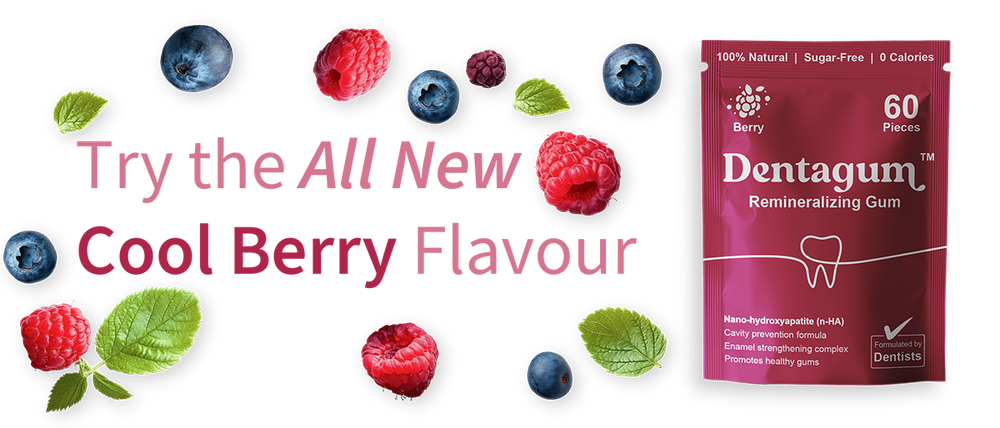
Dentagum's Remineralizing Chewing Gum is designed specifically for the post-meal window. The formula combines all three layers of post-meal protection in a single chewing session: organic xylitol and organic erythritol for the antibacterial layer, nano-hydroxyapatite for the enamel mineral delivery layer, and organic chicle and mastic for the sustained saliva stimulation that underlies the ADA's endorsement. Natural propolis and organic mastic gum add additional antibacterial coverage against the periodontal pathogens that VSC-producing bacteria and S. mutans share space with.
The pouch format is designed for portability: compact enough for a desk drawer, bag, or jacket pocket, with no refrigeration required and no liquid components that create travel restrictions. At 60 pieces per pouch and a recommended 2 to 4 pieces per day, each pouch provides 15 to 30 days of consistent post-meal use. At $0.55 per piece, the daily habit costs less than $2 per day for three covered meals.
Prop 65 heavy metal testing through Lightlabs provides independent third-party safety verification. Not vegan (contains eggshell powder as a natural calcium source). Safe for daily use. Not suitable for pets (xylitol is toxic to dogs).
Try Dentagum risk-free — 30-day guaranteeFrequently Asked Questions
Why should you chew gum after meals?
Because every meal drops your oral pH below the enamel critical threshold and starts a 30 to 40 minute recovery window where enamel loses mineral and bacteria are most active. Chewing sugar-free gum during this window stimulates salivary flow to 10 to 12 times the resting rate, dramatically accelerating acid neutralization and mineral delivery to recovering enamel. The American Dental Association endorses 20 minutes of sugar-free gum chewing after meals as a documented cavity prevention intervention. It covers the most significant unaddressed window in most people's oral care routines.
What does chewing gum after meals actually do for your teeth?
Three things simultaneously. It stimulates saliva that buffers post-meal acid, delivers calcium and phosphate to enamel, and washes food debris from tooth surfaces. With xylitol, it actively kills S. mutans bacteria that metabolize food residue into additional lactic acid. With nano-hydroxyapatite, it deposits enamel mineral directly into the microporosities created by the post-meal acid exposure. The combination addresses the dietary acid, the bacterial acid, and the enamel mineral deficit from both simultaneously across the 20-minute chewing session.
Does the ADA recommend chewing gum after meals?
Yes, specifically for sugar-free gum. The ADA states that chewing sugarless gum for 20 minutes following meals helps prevent tooth decay. They also state: "If you cannot brush your teeth immediately after a meal, then chewing gum can help." The ADA grants its Seal of Acceptance only to sugar-free gum products that meet its criteria. The clinical basis is the saliva stimulation mechanism: chewing generates a salivary surge that buffers post-meal acid and delivers minerals to recovering enamel.
How long should you chew gum after eating?
Twenty minutes, as recommended by the ADA. This duration sustains the elevated salivary flow and active ingredient contact time long enough to meaningfully compress the Stephan Curve recovery window and deliver substantive mineral through nano-HAp. Ten minutes still provides meaningful benefit if 20 isn't available. The key is starting immediately after the meal ends, not waiting until you remember later, so the gum covers the early part of the recovery window when pH is lowest and enamel is most vulnerable.
Is xylitol gum better than regular sugar-free gum after meals?
Yes, meaningfully so. Regular sugar-free gum (typically sweetened with sorbitol) provides the saliva stimulation benefit but has no active antibacterial mechanism. Xylitol actively kills S. mutans through a specific metabolic disruption. A 2025 systematic review in BMC Oral Health found xylitol gum significantly reduced S. mutans in 12 of 14 clinical studies versus sorbitol controls. Over time, consistent xylitol use progressively reduces the cariogenic bacterial population, making each subsequent post-meal window start with fewer acid-producing bacteria to manage.
What is the Stephan Curve?
The Stephan Curve describes the pattern of oral pH change following eating. First described by Robert Stephan in 1944, it shows oral pH dropping sharply below the 5.5 enamel critical threshold within minutes of consuming fermentable carbohydrates, then gradually recovering over 20 to 40 minutes as saliva buffers the acid. During the entire descent and recovery period, enamel is in a net demineralization state. Chewing sugar-free gum immediately after meals stimulates salivary flow that significantly compresses the recovery timeline, reducing the cumulative daily period of enamel vulnerability.
The Bottom Line
The post-meal window is where most daily cavity formation actually happens, and it's the window that twice-daily brushing leaves completely uncovered. Most people don't address it, not because they're negligent, but because the information and the tool were never put in front of them together at the right moment.
The ADA has been specific: 20 minutes of sugar-free gum after meals helps prevent tooth decay. The Stephan Curve explains why: it's the window where acid is attacking enamel and bacteria are most active, and gum compresses that window with saliva stimulation while delivering mineral and killing bacteria with xylitol. The habit requires no extra time, works everywhere, and compounds in its effectiveness over weeks and months of consistent daily use.
Among the small habits that genuinely change oral health outcomes over a lifetime, the post-meal gum habit sits near the top: high impact, zero added time, clinically endorsed, and simple enough to build with one pouch in the right location. Start with one meal. Add the others as the habit becomes automatic. The cumulative effect across five daily acid events, every day, shows in the next dentist visit and every one after it.
Try Dentagum risk-free — 30-day guarantee at dentagum.coResearch Summary
- American Dental Association. Chewing Gum Oral Health Topics. "If you cannot brush your teeth immediately after a meal, then chewing gum can help." Chewing sugarless gum for 20 minutes following meals shown in scientific studies to help prevent tooth decay. Stimulates saliva to 10-12x resting rate. Neutralizes acids, delivers calcium and phosphate, washes food particles.
- Stephan RM, 1944 (Oxford Reference). pH drops below critical 5.5 enamel threshold within minutes of fermentable carbohydrate consumption. 20-40 minute recovery window. Saliva buffering is the primary pH recovery mechanism.
- Söderling E et al. BMC Oral Health, 2025. Xylitol gum significantly reduced S. mutans in 12/14 studies vs sorbitol controls. Xylitol's active antibacterial mechanism against cariogenic bacteria distinguished from saliva stimulation benefit of sorbitol.
- Frequency RCT, BMC Oral Health. 132 participants, 10.32g xylitol/day. Linear reduction in S. mutans with increasing frequency. 3-4x/day: statistically significant. 2x/day: not statistically significant. Confirms daily habit frequency as key variable.
- Limeback H, Enax J, Meyer F. Biomimetics, 2023. 44 clinical trials. Contact time during chewing is key variable for nano-HAp clinical effectiveness. Post-meal recovery window is optimal for enamel mineral delivery when surface is most receptive. 6-80% sensitivity reduction range.
- Alwadi MAM et al. Journal of Natural Medicine, 2023. Mastic gum antibacterial against periodontal pathogens across 14 studies. Relevant for the gum base's active contribution during the post-meal chewing session.
References
- American Dental Association. "Chewing Gum." Oral Health Topics. https://www.ada.org/resources/ada-library/oral-health-topics/chewing-gum
- Söderling E et al. "Specific Effects of Xylitol Chewing Gum on Mutans Streptococci Levels." BMC Oral Health, 2025. https://link.springer.com/article/10.1186/s12903-025-06602-1
- "The Dose-Response Relationship of Xylitol." BMC Oral Health. 132 participants, frequency RCT. https://link.springer.com/article/10.1186/1472-6831-6-6
- Limeback H, Enax J, Meyer F. "Clinical Evidence of Biomimetic Hydroxyapatite in Oral Care Products for Reducing Dentin Hypersensitivity." Biomimetics, 2023. https://pmc.ncbi.nlm.nih.gov/articles/PMC9844412/
- Alwadi MAM et al. "Mastic (Pistacia lentiscus) Gum and Oral Health: A State-of-the-Art Review." Journal of Natural Medicine, 2023. https://pubmed.ncbi.nlm.nih.gov/37147480/
