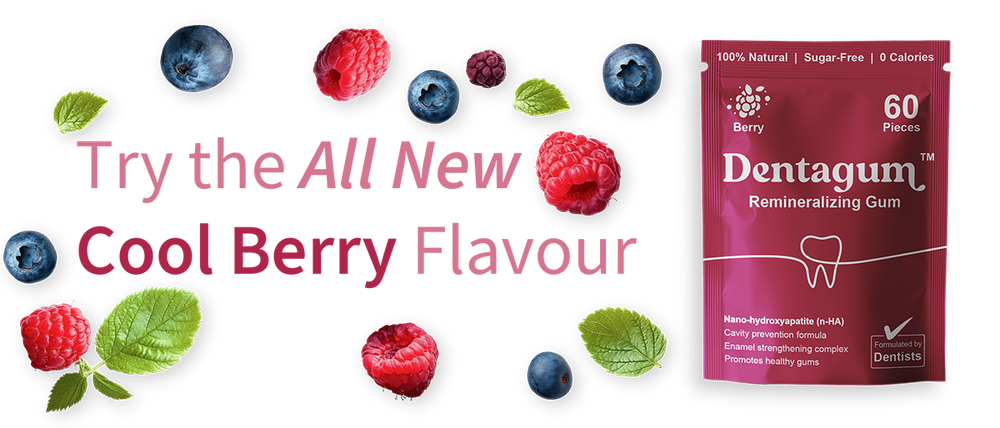

What Makes Dentagum the Best Remineralizing Gum?
The word "remineralizing" gets used a lot in oral care. Here's what it actually means, how each ingredient in Dentagum contributes to it, and why the formula is designed around the 10-20 minutes after every meal.

Remineralizing is one of those words that sounds meaningful but gets applied loosely. A product earns the label when it actively delivers minerals back into enamel structure, supporting the natural repair cycle that your teeth depend on between meals. Not every sugar-free gum does this. Not even most of them.
Dentagum is built specifically around that mechanism. Every ingredient in the formula has a purpose, and those purposes work together across the 10-20 minutes after eating when your enamel is recovering from acid exposure and needs the most support. Here's how it all fits together.
Why Remineralization Matters in the First Place

Your enamel is in a constant cycle of mineral loss and mineral gain. Every time you eat or drink, oral bacteria metabolize sugars and produce acid. That acid lowers your oral pH, and when it drops below 5.5, enamel begins to lose calcium and phosphate into the surrounding fluid. This is demineralization. It happens after every meal, every coffee, every soft drink.
The recovery happens naturally through saliva, which buffers the acid and delivers calcium and phosphate back to the enamel surface. Under healthy conditions with adequate time between acid exposures, the cycle is roughly balanced. The problem is that modern eating and drinking patterns, multiple coffees, frequent snacking, acidic drinks throughout the day, often tip the balance toward net mineral loss over time. That's how enamel thins gradually and silently, before sensitivity, cavities, and visible wear make the damage obvious.
Remineralizing products support the repair side of that cycle. The best ones do it during the post-meal window, when pH is recovering and conditions for mineral deposition are improving. That's precisely when Dentagum is designed to be chewed.
The Formula: Every Ingredient and What It Does
Nano-Hydroxyapatite (nHA): The Core Remineralizing Agent

Nano-hydroxyapatite is the headline ingredient, and it earns that position through the strongest clinical evidence of any remineralizing compound in oral care.
Hydroxyapatite is the mineral that makes up approximately 97% of tooth enamel. Producing it in nanoparticle form, at around 20 nanometres, means the particles are small enough to penetrate the microporosities in enamel rather than simply coating the surface. When you chew Dentagum, nano-HAp is delivered to your tooth surfaces during the chewing window, physically depositing into early lesions and weak spots in the enamel structure.
A 2023 systematic review and meta-analysis by Limeback, Enax, and Meyer, published in Biomimetics, analyzed 44 clinical trials and found that hydroxyapatite significantly reduced dentin hypersensitivity by 39.5% compared to placebo and 23% compared to fluoride controls. Studies specifically measuring hydroxyapatite in gum format found reductions in hypersensitivity of 6% to 80% compared to placebo depending on baseline severity and duration of use.
An 18-month double-blinded randomized clinical trial published in Frontiers in Public Health in 2023 compared a fluoride-free nano-HAp product directly against standard 1,450 ppm fluoride toothpaste for cavity prevention in adults. The nano-HAp product was non-inferior to fluoride, meaning it protected teeth from new cavities at a comparable rate over the full 18 months of the study.
A 2022 systematic review published in Clinical Oral Investigations from the University of Bern reviewed 10 in vivo and in situ studies and supported nano-HAp's efficacy for remineralization and caries reduction. The EU Scientific Committee on Consumer Safety has confirmed nano-hydroxyapatite is safe in oral care products at concentrations up to 29.5%.
The gum format is particularly well-suited to delivering nano-HAp because contact time determines how much mineral can deposit. Toothpaste stays in your mouth for two minutes. Dentagum stays for 10-20. That's the window where the remineralizing mechanism has the most opportunity to work.
Organic Xylitol: Antibacterial Protection from the Source

Xylitol is Dentagum's primary sweetener and its primary antibacterial agent. These two functions are inseparable and both matter for enamel health.
Streptococcus mutans, the main cavity-causing bacterium in the mouth, transports xylitol into its cells expecting to metabolize it like sugar. It can't. The bacterium burns energy trying to process something useless, gets trapped in a futile metabolic cycle, and dies. Bacteria that repeatedly encounter xylitol lose their ability to adhere to tooth surfaces over time, reducing plaque mass and the overall acid-producing capacity of the oral biofilm.
This is why xylitol works upstream of remineralization. Nano-HAp repairs the damage acid causes. Xylitol reduces the bacteria producing that acid. The two mechanisms address both sides of the enamel mineral balance equation simultaneously.
A 2022 systematic review in Clinical Oral Investigations found xylitol gum decreased plaque accumulation in 13 of 14 randomized controlled clinical trials reviewed. A 2025 systematic review in BMC Oral Health found xylitol gum significantly reduced mutans streptococci counts in 12 of 14 studies compared to sorbitol gum. The xylitol in Dentagum is organic, sourced without synthetic processing agents.
Organic Erythritol: A Second Antibacterial Sweetener
Erythritol works alongside xylitol to extend the antibacterial coverage, and the two polyols complement each other in ways that matter for the formula.
Research published in the International Journal of Dentistry found erythritol effectively decreased dental plaque weight, inhibited S. mutans adhesion to tooth surfaces, and reduced overall caries incidence. The same review concluded erythritol demonstrated better efficacy than sorbitol and comparable results to xylitol for oral health endpoints, while being better tolerated digestively than xylitol at higher doses.
Erythritol's non-cariogenic status was established in research as far back as 1992. It contributes sweetness, supports the antibacterial action of xylitol, and does it with a clean safety profile and virtually zero caloric contribution. The combination of two evidence-backed polyols rather than relying on xylitol alone reflects a more complete approach to the bacterial reduction side of the formula.
Organic Mastic Gum: Active Base with Antibacterial Properties

Most people think of the gum base as a passive delivery vehicle. In Dentagum's formula, it isn't.
Mastic gum is a natural resin from the Pistacia lentiscus tree, native to the Mediterranean. It forms part of Dentagum's natural gum base alongside organic chicle, giving the gum its chewable texture through plant-derived materials rather than petroleum-derived synthetic polymers. But mastic gum is biologically active in ways no synthetic base can replicate.
A 2023 state-of-the-art review published in the Journal of Natural Medicine, covering 14 clinical studies, found mastic gum "displayed antibacterial and antimicrobial properties and inhibited plaque accumulation, constituting a beneficial adjuvant in caries prevention." The review also identified anti-inflammatory properties relevant to gum tissue health and periodontal care.
Every minute Dentagum is chewed, mastic gum's active compounds are being released directly into the oral environment. The base doing oral health work is a meaningful upgrade from one that simply holds the formula together.
Organic Chicle Gum: The Natural Gum Base Foundation
Chicle is a latex sap harvested from the sapodilla tree, Manilkara zapota, native to Central American rainforests. It was the original commercial chewing gum base before petroleum-derived synthetic polymers replaced it in the mid-twentieth century for cost and production efficiency reasons.
Unlike synthetic gum bases, which contain polyvinyl acetate, polyisobutylene, and related petroleum compounds, chicle is plant-derived, biodegradable, and has been safely chewed by humans for thousands of years. A 2025 UCLA study found synthetic gum bases release an average of 104 microplastic particles per gram during chewing. Chicle, as a plant-derived latex, doesn't introduce petroleum-derived polymers into the oral environment.
Dentagum's chicle is organic and wildcrafted from sustainably managed forests with Rainforest Alliance roots. It forms the primary structural base of the gum, working alongside mastic gum to deliver the chewable texture without synthetic additives.
Natural Propolis: Antimicrobial Support and Enamel Hardness

Propolis is a resinous compound produced by bees from plant resins, used to protect and seal the hive. In oral health research, it has emerged as a genuinely effective antimicrobial agent with a secondary role in enamel remineralization.
Research published in Dimensions of Dental Hygiene noted that propolis application has demonstrated effectiveness at reducing the speed of enamel demineralization, and that "propolis works by making calcium and phosphate more likely to be absorbed back into the tooth structure, enhancing the remineralization process." Studies have shown that propolis application increases enamel surface microhardness, a direct measure of mineral density.
On the antimicrobial side, referenced literature in a 2025 clinical trial found propolis more effective against certain oral bacteria than chlorhexidine and Listerine in some comparisons. A 2022 double-blinded randomized clinical trial in the International Journal of Dental Hygiene found meaningful reductions in plaque index and gingival bleeding scores in gingivitis patients using propolis-based oral care.
In a gum format chewed for 10-20 minutes, propolis delivers sustained antimicrobial and mineral-support compounds in direct contact with oral tissues throughout the chewing window. Patients who are allergic to bee venom should check with their dentist before using propolis-containing products.
Organic Eggshell Powder: A Natural Calcium Source

Eggshell is composed primarily of calcium carbonate, making it a natural, biocompatible source of calcium to support remineralization alongside nano-HAp.
A 2026 systematic review and meta-analysis published in Odontology analyzed 17 in vitro studies on eggshell extract and enamel remineralization. The meta-analysis found eggshell extract significantly improved enamel microhardness (Cohen's d = 0.45, p < 0.05) and reduced surface roughness (Cohen's d = -0.50, p < 0.01). The calcium-to-phosphate ratio in enamel also improved.
A 2025 in vitro study published in Cureus compared the remineralization potential of fluoride varnish, CPP-ACP cream, and chicken eggshell powder on enamel lesions. All three agents effectively increased enamel surface microhardness. Eggshell powder showed superior results.
In the Dentagum formula, organic eggshell powder provides an additional calcium reservoir that works alongside nano-HAp's mineral delivery, broadening the formula's remineralizing capacity through a second natural calcium source.
Natural Calcium Bentonite Clay: Physical Cleaning Support
Calcium bentonite clay is a natural mineral clay with adsorptive properties, meaning it binds to and lifts impurities and deposits from surfaces. In Dentagum's formula, it contributes a mild physical cleaning effect during chewing: attracting and binding to debris, bacterial deposits, and surface impurities that accumulate on tooth surfaces between brushing sessions.
It doesn't remineralize enamel directly. Its role is supporting a cleaner oral environment, reducing the surface load of material that bacteria colonize, and complementing the antibacterial work being done by xylitol, erythritol, mastic gum, and propolis.
Coconut Oil: Anti-Inflammatory Support
Coconut oil has been studied in oral care primarily for its anti-inflammatory properties and its effect on oral bacteria. The medium-chain fatty acids in coconut oil, particularly lauric acid, demonstrate antimicrobial activity against oral pathogens in research settings, and coconut oil pulling has been studied for its effects on plaque and gingivitis.
In Dentagum's formula, coconut oil contributes anti-inflammatory support to the gum tissue environment and adds to the antimicrobial spectrum of the overall formula. It's a complementary ingredient rather than a headline actives, working alongside propolis, mastic gum, and the polyol sweeteners to create a more complete antibacterial environment during chewing.
Natural Terpene Blend and Spearmint Extract: Flavour with Function
The flavour in Dentagum comes from a natural terpene blend (Menthone, Carvone, and Cineol) and spearmint extract (natural and organic). These aren't just there for taste, though taste matters for a gum you're going to chew consistently after every meal.
Menthone, Carvone, and Cineol are aromatic terpene compounds found naturally in mint plants. They deliver the fresh mint sensation that makes post-meal gum use feel clean and satisfying, and Cineol in particular has documented antimicrobial properties in research. Spearmint extract reinforces the flavour profile while keeping the sourcing consistent with the brand's natural and organic ingredient philosophy.
The flavour experience also matters for habit formation. A gum people enjoy chewing gets chewed consistently. Consistent use after meals is what drives the remineralizing and antibacterial outcomes the formula is designed to produce.
How the Ingredients Work Together
Looking at each ingredient in isolation understates what the formula achieves as a system. The combination is what makes Dentagum specifically remineralizing rather than just sugar-free.
Nano-HAp deposits enamel mineral during the chewing window. Eggshell powder and propolis provide supporting calcium and enhance mineral uptake into the enamel structure. Xylitol and erythritol reduce the bacterial acid load that would otherwise work against that mineral deposition. Mastic gum and propolis deliver sustained antimicrobial contact throughout chewing. Calcium bentonite clay clears surface debris. Coconut oil supports the anti-inflammatory environment. The chicle and mastic gum base delivers all of it without petroleum-derived polymers. And the terpene and spearmint flavour system makes the habit easy to maintain.
None of these ingredients is doing its job in isolation. They're designed to work simultaneously, during the same 10-20 minute post-meal window, each addressing a different aspect of oral health while reinforcing the others.
In Dentagum's own clinical data, 83% of participants showed notable gains in enamel quality and mineral quantity with consistent daily use, 91% reported significant reduction in cold sensitivity, 87% were less susceptible to cavities compared to non-users, and 79% experienced a clinical reduction in gum inflammation.
What "Remineralizing" Requires in Practice
A gum earns the remineralizing label through three things: the right ingredients, the right timing, and the right duration.
The ingredients are above. The timing is immediately after meals and drinks, when oral pH is at its lowest and enamel is most vulnerable. The duration is 10-20 minutes, which maximizes both saliva stimulation and the contact time available for nano-HAp and the supporting mineral ingredients to deposit on enamel surfaces.
Chewing Dentagum for two minutes and discarding it delivers a fraction of the benefit. The 10-20 minute recommendation isn't a suggestion. It's the window the formula is designed around.
Dentagum doesn't replace brushing or flossing. It fills the gap between them, the post-meal period when enamel is under attack and toothpaste isn't in your mouth. Used consistently in that window, every ingredient in the formula is working at the moment it can do the most good.
Try Dentagum risk-free with a 30-day guarantee at dentagum.co.
Frequently Asked Questions
What makes Dentagum a remineralizing gum?
Dentagum contains nano-hydroxyapatite, the mineral enamel is made of in nanoparticle form, which physically deposits into enamel microporosities and early lesions during the chewing window. Organic eggshell powder provides a supporting calcium source, and propolis enhances calcium and phosphate uptake back into tooth structure. Together these ingredients actively support enamel mineral repair during the 10-20 minutes after meals when pH is recovering and remineralization conditions are most favorable.
How does nano-hydroxyapatite in Dentagum differ from fluoride?
Fluoride works by chemically modifying enamel's surface to form fluorapatite, a more acid-resistant mineral. Nano-hydroxyapatite replenishes the same mineral enamel is already made of, physically depositing into weak spots and early lesions without chemically altering the enamel structure. A 2023 18-month randomized clinical trial found nano-HAp non-inferior to 1,450 ppm fluoride for cavity prevention in adults. Nano-HAp is also non-toxic when swallowed in small amounts, making it particularly suitable for households with young children.
Why does Dentagum use both xylitol and erythritol?
Xylitol and erythritol are both sugar alcohols with documented antibacterial effects on Streptococcus mutans and other oral bacteria, but they work through slightly different mechanisms and erythritol is better tolerated digestively at higher doses. Using both provides broader antibacterial coverage and a better overall sweetness profile than either alone. Both are non-cariogenic, meaning neither feeds cavity-causing bacteria the way sugar does.
What does propolis do in Dentagum?
Propolis contributes two meaningful functions. First, it demonstrates broad-spectrum antimicrobial activity against oral bacteria, including S. mutans. Second, research has shown propolis application increases enamel surface microhardness and makes calcium and phosphate more likely to be absorbed back into tooth structure, directly supporting remineralization. In a gum format chewed for 10-20 minutes, these compounds are released in sustained contact with oral tissues throughout the chewing window.
Why does Dentagum use a natural gum base instead of synthetic?
Most commercial gum uses petroleum-derived synthetic polymers including polyvinyl acetate and polyisobutylene as the base. Dentagum uses organic chicle (a plant-derived latex from the sapodilla tree) and organic mastic gum (a resin from Pistacia lentiscus). Both are biodegradable, have been safely chewed by humans for thousands of years, and mastic gum specifically has documented antibacterial and anti-inflammatory properties. A 2025 UCLA study found synthetic gum bases release an average of 104 microplastic particles per gram during chewing. Chicle, as a plant-derived latex, avoids petroleum-derived polymers entirely.
How long should I chew Dentagum for remineralizing benefits?
Ten to twenty minutes after meals. That duration reflects both the contact time needed for nano-HAp to deposit meaningfully on enamel surfaces and the sustained saliva stimulation that amplifies the remineralizing environment. Chewing for shorter periods reduces the benefit. Timing after meals is also important: the post-meal window is when oral pH is at its lowest, enamel is most vulnerable, and the remineralizing support has the greatest impact.
In Conclusion
Dentagum is a remineralizing gum because every ingredient in its formula has a documented function relevant to enamel health, and those functions work together during the 10-20 minutes after meals when your teeth need the most support.
Nano-hydroxyapatite deposits enamel's own mineral back into early lesions. Xylitol and erythritol reduce the bacteria responsible for ongoing acid attack. Mastic gum and propolis deliver sustained antimicrobial contact through the chewing window. Eggshell powder and propolis enhance calcium uptake into enamel structure. Calcium bentonite clay supports a cleaner oral environment. And the whole formula is delivered through a plant-derived gum base that's been chewed safely for millennia.
The word remineralizing means something specific. Dentagum earns it ingredient by ingredient.
Dentagum's Remineralizing Chewing Gum is dentist-formulated, 3rd-party tested, and designed to be chewed for 10-20 minutes after meals. Try it risk-free with a 30-day guarantee at dentagum.co.
RESEARCH SUMMARY
- Limeback H, Enax J, Meyer F. "Clinical Evidence of Biomimetic Hydroxyapatite in Oral Care Products for Reducing Dentin Hypersensitivity: An Updated Systematic Review and Meta-Analysis." Biomimetics, 2023. 44 clinical trials included. HAP significantly reduced dentin hypersensitivity by 39.5% compared to placebo and 23% compared to fluoride. HAP in gum format reduced hypersensitivity by 6-80% compared to placebo.
- Paszynska E et al. "Caries-Preventing Effect of a Hydroxyapatite Toothpaste in Adults: An 18-Month Double-Blinded Randomized Clinical Trial." Frontiers in Public Health, 2023. Fluoride-free nano-HAp toothpaste non-inferior to 1,450 ppm fluoride for cavity prevention over 18 months.
- Wierichs RJ et al. "Efficacy of Nano-Hydroxyapatite on Caries Prevention: A Systematic Review and Meta-Analysis." Clinical Oral Investigations, 2022. 10 in vivo and in situ studies included. Supported nano-HAp for remineralization and caries reduction.
- Mäkinen KK et al. "Erythritol Is More Effective Than Xylitol and Sorbitol in Managing Oral Health Endpoints." International Journal of Dentistry, 2016. Erythritol non-cariogenic since 1992. Effective plaque reduction, S. mutans inhibition, and caries reduction.
- Alwadi MAM et al. "Mastic Gum and Oral Health: A State-of-the-Art Review." Journal of Natural Medicine, 2023. Mastic gum inhibits plaque accumulation and displays antibacterial and anti-inflammatory properties across 14 studies.
- "Managing Enamel Demineralization." Dimensions of Dental Hygiene, 2022. Propolis application increased enamel microhardness and reduced speed of enamel demineralization. Works by making calcium and phosphate more likely to be absorbed back into tooth structure.
- "In Vitro Remineralization Effectiveness of Eggshell Extract on Human Teeth: A Systematic Review and Meta-Analysis." Odontology, 2026. 17 in vitro studies included. Eggshell extract significantly improved enamel microhardness (Cohen's d = 0.45, p < 0.05) and reduced surface roughness. Ca/P ratio also improved.
- Bandekar S et al. "The Remineralization Potential of Fluoride, CPP-ACP, and Chicken Eggshell on Enamel Lesions." Cureus, 2025. All three agents effectively increased enamel surface microhardness. Chicken eggshell powder showed superior results.
References
- Limeback H, Enax J, Meyer F. "Clinical Evidence of Biomimetic Hydroxyapatite in Oral Care Products for Reducing Dentin Hypersensitivity: An Updated Systematic Review and Meta-Analysis." Biomimetics, 2023. https://pmc.ncbi.nlm.nih.gov/articles/PMC9844412/
- Paszynska E et al. "Caries-Preventing Effect of a Hydroxyapatite Toothpaste in Adults: An 18-Month Double-Blinded Randomized Clinical Trial." Frontiers in Public Health, 2023. https://www.frontiersin.org/journals/public-health/articles/10.3389/fpubh.2023.1199728/full
- Wierichs RJ et al. "Efficacy of Nano-Hydroxyapatite on Caries Prevention: A Systematic Review and Meta-Analysis." Clinical Oral Investigations, 2022. https://link.springer.com/article/10.1007/s00784-022-04390-4
- Mäkinen KK et al. "Erythritol Is More Effective Than Xylitol and Sorbitol in Managing Oral Health Endpoints." International Journal of Dentistry, 2016. https://www.ncbi.nlm.nih.gov/pmc/articles/PMC5011233/
- Alwadi MAM et al. "Mastic (Pistacia lentiscus) Gum and Oral Health: A State-of-the-Art Review." Journal of Natural Medicine, 2023. https://pubmed.ncbi.nlm.nih.gov/37147480/
- "Managing Enamel Demineralization." Dimensions of Dental Hygiene, 2022. https://dimensionsofdentalhygiene.com/article/managing-enamel-demineralization/
- "In Vitro Remineralization Effectiveness of Eggshell Extract on Human Teeth: A Systematic Review and Meta-Analysis." Odontology, 2026. https://link.springer.com/article/10.1007/s10266-025-01265-4
- Bandekar S et al. "The Remineralization Potential of Fluoride, CPP-ACP, and Chicken Eggshell on Enamel Lesions." Cureus, 2025. https://www.ncbi.nlm.nih.gov/pmc/articles/PMC11821557/
