
The Traveler's Guide to Keeping Your Teeth Healthy on the Road
Travel is one of the most reliable ways to let your oral care routine fall apart. Irregular meals, airport food, long flights, and restaurants without bathroom access stack up into days of missed post-meal coverage. Here's a complete practical guide to keeping your teeth healthy whether you're flying for work or on a two-week vacation.

For carry-on travel: pack toothpaste at 3.4 oz or under (TSA liquid rule), floss picks or a small floss container (no size limit), a travel toothbrush, and a pouch of xylitol and nano-HAp remineralizing gum. The gum is the highest-leverage addition for travel specifically because it covers every post-meal window when brushing isn't possible, requires no liquid, has no TSA restriction, fits in any pocket, and addresses the increased cavity and bad breath risk from long flights (cabin air reduces salivary flow), restaurant meals, and irregular eating that travel creates. On long-haul flights specifically, chewing gum also helps equalize ear pressure during ascent and descent.
Travel is one of the most reliable ways for an oral care routine to quietly fall apart. It starts small: you forget to brush the night you arrive because you're exhausted. Restaurant meals mean you're never near a bathroom when you finish eating. Airport food is usually a combination of sugar, refined carbohydrates, and acidic drinks. Long-haul flights dehydrate you, reduce salivary flow, and create exactly the conditions where bacteria thrive and bad breath worsens. By day three of a trip that involved none of these decisions at home, the cumulative effect on your enamel and oral microbiome is real.
This guide is practical and specific: what to pack, what the TSA rules actually mean for your oral care kit, what to do on a plane, and how to build a travel-specific routine around the constraints that travel actually creates.
The TSA Rules for Oral Care Products
Most people know the basics of the TSA liquid rule but not how it specifically applies to oral care. Here's the complete picture.
Toothpaste
Toothpaste is classified as a gel or paste under TSA guidelines and falls under the 3-1-1 liquid rule. That means containers must be 3.4 oz (100ml) or smaller, all liquid containers must fit in one quart-sized clear zip-top bag, and you can bring one such bag per person in your carry-on. A 3.4 oz tube of toothpaste provides approximately 9 to 10 brushing sessions, enough for roughly 4 to 5 days of twice-daily brushing. For longer trips with only carry-on luggage, either pack multiple small tubes, buy toothpaste at your destination, or use toothpaste tablets (solid, not subject to the liquid rule).
Larger tubes belong in checked luggage. Hotels often provide small toothpaste tubes in their amenity kits, but these run out faster than expected if multiple people are using them and they're not guaranteed at every property.
Mouthwash
Mouthwash is a liquid and subject to the same 3.4 oz carry-on restriction. Most travel-sized mouthwash bottles are 3.4 oz. If mouthwash is part of your routine, pack it in your quart bag alongside toothpaste. If your quart bag is already full, skip the mouthwash before the toothpaste since brushing is the priority.
Floss and interdental cleaners
Floss is not a liquid or gel and has no carry-on size restriction. A standard floss container or a small packet of floss picks goes in any bag without touching your quart bag. Floss picks are particularly useful for travel because they're easier to use in cramped airplane bathrooms and hotel bathrooms with limited counter space. Pack more than you think you need: floss picks end up in pockets, bags, and jacket linings and occasionally run out without warning.
Toothbrush
Both manual and electric toothbrushes are allowed in carry-on and checked baggage. Electric toothbrushes with lithium batteries should go in carry-on luggage, not checked bags, because most airlines restrict lithium batteries from checked baggage due to fire risk. Store your toothbrush in a vented travel case: a toothbrush stored in an airtight case grows bacteria faster than one stored in open air.
Chewing gum
No restriction whatsoever. Gum is a solid, not subject to the liquid rule, and passes through security without a second glance. A full 60-piece pouch of remineralizing gum fits in any jacket pocket or bag compartment and goes through the X-ray belt without being pulled for inspection. For oral care specifically, this makes gum the only tool that travels completely unrestricted and requires zero TSA management.
Why Your Teeth Are More Vulnerable When You Travel

Before covering the solutions, it's worth understanding why travel specifically creates elevated oral health risk. The answer is a combination of factors that rarely occur together at home but consistently occur together on any trip of more than two or three days.
The cabin air problem
Commercial aircraft maintain cabin humidity at roughly 12 to 20%, compared to the 40 to 60% that most indoor environments maintain at ground level. That dry air significantly reduces salivary flow during flights, particularly long-haul ones. Saliva is your primary protection against the bacteria that cause cavities and bad breath: it washes surfaces, delivers minerals to enamel, and carries antimicrobial proteins that suppress VSC-producing anaerobes. Reduced salivary flow for several hours means reduced protection for the same duration.
This is why breath tends to be worse after long flights, why your mouth feels sticky and dry at landing, and why people who are prone to dental sensitivity sometimes find their teeth more reactive after a long flight. The cabin environment is systematically hard on oral health.
Chewing gum during ascent and descent is a well-known technique for equalizing ear pressure. Most travelers already know this. What fewer realize is that the saliva stimulation from chewing during the flight also actively counteracts the low-humidity cabin environment that reduces salivary flow. Chewing xylitol and nano-HAp gum on a long-haul flight is doing two protective things at once: equalizing ear pressure and maintaining the salivary activity that the dry cabin air is suppressing.
The diet disruption problem
Travel diet is typically worse for teeth than home diet, not because travelers are careless but because the options available at airports, on planes, and in unfamiliar cities skew toward high-sugar, high-acid, and high-carbohydrate foods. Airport food options lean toward sandwiches, pastries, sodas, and juice. Long-haul flight meals are rarely balanced. Vacation eating involves more alcohol (acidic, with a bacterial acid component from the sugars), more desserts, more exotic local foods, and more frequent snacking between meals.
Each of these meals and snacks creates a post-meal acid event, and travelers are almost never near a bathroom when they finish eating at a restaurant table, a street food stand, or a boarding gate. The gap between the acid event and any intervention is much longer than at home.
The routine disruption problem
Time zone changes shift the circadian rhythm, and with it the timing of meals and the bedtime routine where evening brushing and flossing happen. A traveler arriving in a new time zone at 11pm local time who fell asleep on the plane has often skipped both evening oral care and had a full flight's worth of unaddressed post-meal bacterial activity. One missed session isn't critical. A pattern of missed or disrupted sessions across a 10-day trip creates meaningful cumulative plaque and enamel impact.
The Travel Oral Care Kit: What to Pack
A well-designed travel oral care kit requires only a few items, all of which fit within a standard TSA quart bag with room to spare.
A compact, foldable travel toothbrush or a standard manual toothbrush in a vented case. Soft bristles. If you use an electric toothbrush at home, a dedicated travel electric model with a lithium battery is worth the investment for anything longer than a week. Store in a vented case; airtight storage promotes bacterial growth on the bristles.
A standard travel-size tube fits the TSA liquid rule and provides 9 to 10 brushing sessions, enough for 4 to 5 days of twice-daily brushing. For longer trips with carry-on only, pack two tubes or plan to buy toothpaste at your destination. Fluoride toothpaste is the clinical standard. If your quart bag is crowded, toothpaste tablets (solid, no liquid restriction) are a useful alternative that take no quart bag space at all.
A small container of floss picks or pre-threaded flossers. Floss has no TSA restriction and doesn't use quart bag space. Floss picks are easier to use in small spaces (airplane bathrooms, cramped hotel bathrooms) than string floss. Put a handful loose in your carry-on bag so they're immediately accessible rather than buried in your checked luggage.
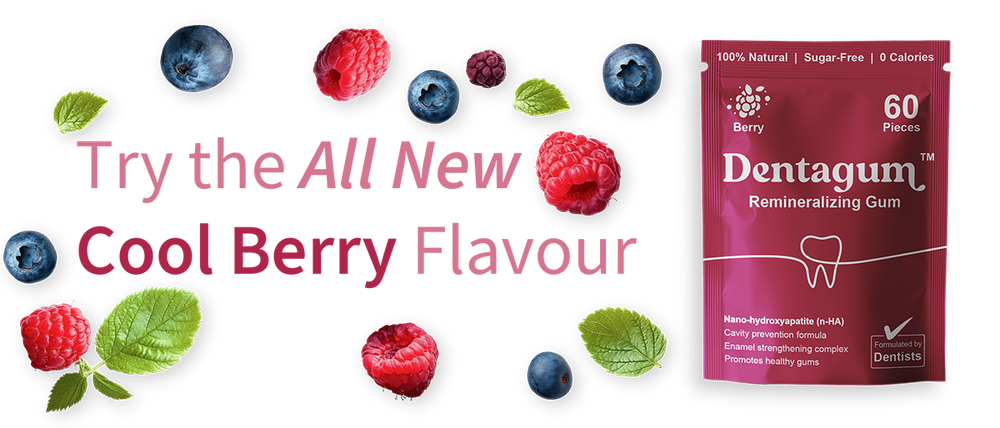
This is where Dentagum earns its place on any packing list specifically because of travel constraints. It passes through security with no restriction. It requires no water, no bathroom access, no counter space. It works on the plane, at a restaurant table, on a train, at a boarding gate, in the back of a taxi. It covers every post-meal and post-drink acid event that travel creates in environments where no other oral care option is available. A single 60-piece pouch weighs almost nothing and lasts two to three weeks of consistent post-meal use.
If mouthwash is part of your home routine and you have quart bag space after toothpaste, a 3.4 oz bottle is worth packing. If you're tight on space, skip it: brushing covers most of what mouthwash does, and the gum covers the between-session windows where mouthwash is often used. Mouthwash is the lowest-priority item in the kit.
The Travel Oral Care Routine
The key insight for travel is that the twice-daily brushing foundation stays the same. What changes is the midday and between-meal coverage, because the situations where you finish a meal and can't brush immediately are much more frequent when traveling than at home.
Before your flight (at home)
Brush and floss before leaving for the airport. This removes overnight or pre-flight plaque so you're starting the travel day with clean teeth. Pack gum where it's immediately accessible, not buried in checked luggage: jacket pocket, outer bag pocket, or personal item. Airport food and drinks happen before and during boarding, and the gum needs to be reachable when you finish eating at the gate.
On the plane
Chew gum during ascent and descent for ear pressure equalization. This is standard travel advice and the oral health benefit (saliva stimulation that counteracts the dry cabin air) is a free bonus. After any in-flight meal or snack, chew gum for 10 to 20 minutes. Drink water consistently throughout the flight rather than waiting until you feel thirsty. Dehydration reduces salivary flow, which compounds the cabin air's drying effect on the oral environment. On overnight flights, brush your teeth before sleeping if the plane has functioning bathrooms; many long-haul carriers have designated bathroom windows for this.
At restaurants and street food

You will almost never be near a bathroom immediately after a restaurant meal when traveling. The gap between finishing dinner and returning to a hotel room might be 45 minutes to two hours. Chewing gum at the table after finishing your meal covers this entire window without requiring you to find a bathroom. The ADA is clear: when brushing isn't possible after eating, chewing sugar-free gum is the evidence-backed alternative.
Travel exhaustion is the most common reason oral care routines break down on trips. The logic of "I'll just skip it this once" is understandable when you've been traveling for 14 hours, but evening brushing and flossing before bed are the most important sessions of the day. Whatever plaque, food residue, and bacteria are present when you fall asleep operate for 7 to 8 hours in a low-saliva overnight environment. Keep your toothbrush and floss on the hotel bathroom counter (not in a bag) so they're visible and the decision is automatic rather than requiring you to find them when tired.
International travel: water quality
In destinations where tap water isn't safe to drink, use bottled or filtered water for brushing and rinsing your toothbrush. If you wouldn't drink the tap water, don't brush with it. Swallowing small amounts of contaminated water while brushing is a genuine risk for traveler's diarrhea and other gastrointestinal issues. Most hotel rooms in affected regions have bottled water; use it deliberately for brushing and rinse your toothbrush with it as well.
Road trips
Road trips often mean long driving stretches followed by fast food stops where nobody gets out of the car or washes their hands properly, let alone brushes their teeth. Gum in the cupholder and a floss pick container in the center console means post-meal coverage is always available without stopping. The car is actually one of the easiest environments to build the post-meal gum habit: you're stationary, you have both hands available (not immediately), and 15 minutes of chewing time passes naturally while driving.
How Dentagum Specifically Suits Travel

Dentagum's pouch format was designed for the post-meal window, which is exactly the problem that travel creates repeatedly across every day of a trip.
The pouch is compact: 60 pieces, fits in any jacket pocket or bag pocket, weighs around 100 grams. It passes through airport security without any restriction or quart bag management. It requires no water, no counter space, no electricity, and no bathroom access. It works at a restaurant table, in an airplane seat, in a car, at a hotel breakfast buffet, at a street food stand, or anywhere else food has just been consumed.
The formula delivers what travel's elevated oral risk requires: organic xylitol reduces S. mutans that proliferate in the high-sugar, high-carbohydrate travel diet. Nano-hydroxyapatite deposits enamel mineral during the post-meal recovery windows that travel makes so frequent and so poorly covered. Organic mastic gum and natural propolis add antibacterial coverage against the periodontal pathogens that dry cabin air and dietary disruption allow to build up. The saliva stimulation from chewing directly counteracts the reduced salivary flow that cabin pressure and dehydration create.
At $0.55 per piece, covering every post-meal window on a 10-day trip (roughly 30 to 40 pieces depending on meal frequency) costs around $17 to $22 total. That's one missed filling appointment saved several times over.
Try Dentagum risk-free — 30-day guaranteeFrequently Asked Questions

Can you bring toothpaste on a plane?
Yes, but only in containers of 3.4 oz (100ml) or smaller in your carry-on luggage. Toothpaste is classified as a gel or paste and falls under the TSA 3-1-1 liquid rule. It must fit inside your quart-sized clear zip-top bag alongside other liquid toiletries. Larger tubes can go in checked luggage without restriction. A 3.4 oz tube of toothpaste lasts approximately 9 to 10 brushing sessions, enough for 4 to 5 days of twice-daily use.
Is chewing gum allowed on airplanes?
Yes, with no restriction. Gum is a solid and is not subject to the TSA liquid rule. It passes through airport security without going in your quart bag and can be carried in any quantity. Chewing gum during ascent and descent is also specifically useful for equalizing ear pressure in the Eustachian tube as cabin pressure changes. Sugar-free remineralizing gum provides both the ear pressure benefit and saliva stimulation that counteracts the dry cabin environment's effect on oral health.
Why is dental hygiene harder to maintain while traveling?
Travel creates several overlapping challenges simultaneously: low cabin humidity on flights (12-20%) reduces salivary flow; diet shifts toward higher-sugar, higher-acid foods; meals happen in restaurants and transit points where bathroom access to brush isn't immediate; time zone disruption affects the bedtime routine where evening brushing should happen; and travel fatigue makes it easier to skip steps that feel optional. Each factor alone is minor. Together across a multi-day trip, they create meaningfully elevated cavity and gum disease risk compared to the home environment.
What should I do for my teeth on a long-haul flight?
Chew sugar-free xylitol gum during ascent and descent for ear pressure equalization and throughout the flight to stimulate saliva that counteracts the dry cabin air. Drink water consistently rather than waiting for thirst. Chew gum for 10 to 20 minutes after any in-flight meal or snack. On overnight flights, brush your teeth before sleeping if the cabin has accessible bathrooms. Avoid drinking acidic drinks (soda, juice, wine) without following with water, and avoid alcohol, which dehydrates and reduces salivary flow further.
Should I use bottled water to brush my teeth when traveling internationally?
Yes, in any destination where tap water isn't safe to drink. If you wouldn't drink the tap water, don't brush with it. Small amounts of contaminated water ingested during brushing are a genuine risk for traveler's diarrhea and gastrointestinal illness. Use bottled water for brushing and for rinsing your toothbrush after brushing. Most hotels in affected regions provide bottled water in rooms; use it deliberately for oral care, not just for drinking.
What oral care products are most important to pack for travel?
In priority order: a travel toothbrush in a vented case, fluoride toothpaste at 3.4 oz or under (for carry-on), floss picks (no TSA restriction), and remineralizing gum (no TSA restriction, no quart bag space needed). The gum is specifically valuable for travel because it requires no bathroom, no water, and no counter space, making it the only post-meal oral care tool that works in every travel environment. Mouthwash is optional if you have quart bag space after toothpaste.
The Bottom Line
Travel disrupts oral care in predictable ways: dry cabin air reduces salivary flow, diet skews toward higher-acid and higher-sugar foods, meals happen in places where brushing immediately after isn't possible, and exhaustion erodes the evening routine. None of these are problems without solutions.
The packing list is simple and fits easily in a carry-on: travel toothbrush in a vented case, 3.4 oz toothpaste in your quart bag, floss picks in an outside pocket, and remineralizing gum accessible at all times. The routine is the same three-window approach that works at home, adjusted for the environments travel creates: brush and floss before your flight, chew gum after every meal and on the plane, and keep the evening brush-and-floss non-negotiable regardless of how late you arrive.
The gum earns its place on every packing list specifically because it's the only tool that works in every travel environment without restriction. Restaurant table, airplane seat, boarding gate, moving vehicle, street corner after street food. Wherever the meal happened, the gum can follow it.
Try Dentagum risk-free — 30-day guarantee at dentagum.coResearch Summary
- TSA Transportation Security Administration. Toothpaste classified as gel/paste, subject to 3-1-1 liquid rule: 3.4 oz max container, quart-sized clear bag, carry-on only. Floss: no size restriction. Electric toothbrushes with lithium batteries: carry-on only. Gum (solid): no restriction.
- Aviation sources. Commercial aircraft cabin humidity maintained at 12-20%, compared to typical indoor ground-level humidity of 40-60%. Low humidity reduces salivary flow during long flights. Chewing gum during ascent and descent equalizes Eustachian tube pressure.
- American Dental Association. Chewing Gum Oral Health Topics. "If you cannot brush your teeth immediately after a meal, then chewing gum can help." Sugar-free gum endorsed for 20 minutes after meals for cavity prevention.
- Colgate, 2025. Sugar-free gum "your best friend" when you cannot brush on the road. Helps remove food particles, stimulates saliva, xylitol prevents tooth decay. Accessible oral care tools essential for travel.
- Söderling E et al. BMC Oral Health, 2025. Xylitol gum significantly reduced S. mutans in 12/14 studies. Relevant for travel diet that typically includes higher sugar content than home diet.
- Boka / Quip travel guides, 2025-2026. Travel-size 3.4 oz toothpaste provides approximately 9-10 brushing sessions. Floss picks recommended for travel ease. Bottled water recommended for brushing in destinations with unsafe tap water. Electric toothbrush lithium batteries should not go in checked luggage.
References
- Transportation Security Administration. "3-1-1 Liquids Rule." TSA.gov. https://www.tsa.gov/travel/security-screening/whatcanibring/
- "Does Toothpaste Count as a Liquid? TSA Traveler's Guide." Boka, updated 2025. https://www.boka.com/blogs/guides/taking-toothpaste-on-plane
- "How to Maintain Good Dental Care While Traveling." Colgate, updated 2025. https://www.colgate.com/en-us/oral-health/adult-oral-care/how-to-maintain-good-dental-care-while-traveling
- American Dental Association. "Chewing Gum." Oral Health Topics. https://www.ada.org/resources/ada-library/oral-health-topics/chewing-gum
- Söderling E et al. "Specific Effects of Xylitol Chewing Gum on Mutans Streptococci Levels." BMC Oral Health, 2025. https://link.springer.com/article/10.1186/s12903-025-06602-1
- "Traveling with Toothpaste: Tips for Every Trip." Quip, 2025. https://www.getquip.com/blogs/mouthoff-blog/traveling-with-toothpaste-tips-for-every-trip
- "Tips for Maintaining Good Oral Hygiene While Traveling." Lighthouse Dental, July 2025. https://lighthousedentalva.com/tips-for-maintaining-good-oral-hygiene-while-traveling/
