
The Science Behind Gum That Actually Cleans Teeth
Most people think of gum as a breath freshener. But the right formula, chewed at the right time, does something far more interesting: it actively reduces plaque, stimulates your mouth's natural defenses, and delivers cleaning ingredients directly to your teeth.

Gum that cleans teeth isn't a marketing invention. It's a well-documented biological mechanism with endorsements from the American Dental Association, the FDI World Dental Federation, and the European Food Safety Authority. The science behind it involves saliva, specific antibacterial ingredients, and the mechanics of chewing itself. Understanding how each piece works helps you choose a gum that actually does something, rather than one that just tastes clean.
What "Cleaning" Actually Means in This Context
Before getting into the how, it's worth being precise about what we mean when we say a gum cleans teeth.
Gum doesn't replace brushing. It can't remove the thick, established plaque that builds up along the gumline or between teeth the way a toothbrush and floss can. What it can do is reduce new plaque accumulation, neutralize the acid that drives enamel erosion, reduce the bacteria responsible for plaque formation, and deliver remineralizing minerals to enamel surfaces. Done consistently, that's a meaningful contribution to oral health.
The ADA is explicit about this: sugar-free gum chewed for 20 minutes after meals increases salivary flow, reduces plaque acid, and strengthens teeth. That's the baseline. Functional gums with active ingredients go further.
Mechanism 1: Saliva Is Your Mouth's First Cleaning System
Chewing anything stimulates saliva production. That might sound unremarkable, but saliva is doing a lot more than keeping your mouth comfortable.
Saliva buffers acid. Every meal temporarily lowers your oral pH, creating an acidic environment where enamel dissolves and plaque bacteria thrive. Saliva neutralizes that acid and helps restore a healthy pH. The faster it does that, the shorter the window during which your teeth are vulnerable.
Saliva also physically washes away food debris and loose bacteria. It contains antimicrobial proteins, including lactoferrin and lysozyme, that inhibit bacterial growth. And it delivers calcium and phosphate ions to the enamel surface, supporting the natural remineralization process that repairs early mineral loss between brushing.
A 2023 systematic review published in Frontiers in Oral Health confirmed that chewing gum prevents dental caries through several overlapping mechanisms, including "the clearance of the oral cavity, neutralization of oral acidity, inhibition of cariogenic bacterial growth, and remineralization of enamel." All of that starts with the simple act of stimulating more saliva.
The timing matters too. Chewing gum for 10-20 minutes immediately after eating is when the saliva benefit is most relevant, because that's the post-meal acid window when your enamel is most at risk.
Mechanism 2: Xylitol Targets the Bacteria That Build Plaque
Plaque isn't just food residue. It's a structured bacterial biofilm, primarily built by Streptococcus mutans, the main cavity-causing bacterium in the human mouth. S. mutans adheres to tooth surfaces, feeds on sugar, produces lactic acid, and creates the sticky matrix that other bacteria colonize. Reduce S. mutans, and you reduce plaque formation at its source.
Xylitol does this through a mechanism specific to cariogenic bacteria. S. mutans transports xylitol into its cells expecting to metabolize it like sugar. It can't. The bacterium burns energy trying to process something useless, gets caught in a futile metabolic cycle, and dies. Bacteria that survive repeated xylitol exposure lose their ability to adhere to tooth surfaces, which further reduces plaque formation over time.
The clinical evidence is consistent. A 2022 systematic review published in Clinical Oral Investigations examined 14 randomized controlled clinical trials on xylitol gum and plaque accumulation. In 13 of those 14 studies, xylitol gum decreased plaque. The review also found that xylitol gum's effect on plaque went beyond the mechanical action of chewing, confirming a specific antibacterial mechanism at work.
A 2022 meta-analysis from King's College London, published in Frontiers in Oral Health, analyzed the role of sugar-free chewing gum across multiple studies and found a statistically significant reduction in plaque quantity (effect size -0.778). For xylitol gum specifically, the effect size was -0.743, a clinically meaningful result across a large body of independent research.
Mechanism 3: The Mechanical Action of Chewing
There's a simpler physical component that often gets overlooked: the act of chewing itself creates friction against tooth surfaces and stimulates saliva flow that washes debris away.
A 2025 study from Padova University measured plaque reduction using 3D colorimetric analysis in 34 healthy adults before and after 15 minutes of gum mastication. A significant reduction in plaque scores was observed (p < 0.05). The mechanical action of chewing, independent of any specific ingredient, contributed to that reduction.
This is why chewing time matters. The recommendation to chew for 10-20 minutes isn't arbitrary. That duration maximizes both the mechanical cleaning benefit and the saliva stimulation effect. A piece of gum chewed for two minutes and spat out delivers a fraction of the benefit.
Mechanism 4: Active Ingredients That Go Beyond Sugar-Free
Standard sugar-free gum gets you the saliva and mechanical benefits. Functional gums with specific active ingredients go further, targeting plaque and bacteria directly.
Mastic Gum
Mastic gum (from the Pistacia lentiscus tree) has been used in Mediterranean oral care traditions for centuries. The science behind it is more recent. A 2023 state-of-the-art review published in the Journal of Natural Medicine, conducted across 13 databases and including 14 studies, found that mastic gum displayed "antibacterial and antimicrobial properties and inhibited plaque accumulation, constituting a beneficial adjuvant in caries prevention." The review also found anti-inflammatory properties relevant to periodontal health.
What makes mastic gum interesting as a chewing gum ingredient specifically is that it's the base material being chewed, not just an additive. Every minute of chewing releases its active compounds directly into contact with the oral environment.
Natural Propolis
Propolis is a resinous compound produced by bees from plant resins, used to seal and protect the hive. In oral health research, it's emerged as a genuinely potent antimicrobial agent. Referenced literature from a 2025 clinical trial published in BMC Oral Health noted that propolis has been shown to be more effective against oral bacteria than chlorhexidine and Listerine in certain comparisons. A 2022 double-blinded randomized clinical trial published in the International Journal of Dental Hygiene evaluated propolis mouthwash against a control in gingivitis patients and found meaningful reductions in plaque index and papillary bleeding scores.
Propolis in a chewing gum format delivers sustained contact time with oral bacteria throughout the chewing window, which makes it a logical fit for a functional gum designed to support oral hygiene between brushing.
Nano-Hydroxyapatite
Nano-hydroxyapatite doesn't clean teeth in the bacterial sense. Its contribution is structural: it deposits the mineral enamel is made of onto tooth surfaces during the chewing window, filling in early lesions and restoring the mineral density that plaque acid erodes. Cleaner teeth, in the full picture, means both lower bacterial load and stronger enamel. nHA addresses the second part of that equation.
Why the Post-Meal Window Matters
Your oral environment shifts dramatically after eating. pH drops as bacteria metabolize food sugars and produce acid. Enamel begins to lose minerals. Plaque bacteria become more active. This window, roughly 20-30 minutes after eating, is when your teeth are most vulnerable and least protected.
Brushing immediately after eating isn't recommended, particularly after acidic meals, because the enamel is temporarily softened and brushing can cause abrasion. That creates a gap. Chewing a functional gum fills that gap practically and effectively: it stimulates saliva to neutralize acid, delivers active ingredients to reduce bacteria and support remineralization, and does it at exactly the moment the teeth need support.
For people who eat at work, travel frequently, or simply can't brush after every meal, a well-formulated healthy chewing gum is one of the most practical oral care tools available.
What Separates a Functional Gum from Regular Gum
Most commercial gum, even sugar-free varieties, is built on a synthetic petroleum-derived gum base and sweetened with sorbitol. Sorbitol can be partially fermented by oral bacteria, which limits its antibacterial effect compared to xylitol. The base itself offers nothing beyond the mechanical chewing benefit.
Functional gums differ in three ways:
The sweetener. Xylitol instead of sorbitol. The antibacterial mechanism is specific to xylitol and isn't replicated by other polyols at the same level of evidence.
The gum base. Natural chicle (from the sapodilla tree) instead of synthetic polymer. Chicle is the original chewing gum material and carries none of the concerns associated with petroleum-derived bases.
Active ingredients. Mastic gum, propolis, nano-hydroxyapatite, and similar ingredients with documented oral health benefits, rather than flavoring agents alone.
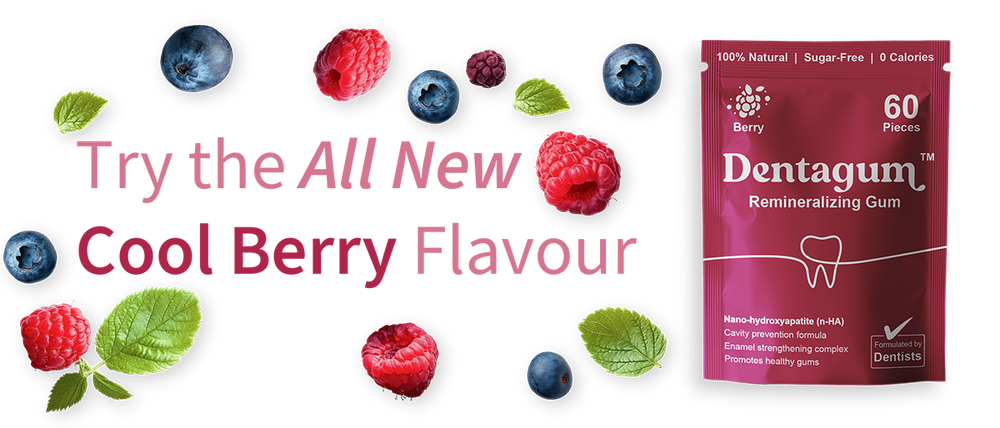
Dentagum's Remineralizing Chewing Gum is built on an organic chicle base and combines organic xylitol, nano-hydroxyapatite, organic mastic gum, and natural propolis, alongside organic erythritol, organic eggshell powder, and calcium bentonite clay. Every ingredient serves a function. In Dentagum's own clinical data, 87% of participants were less susceptible to cavities compared to non-users, and 79% experienced a clinical reduction in gum inflammation with consistent daily use.
Frequently Asked Questions
Does chewing gum actually clean your teeth?
Sugar-free gum with the right ingredients genuinely reduces plaque accumulation and supports oral hygiene between brushing. A 2022 meta-analysis from King's College London found a statistically significant reduction in plaque quantity with sugar-free gum use. It doesn't replace brushing or flossing, but it does meaningful work during the post-meal window when brushing isn't practical.
What makes a gum good for cleaning teeth?
The key factors are: xylitol as the primary sweetener (which kills plaque-forming bacteria through a specific metabolic mechanism), a natural gum base like chicle that avoids synthetic additives, and active ingredients like mastic gum or propolis with documented antibacterial and anti-inflammatory properties. Chewing time also matters. Ten to twenty minutes after meals is the recommended window.
How does chewing gum reduce plaque?
Through several overlapping mechanisms: saliva stimulation neutralizes the acid that allows plaque bacteria to thrive, xylitol directly reduces Streptococcus mutans counts, the physical friction of chewing dislodges loose debris, and ingredients like mastic gum and propolis deliver antimicrobial compounds directly to the oral environment. A 2022 systematic review found xylitol gum decreased plaque in 13 of 14 clinical trials reviewed.
Is xylitol gum better than regular sugar-free gum for cleaning teeth?
Yes, based on current evidence. Sorbitol, the most common sweetener in standard sugar-free gum, can be partially fermented by oral bacteria and shows weaker antibacterial effects than xylitol in head-to-head studies. Xylitol's mechanism against Streptococcus mutans is specific and well-documented. For plaque reduction, xylitol gum consistently outperforms sorbitol alternatives.
When is the best time to chew gum for oral health?
After meals and drinks, particularly when brushing isn't possible. The post-meal window is when oral pH drops, bacteria become most active, and enamel is temporarily more vulnerable. Chewing gum during this period neutralizes acid faster, reduces bacterial activity, and delivers any remineralizing ingredients to teeth at the moment they're most needed.
Can gum replace brushing and flossing?
No. Gum works as a complement to brushing and flossing, not a replacement. Established plaque along the gumline and between teeth requires the mechanical action of a toothbrush and floss to remove. Gum reduces new plaque accumulation and supports oral health between brushing sessions. The two routines cover different windows of the day and different types of oral hygiene need.
The Bottom Line
The science behind gum that cleans teeth is more substantial than most people expect. Saliva stimulation, xylitol's specific action against plaque-forming bacteria, the mechanical effect of chewing, and the antimicrobial properties of ingredients like mastic gum and propolis work together to produce real, measurable reductions in plaque. These effects are endorsed by the ADA, supported by systematic reviews from major institutions, and most useful when you use them consistently after meals.
The key is choosing a gum that's actually formulated to do this: xylitol as the primary sweetener, a natural base, and active ingredients with clinical support behind them. A well-made healthy chewing gum is one of the simplest habits you can build into a day that's already too busy for perfect oral hygiene.
Dentagum's Remineralizing Chewing Gum is dentist-formulated with organic xylitol, nano-hydroxyapatite, organic mastic gum, and natural propolis, designed to be chewed for 10-20 minutes after meals. Try it risk-free with a 30-day guarantee at dentagum.co.
References
- Nasseripour M et al. "A Systematic Review and Meta-Analysis of the Role of Sugar-Free Chewing Gum on Plaque Quantity in the Oral Cavity." Frontiers in Oral Health, 2022. https://www.ncbi.nlm.nih.gov/pmc/articles/PMC9006880/
- Söderling E, Pienihäkkinen K. "Effects of Xylitol Chewing Gum and Candies on the Accumulation of Dental Plaque: A Systematic Review." Clinical Oral Investigations, 2022. https://link.springer.com/article/10.1007/s00784-021-04225-8
- Yeung CY, Chu CH, Yu OY. "A Concise Review of Chewing Gum as an Anti-Cariogenic Agent." Frontiers in Oral Health, 2023. https://www.frontiersin.org/journals/oral-health/articles/10.3389/froh.2023.1213523/full
- Alwadi MAM et al. "Mastic (Pistacia lentiscus) Gum and Oral Health: A State-of-the-Art Review of the Literature." Journal of Natural Medicine, 2023. https://pubmed.ncbi.nlm.nih.gov/37147480/
- Kiani S et al. "Effect of Propolis Mouthwash on Clinical Periodontal Parameters in Patients with Gingivitis: A Double-Blinded Randomized Clinical Trial." International Journal of Dental Hygiene, 2022. https://onlinelibrary.wiley.com/doi/abs/10.1111/idh.12550
- American Dental Association. "Chewing Gum." Oral Health Topics. https://www.ada.org/resources/ada-library/oral-health-topics/chewing-gum
- Ludovichetti FS et al. "Effect of Xylitol and Maltitol Chewing Gums on Plaque Reduction and Salivary pH Modulation." Dentistry Journal, Padova University, 2025. https://www.ncbi.nlm.nih.gov/pmc/articles/PMC12199195/
