
The Rise of Enamel Strengthening Gum: What's Driving the Demand
Dental erosion is more common than most people realize. A 2026 narrative review published in MDPI Biomimetics put the global prevalence at 20% to 40% in adults and 30% to 50% in children. Those numbers have been climbing steadily, driven by lifestyle changes over the past few decades

Enamel is the hardest substance in the human body. It's also the only tissue that can't regenerate. Once it wears away, the damage is permanent, which makes protecting it while you still have it one of the most important things you can do for your long-term dental health.
That biological reality, combined with modern diets high in acid and sugar, is pushing more people toward products specifically designed to support enamel mineral balance throughout the day. Enamel strengthening gum sits at the front of that wave, and the market data reflects just how significant the shift has become.
The Problem That's Driving the Trend
Dental erosion is more common than most people realize. A 2026 narrative review published in MDPI Biomimetics put the global prevalence at 20% to 40% in adults and 30% to 50% in children. Those numbers have been climbing steadily, driven by lifestyle changes over the past few decades: more frequent consumption of acidic beverages, higher sugar intake across processed foods, acid reflux, and the everyday reality of a diet that most people's enamel wasn't designed to handle at this frequency.
The mechanism is straightforward. Every acidic food or drink temporarily lowers oral pH. When that pH drops below 5.5, enamel begins to dissolve. Minerals leave the tooth surface in a process called demineralization. Saliva naturally reverses this by delivering calcium and phosphate ions that reintegrate into the enamel structure, a process called remineralization. The problem is that modern eating patterns often outpace saliva's natural capacity to keep up. Frequent snacking, constant coffee and soft drink consumption, and meals eaten quickly without recovery time all keep pH suppressed and leave saliva less time to do its repair work between exposures.
The result is incremental enamel loss that accumulates quietly over years, often showing up as increased sensitivity, visible thinning, or new cavities in people who thought they were taking care of their teeth. By the time most people notice the signs, meaningful enamel loss has already occurred.
Why Brushing Alone Isn't Enough

Most people's oral care routine is built around brushing twice a day and flossing. That's a solid foundation. But it leaves a significant gap.
You eat three times a day, drink coffee between meals, and snack throughout the afternoon. Every one of those moments creates an acid challenge your enamel has to recover from. Brushing happens at fixed points in the day, not in response to each acid exposure. And brushing immediately after acidic meals is actually counterproductive: temporarily softened enamel is more susceptible to abrasion from a toothbrush, which is why dentists recommend waiting at least 30 minutes after acidic intake before brushing.
That creates a meaningful window during which your teeth are recovering from acid exposure with only saliva as support. For most people, that window happens multiple times every day. Enamel strengthening gum is designed to fill exactly that gap, delivering remineralizing ingredients in sustained contact with enamel during the 10-20 minutes after eating when support is most needed.
The Market Response
The data reflects a consumer base that has started to understand this gap and is actively looking for solutions.
The global remineralizing gum market was valued at USD 1.19 billion in 2026 and is projected to reach USD 2.05 billion by 2036, according to Future Market Insights. The growth is attributed specifically to preventive oral care trends, xylitol adoption, and demand for premium enamel-support formulations. This isn't fringe growth. It's a category expanding at nearly double the rate of the broader chewing gum market.
The remineralizing toothpaste category is showing the same signal. That market was valued at USD 1.2 billion in 2024 and is projected to reach USD 2.5 billion by 2033 at a CAGR of 9.2%, led by the non-fluoride remineralizing segment. Consumer research consistently points to a demand for products that go beyond basic cleaning to actively support enamel health.
Sugar-free gum already captured 60.01% of the entire chewing gum market in 2024. The next evolution is the functional segment: sugar-free gums with active remineralizing ingredients that do more than prevent damage by avoiding sugar. They actively support mineral balance in real time.
What Enamel Strengthening Gum Actually Does
The term "enamel strengthening" can mean different things depending on what's in the formula. It's worth being precise about what each mechanism actually delivers.
Nano-Hydroxyapatite: Direct Mineral Replenishment
Nano-hydroxyapatite (nano-HAp or nHA) is the ingredient with the strongest clinical case for enamel repair in a gum format. It's a synthetic form of the mineral that already makes up around 97% of your tooth enamel, produced in nanoparticle sizes small enough to penetrate the microporosities in enamel and deposit directly into early lesions.
Where saliva naturally delivers calcium and phosphate for remineralization, nano-HAp delivers those same minerals in a concentrated, stable form during the chewing window. A 2022 review published in Biomimetics confirmed that hydroxyapatite and xylitol are effective combination ingredients, with hydroxyapatite providing the remineralizing mechanism and xylitol providing antibacterial support. A 2023 systematic review and meta-analysis by Limeback, Enax, and Meyer found that hydroxyapatite in oral care products performed comparably to fluoride for caries prevention and reduced dentin hypersensitivity by 6% to 80% compared to placebo in gum format specifically.
The gum format is important here. Contact time determines how much mineral can be deposited. Toothpaste stays in your mouth for two minutes. A well-formulated enamel gum chewed for 10-20 minutes after meals gives nano-HAp particles sustained access to enamel surfaces at the moment when pH is recovering and remineralization conditions are improving. That's a fundamentally different delivery mechanism than toothpaste.
Xylitol: Reducing the Acid Load
Xylitol supports enamel health indirectly but meaningfully. By disrupting the metabolism of Streptococcus mutans, the primary acid-producing bacterium in the mouth, xylitol reduces the bacterial contribution to pH drop after meals. Less acid produced means less enamel at risk of demineralization. The enamel repair work that nano-HAp and saliva are doing doesn't get undone as quickly.
A 2022 microbiome study from Taipei Medical University found that xylitol gum reduced both cariogenic and periodontopathic bacteria in plaque after two weeks of use. The combination of nano-HAp's remineralizing action with xylitol's bacterial reduction creates a formula that addresses both sides of the enamel balance equation: reducing the forces that erode it while actively replenishing what's lost.
Saliva Stimulation: Amplifying Your Natural Defense
Chewing itself stimulates saliva production, and that saliva brings more of the natural mineral content that supports remineralization. A 2021 narrative review published in F1000Research confirmed that saliva acts as "a carrier of essential ions, such as fluoride, calcium and phosphate, which have a positive role in enamel's remineralization." More saliva means more natural remineralizing capacity working alongside the active ingredients in the gum.
The chewing stimulus also neutralizes post-meal acid faster, shortening the window during which enamel is at risk. It's a compounding effect: the mechanical act of chewing, the saliva it stimulates, and the active ingredients it delivers all work in the same direction at the same time.
Why the Timing of Enamel Gum Matters
Most people who understand the concept of remineralizing gum still underestimate how much timing shapes the result.
The post-meal period, roughly the 20-30 minutes after eating, is when oral pH is at its lowest and enamel is most vulnerable. Remineralizing conditions improve as saliva gradually restores pH back toward the neutral range of 6.7 to 7.4. Chewing a well-formulated gum during this specific window does two things: it accelerates the pH recovery through saliva stimulation, and it delivers nano-HAp to enamel surfaces at the exact moment when remineralization conditions are improving and the mineral can integrate most effectively.
Chewing the same gum two hours after a meal, when pH has already recovered naturally, is less impactful. The ingredient is still making contact with enamel, but the biological window for remineralization is less favorable. The habit of reaching for enamel gum specifically after meals, rather than randomly throughout the day, reflects where the clinical evidence points most clearly.
Who Benefits Most
Enamel strengthening gum is relevant for most adults to some degree, but a few groups have particular reason to prioritize it.
People who drink coffee, tea, soft drinks, or acidic juices regularly are creating frequent acid challenges their enamel has to recover from. Chewing a remineralizing gum after these drinks extends the recovery window with active mineral support.
People with a history of cavities or early enamel erosion have enamel that's already compromised. Consistent daily use of nano-HAp gum after meals is the kind of preventive habit that slows further loss and supports repair of early lesions before they require intervention.
People with tooth sensitivity, which often signals exposed dentinal tubules from enamel wear, will find that nano-HAp's tubule-sealing mechanism addresses the structural cause of sensitivity rather than just numbing the nerve signal.
People who can't always brush after meals, whether at work, travelling, or in situations where brushing isn't practical, have a meaningful alternative that does real enamel support work in the window after eating.
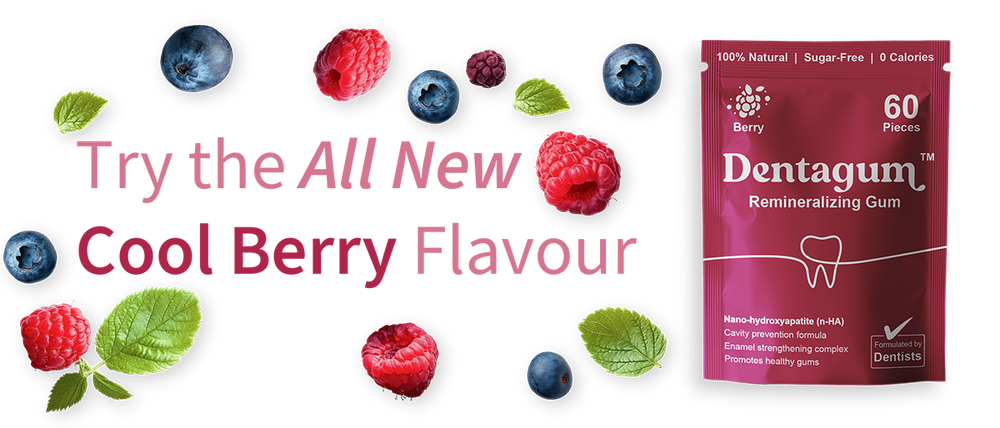
Dentagum's Remineralizing Chewing Gum is formulated specifically for this gap. Nano-hydroxyapatite and organic xylitol address enamel mineral balance and bacterial reduction simultaneously. Organic mastic gum, natural propolis, organic eggshell powder, and calcium bentonite clay round out a formula designed to do more in those 10-20 minutes after eating than any standard sugar-free gum. Dentist-formulated and 3rd-party tested. In Dentagum's own clinical data, 83% of participants showed notable gains in enamel quality and mineral quantity, and 91% reported significant reduction in cold sensitivity with consistent daily use. Try it risk-free with a 30-day guarantee at dentagum.co.
What to Look for When Choosing an Enamel Gum
The category is growing fast, and not everything marketed as enamel-strengthening delivers on that claim. A few things separate formulas that work from ones that simply use the right language.
Nano-hydroxyapatite, not just calcium: Some products list calcium compounds as remineralizing agents. Nano-HAp is the specific form with clinical evidence for enamel mineral deposition in gum format. The nano particle size is what enables penetration into enamel microporosities. Standard calcium compounds don't have the same mechanism.
Xylitol as the primary sweetener: The antibacterial mechanism is specific to xylitol and isn't replicated by sorbitol or synthetic sweeteners. A product that leads with xylitol is doing more than sweetening.
A natural gum base: Chicle or mastic gum rather than synthetic petroleum-derived polymers. You're chewing this for 10-20 minutes. The base material matters for what's in sustained contact with your oral tissues.
Clear chewing guidance: Brands that specify the post-meal timing and the 10-20 minute duration are demonstrating that they understand how the formula works. Vague guidance often reflects a formula that doesn't require precision because it isn't doing much.
Third-party testing: Independent verification of what's in the product is increasingly the baseline expectation in a category that's growing quickly and attracting brands without the research behind their claims.

Frequently Asked Questions
Can chewing gum actually strengthen enamel?
Yes, when the formula contains nano-hydroxyapatite. Nano-HAp particles deposit the same mineral enamel is made of into early lesions and weak spots during the chewing window, supporting remineralization. A 2023 systematic review found hydroxyapatite in oral care products performed comparably to fluoride for caries prevention. Chewing also stimulates saliva, which delivers natural calcium and phosphate for additional remineralizing support.
What is enamel erosion and how common is it?
Enamel erosion is the chemical loss of mineralized tooth substance caused by acid exposure from food, drinks, acid reflux, or other sources. A 2026 narrative review found global prevalence ranges from 20% to 40% in adults and 30% to 50% in children. The ADA recognizes it as a multifactorial condition driven primarily by frequent exposure to acidic foods and beverages. It's more common than most people suspect and often progresses silently before symptoms appear.
How does enamel strengthening gum work?
Through three overlapping mechanisms: nano-hydroxyapatite deposits enamel's own mineral directly into early lesions and microporosities during the chewing window, xylitol reduces the acid-producing bacteria responsible for ongoing enamel attack, and chewing stimulates saliva production that buffers post-meal acid and delivers natural remineralizing ions. The three mechanisms work simultaneously during 10-20 minutes of chewing after meals.
When is the best time to chew enamel strengthening gum?
Immediately after meals and drinks. The post-meal window is when oral pH is at its lowest, enamel is most vulnerable, and remineralizing support has the greatest impact. Chewing for 10-20 minutes during this specific period, rather than randomly throughout the day, reflects where the clinical evidence for timing is most consistent.
Is enamel repair gum a replacement for toothpaste or brushing?
No. Enamel gum works as a complement to your existing routine, not a replacement. Brushing removes established plaque and delivers fluoride or other active ingredients during your morning and evening routine. Enamel gum covers the post-meal windows when brushing isn't practical and when active remineralizing support is most needed. The two routines address different parts of the day and different aspects of enamel health.
Why is the remineralizing gum market growing so fast?
Several factors are converging. Consumer awareness of enamel erosion is increasing. The broader shift toward preventive oral care, functional food products, and clean-label ingredients is creating demand for gums that do more than freshen breath. And the clinical evidence for nano-hydroxyapatite as a meaningful enamel-support ingredient has strengthened considerably over the last few years, giving the category a credible scientific foundation that supports consumer confidence.
The Bottom Line
Enamel strengthening gum exists because there's a genuine gap in most oral care routines: the post-meal window when enamel is recovering from acid exposure and brushing isn't an option. The growth of the category reflects consumers who understand that gap and are looking for something that fills it meaningfully.
The science is real. Nano-hydroxyapatite deposits the mineral enamel is made of directly into early lesions during the chewing window. Xylitol reduces the bacteria responsible for ongoing acid attack. Saliva stimulation accelerates pH recovery. Used consistently after meals, a well-formulated enamel gum does the kind of incremental protective work that adds up to meaningfully better enamel health over months and years.
The habit itself is simple. Ten to twenty minutes after eating. The formula does the rest.
Dentagum's Remineralizing Chewing Gum is dentist-formulated with nano-hydroxyapatite, organic xylitol, and mastic gum, designed to fit into your routine after every meal. Try it risk-free with a 30-day guarantee at dentagum.co.
References
- "Dental Erosion Management: From Remineralization to Emerging Regenerative Approaches: A Narrative Review." MDPI Biomimetics, 2026. https://www.mdpi.com/2313-7673/11/2/107
- American Dental Association. "Dental Erosion." Oral Health Topics. https://www.ada.org/resources/ada-library/oral-health-topics/dental-erosion
- Future Market Insights / Morningstar. "Remineralizing Gum Market to Reach USD 2.05 Billion by 2036." May 2026. https://www.morningstar.com/news/accesswire/1167683msn/remineralizing-gum-market-to-reach-usd-205-billion-by-2036
- Enax J et al. "Overview on Adjunct Ingredients Used in Hydroxyapatite-Based Oral Care Products." Biomimetics, 2022. https://www.ncbi.nlm.nih.gov/pmc/articles/PMC9775056/
- Limeback H, Enax J, Meyer F. "Clinical Evidence of Biomimetic Hydroxyapatite in Oral Care Products for Reducing Dentin Hypersensitivity: An Updated Systematic Review and Meta-Analysis." Biomimetics, 2023. https://pmc.ncbi.nlm.nih.gov/articles/PMC9844412/
- Farooq I et al. "The Role of Salivary Contents and Modern Technologies in the Remineralization of Dental Enamel: A Narrative Review." F1000Research, 2021. https://www.ncbi.nlm.nih.gov/pmc/articles/PMC7076334/
- Wu Y-F et al. "Xylitol-Containing Chewing Gum Reduces Cariogenic and Periodontopathic Bacteria in Dental Plaque: Microbiome Investigation." Frontiers in Nutrition, 2022. https://www.ncbi.nlm.nih.gov/pmc/articles/PMC9131035/
RESEARCH SUMMARY
- "Dental Erosion Management: From Remineralization to Emerging Regenerative Approaches." MDPI Biomimetics, 2026. Global prevalence of dental erosion ranges from 20% to 40% in adults and 30% to 50% in children. Saliva alone can partially remineralize early erosive enamel lesions by depositing calcium phosphate phases. Management is a clinical priority to prevent long-term complications including dentine hypersensitivity.
- American Dental Association. "Dental Erosion." Oral Health Topics. Dental erosion is the chemical loss of mineralized tooth substance caused by acid exposure. Etiology is multifactorial. ADA emphasizes reducing exposure to erosive acidic drinks and dietary sources.
- Future Market Insights / Morningstar, 2026. Global remineralizing gum market valued at USD 1.19 billion in 2026, projected to reach USD 2.05 billion by 2036. Growth driven by preventive oral care trends, xylitol adoption, and premium enamel-support formulations.
- Remineralizing toothpaste market data, 2024-2025. Global market valued at USD 1.2 billion in 2024, projected to reach USD 2.5 billion by 2033 at a CAGR of 9.2%. Led by non-fluoride remineralizing segment. Consumer demand for products that "go beyond basic cleaning."
- Accio market data, 2025. Sugar-free gum captured 60.01% of the chewing gum market in 2024. Nano-hydroxyapatite emerging as key differentiating ingredient in enamel-focused gum formulations. Brands Larineco and Boka highlighting nano-HAp for enamel remineralization.
- Enax J et al. "Overview on Adjunct Ingredients Used in Hydroxyapatite-Based Oral Care Products." Biomimetics, 2022. Confirmed hydroxyapatite and xylitol as complementary active ingredients. Hydroxyapatite provides remineralization, xylitol provides antibacterial action.
- Limeback H, Enax J, Meyer F. "Clinical Evidence of Biomimetic Hydroxyapatite in Oral Care Products for Reducing Dentin Hypersensitivity." Biomimetics, 2023. HAp in gum format reduced dentin hypersensitivity by 6% to 80% compared to placebo. Comparable caries prevention to fluoride in 18-month RCT.
- Farooq I et al. F1000Research, 2021. Saliva acts as a carrier of calcium and phosphate ions for enamel remineralization. Salivary proteins play a role in natural enamel mineralization.
