
Organic vs Non-Organic Ingredients in Oral Care: Does It Matter?
Organic" on a chewing gum label can mean several different things depending on which ingredient you're talking about and which certification standard was applied. Here's the honest breakdown: where organic sourcing matters significantly, where the difference is modest, and where it's largely irrelevant to the product's oral health function

Organic certification means different things for different ingredients, and the answer to whether it matters depends on which specific ingredient you're evaluating. For xylitol, organic sourcing is meaningful: most commercial xylitol comes from GMO corn, and organic certification requires non-GMO feedstock and production without synthetic processing aids. For essential oils like spearmint and peppermint, organic certification matters significantly because conventional mint crops are heavily treated with pesticides and distillation concentrates any residues in the final oil. For mineral ingredients like nano-hydroxyapatite and calcium bentonite clay, the organic category doesn't apply (they aren't agricultural products). "Natural" on an oral care label means nothing legally, as it has no regulated definition in the US. "Organic" has a regulated meaning only when the relevant certification standard has actually been applied and verified by an accredited third party.
Organic oral care products sit at an unusual intersection of food regulation, personal care regulation, and consumer marketing. The claims that appear on labels range from rigorously verified to entirely unregulated depending on which word is used and which certification framework, if any, was applied. Understanding the difference matters both for evaluating what you're buying and for understanding why some organic sourcing decisions are meaningful and others are not.
This article is specifically honest about where organic certification adds something real, where it's largely symbolic, and where the category doesn't apply at all. For Dentagum's formula, the organic sourcing choices were made where the distinction is most meaningful, not uniformly across all ingredients regardless of whether it changes anything relevant.
What "Organic" Actually Means in a Regulatory Sense

In the United States, "organic" has a regulated legal meaning when applied to agricultural products under the USDA National Organic Program (NOP). For food products, the NOP sets clear thresholds:
"100% Organic" means every ingredient must be certified organic. "Organic" (with the USDA seal) means at least 95% of the content must be certified organic, with the remaining 5% restricted to substances on the NOP's approved list. "Made with Organic [ingredient]" means at least 70% of the content is certified organic. Products with less than 70% organic content cannot use the word "organic" anywhere on the principal display panel, though they may list specific organic ingredients in the ingredient statement.
For personal care products, including oral care products like chewing gum, the situation is more complex. The USDA NOP can apply if a personal care product contains only agricultural ingredients eligible under NOP standards. The NSF/ANSI 305 standard was developed specifically for personal care and cosmetics, requiring at least 70% organic content, and applies NOP-based standards to a broader range of ingredients that might not qualify under the food-specific NOP rules.
A January 2024 rule strengthened NOP enforcement by adding supply chain traceability requirements, unannounced inspections, and import certificates, making the USDA organic label more difficult to fraudulently obtain.
"Natural" has no legal definition in the US for cosmetics, personal care products, or oral care products. The FDA has not defined the term for these product categories. Any product can be labeled "natural" without meeting any standard. "Non-GMO" has a specific meaning but does not require organic farming standards, processing restrictions, or supply chain transparency. "Clean label" is a marketing concept with no regulatory definition. Only "organic" with a specific certification standard (USDA NOP or NSF/ANSI 305) carries regulated meaning, and only when a USDA-accredited certifier has verified the claim and can be identified on the packaging.
The Ingredient-by-Ingredient Analysis
Whether organic sourcing matters depends entirely on which ingredient you're evaluating. The answer varies substantially across the typical oral care ingredient set.
Xylitol: Where organic sourcing is most meaningful

The xylitol question is the most commercially significant one in oral care products, because xylitol sourcing is widely misrepresented and the difference between organic and conventional is genuine.
Most commercial xylitol is derived from corn cobs. Corn in the US is predominantly genetically modified (GMO). The extraction process involves hydrolysis of the corn cob xylan using acid and high heat, followed by hydrogenation. Conventional corn-derived xylitol is produced from GMO feedstock using a process that may involve synthetic processing aids not permitted under organic standards.
Organic xylitol requires certified organic feedstock (typically birch wood or certified organic non-GMO corn) and processing without synthetic processing aids prohibited under organic standards. Birch-derived xylitol is associated with the original Finnish clinical research on xylitol and caries prevention, though the clinical evidence for xylitol's effectiveness is based on the xylitol molecule itself (C5H10O5) regardless of source. The end molecule is chemically identical whether from birch or corn. The organic distinction applies to the agricultural and processing standards used to produce the feedstock, not to the chemistry of the final ingredient.
The honest framing: organic xylitol from birch or certified organic corn is produced without GMO feedstock and without synthetic processing aids. The clinical evidence on xylitol's antibacterial effects doesn't distinguish between conventional and organic sources (the molecule is identical). But for consumers who care about GMO-free ingredients and organic agricultural standards, organic xylitol is the meaningful choice, and it's one that requires genuine certification rather than just a label claim.
The xylitol molecule (C5H10O5) is identical regardless of whether it comes from birch wood, corn cobs, or any other xylan source. Xylitol's clinical effects on S. mutans are based on the molecule, not its source. The arguments for birch-derived or organic xylitol relate to: (1) the agricultural standards applied to the feedstock, (2) the absence of GMO corn in the supply chain, and (3) the absence of synthetic processing aids. Some proponents argue for superior purity of birch-derived xylitol (lower residual hemicellulose, cleaner sensory profile). The 40+ years of xylitol clinical research was conducted primarily using birch-derived xylitol. For a consumer who prioritizes organic and non-GMO sourcing, organic birch xylitol delivers on those standards. For a consumer who prioritizes only the clinical antibacterial effect, the source is less relevant.
Essential oils (spearmint, peppermint): Where organic certification matters most
Essential oils are among the ingredients where organic certification has the strongest case, for a specific and mechanistic reason: distillation concentrates.
When mint is grown conventionally, synthetic pesticides and herbicides may be applied during cultivation. When the mint is then steam-distilled to produce essential oil, the process concentrates everything that survives distillation into the oil. Pesticide residues that might be at trace levels in the whole plant can be amplified in the concentrated essential oil product.
Organic essential oil certification requires that the mint is grown without synthetic pesticides or herbicides, from certified organic seed or planting stock, on certified organic land. The absence of synthetic pesticide application means the distilled oil doesn't contain concentrated residues of those inputs. For an ingredient that is literally a concentration of plant chemistry, organic sourcing removes the synthetic chemical inputs that would otherwise be concentrated alongside the beneficial terpene compounds.
This is the strongest argument for organic essential oils in an oral care product: you're not just buying a different farming philosophy, you're removing specific chemical inputs from a concentration process that would otherwise amplify them.
Mastic gum and chicle: where "organic" is close to the natural state
Mastic and chicle are natural plant resins that are tapped or harvested from trees. They aren't agricultural crops in the same sense as mint or corn, and their conventional forms are close to natural by default. Organic certification for mastic and chicle primarily adds: no synthetic processing aids in the extraction and processing steps, and traceable supply chain documentation.
The organic distinction here is less about removing synthetic agricultural inputs (since mastic trees and chicle trees aren't typically treated with synthetic pesticides in the way mint crops are) and more about the processing standards and documentation transparency that organic certification requires.
Nano-hydroxyapatite: where organic doesn't apply
Nano-hydroxyapatite is a synthetically produced mineral compound (calcium phosphate ceramic). It is not an agricultural product and the organic certification framework doesn't apply to it. Its quality is evaluated by pharmaceutical or food-grade standards (purity, particle size, absence of contaminants), not organic agricultural standards. This is entirely appropriate: you want nano-HAp that meets pharmaceutical or food-grade specifications for purity and particle size, not one that happens to have been produced from agricultural inputs.
Calcium bentonite clay: where organic doesn't apply
Bentonite clay is a geological mineral extract, not an agricultural product. The relevant quality standard is food-grade specification and heavy metal testing (such as Prop 65 testing) rather than organic certification. Organic certification doesn't apply to geological mineral extraction. The appropriate verification for clay in oral care products is independent heavy metal testing, not organic certification.
Propolis: where organic requires certified organic hives
Organic propolis requires that the bees producing it are kept in certified organic hives, foraging on certified organic land without exposure to pesticides or other prohibited substances. This is a meaningful but logistically complex certification, because it requires controlling the foraging range of honeybee colonies. Genuinely certified organic propolis exists but is less common and more expensive than conventional propolis.
How to Actually Evaluate an Organic Claim on an Oral Care Product
Knowing what organic certification means is useful. Knowing how to verify that it's real is equally important, because organic fraud exists and the supplement/personal care space has historically had less rigorous enforcement than food products.
Look for the certifying agent, not just the seal. USDA organic-certified products must display the name of the certifying agent (the USDA-accredited organization that audited the supply chain) on the information panel. A USDA seal without a named certifier is a red flag. You can verify an operation's organic certification in USDA's Organic INTEGRITY Database.
Distinguish between product-level and ingredient-level certification. A product that lists "contains organic xylitol" in the ingredient statement is making a different claim than a product that carries the USDA organic seal on the principal display panel. The former means that specific ingredient is organically sourced. The latter means the entire product has been assessed against organic standards at the product level.
For personal care products specifically, look for NSF/ANSI 305. This is the standard designed for products like oral care gum that aren't purely food but contain agricultural ingredients. USDA NOP can also apply, but NSF/ANSI 305 is the standard specifically developed for this product category.
"Natural" means nothing. There is no legal definition of "natural" for oral care products in the US. A product labeled "natural" has made no verified claim under any regulatory framework. This is not a cynical observation; it's simply what the regulatory landscape looks like. Many genuinely clean-formulated products use "natural" accurately to describe their ingredient philosophy. But the label itself provides no verification.
Where Organic Sourcing Doesn't Change the Oral Health Outcome
It's worth being direct about this, because it's part of the honest picture that most organic product marketing avoids.
The clinical evidence on xylitol's antibacterial effects is based on the xylitol molecule. A 2025 systematic review found xylitol significantly reduced S. mutans in 12 of 14 studies. Those studies were not conducted specifically on organic birch xylitol: they were conducted on xylitol. The antibacterial mechanism doesn't distinguish between a xylitol molecule from a GMO corn cob and one from an organic birch tree. They're chemically identical.
Similarly, the essential oil terpene antimicrobial data discussed in our article on terpenes doesn't distinguish between organic and conventionally grown mint. The carvone from organic spearmint is the same molecule as carvone from conventional spearmint. The mechanism that disrupts bacterial membranes is identical.
The argument for organic sourcing is not that organic ingredients are pharmacologically superior at the molecular level. It's that the process used to produce them: without synthetic pesticides, without GMO feedstock, without synthetic processing aids, with transparent supply chain documentation, better aligns with a consumer's values around agricultural and environmental standards. This is a legitimate reason to choose organic. It's just a different reason from the clinical evidence for the specific oral health outcomes, and conflating them produces marketing claims that the underlying science doesn't support.
Dentagum's Organic Sourcing Choices

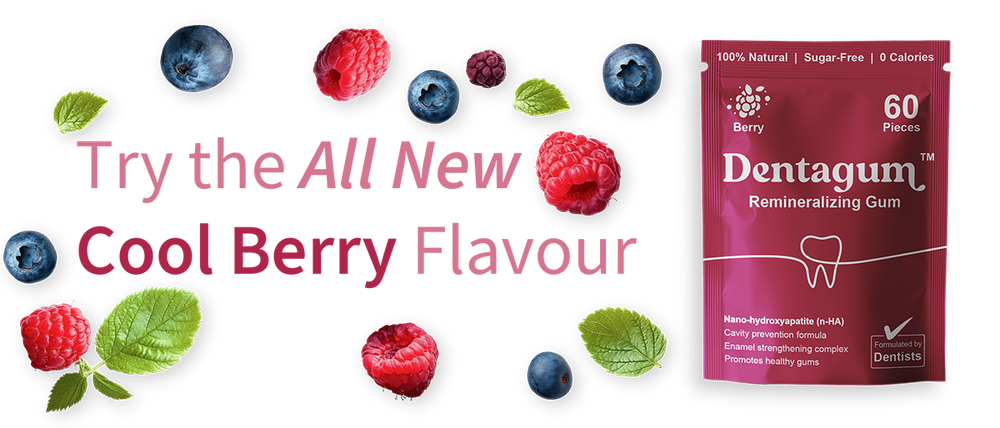
Dentagum uses organic xylitol, organic erythritol, an organic mastic and chicle gum base, and organic spearmint and peppermint essential oils. These are the ingredients where organic certification makes the strongest argument: the sweeteners for their GMO-free and processing standard basis, the essential oils for the distillation concentration argument.
The formula also contains ingredients where the organic category doesn't apply (nano-hydroxyapatite, calcium bentonite clay) and ingredients where the organic supply chain is more complex (propolis, eggshell powder). Dentagum is transparent about the formula's non-vegan status (eggshell powder) and the pet safety concern (xylitol toxic to dogs).
The organic sourcing choices are genuine: ingredients listed as organic are from certified organic sources. The formula is Prop 65 tested through Lightlabs for heavy metal safety, providing independent third-party verification of the safety profile that organic certification alone doesn't guarantee (since geological minerals and some natural ingredients require heavy metal testing regardless of how they're grown).
Try Dentagum risk-free — 30-day guaranteeFrequently Asked Questions
Does organic certification matter for oral care products?
It depends on which ingredient you're evaluating. For essential oils, organic certification matters significantly because distillation concentrates anything in the plant material, including pesticide residues. For xylitol, organic sourcing means non-GMO feedstock and production without synthetic processing aids, which matters for consumers who prioritize these standards. For mineral ingredients like nano-hydroxyapatite and calcium bentonite clay, the organic category doesn't apply and is not the relevant quality standard. The honest answer is ingredient-specific, not a blanket yes or no.
What does "natural" mean on oral care products?
Nothing regulated in the United States. The FDA has not defined "natural" for cosmetics, personal care products, or oral care products. Any product can use the word "natural" without meeting any standard or verification requirement. For meaningful claims, look for specific organic certifications (USDA NOP or NSF/ANSI 305) with a named certifying agent, or for independently verified safety testing like Prop 65 certification through a named laboratory.
Is organic xylitol different from regular xylitol?
The xylitol molecule (C5H10O5) is chemically identical regardless of whether it comes from organic birch or conventional GMO corn. The clinical evidence on xylitol's antibacterial effects applies to the molecule, not its source. The arguments for organic xylitol are about the production process: non-GMO feedstock, no synthetic processing aids, organic agricultural standards applied to the source plant material. For consumers who prioritize GMO-free and organic sourcing standards, organic xylitol delivers on those values. For consumers who prioritize only the clinical antibacterial effect, the source is less relevant.
Why does organic certification matter most for essential oils?
Because distillation concentrates everything in the plant material. When mint is grown conventionally with synthetic pesticides and the plant is then steam-distilled to produce essential oil, any pesticide residues present in the plant are concentrated in the finished oil. Organic certification for essential oils requires pesticide-free cultivation, meaning the distillation process isn't concentrating synthetic pesticide inputs. For a highly concentrated ingredient like an essential oil, the organic sourcing argument is stronger than for a diluted ingredient in a processed product.
What's the difference between USDA NOP organic and NSF/ANSI 305?
USDA NOP is the main US organic certification, originally designed for food products but applicable to personal care and oral care if the product uses only agricultural ingredients eligible under food NOP standards. NSF/ANSI 305 is a certification standard specifically developed for personal care and cosmetics, applying NOP-based standards to a broader range of ingredients that might not qualify under the food-specific NOP rules, while still requiring at least 70% organic content. Both require a third-party certifier to audit the supply chain. Products certified under either standard must display the certifying agent's name on the label.
Can you trust organic claims on chewing gum?
With verification, yes. The USDA's 2024 Strengthening Organic Enforcement rule strengthened supply chain traceability requirements, unannounced inspections, and import certificate requirements, making organic fraud more difficult. Verified organic claims require a named certifying agent on the product label, whose certification can be checked in the USDA's Organic INTEGRITY Database. Claims without a named certifying agent are not verified. The most trustworthy combination is specific organic ingredient sourcing plus independent third-party safety testing for things organic certification doesn't cover (like heavy metal content in mineral ingredients).

The Bottom Line
Organic certification matters in oral care, but it matters differently for different ingredients, and it doesn't matter uniformly across a formula. For essential oils, it removes synthetic pesticide inputs from a concentration process that would otherwise amplify them. For xylitol, it ensures non-GMO feedstock and organic processing standards. For mineral ingredients like nano-HAp and bentonite clay, the category doesn't apply and the relevant quality standards are purity specifications and independent heavy metal testing.
"Natural" on a label is not a verified claim. "Organic" with a named certifying agent is. The difference between those two statements captures most of what a consumer needs to know when evaluating oral care product labels.
Dentagum's organic sourcing covers the ingredients where it makes the strongest argument: the sweeteners, the essential oils, and the gum base. The mineral ingredients are evaluated by the standards relevant to their category (pharmaceutical-grade purity for nano-HAp, Prop 65 heavy metal testing for clay). This is what honest, ingredient-specific sourcing looks like rather than blanket marketing claims that paper over the distinction between ingredients where organic sourcing matters and ones where it doesn't apply.
Try Dentagum risk-free — 30-day guarantee at dentagum.coResearch Summary
- USDA National Organic Program (NOP). Regulated organic certification for agricultural and food products. Thresholds: 100% Organic (all organic), Organic (95%+ organic, USDA seal permitted), Made with Organic (70%+ organic), specific ingredients (under 70%, named in ingredient list only). 2024 Strengthening Organic Enforcement rule added supply chain traceability, unannounced inspections, import certificates.
- NSF/ANSI 305. Organic personal care certification standard specifically for cosmetics and personal care including oral care. Based on NOP standards, extends to ingredients not covered by food NOP. Requires 70%+ organic content. NSF mark with organic content percentage on label.
- Oregon Tilth / USDA guidance. Personal care products must display certifying agent name on information panel. Can verify certification in USDA Organic INTEGRITY Database. "Natural" has no legal definition for personal care products in the US.
- Xylitol sourcing. Most commercial xylitol from GMO corn cobs. Organic xylitol requires certified organic feedstock (typically birch or certified organic corn) and production without synthetic processing aids. Xylitol molecule (C5H10O5) chemically identical regardless of source. Clinical evidence based on molecule, not source.
- Essential oil organic rationale. Distillation concentrates plant material contents including pesticide residues. Organic cultivation eliminates synthetic pesticide inputs that would otherwise be concentrated in the distilled oil. Strongest argument for organic certification in the formula context.
- Mineral ingredients (nano-HAp, bentonite clay). Not agricultural products. Organic certification category doesn't apply. Relevant quality standards: pharmaceutical/food-grade purity specifications and independent heavy metal testing (Prop 65 via Lightlabs for Dentagum).
References
- USDA Agricultural Marketing Service. "USDA Certified Organic: Understanding the Basics." https://www.ams.usda.gov/services/organic-certification/organic-basics
- Federal Register. "National Organic Program (NOP): Strengthening Organic Enforcement." Implementation date March 19, 2024. https://www.federalregister.gov/
- NSF International. "Organic Personal Care and Cosmetic Product Certification." NSF/ANSI 305 standard overview. https://www.nsf.org/food-beverage/organic-specialty-foods/organic-personal-care-certification
- NSF International. "Organic Product Labels." USDA organic labeling thresholds. https://www.nsf.org/consumer-resources/articles/organic-product-labels
- Oregon Tilth. "Choosing a certification standard." Personal care certification options NOP vs NSF/ANSI 305. https://tilth.org/knowledgebase_category/personal-care-options/
- "How To Choose Organic Birch Xylitol: A Complete Buying Guide." Alibaba Insights, January 2026. Xylitol sourcing overview, GMO corn vs organic birch, certification documentation requirements. https://www.alibaba.com/product-insights/
