
Natural Chewing Gum vs Conventional Gum: What's the Difference?
Most commercial chewing gum is built on a synthetic petroleum-derived base that never breaks down. Natural gums use chicle, mastic, or other plant resins instead. Here's what that swap actually means for your health and your smile.

The difference between natural and conventional chewing gum comes down to one core ingredient: the gum base. Conventional gum uses a synthetic, petroleum-derived polymer that your body can't digest and the environment can't break down. Natural chewing gum replaces that base with plant-sourced resins, primarily chicle, mastic, or candelilla wax, that are biodegradable and have been chewed by humans for thousands of years.
That's the short answer. The longer answer involves what else goes into each type of gum, how those ingredients interact with your teeth, and which option actually earns the label "healthy chewing gum."
What Is Conventional Chewing Gum Actually Made Of?
Walk through the ingredient list on a standard supermarket gum and you'll hit a frustrating wall: "gum base." That's it. Legally, manufacturers don't have to disclose what's inside it.
What's typically in there is a blend of synthetic elastomers (the most common being polyisobutylene and polyvinyl acetate), resins, plasticisers, and fillers. Some of these compounds are derived from petrochemical processing. They're food-safe at the trace amounts involved, and regulatory bodies including the FDA and EFSA have approved them for use. But "approved" and "natural" aren't the same thing.
The gum base provides chewability, it's what gives the texture and elasticity people expect. It's also inert, indigestible, and essentially permanent. That's why conventional gum is the most littered item in the world outside of cigarette butts, and why it costs cities enormous amounts to remove from pavements each year.
Beyond the base, conventional gum typically contains artificial sweeteners, synthetic flavours, and in many cases artificial dyes. Some formulas still use sugar, which, as anyone thinking about their dental health should know, directly feeds cavity-causing bacteria.
What Makes Natural Chewing Gum Different?
Natural chewing gum swaps the synthetic polymer base for plant-derived alternatives. The two most historically significant are chicle and mastic.
Chicle: The Original Chewing Gum
Chicle is a natural latex harvested from the sapodilla tree (Manilkara zapota), native to Central America and Mexico. The Mayans and Aztecs chewed it centuries before commercial gum existed, and it was the base of the original Wrigley's formulations in the early 20th century.
It's soft, slightly sweet, biodegradable, and sustainably harvestable without killing the tree. Chicle-based gum tends to have a slightly softer, more subtle texture than synthetic gum, which some people love and others find takes getting used to.
Chicle production largely disappeared from commercial gum in the mid-20th century because synthetic polymers were cheaper and more consistent. A small but growing number of brands have brought it back, partly for environmental reasons and partly because "the original" is a compelling story.
Mastic Gum: The Ancient Resin
Mastic is a resin produced by the Pistacia lentiscus tree, grown almost exclusively on the Greek island of Chios. It's been chewed as a digestive aid and breath freshener since antiquity, Hippocrates wrote about it, and "mastic" is the likely root of the English word "masticate."
Mastic has a distinctive, slightly pine-like flavour that's an acquired taste for some, and it's considerably firmer than chicle when cold. Unlike chicle, it's not soft and plasticky, it shatters when you bite into it, then softens as you chew.
More interestingly for oral health: mastic has demonstrated genuine antimicrobial properties in research settings. A study in the Journal of Ethnopharmacology found that mastic inhibited the growth of several oral pathogens, including Streptococcus mutans, the primary bacterial driver of tooth decay. It also showed activity against Candida albicans and several periodontal bacteria.
That's a meaningful finding. It suggests mastic gum isn't just a cleaner base material, it may actively contribute to a healthier oral microbiome.
Other Natural Bases
Some brands use candelilla wax (derived from a Mexican shrub, and vegan), beeswax, or combinations of plant resins and natural waxes to achieve different textures. The common thread is that these ingredients come from identifiable plant or animal sources, biodegrade in the environment, and don't involve petrochemical processing.
How Do the Sweeteners Compare?
The gum base is one part of the story. The sweetener is the other, and it matters just as much for dental health.
Conventional gum with sugar feeds cariogenic bacteria. That's a clear problem. Most conventional gum has shifted to artificial sweeteners, sorbitol, aspartame, acesulfame potassium, which are better for teeth but come with their own debate around long-term metabolic effects (the research is mixed and ongoing).
Natural chewing gum brands tend to reach for xylitol, erythritol, or raw sweeteners like organic cane syrup or coconut sugar. Here's how those break down:
Xylitol is the gold standard for a reason. It's a plant-derived sugar alcohol that bacteria can't ferment into acid. Beyond being inert, xylitol actively disrupts S. mutans' ability to adhere to tooth enamel and reduces bacterial populations with consistent use. The ADA recognises its cavity-reducing effect.
Erythritol is another sugar alcohol with a similar mechanism. Some research suggests it may even outperform xylitol at inhibiting S. mutans biofilm formation, though the evidence base is smaller.
Coconut sugar and cane syrup, even in small amounts, are still fermentable. A natural gum that uses these as its primary sweetener isn't doing your teeth any favours, regardless of how clean the base material is. Always check.
What Is Remineralising Chewing Gum?
Remineralising chewing gum takes the functional ingredient story one step further. Beyond xylitol or erythritol, it includes active compounds that can help reverse early-stage enamel demineralisation.
The two most studied are CPP-ACP (Casein Phosphopeptide-Amorphous Calcium Phosphate) and nano-hydroxyapatite (nHa).
CPP-ACP, found in products like Recaldent, uses milk-derived proteins to deliver calcium and phosphate ions to tooth surfaces. It's well-researched and clinically supported, though it's not suitable for people with dairy allergies.
Nano-hydroxyapatite is a newer but increasingly well-supported alternative. Hydroxyapatite is literally the mineral your enamel is made from (about 97% of it). In nano-particle form, it can integrate directly into micro-lesions and surface cracks in enamel, effectively patching and strengthening the structure at a molecular level. Research published in Scientific Reports found that nHa reduced enamel demineralisation comparably to fluoride in several in vitro models.
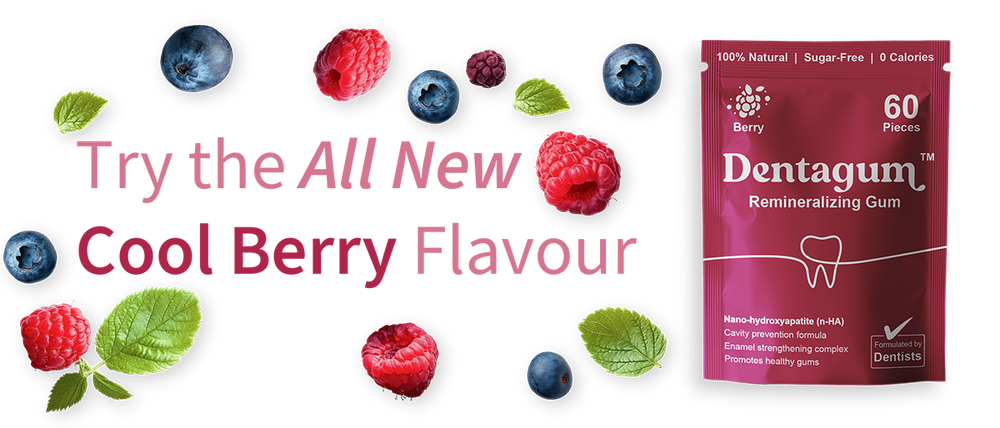
A truly functional, healthy chewing gum would combine a natural base, a xylitol-led sweetener profile, and an active remineralising ingredient like nano-hydroxyapatite. Used consistently after meals, that combination supports saliva flow, inhibits bacterial activity, and actively works to maintain enamel integrity between brushing sessions.
Does the Gum Base Actually Affect Your Health?
This is a fair question, and the honest answer is: probably not significantly, at the trace levels involved in chewing.
Food-grade synthetic gum base materials are approved precisely because they pass through the body without being absorbed. You're not meaningfully ingesting petrochemicals when you chew conventional gum.
The cleaner case for natural gum bases isn't primarily about internal health risk. It's about:
- Environmental impact. Chicle and mastic biodegrade. Synthetic gum base does not. If you're someone who thinks about where your products end up, this matters.
- Ingredient transparency. "Gum base" on a label tells you nothing. A brand that lists chicle, mastic, or candelilla wax is showing its work.
- Bioactive potential. Synthetic bases are inert. Mastic, chicle, and similar materials aren't, they contain trace compounds with documented biological activity, including antimicrobial and anti-inflammatory properties.
If you're evaluating gum purely on dental health outcomes, the sweetener and any active ingredients matter more than the base material. But if ingredient integrity and environmental impact are part of how you choose products, natural gum base is a meaningful differentiator.
How to Read a Chewing Gum Label
Choosing the right gum gets easier once you know what to look for:
- Gum base: Does it name the source (chicle, mastic, candelilla wax) or just say "gum base"?
- Sweetener: Is xylitol the first sweetener listed? Is there any sugar (sucrose, glucose, fructose syrup) at all?
- Xylitol content: Look for at least 1 gram per piece for a meaningful therapeutic dose
- Active ingredients: Does it contain CPP-ACP, nano-hydroxyapatite, or other remineralising compounds?
- Certifications: ADA Seal, non-GMO, organic where relevant to your preferences
- Additives: Artificial colours (Red 40, Blue 1) and artificial flavours serve no oral health purpose
A gum that passes all of these checks is genuinely doing something useful. Most supermarket gum passes none of them.
The Bottom Line
Natural chewing gum and conventional gum aren't just different on a philosophical level, they reflect genuinely different ingredient philosophies. Conventional gum prioritises cost, consistency, and shelf life. Natural gum prioritises ingredient provenance, biodegradability, and increasingly, functional dental benefits.
For your teeth, the sweetener profile and any active ingredients are the most important variables. A natural gum sweetened with xylitol and containing nano-hydroxyapatite will do measurably more for your enamel than a synthetic gum sweetened with sugar, regardless of the base material.
But if you want the full picture, cleaner ingredients, a base you can actually name, biodegradable packaging, and active oral health benefits, natural remineralising gum is the direction the category is moving.
See how we approach gum formulation and explore our full range of remineralising oral care products built on ingredients with both a history and a body of clinical evidence behind them.
FAQ
What is natural chewing gum made from? Natural chewing gum uses plant-derived bases like chicle (from the sapodilla tree), mastic (a resin from the Pistacia lentiscus tree), or candelilla wax instead of the synthetic petroleum-derived polymers found in conventional gum. It's typically sweetened with xylitol, erythritol, or other non-fermentable sweeteners rather than artificial alternatives or sugar.
Is natural chewing gum better for your teeth? It can be, depending on what it contains. The most important factors are whether the gum is sugar-free, whether it contains xylitol at a meaningful dose, and whether it includes active remineralising ingredients. Some natural gum bases like mastic also have documented antimicrobial activity against cavity-causing bacteria, which adds an additional layer of benefit.
What is remineralising chewing gum? Remineralising chewing gum contains active ingredients designed to help restore mineral content to weakened enamel. The most researched options are CPP-ACP (casein phosphopeptide-amorphous calcium phosphate) and nano-hydroxyapatite (nHa). These compounds are released through chewing and delivered to tooth surfaces via saliva, where they can fill in microscopic enamel lesions and strengthen the tooth surface.
Is conventional gum harmful? Not in any acute sense. The synthetic materials in conventional gum base are considered food-safe at the amounts involved. The bigger issues are that many conventional gums still contain sugar or additives with no oral health benefit, and that synthetic gum base is environmentally persistent and virtually impossible to biodegrade.
Does mastic gum have dental benefits? Research suggests mastic has genuine antimicrobial properties. Studies have shown it can inhibit Streptococcus mutans (the primary bacteria responsible for tooth decay) as well as periodontal pathogens and Candida species. While more clinical data is still being gathered on its use specifically as a chewing gum, its bioactive properties make it one of the more interesting natural gum base materials from a dental health perspective.
How much xylitol should healthy chewing gum contain? Clinical studies showing significant cavity reduction typically used 6 to 10 grams of xylitol per day across three to five chewing sessions. That means looking for gum with at least 1 to 1.3 grams of xylitol per piece, with xylitol listed first among sweeteners. Gums that include xylitol as a minor ingredient alongside sorbitol or artificial sweeteners are unlikely to deliver the same benefit.
