
How to Whiten Teeth Without Hydrogen Peroxide at Home
There are several ways to whiten teeth without hydrogen peroxide at home. They range from genuinely effective (PAP+ strips, which achieve comparable stain removal to peroxide in vitro) to marginally useful (whitening toothpastes) to largely ineffective (most charcoal products). This guide ranks the options by evidence, explains how each works, and gives you the honest picture of what to expect from each one.

The most effective way to whiten teeth without hydrogen peroxide at home is PAP+ (phthalimidoperoxycaproic acid) whitening strips. In vitro research found PAP+ achieved 7.11 lightness units of whitening compared to 7.19 for hydrogen peroxide: effectively equivalent stain removal, with significantly less sensitivity and reduced enamel organic matrix interaction. Other peroxide-free at-home options include whitening toothpastes with abrasive agents (mild surface stain removal, no chemical chromophore oxidation), oil pulling (evidence for gum health improvement, limited whitening evidence), activated charcoal (no chromophore oxidation, possible enamel abrasion risk), baking soda (very mild abrasive, weak whitening), and professional in-office non-peroxide treatments. For meaningful whitening without peroxide, PAP+ strips are the only option with published in vitro evidence of effectiveness comparable to hydrogen peroxide. All statistics reflect published ingredient research; not clinical studies of this product.
1. Why People Want to Avoid Hydrogen Peroxide
Hydrogen peroxide has been the dominant tooth whitening active for 30 years because it works. Free radical oxidation breaks down the chromophore molecules responsible for tooth discoloration, and peroxide does this effectively at a range of concentrations. The dental professional and consumer evidence base is extensive.
So why do so many people specifically want to avoid it?
Sensitivity. The most common reason. 35% of people who use peroxide whitening strips quit before completing the treatment due to sensitivity severe enough that they can't or won't continue. Hydrogen peroxide (34 g/mol) is small enough to diffuse through enamel's water-filled channels and reach the pulp tissue, where it triggers an inflammatory response experienced as sharp sensitivity pain. The "zingers" and "lightning bolts" that characterize peroxide whitening sensitivity are a real and significant compliance barrier.
Enamel concerns. Peroxide's non-selective free radical mechanism interacts with the organic matrix of enamel (collagen and other proteins) in addition to chromophores. At typical OTC concentrations over a single treatment course, these effects are generally mild and reversible. For people who whiten repeatedly over years, or who have already thinning enamel, the cumulative organic matrix interaction is a legitimate concern.
Ingredient preferences. A growing segment of consumers evaluate oral care products through the same clean-ingredient lens they apply to skincare and food. For these consumers, a 30-year-old industrial bleaching chemistry is simply not the product philosophy they want, regardless of its efficacy record.
EU regulatory access. In the EU, hydrogen peroxide above 0.1% in cosmetic dental products requires professional supervision. This practically limits OTC peroxide whitening strip options in European markets.
All of these are legitimate reasons to look for peroxide-free alternatives. The question is which alternatives actually work, and at what level of efficacy relative to what you're giving up.
2. How Tooth Whitening Actually Works
Before evaluating alternatives to peroxide, it helps to understand what tooth whitening is at the molecular level, because this determines which alternatives can work and which ones can't.
Tooth discoloration comes from chromophores: molecules with extended conjugated electron systems (alternating single and double bonds in a chain or ring). These structures absorb specific wavelengths of visible light and reflect others. Yellow and brown chromophores from coffee, tea, wine, and tobacco absorb blue wavelengths and reflect yellow-brown, producing the staining visible on teeth.
Chromophores deposit on the enamel surface (extrinsic staining) and penetrate into the enamel microstructure over time (early intrinsic staining). Effective chemical whitening requires oxidizing or otherwise breaking the conjugated double bond systems of chromophores, which destroys their light-absorbing structure and makes the stain colorless.
Mechanical whitening (abrasives in toothpastes, charcoal, baking soda) physically removes surface-deposited chromophores by abrasion rather than chemical oxidation. This can remove extrinsic surface staining but cannot address chromophores that have penetrated into the enamel microstructure.
Color correction (the violet layer in purple whitening strips) doesn't remove stains at all: it optically cancels the yellow visual signal using complementary color theory. Purple sits opposite yellow on the color wheel; violet pigment deposited on the tooth surface neutralizes the yellow undertone perceptually.
Understanding this framework explains why some peroxide-free alternatives work and others don't: only methods that achieve chemical chromophore oxidation can match peroxide's whitening depth. Methods that rely only on abrasion or color correction have inherent limitations on what they can achieve.
3. Option 1: PAP+ Whitening Strips (Most Effective)
Evidence level: High. Whitening depth: Surface and subsurface. Sensitivity: Significantly lower than peroxide.
PAP+ (phthalimidoperoxycaproic acid) is the peroxide-free whitening active that changed the category. It is the only alternative to hydrogen peroxide with published in vitro research demonstrating comparable whitening effectiveness: in a 2026 study in the Journal of Functional Biomaterials, PAP+ achieved 7.11 lightness units of whitening versus 7.19 for hydrogen peroxide. The difference of 0.08 L* units is below the perceptibility threshold in dental research. For at-home whitening purposes, the results are indistinguishable. Figures from ingredient research; not a clinical study of this product.
PAP+ achieves this through electrophilic oxidation: like peroxide, it breaks the conjugated double-bond systems of chromophores, destroying the molecular structure that causes tooth discoloration. Unlike peroxide, it does not generate free radicals and has a molecular weight (approximately 265 g/mol) that limits its penetration through enamel. It achieves chromophore oxidation at the enamel surface and near-surface layers without the pulp penetration that makes peroxide painful. This is the mechanistic basis for PAP+'s dramatically lower sensitivity profile.
The Best PAP+ Strips: What to Look For
Not all PAP+ strips are equal. The best formulations add a violet color-correcting layer (for day-one visible brightening via complementary color science), nano-hydroxyapatite (enamel mineral support during whitening, approximately 40% microhardness recovery in approximately 30 minutes in vitro per PMC8659594), potassium nitrate (clinical sensitivity protection, up to approximately 91% hypersensitivity reduction), and xylitol (antibacterial during the treatment session, significant S. mutans reduction in 12 of 14 clinical studies per Söderling et al., BMC Oral Health 2025). All figures from ingredient research; not clinical studies of this product.
How to use PAP+ strips: Brush and thoroughly dry teeth before application. Moisture dilutes the gel and reduces adhesion. Apply strips with the gel side against the tooth, aligning with the gumline. Press firmly for even contact. Wear 30 to 60 minutes once daily. Do not rinse for 30 minutes after removal. Use daily for 14 consecutive days for the full treatment result.
What to expect: The violet color correction is visible from session one during and immediately after the session. PAP+ stain removal results become noticeable at baseline around days 6 to 8 of consistent use. Full treatment result at day 14.
Honest limitation: PAP+'s clinical evidence base is shorter than peroxide's 30-year literature. The in vitro evidence is strong; large-scale multi-centre RCTs at the scale of the peroxide literature are still accumulating.
In CIELAB colorimetry (the scientific standard for quantifying tooth color change), L* measures lightness. A change of 7 L* units is a clearly visible, significant whitening result. The difference between PAP+'s 7.11 and hydrogen peroxide's 7.19 is 0.08 L* units, far below the 1.0 to 2.0 L* minimum perceptibility threshold. In practical terms, PAP+ achieves the same visible whitening result as peroxide in this in vitro model. The only meaningful differences are mechanism, sensitivity, and enamel interaction, all of which favor PAP+. Source: J. Funct. Biomater., 2026. Figures from ingredient research; not a clinical study of this product.
4. Option 2: Whitening Toothpaste
Evidence level: Moderate for surface stain removal. Whitening depth: Surface only. Sensitivity: Low (depends on abrasive concentration).
Whitening toothpastes work primarily through abrasion rather than chemical oxidation. They contain abrasive particles (hydrated silica, calcium carbonate, or sodium bicarbonate) that physically scrub surface-deposited chromophores from the enamel surface during brushing. Some whitening toothpastes also include blue covarine, a blue-tinted compound that temporarily deposits on enamel and provides a color-correcting effect similar in principle to the violet layer in purple strips.
The genuine clinical benefit of whitening toothpaste is real but limited in scope. Systematic reviews consistently show that whitening toothpastes produce measurable improvements in tooth color compared to non-whitening toothpastes, and that they maintain results by preventing dietary staining from embedding as deeply. The Cochrane review of toothpaste for tooth whitening found evidence of color improvement, with the caveat that the absolute magnitude of improvement is modest compared to strip-based whitening products.
What whitening toothpaste can do: Remove fresh surface staining effectively. Prevent recent staining from becoming embedded. Maintain whitening results achieved through other methods. Provide modest color improvement with consistent use.
What whitening toothpaste cannot do: Dissolve embedded intrinsic staining below the enamel surface. Match the whitening depth of chemical oxidation-based products. Produce visible whitening results in a defined treatment course the way strips do.
Abrasion caution: The abrasiveness of whitening toothpastes is measured by Relative Dentin Abrasivity (RDA). Products with RDA above 150 are considered high-abrasion and may damage enamel with repeated daily use. Low-RDA whitening toothpastes (RDA below 70) are generally considered safe for daily use. This distinction matters particularly for people with already thinning enamel.
Best use: Whitening toothpaste works best as a maintenance tool used alongside chemical whitening treatments, not as a standalone replacement for them. Using a quality whitening toothpaste daily between PAP+ strip treatment courses helps maintain results and reduces the frequency of full treatment courses needed.
5. Option 3: Oil Pulling

Evidence level: Limited for whitening. Evidence level: Moderate for gum health. Sensitivity: None.
Oil pulling involves swishing a tablespoon of oil (typically coconut oil, sesame oil, or sunflower oil) around the mouth for 10 to 20 minutes before spitting. It is an Ayurvedic practice with thousands of years of use and growing modern clinical interest, primarily for its effects on oral bacteria rather than for whitening.
The evidence for oil pulling and gum health is more substantive than for oil pulling and whitening. A 2024 meta-analysis of RCTs (Peng et al., J Clin Med) found significant effects on plaque index and gingival inflammation with consistent oil pulling. The antibacterial mechanism involves lauric acid (the dominant fatty acid in coconut oil) disrupting bacterial cell membranes, and the mechanical swishing action creating a saponification effect that lifts bacterial biofilm from tooth surfaces.
The whitening evidence is weaker. A small number of studies have shown modest tooth color improvement with sustained oil pulling, attributed to the removal of surface staining bacteria and debris during the swishing action rather than any chemical chromophore oxidation. The whitening effect is at the surface stain level and is comparable to other mechanical approaches rather than to chemical oxidation.
What oil pulling can do: Reduce plaque and gingival inflammation (well-supported). Provide a fresh sensation and reduce morning breath bacteria. Remove some surface debris during the swishing action. Support oral health as a complementary practice.
What oil pulling cannot do: Achieve chemical chromophore oxidation. Match the whitening depth of PAP+ or peroxide strips. Produce visible whitening results in a defined treatment timeframe for most people.
Honest context: Oil pulling's gum health evidence is genuinely good and makes it a worthwhile oral health practice independent of any whitening claim. As a whitening method, it should be understood as at-best modest surface stain removal rather than meaningful whitening.
6. Option 4: Activated Charcoal

Evidence level: Weak. Whitening depth: Surface only, with abrasion risk. Sensitivity: Variable (abrasion-related).
Activated charcoal whitening products (toothpaste, strips, and powders) have attracted significant consumer interest through social media marketing. The mechanism most commonly cited is adsorption: activated charcoal's highly porous surface traps surface staining compounds as it contacts teeth.
The clinical evidence does not support activated charcoal as an effective teeth whitening agent. A systematic review published in the Journal of the American Dental Association (JADA) found there was no evidence to support the whitening and antibacterial claims of charcoal toothpastes and powders. The review also found that many charcoal products are excessively abrasive (high RDA values) and could cause enamel damage with repeated use. The ADA has not granted its Seal of Acceptance to any charcoal-based dental product.
The concern about activated charcoal is not just that it lacks evidence for whitening efficacy, but that the abrasive mechanism could actively cause harm. Enamel does not regenerate once abraded. High-RDA charcoal products used daily could thin enamel over time, paradoxically making teeth appear more yellow as the dentin underneath shows through more clearly.
Honest assessment: Activated charcoal is one of the least evidence-supported whitening options and one of the most potentially harmful if used at high abrasivity levels. The social media visibility of charcoal whitening products is significantly out of proportion to their clinical evidence base. Unless a specific charcoal toothpaste has a verified low RDA and is used infrequently, it is not recommended as a primary whitening strategy.
7. Option 5: Baking Soda (Sodium Bicarbonate)
Evidence level: Weak to moderate for surface stain removal. Whitening depth: Surface only. Sensitivity: Low.
Sodium bicarbonate is a mild abrasive that has been used in oral care for over a century. It has a low RDA (approximately 7, very low abrasivity) compared to most commercial toothpastes, making it safe for regular use. It provides mild mechanical surface stain removal during brushing, and its mild alkalinity may partially counteract post-meal acid in a limited way.
Baking soda is genuinely the most safe of the abrasive-based whitening options: its low RDA means the abrasion risk that makes high-RDA charcoal products concerning is not present. Clinical studies have found that sodium bicarbonate-containing toothpastes produce slightly better surface stain removal than toothpastes without it, and are safe for regular use.
The limitation is that the whitening effect is very modest: mild surface stain removal, nothing more. Baking soda cannot dissolve the subsurface chromophores that PAP+ or peroxide targets. Its whitening action is purely mechanical and limited to the most superficially deposited surface staining.
Best use: Baking soda-containing toothpaste (such as Arm and Hammer) is a reasonable daily brushing option for people who want gentle surface stain maintenance without any chemical whitening. As a standalone whitening strategy, the results are modest but safe.
8. Option 6: Dietary Stain Reduction
Evidence level: Logical (prevention). Whitening depth: Prevention only, not reversal. Sensitivity: None.
This is not a whitening method in the active sense: it does not remove existing staining. But it is highly effective at slowing the accumulation of new staining, and therefore at extending the interval between active whitening treatments and maintaining results after a whitening course.
The primary staining agents are coffee, tea, red wine, dark-colored juices, and tobacco. All contain high concentrations of chromophoric compounds (tannins, polyphenols, anthocyanins) that deposit readily on enamel surfaces and penetrate the microstructure over time.
Practical stain-reduction measures:
Rinse immediately after consuming staining beverages. Water rinsing within 30 seconds of consuming coffee, tea, or red wine significantly reduces the amount of chromophore that deposits on enamel. The chromophore needs contact time to adhere; rinsing interrupts this.
Use a straw for staining cold beverages. Reduces direct tooth surface contact with staining liquids. Most relevant for iced coffee, iced tea, cold-brew, and similar drinks.
Brush 30 minutes after consuming acidic or staining beverages. Not immediately after (acid temporarily softens enamel; brushing immediately can cause microscopic abrasion) but within 30 to 60 minutes removes the chromophore deposits before they embed deeper.
Chew xylitol gum after meals. The post-meal period is when the most staining and demineralization occur. Chewing xylitol-containing remineralizing gum for 20 minutes after eating both buffers the acid environment and helps clear food debris and surface staining compounds. The xylitol's antibacterial effect simultaneously reduces the cariogenic bacteria that contribute to staining.
Dietary stain reduction works best as a complement to active whitening rather than a standalone approach. Used alongside a PAP+ treatment course and continued between courses, it meaningfully extends result duration and reduces the frequency of full whitening treatments needed.
9. Combining Methods for Best Results
The most effective peroxide-free whitening approach combines methods that address different aspects of the whitening challenge simultaneously: active chemical whitening (PAP+ strips), enamel support (nano-hydroxyapatite in the strip formula), maintenance and antibacterial coverage (remineralizing xylitol gum between sessions), and stain prevention (dietary habits).
The evidence-based peroxide-free whitening stack:
Active whitening course: 14-day PAP+ purple strip treatment, once daily, 60 minutes per session. This is the only peroxide-free approach that addresses subsurface chromophores, delivers a day-one visible result, supports enamel mineral status during treatment, and provides concurrent antibacterial coverage via xylitol.
Daily oral care between courses: Twice-daily brushing with a low-abrasivity fluoride toothpaste (optionally a whitening toothpaste for mild surface stain maintenance), and daily flossing. This is the foundation on which all other whitening approaches build.
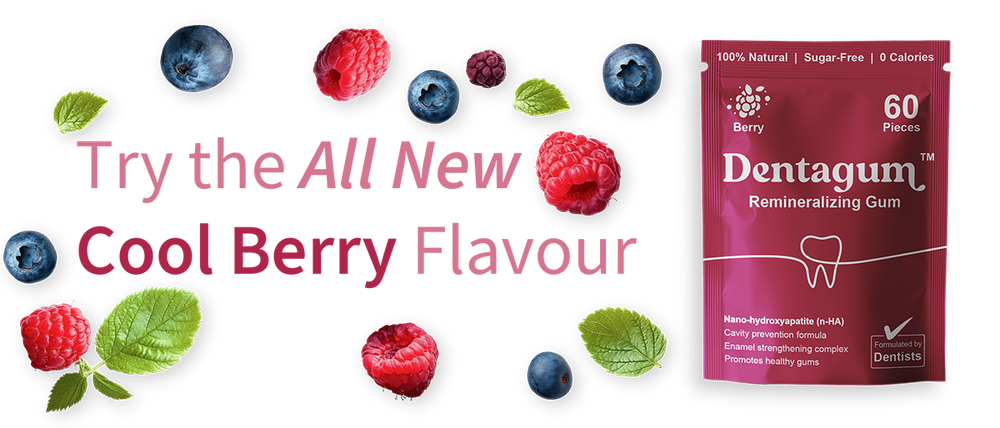
Post-meal routine: Chewing xylitol-containing remineralizing gum (such as Dentagum) for 20 minutes after each meal. The ADA endorses 20 minutes of sugar-free gum after meals for cavity prevention via saliva stimulation. A xylitol remineralizing gum adds antibacterial coverage (reducing S. mutans populations and their acid production), enamel mineral delivery via nano-hydroxyapatite, and surface debris clearance that reduces staining between whitening courses.
Stain management: Water rinsing after staining beverages, strategic straw use for cold drinks, and reduced consumption frequency of the highest-staining foods and drinks.
Repeat whitening course: Every 1 to 3 months depending on dietary habits and how quickly staining rebuilds. With consistent dietary stain management and daily remineralizing gum use, many people find they need retreatment less frequently than without these supporting habits.
10. Which Method Is Right for You?
If you want whitening results comparable to peroxide strips without peroxide: PAP+ whitening strips are the only evidence-based option. Nothing else approaches the chromophore oxidation depth that produces meaningful whitening results in a defined treatment timeframe.
If you've tried peroxide strips and quit due to sensitivity: PAP+ strips with potassium nitrate are specifically designed for you. The molecular size of PAP+ limits pulp penetration. The potassium nitrate desensitizes the nerve response. This combination enables people who previously couldn't complete a whitening course to do so.
If you want a result before tomorrow: Only PAP+ purple strips (with the violet color-correcting layer) provide a day-one visible result. The color correction is visible during and immediately after the first session. No other at-home peroxide-free option achieves an immediate visible improvement.
If you want to maintain results between treatment courses: A low-RDA whitening toothpaste daily and xylitol remineralizing gum after meals are the evidence-backed maintenance combination. The toothpaste removes surface staining. The gum prevents new staining from embedding and supports enamel mineral status between treatments.
If you're interested in broader oral wellness rather than primarily cosmetic whitening: Oil pulling has genuine gum health evidence and works well as a complementary practice. Paired with PAP+ strips for whitening and remineralizing gum for daily oral health support, it contributes to a comprehensive oral wellness approach.
If someone recommends activated charcoal: Check the product's RDA. If it's above 70, use it very infrequently if at all. The evidence for charcoal whitening doesn't support regular daily use, and the abrasion risk makes high-RDA charcoal products a caution rather than a recommendation.
Try Dentagum Purple Whitening Strips — 30-day guarantee11. Frequently Asked Questions
Can you whiten teeth effectively without hydrogen peroxide?
Yes, with PAP+ (phthalimidoperoxycaproic acid) whitening strips. In vitro research found PAP+ achieved 7.11 lightness units of whitening compared to 7.19 for hydrogen peroxide: a difference of 0.08 L* units below the perceptibility threshold. The whitening results are indistinguishable in this model. Other peroxide-free options (whitening toothpaste, oil pulling, baking soda, charcoal) produce at best mild surface stain removal and cannot match the chromophore oxidation depth of chemical whitening actives. Figures from ingredient research; not a clinical study of this product.
What whitens teeth without peroxide?
PAP+ (phthalimidoperoxycaproic acid) is the only peroxide-free whitening active with published research showing effectiveness comparable to hydrogen peroxide. It achieves stain removal through electrophilic chromophore oxidation rather than peroxide's free radical mechanism. Other approaches include whitening toothpaste (abrasive surface stain removal), oil pulling (antibacterial, modest stain removal), baking soda (very mild abrasive), and dietary stain reduction (prevention only). Only PAP+ achieves chemical chromophore destruction at the level needed for meaningful whitening results.
Does activated charcoal whiten teeth?
The evidence does not support activated charcoal as an effective teeth whitening agent. A systematic review in the Journal of the American Dental Association found no evidence to support the whitening claims of charcoal toothpastes. Additionally, many charcoal products have high abrasivity (RDA values) that pose an enamel damage risk with regular use. The ADA has not granted its Seal of Acceptance to any charcoal dental product. Activated charcoal may temporarily remove some surface debris through adsorption, but this is not equivalent to chemical chromophore oxidation and does not produce meaningful whitening results for most users.
Does baking soda whiten teeth?
Baking soda provides very mild surface stain removal through mechanical abrasion. It has an extremely low RDA (approximately 7), making it safe for regular use without enamel damage risk. Clinical studies show baking soda-containing toothpastes produce slightly better surface stain removal than toothpastes without it. However, the whitening effect is limited to the most superficially deposited surface staining and cannot match the depth of chemical whitening products. Baking soda is safe as part of a daily oral care routine but should not be expected to produce visible whitening results comparable to strip-based treatments.
How can I whiten my teeth at home without sensitivity?
PAP+ whitening strips with potassium nitrate offer the best combination of meaningful whitening and low sensitivity among at-home options. PAP+'s larger molecular size (approximately 265 g/mol vs H2O2's 34 g/mol) limits enamel penetration and pulp access, the primary cause of whitening sensitivity. Potassium nitrate adds a second layer of sensitivity protection through nerve depolarization. High-concentration potassium nitrate has been shown to reduce dentin hypersensitivity by up to approximately 91% in clinical research. For people who have previously found any whitening too painful, starting with 30-minute rather than 60-minute sessions in the first week reduces the initial exposure while the desensitizing effect accumulates. Figures from ingredient research; not a clinical study of this product.
Is oil pulling effective for whitening teeth?
Oil pulling has more evidence for gum health improvement (plaque reduction, gingival inflammation reduction) than for whitening. The whitening evidence is limited: a small number of studies show modest surface stain removal from the mechanical swishing action, but this is comparable to other mechanical approaches rather than to chemical oxidation-based whitening. Oil pulling is a worthwhile oral health practice for its gum health benefits and has a low risk profile. As a whitening strategy, expectations should be calibrated to mild surface stain removal rather than meaningful color improvement.
What is the best peroxide-free teeth whitening method?
PAP+ whitening strips, specifically formulations that include the violet color-correcting layer for day-one visible brightening, nano-hydroxyapatite for enamel mineral support, potassium nitrate for sensitivity protection, and xylitol for antibacterial coverage during the treatment session. This is the only peroxide-free approach with in vitro evidence of whitening effectiveness comparable to hydrogen peroxide, plus the supporting ingredient stack that makes the treatment session beneficial for overall oral health beyond just stain removal.
How long does it take to see results from peroxide-free whitening?
With PAP+ purple strips, the violet color-correcting effect is visible from the first session. The lasting PAP+ stain removal results become noticeable at your baseline (without strips) around days 6 to 8 of consistent daily use. Full treatment result is visible at day 14. Other peroxide-free methods: whitening toothpaste may show modest color improvement over weeks of consistent use. Oil pulling and baking soda have a similar modest timeline. Activated charcoal does not have evidence supporting meaningful whitening at any timeline.
The Bottom Line
If you want to whiten your teeth without hydrogen peroxide and want results that actually match what peroxide strips achieve, PAP+ whitening strips are the only evidence-based option. Everything else (whitening toothpaste, oil pulling, baking soda, charcoal) works at the level of surface stain removal or color correction, not at the chemical chromophore oxidation depth that produces meaningful whitening comparable to peroxide.
The honest hierarchy: PAP+ strips are the only peroxide-free method that can match peroxide's whitening results, with better sensitivity profile and richer formulation potential. Whitening toothpaste is a useful maintenance tool. Oil pulling is worth doing for gum health. Baking soda is safe and mildly helpful. Activated charcoal needs RDA scrutiny. Dietary stain reduction is an effective prevention strategy that extends results from all active whitening methods.
Try Dentagum Purple Whitening Strips — 30-day guarantee at dentagum.coResearch Summary
- J. Funct. Biomater., 2026. In vitro: PAP+ 7.11 vs H2O2 7.19 L* (CIELAB). 0.08 L* difference below perceptibility threshold (1.0-2.0 L*). Effectively equivalent whitening. Figures from ingredient research; not a clinical study of this product.
- PMC8659594. Nano-HAp: approximately 40% enamel microhardness recovery in approximately 30 minutes in vitro. Concurrent enamel support during PAP+ whitening. Figures from ingredient research; not a clinical study of this product.
- Potassium nitrate. High-concentration KNO3: up to approximately 91% dentin hypersensitivity reduction in clinical research. Sensitivity protection in PAP+ formulations. Figures from ingredient research; not a clinical study of this product.
- Söderling E et al. BMC Oral Health, 2025. Xylitol significantly reduced S. mutans in 12/14 studies. Antibacterial benefit during treatment sessions. Figures from ingredient research; not a clinical study of this product.
- 35% sensitivity quit rate. Industry figure for peroxide whitening strip discontinuation. Mechanistic basis: H2O2 pulp penetration. PAP+ primary rationale for sensitivity-affected population.
- Peng TR et al. J Clin Med, 2024. Oil pulling meta-analysis of RCTs: significant effects on plaque and gingival inflammation. Gum health evidence stronger than whitening evidence for oil pulling.
- JADA systematic review on charcoal. No evidence supporting whitening or antibacterial claims of charcoal products. High-RDA charcoal products pose enamel abrasion risk. ADA Seal not granted to any charcoal dental product.
- Cochrane review, whitening toothpaste. Evidence of color improvement vs non-whitening toothpaste. Absolute magnitude modest compared to strip-based treatments. RDA consideration for daily use safety.
- ADA. Sugar-free gum endorsed for 20 minutes after meals for cavity prevention via saliva stimulation. Xylitol specifically noted favorably for additional S. mutans reduction.
