
How to Use Remineralizing Gum at Work: An After-Lunch Habit
You finish lunch at your desk. Brushing isn't an option. Most people do nothing, which means the post-lunch acid attack runs its full 30 to 40 minutes uncovered. Here's a simple after-lunch habit that takes no extra time, requires no bathroom, and does meaningful protective work on your teeth while you're already back at your computer.

Keep a pouch of xylitol and nano-HAp remineralizing gum in your desk drawer. When you finish lunch, close the container, take one piece, and chew for 10 to 20 minutes while you're back at your computer. That's the entire habit. The American Dental Association endorses this exactly: "If you cannot brush your teeth immediately after a meal, then chewing gum can help." The saliva stimulation from chewing buffers post-lunch acid at 10 to 12 times the resting rate, delivers enamel mineral during the recovery window, and reduces the bacteria that would otherwise spend the next 30 to 40 minutes metabolizing your lunch into additional acid. No bathroom needed. No time added. No equipment beyond the pouch in your drawer.
The average office worker eats lunch at or near their desk somewhere around noon, finishes in 20 to 30 minutes, and then sits back down to work. From an oral health perspective, that moment, finishing lunch with no realistic path to a toothbrush, is one of the most consistently unaddressed windows in most people's day.
Not because they don't care. Because the gap between "I should probably do something" and "I have a specific, low-friction thing I actually do" never got filled. This article fills that gap with the simplest possible after-lunch habit, the one the ADA has explicitly endorsed for exactly this situation.
Why the After-Lunch Window Matters
Every time you eat, the bacteria in your mouth metabolize the food residue and produce acid. That acid drops your oral pH below the 5.5 critical threshold, the point at which enamel begins losing mineral, within a few minutes of eating. Saliva then begins buffering the acid and pH gradually recovers over 20 to 40 minutes. This is the Stephan Curve, and it repeats with every eating event across the day.
Office lunch is one of the most significant of those events. It's typically the largest calorie intake of the midday period, often includes fermentable carbohydrates (sandwiches, pasta, rice, bread), and sometimes includes an acidic drink (soda, juice, coffee). Without any intervention, the acid attack from lunch runs its full 30 to 40 minute course uncovered while you're sitting at your desk thinking about your afternoon.
At home, you might brush after dinner. In the morning you brush before breakfast. But lunch at work almost never gets any post-meal coverage for the overwhelming majority of office workers. Multiply that by five working days per week, 48 working weeks per year, and the cumulative effect of 240 uncovered lunch acid events becomes real enamel loss over time.
The American Dental Association's Oral Health Topics page on chewing gum states directly: "If you cannot brush your teeth immediately after a meal, then chewing gum can help." This is the ADA's specific answer to the office lunch scenario. They go on to endorse 20 minutes of sugar-free gum chewing after meals for cavity prevention, citing the saliva stimulation mechanism that buffers post-meal acid and delivers calcium and phosphate to recovering enamel.
What Chewing Gum Is Actually Doing During Those 20 Minutes

For a habit to stick, it helps to understand what it's actually doing rather than just trusting that it's good for you. Here's the precise sequence of what happens during 20 minutes of post-lunch gum chewing.
Within the first 30 seconds, the chewing action stimulates both mechanical and taste receptors in the mouth and salivary flow increases substantially. By 2 to 3 minutes, salivary flow has reached 10 to 12 times the resting rate, the rate the ADA cites for the protective mechanism they're endorsing. That surge of saliva begins flooding the oral environment with bicarbonate, which buffers the post-lunch acid and accelerates pH recovery. The same saliva delivers calcium and phosphate ions to enamel surfaces where mineral was lost during the lunch acid exposure.
Simultaneously, xylitol from the gum is being transported into the S. mutans bacteria that are metabolizing your lunch residue and producing the bacterial acid component of the post-meal attack. Xylitol creates a futile energy cycle in these bacteria that kills them. Over weeks of consistent daily use, this progressively reduces the S. mutans population in your mouth, meaning each subsequent post-lunch window has fewer acid-producing bacteria to manage.
If the gum contains nano-hydroxyapatite, the nano-scale particles (20 to 100 nanometres) are physically depositing into the microporosities left in enamel by the lunch acid exposure. Enamel that just lost mineral during the Stephan Curve's descent is receiving targeted mineral replacement during the recovery window. A 2023 systematic review in Biomimetics covering 44 clinical trials confirmed that contact time during chewing is a key variable in nano-HAp's clinical effectiveness: the 20 minutes of post-lunch chewing time is exactly the window where the mineral deposition benefit accumulates.
Why This Habit Sticks When Others Don't
Most oral health habit advice fails because it asks people to do something extra: go somewhere they wouldn't otherwise go, take time they don't have, use equipment they don't carry. The after-lunch desk gum habit sidesteps every one of these friction points.
No extra time. The 20 minutes of chewing happens while you're doing whatever you'd do after lunch anyway: answering emails, rejoining a meeting, scrolling through tasks. The chewing is completely passive alongside any other activity. No time cost whatsoever.
No bathroom needed. You don't have to go anywhere. The habit lives at your desk, not in a bathroom that requires walking down a corridor and hoping a stall is free.
No social friction. Chewing gum at a desk is entirely normal office behaviour. Nobody notices or comments. Unlike excusing yourself to brush after lunch, which requires explaining yourself to whoever you're eating with, the gum step is invisible.
Clear trigger. The habit anchors naturally to finishing lunch. Closing the food container or pushing away the lunch box is the cue. That existing action triggers the new one. Habit formation research consistently finds that anchoring new habits to existing actions produces significantly higher long-term adoption rates than habits requiring their own independent trigger.
The single most important practical decision for this habit is where the gum lives. If it lives in your bathroom cabinet at home, you will not remember it at 12:30pm at your desk. If it lives in your desk drawer, it's there when the trigger fires. Put the pouch in the top drawer of your desk, visible when you open it. That's the entire implementation. One pouch in one drawer is the difference between a habit that happens automatically and one that requires remembering.
The Complete After-Lunch Desk Routine

Here is the full sequence, in the order that produces the best outcome:
Put away your lunch container, wipe down your desk if needed, close any food-related tabs. This clearing action is the trigger for everything that follows. The habit attaches to this moment, not to a clock time.
A quick swirl of water around your mouth for 10 to 15 seconds before chewing gum clears the most easily dislodged food particles from tooth surfaces and slightly dilutes residual acid. This takes 15 seconds and noticeably improves the oral environment that the gum then works on. Most people already have a water bottle at their desk.
One piece is enough. The active ingredients work through sustained contact and saliva stimulation, not through quantity. Chewing two or three pieces simultaneously doesn't improve the outcome and uses your supply faster.
The ADA recommends 20 minutes as the full benefit window. If you have back-to-back meetings or calls, 10 minutes still captures most of the saliva stimulation benefit. Don't aim for perfect; aim for consistent. A 10-minute session five days a week delivers significantly more cumulative benefit than an occasional 20-minute session when you remember.
No further action needed. The gum has done its work. If you have an afternoon coffee or snack, repeat steps 2 through 4 after that as well. Each additional session covers another acid exposure window that would otherwise run unaddressed.
What to Keep at Your Desk (and Where)
The physical setup determines whether the habit happens. Three items, three locations:
Desk drawer: One pouch of remineralizing gum, in the top or most accessible drawer, visible when you open it. This is the primary habit location. Restock when it gets below 10 pieces so you're never reaching for an empty pouch.
Bag or pocket: A secondary supply for days you eat lunch away from your desk: a café, a client's office, a food court. The bag supply means the post-lunch habit travels with you even when the desk drawer doesn't.
Water bottle: Already there for most people. Using it for the 15-second pre-gum rinse step requires no additional equipment at all.
Making It Stick: The First Two Weeks

Habits form through repetition at the same trigger, not through willpower. The first two weeks of the after-lunch desk habit are the most important, because they're when the trigger-to-action link is being established. A few things make those two weeks easier.
Start the first day with the pouch in your drawer. Not tomorrow, not after you finish the current pack of gum you have. Order it today, put it in the drawer when it arrives, and do the habit the very next lunch. The sooner the repetition starts, the sooner the automatic trigger fires without conscious decision.
Set a visual reminder for the first week only. A sticky note on your monitor that says "gum after lunch" is enough. After five or six repetitions, the trigger fires automatically and you can remove the note. You're not building a reminder dependency; you're building the neurological trigger-action link that makes the reminder unnecessary.
Do it even on days when lunch was light or you're not that hungry. Consistency matters more than any individual session. A salad with light acid exposure still benefits from the post-meal saliva stimulation and xylitol step, even if the benefit is modest. More importantly, doing it consistently on low-stakes days is what makes the habit robust enough to fire automatically on the high-stakes days.
Keep the standard high: 10 minutes minimum. If you have a meeting at 12:45 and lunch finishes at 12:30, chew for 10 minutes before the meeting. The pop-in-then-out sessions (gum for 2 minutes, spit before the meeting) don't build the habit. They teach your brain that sometimes the action gets skipped at this trigger, which weakens the automatic firing.
What About Other Meals?
The lunch desk habit is the easiest entry point because it has the most natural trigger and the fewest friction points. Once it's established and automatic, consider expanding:
After breakfast at home: Keep a pouch on the kitchen counter or table, not in the bathroom. Chew while reading the news, making coffee, or doing the school run. The morning is another high-value window because it follows the overnight bacterial accumulation period. Our full guide on How Often Should You Chew Remineralizing Gum for Best Results covers the clinical evidence on frequency and timing.
After afternoon coffee: Coffee at pH 4.8 to 5.1 creates its own Stephan Curve. If you're already at your desk with the drawer open, the step from lunch habit to coffee habit is small. Our guide on Can Chewing Gum Help After Coffee covers the coffee-specific evidence.
After dinner: More friction than the desk habit (the trigger is softer and you're often moving between rooms), but the same principle applies. A pouch at the dining table or kitchen counter rather than in the bathroom removes the friction of having to go somewhere.
How Dentagum Fits the Desk Habit
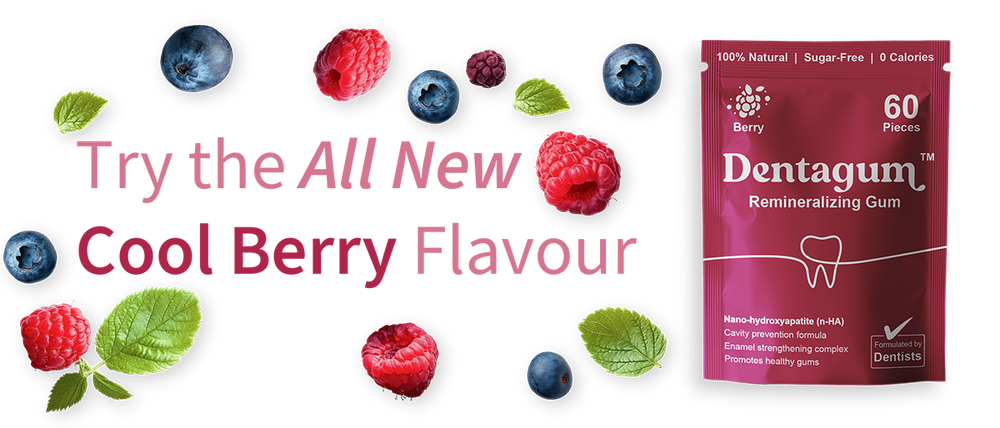
Dentagum is designed exactly for the post-meal window. The pouch is compact enough to fit in any desk drawer without displacing other things. The formula delivers what the post-lunch window specifically requires: organic xylitol and organic erythritol for the antibacterial effect against S. mutans that peaks when bacterial activity is highest after eating, nano-hydroxyapatite for enamel mineral delivery during the 10 to 20 minute post-lunch recovery window, organic mastic gum and natural propolis for additional antibacterial coverage, and an organic chicle and mastic base for the sustained saliva stimulation that buffers post-lunch acid.
In Dentagum's own clinical data, 87% of participants were less susceptible to cavities with consistent daily use, and 83% showed notable gains in enamel quality and mineral quantity. Both outcomes reflect the cumulative effect of daily post-meal use in exactly the kind of routine this article describes.
At $0.55 per piece, one piece per lunch day costs $2.75 per working week, roughly $130 per year. The average cost of a cavity filling in the US is $200 to $300. The math on prevention versus treatment is straightforward.
Try Dentagum risk-free — 30-day guaranteeFrequently Asked Questions
Is it okay to chew gum at your desk at work?
Yes. Chewing gum at a desk is entirely normal professional behaviour and draws no attention in the vast majority of office environments. Unlike brushing after lunch, which requires leaving your desk and explaining yourself, the desk gum habit is invisible. It happens while you're working, requires no break in your workflow, and produces no social friction. The only exception might be client-facing or formal meeting situations where it's worth pocketing the gum, but even then you can chew for the 10 minutes you have before the meeting starts.
Should I chew gum after lunch instead of brushing?
Not instead of. In addition to. Gum is the best available option when brushing isn't possible, which is the situation at a work desk after lunch for most people. It doesn't replace brushing's mechanical plaque removal, which remains essential as your morning and evening routine. The ADA is clear that gum is a supplement to, not a substitute for, twice-daily brushing and daily flossing. The desk gum habit fills the midday window that the home brushing routine doesn't cover, making your overall oral care routine more complete rather than replacing any part of it.
How long should I chew gum after lunch?
The ADA recommends 20 minutes for the maximum benefit. The saliva surge peaks within the first 2 to 3 minutes and remains elevated throughout the chewing session, delivering the most acid-buffering and mineral-delivery benefit during the 20-minute window after meals. If back-to-back meetings or other constraints mean 10 minutes is what's available, that still captures the majority of the salivary benefit. Aim for 20 when you can, accept 10 when you can't, and stay consistent.
What's the best gum to keep at your desk for oral health?
A sugar-free gum with xylitol as the primary sweetener and nano-hydroxyapatite as an active ingredient. Standard sugar-free sorbitol gum provides the saliva stimulation benefit but lacks xylitol's active antibacterial reduction of S. mutans and nano-HAp's targeted enamel mineral delivery. The combination of xylitol, nano-HAp, and the saliva stimulation from chewing addresses the post-meal window's three simultaneous needs: acid buffering, mineral delivery, and bacterial reduction.
How do I remember to chew gum after lunch every day?
Put the pouch in your desk drawer, visible when you open it. Attach the habit to the physical act of finishing lunch and clearing your space, not to a clock time or a phone reminder. The trigger is clearing your lunch away; the action is opening the drawer and taking a piece. For the first week, a sticky note on your monitor saying "gum after lunch" helps reinforce the trigger-action link before it becomes automatic. After 5 to 7 repetitions at the same trigger, most people find it fires without conscious effort.
The Bottom Line
The after-lunch desk gum habit is the easiest oral care improvement available for office workers. It requires no extra time, no bathroom, no equipment beyond a pouch in a drawer, and no social capital. It fills the single most consistently unaddressed window in most working adults' oral care routines: the midday period where three to five eating and drinking events happen with zero post-meal coverage.
The ADA has endorsed this approach directly for the situation office workers face daily. The mechanism is well-understood: 20 minutes of sugar-free gum chewing after meals stimulates a salivary surge that buffers post-meal acid at 10 to 12 times the resting rate, delivers calcium and phosphate to recovering enamel, and (with xylitol) actively reduces the bacteria producing additional acid from lunch residue.
One pouch in your desk drawer. One piece when you close your lunch container. Ten to twenty minutes of chewing while you're already back at your computer. That's the whole habit. The clinical evidence behind it is robust, the cost is minimal, and the implementation friction is as close to zero as any oral health habit gets.
Try Dentagum risk-free — 30-day guarantee at dentagum.coResearch Summary
- American Dental Association. Chewing Gum Oral Health Topics. "If you cannot brush your teeth immediately after a meal, then chewing gum can help." Sugar-free gum endorsed for 20 minutes after meals. Stimulates saliva to 10-12x resting rate. Neutralizes acids, delivers calcium and phosphate, washes food debris.
- Söderling E et al. BMC Oral Health, 2025. Xylitol gum significantly reduced S. mutans in 12/14 studies vs sorbitol. Active antibacterial mechanism for the post-meal bacterial acid component. Cumulative effect with daily use.
- Limeback H, Enax J, Meyer F. Biomimetics, 2023. 44 clinical trials. Contact time during chewing is key variable for nano-HAp clinical effectiveness. Post-meal window is optimal for enamel mineral delivery when surface is most receptive.
- Stephan RM, 1944 (Oxford Reference). pH drops below critical 5.5 enamel threshold within minutes of fermentable carbohydrate consumption. 20-40 minute recovery window. Saliva buffering is the primary pH recovery mechanism.
- Habit formation research. Habit stacking: attaching new habits to existing trigger actions significantly improves long-term adoption rates. Location specificity (gum at desk, not bathroom) is a key factor in post-meal habit success.
References
- American Dental Association. "Chewing Gum." Oral Health Topics. https://www.ada.org/resources/ada-library/oral-health-topics/chewing-gum
- Söderling E et al. "Specific Effects of Xylitol Chewing Gum on Mutans Streptococci Levels." BMC Oral Health, 2025. https://link.springer.com/article/10.1186/s12903-025-06602-1
- Limeback H, Enax J, Meyer F. "Clinical Evidence of Biomimetic Hydroxyapatite in Oral Care Products for Reducing Dentin Hypersensitivity." Biomimetics, 2023. https://pmc.ncbi.nlm.nih.gov/articles/PMC9844412/
- American Dental Association. "Home Oral Care." Oral Health Topics. https://www.ada.org/resources/ada-library/oral-health-topics/home-care
