
How to Read a Chewing Gum Ingredient Label: The Full Guide
The ingredient label on most chewing gum is one of the least transparent in the food industry. "Gum base" can legally hide up to 46 ingredients including petroleum-derived plastics, without disclosing any of them individually. Here's a complete guide to reading a gum label, ingredient by ingredient: what to look for, what to watch out for, and what the research says about each.

A typical conventional sugar-free gum label reads: Sorbitol, Gum Base, Glycerol, Natural and Artificial Flavors, Mannitol, Soy Lecithin, Aspartame, Acesulfame K, BHT. Of these, "Gum Base" is legally permitted to hide up to 46 undisclosed ingredients including petroleum-derived polymers like polyvinyl acetate, polyisobutylene, and polyethylene. A 2025 ACS pilot study found 100 to 637 microplastic particles per gram of chewed gum. Aspartame was classified as possibly carcinogenic (IARC Group 2B) by the WHO in 2023. BHA is a listed carcinogen in California and Japan. BHT is under FDA review in 2026. On the positive side: xylitol as the primary sweetener (not buried after sorbitol) is the clearest signal that a gum provides active antibacterial benefit. Natural essential oils (not "natural and artificial flavors") deliver the full antimicrobial terpene spectrum. And nano-hydroxyapatite in the ingredient list means direct enamel mineral delivery during chewing.
Most people assume food labels give them a reasonably accurate picture of what's in the product. For chewing gum, that assumption is wrong in one specific and important way: the ingredient listed as "Gum Base" is legally permitted to conceal the entire composition of the gum's physical matrix under a single opaque term, without disclosing any of its actual components.
This guide walks through every ingredient category on a typical conventional gum label, explains what each one actually is, notes any documented safety concerns, and then explains what a label that prioritizes both safety and oral health function looks like instead. By the end, you'll know exactly what you're evaluating when you flip over a gum packet.
The Anatomy of a Typical Conventional Gum Label
Here is the ingredient list from a typical bestselling sugar-free gum (the specific format common to Wrigley's Extra, Orbit, and similar products):
Sorbitol, Gum Base, Glycerol, Natural and Artificial Flavors, Mannitol, Soy Lecithin, Aspartame, Acesulfame K, BHT, Colors (Titanium Dioxide)
Ten ingredient categories. Some are entirely benign. Several have documented concerns that consumer-facing materials rarely explain. One is a legally sanctioned black box hiding the composition of the physical material you're chewing for 20 minutes. This guide addresses each in turn.
Gum Base: The Industry's Least Transparent Label Claim

The FDA permits gum manufacturers to list all gum base ingredients collectively under the single term "gum base" without disclosing its composition. This means a product can contain polyvinyl acetate (PVA, a synthetic plastic polymer), polyisobutylene (a petroleum-derived synthetic elastomer), polyethylene (the same material used in plastic shopping bags), and styrene-butadiene rubber, and simply list "Gum Base" as the entire disclosure.
The gum base can legally contain up to 46 FDA-permitted ingredients, none requiring individual disclosure. A 2025 pilot study published by American Chemical Society researchers detected 100 to 637 microplastic particles per gram of chewed gum, with approximately 94% of those particles released during the first 8 minutes of chewing. These particles come from the synthetic polymer components of the gum base fragmenting into microscopic pieces during the mechanical action of chewing.
The conventional gum industry transitioned from natural plant resins (chicle, a tree sap that was the original gum base) to synthetic petroleum-derived polymers in the 1960s. The shift was driven by supply chain economics and consistency: synthetic polymers are cheaper, more uniform, and easier to work with at industrial scale than natural resins. The environmental and health implications of chewing petroleum-derived polymers for 20 minutes multiple times daily, and the microplastic generation that entails, were not considerations at the time of that transition.
Under FDA food labeling regulations, "gum base" is a permitted collective ingredient declaration. The entire physical matrix of the gum (elastomers, resins, plasticizers, fillers, softeners, emulsifiers, and antioxidants) can be disclosed under this single term. Polyvinyl acetate, polyisobutylene, polyethylene, styrene-butadiene rubber, and various petroleum waxes and resins are all FDA-permitted gum base ingredients that do not require individual disclosure. When a gum label lists only "Gum Base," the consumer has no information about what the physical material they are chewing actually is.
Sweeteners: The Most Consequential Label Category for Oral Health
The sweetener section is where the most important oral health decisions are made visible on a label. Sweeteners appear early in the ingredient list (ingredients are listed in descending order by weight), so the first sweetener listed is present in the highest amount.
Sorbitol
A sugar alcohol derived from glucose. Not fermented by oral bacteria in the same way as sucrose, so it doesn't drive the acid production that causes cavities. Provides the saliva stimulation benefit from chewing. No specific antibacterial mechanism against S. mutans. Can cause digestive discomfort (gas, bloating, loose stools) in some people at doses above 5 to 20 grams per day, roughly equivalent to 4 to 16 pieces of sorbitol-heavy gum. At typical use levels (2 to 3 pieces per day), digestive effects are rarely an issue for most people.
Xylitol
A sugar alcohol found naturally in birch trees and many fruits. The most clinically significant sweetener for oral health. S. mutans transports xylitol into its cells expecting to metabolize it, initiates a futile energy cycle, and is killed. A 2025 systematic review found xylitol gum significantly reduced S. mutans in 12 of 14 clinical studies versus sorbitol controls. Look for xylitol listed first among the sweeteners, or in the top three ingredients overall. If xylitol appears after sorbitol and multiple other ingredients, it's present in small quantities insufficient to drive the antibacterial effect documented in clinical trials.
Erythritol
A sugar alcohol with an excellent digestive profile: it is largely absorbed in the small intestine before reaching the large intestine where sorbitol ferments. Much lower risk of digestive discomfort. Also has some antibacterial activity against oral pathogens, though less extensively studied than xylitol. A favorable ingredient to see on a label.
Aspartame (E951)
An artificial sweetener widely used in conventional sugar-free gum, including Wrigley's Extra and Orbit. In July 2023, the International Agency for Research on Cancer (IARC) classified aspartame as Group 2B: "possibly carcinogenic to humans." The WHO and FDA maintain that aspartame is safe at normal consumption levels and have not changed their approved use status. The IARC classification reflects limited evidence of carcinogenicity in humans and sufficient evidence in animals. This is a documented scientific concern, not a fringe claim, from one of the world's most respected cancer research organizations. Many consumers prefer to avoid it. It is not an ingredient that appears in products positioned around clean, natural formulations.
Acesulfame K (E950)
An artificial sweetener typically paired with aspartame in commercial gum formulations (they have different flavor profiles that complement each other). Animal studies have raised concerns about effects on gut microbiome composition and insulin responses. Regulatory agencies including the FDA and EFSA maintain it is safe at approved levels. Growing consumer concern about artificial sweeteners generally has led many formulations to shift away from aspartame and acesulfame K toward stevia, monk fruit, and sugar alcohols.
Sucralose
An artificial sweetener derived from chlorinating sucrose. Used in some gum products. Has been associated with potential DNA damage in some studies at high temperatures (not relevant for room-temperature gum chewing) and possible effects on gut bacteria. Regulatory agencies consider it safe at normal use levels.
Preservatives and Stabilizers: The Ingredients You Didn't Know to Look For
BHT (Butylated Hydroxytoluene, E321)
A synthetic antioxidant added to gum to extend shelf life by preventing the fats and oils in the gum base from going rancid. BHT is FDA-approved and GRAS (Generally Recognized As Safe) for use in food in the United States. However, the FDA opened a safety review of BHT in 2026 following research raising questions about its potential hormonal effects. The EU has restricted BHT in several food categories. It remains in most conventional gum formulations because it's highly effective at its primary function and cheap.
BHA (Butylated Hydroxyanisole, E320)
A related synthetic antioxidant sometimes used instead of or alongside BHT. BHA is listed as a known carcinogen in California under Prop 65 and is classified as a carcinogen in Japan. The International Chemical Secretariat includes BHA on its SIN List (Substitute It Now) due to documented hormonal (endocrine-disrupting) effects. BHA is FDA-approved in the US but is not an ingredient that should appear in a product marketed around health and clean ingredients.
Titanium Dioxide (E171)
A whitening agent used in some gum coatings and fillings to produce a bright white appearance. The EU banned titanium dioxide as a food additive in August 2022 after the European Food Safety Authority found it could no longer be considered safe, citing concerns about potential genotoxicity (DNA damage). The FDA has not followed with a ban and titanium dioxide remains permitted in US food products. It can still be found in some US gum brands. If you want to avoid it, it will appear by name (Titanium Dioxide) or as E171 in the ingredient list.
Humectants and Texturizers
Glycerol (Glycerin)
A humectant that keeps the gum moist and pliable during storage and use. GRAS, derived from vegetable or animal fats. No safety concerns at typical use levels in gum. A benign functional ingredient.
Mannitol
A sugar alcohol used as a bulking agent and sweetener. Lower risk of digestive discomfort than sorbitol because it is absorbed more slowly. Not cariogenic. No significant oral health benefit beyond being non-acidogenic.
Soy Lecithin
An emulsifier derived from soybean oil. Keeps the gum's texture consistent and prevents ingredient separation. GRAS. People with severe soy allergies should note it. No oral health concern.
Acacia (Gum Arabic)
A natural binder from acacia tree sap. GRAS, no known concerns. A genuinely natural functional ingredient when it appears.
Flavoring: Natural vs Artificial, and Why It Matters for Oral Care
The flavor category is where a label reveals whether it contains the full antimicrobial terpene complex of natural essential oils or just the sensory experience of mint without the biological activity.
"Natural and artificial flavors" in conventional gum typically means isolated menthol (the single compound primarily responsible for mint's cooling sensation) plus various synthetic flavor modifiers. Isolated menthol provides the taste and cooling effect of peppermint. It does not provide menthone, 1,8-cineole (eucalyptol), linalool, carvone, or the other terpene compounds in the natural essential oil that have documented antimicrobial activity against oral bacteria.
"Organic peppermint essential oil" or "organic spearmint essential oil" in an ingredient list means the full-spectrum plant oil, containing the complete monoterpene complex, including the same four compounds that Listerine has used as active antibacterials since 1914: eucalyptol, menthol, thymol (from thyme EO), and methyl salicylate. Natural essential oils deliver both the sensory experience and the antimicrobial function. Synthetic flavor delivers only the former.
Active Functional Ingredients: What Distinguishes Remineralizing Gum

Most conventional gum labels contain no active oral health ingredients beyond the sweetener. A functional remineralizing gum adds ingredients specifically chosen for their clinical evidence of oral health benefit.
Nano-hydroxyapatite
If this appears on a gum label, the product is designed to directly deposit enamel mineral during chewing. Nano-HAp is the same mineral enamel is made from (Ca10(PO4)6(OH)2), sized at 20 to 100 nanometres to enter enamel microporosities and dentinal tubules. The 2023 Biomimetics meta-analysis of 44 clinical trials confirmed its effectiveness for enamel mineral delivery and sensitivity reduction. Contact time during chewing is the key delivery variable, making gum format particularly effective.
Propolis extract
Bee-derived resin with documented antibacterial and anti-inflammatory activity. The 2025 PROSPERO-registered systematic review (Journal of Functional Biomaterials) confirmed propolis's effectiveness for improving gingival health and reducing gingivitis, with effects comparable to chlorhexidine in one 21-day RCT. A meaningful functional addition to a gum formula.
Mastic gum (in the gum base)
The resin of Pistacia lentiscus. If the gum base is described as natural mastic or organic mastic, the base material itself is biologically active, unlike synthetic polymer bases. The 2023 state-of-the-art review in the Journal of Natural Medicines confirmed mastic's antibacterial properties against periodontal pathogens and its plaque-inhibiting activity across 14 clinical studies.
Eggshell calcium
Organic calcium carbonate from chicken eggshell. Releases Ca2+ ions in the acidic post-meal oral environment, contributing dissolved calcium to the remineralization fluid environment alongside nano-HAp's particulate delivery. The 2026 Odontology meta-analysis (17 in vitro studies) confirmed significant enamel microhardness improvement, comparable to fluoride varnish, from eggshell extract.
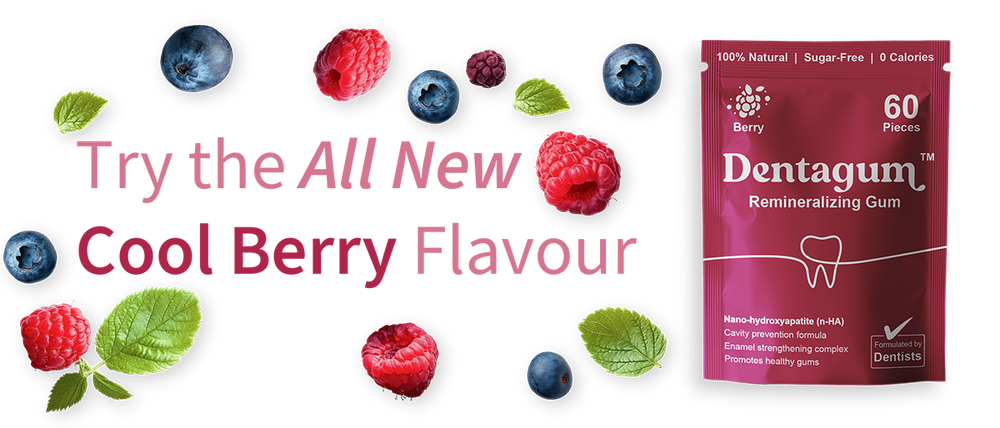
What a Good Gum Label Looks Like: Reading Dentagum's Ingredients

Applying this framework to Dentagum's label shows what each choice reflects.
Organic xylitol (listed first): Primary sweetener, confirming it's present at concentrations shown to drive the antibacterial S. mutans effect. Organic certification means non-GMO feedstock and production without synthetic processing aids.
Organic erythritol: Secondary sweetener with excellent digestive profile and supporting antibacterial activity. Organic certified.
Organic mastic gum and chicle gum base: The base material itself is a plant resin with 2,500 years of documented safe use and confirmed antibacterial activity in 14 clinical studies. Not a synthetic polymer. No hidden petroleum-derived plastics. No microplastic generation.
Nano-hydroxyapatite: Direct enamel mineral delivery during each chewing session, confirmed across 44 clinical trials in the 2023 Biomimetics meta-analysis.
Organic eggshell calcium: Biogenic calcium carbonate providing pH-responsive Ca2+ release in the post-meal acid environment, complementing nano-HAp's particulate delivery.
Organic propolis extract: Broad-spectrum antibacterial and anti-inflammatory, confirmed across a PROSPERO-registered systematic review.
Calcium bentonite clay: Adsorptive mineral with negative electrical charge that physically binds bacteria and debris during chewing. Prop 65 tested via Lightlabs for heavy metal safety.
Organic spearmint and peppermint essential oils: Full-spectrum natural mint oils, not isolated menthol or artificial flavor. The complete antimicrobial terpene complex including carvone, menthol, menthone, 1,8-cineole, and limonene.
No BHT, BHA, titanium dioxide, aspartame, or acesulfame K.
Frequently Asked Questions
What is gum base made of?
In most commercial gum, gum base is a mixture of synthetic petroleum-derived polymers including polyvinyl acetate (PVA), polyisobutylene, and sometimes polyethylene or styrene-butadiene rubber, along with plasticizers, softeners, fillers, emulsifiers, and antioxidants. Up to 46 ingredients can be present in the gum base under FDA regulations, none requiring individual disclosure. A 2025 ACS pilot study found 100 to 637 microplastic particles per gram of chewed gum, with 94% released in the first 8 minutes. Natural alternatives include chicle (from the Manilkara zapota tree, the original chewing gum base) and mastic (from Pistacia lentiscus, used for 2,500 years).
Is aspartame in gum dangerous?
The IARC classified aspartame as Group 2B (possibly carcinogenic to humans) in 2023. This classification reflects limited evidence of carcinogenicity in humans and sufficient evidence in animal studies. The WHO and FDA maintain that aspartame is safe at normal consumption levels and have not changed its approved use status. The scientific concern is documented and legitimate, from one of the world's most authoritative cancer research organizations. Many consumers prefer to avoid it. Whether to avoid it is a personal decision informed by the evidence. Aspartame-free alternatives that provide the same sweetness without the concern include xylitol, erythritol, and stevia.
What does "natural and artificial flavors" mean on gum?
In gum, this typically means isolated flavor compounds rather than whole essential oils. "Natural flavor" often refers to isolated menthol (the compound primarily responsible for mint's cooling sensation) derived from corn mint oil. "Artificial flavors" are synthetic compounds designed to replicate mint's taste profile. Neither provides the full antimicrobial terpene complex of natural peppermint or spearmint essential oil, which includes menthol, menthone, 1,8-cineole, carvone, linalool, and other compounds with documented antibacterial activity against oral pathogens. If a label specifies "organic peppermint essential oil" or "organic spearmint essential oil," that's the full-spectrum oil, not isolated flavor compounds.
Is sorbitol in gum safe?
Yes, at typical gum use levels. Sorbitol is a sugar alcohol that is not fermented by oral bacteria in the way sucrose is, so it doesn't drive the acid production that causes cavities. It is GRAS and well-tolerated at the amounts in 2 to 3 pieces of gum per day. At higher daily doses (above 5 to 20 grams, roughly 4 to 16 pieces depending on brand), sorbitol can cause gas, bloating, or loose stools in sensitive individuals. Sorbitol doesn't have the active antibacterial mechanism of xylitol, but it's not harmful at normal use levels.
What gum ingredients should I avoid?
The ingredients with the most significant documented concerns are: aspartame (IARC Group 2B possibly carcinogenic, 2023); BHA (listed carcinogen in California and Japan, on SIN List for hormonal effects); titanium dioxide/E171 (banned in EU food 2022 over genotoxicity concerns, still permitted in US); and undisclosed synthetic gum base (which can contain petroleum-derived polymers associated with microplastic generation). BHT is under FDA review and worth avoiding for a precautionary approach. Sugar (sucrose) in gum actively feeds cavity-causing bacteria and should be avoided entirely.
What should I look for on a gum label?
The most important positive signals: xylitol listed as the primary or first sweetener (not buried after sorbitol in the middle of the list); erythritol as a secondary sweetener; natural gum base (mastic, chicle) or specific disclosure of what the base contains; organic essential oils rather than "natural and artificial flavors"; nano-hydroxyapatite for enamel mineral delivery; and an absence of aspartame, BHA, BHT, and titanium dioxide. A product with Prop 65 testing from an independent third-party laboratory (especially relevant for any clay-containing product) provides additional safety verification beyond what label claims alone establish.

The Bottom Line
Chewing gum labels are more complex and in one specific area less transparent than most consumers realize. "Gum Base" is a legally permitted black box that can conceal up to 46 undisclosed ingredients, including petroleum-derived synthetic polymers associated with microplastic generation. The sweetener section is where the most important oral health differences are visible: xylitol first means meaningful antibacterial benefit; aspartame anywhere means a 2023 IARC classification as possibly carcinogenic. BHA and titanium dioxide are ingredients with significant enough regulatory concern in other jurisdictions that avoiding them in a product you use daily is a reasonable precaution.
The positive signals on a label are equally clear: xylitol as primary sweetener, erythritol as secondary, a natural or disclosed gum base, organic essential oils, and active functional ingredients like nano-hydroxyapatite tell you a manufacturer has made deliberate choices about what goes into the product and at what standard. Those choices are visible on the label for anyone who knows what they're reading.
Try Dentagum risk-free — 30-day guarantee at dentagum.coResearch Summary
- FDA food labeling regulations. "Gum base" permitted as collective ingredient declaration covering up to 46 ingredients without individual disclosure. Polyvinyl acetate, polyisobutylene, polyethylene, styrene-butadiene rubber, and various waxes and resins are FDA-permitted gum base ingredients requiring no individual disclosure.
- ACS Pilot Study, 2025. 100 to 637 microplastic particles per gram of chewed gum detected. Approximately 94% released in the first 8 minutes of chewing. Particles originate from synthetic polymer gum base fragmentation during mechanical chewing action.
- IARC/WHO, 2023. Aspartame classified Group 2B: "possibly carcinogenic to humans." WHO and FDA maintain aspartame safe at normal consumption levels and have not changed approved use status. IARC Group 2B = limited evidence of carcinogenicity in humans, sufficient evidence in animals.
- BHA regulatory status. Listed as known carcinogen under California Prop 65. Classified as carcinogen in Japan. On International Chemical Secretariat SIN List for hormonal (endocrine-disrupting) effects. FDA-approved in US.
- Titanium dioxide (E171). EU banned as food additive August 2022 following EFSA finding it could no longer be considered safe due to potential genotoxicity. FDA has not banned. Still used in some US gum products.
- BHT regulatory status. FDA opened safety review 2026. EU has restricted in several food categories. Still FDA-permitted in gum in the US.
- Söderling E et al. BMC Oral Health, 2025. Xylitol gum significantly reduced S. mutans in 12/14 studies. Confirms xylitol as primary sweetener of choice for oral health function.
- Nathan and Sons. "Natural Chewing Gum" blog, September 2025. Current labeling regulations confirm gum base disclosure as single collective term. Conventional gum base composition described.
References
- Elyvora US. "The Science of Chewing Gum: Undisclosed Plastics, Banned Additives, and What That 'Clean Teeth' Feeling Actually Is." March 2026. https://elyvora.us/blog/chewing-gum-plastic-ingredients-banned-additives-clean-teeth-science-2026
- Nathan and Sons. "Natural Chewing Gum." September 2025. https://nathanandsons.com/blogs/news/natural-chewing-gum
- IARC/WHO. "IARC Monographs Volume 134: Aspartame and Other Sweeteners." 2023. https://www.iarc.who.int/featured-news/iarc-monographs-volume-134-aspartame/
- European Food Safety Authority. Titanium dioxide (E171) safety assessment. EU ban effective August 2022. https://www.efsa.europa.eu/en/topics/topic/titanium-dioxide
- Söderling E et al. "Specific Effects of Xylitol Chewing Gum on Mutans Streptococci Levels." BMC Oral Health, 2025. https://link.springer.com/article/10.1186/s12903-025-06602-1
- Limeback H, Enax J, Meyer F. "Clinical Evidence of Biomimetic Hydroxyapatite in Oral Care Products." Biomimetics, 2023. https://pmc.ncbi.nlm.nih.gov/articles/PMC9844412/
- California Prop 65. BHA listed as known carcinogen. https://oehha.ca.gov/proposition-65/chemicals/butylated-hydroxyanisole
