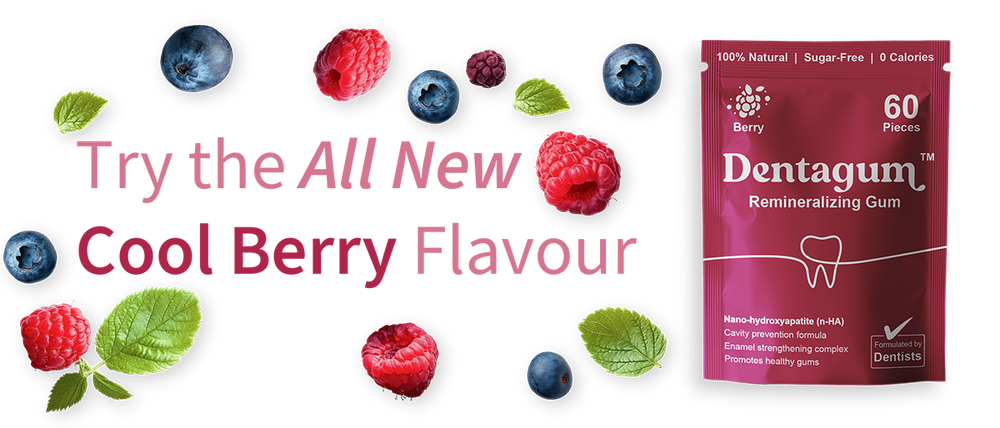

Dentagum vs Enamio: Which Remineralizing Gum Wins?
Both gums use nano-hydroxyapatite. Both use chicle. Both skip aspartame. So why does Dentagum have over 700 Amazon reviews averaging 4.4 stars while Enamio sits at 128 reviews averaging 3.2 to 3.5? Here's a full ingredient, value, and verified testing breakdown.
The remineralizing gum category is growing fast, and two brands keep appearing in the same conversation: Dentagum and Enamio. Both use nano-hydroxyapatite. Both use xylitol. Both avoid aspartame and synthetic gum bases. On the surface, they look like close competitors.
Look closer and the picture is quite different. The formulas diverge significantly when you get past the headline ingredients. The value gap is substantial. The verified customer feedback tells a clear story. And when it comes to third-party testing, one brand publishes verifiable lab results and one does not.
Here's the full breakdown.
The Review Gap Nobody Talks About
Before getting into ingredients, the Amazon data deserves to lead this conversation, because 800-plus reviewers who have used these products daily are the most reliable signal available.
Dentagum on Amazon:
- Mint: 4.4 out of 5 stars from 529 verified reviews
- Berry: 4.4 out of 5 stars from 178 verified reviews
- Combined: 707 verified reviews averaging 4.4 stars on Amazon alone
- over 700 additional verified reviews on their website averaging a 4.87/5 stars
Enamio on Amazon:
- Mint: 3.5 out of 5 stars from 92 verified reviews
- Berry: 3.2 out of 5 stars from 36 verified reviews
- Combined: 128 verified reviews averaging 3.2 to 3.5 stars
That's not a close race. Dentagum has more than five times the review volume and a meaningfully higher average rating across both flavors. In a category where results accumulate over weeks of daily use, consistent high ratings from hundreds of verified buyers is the strongest real-world signal that a product is delivering on its promise.
The Value Comparison: How Far Does Your Dollar Go?
Dentagum: $32.97 for 60 pieces. That's $0.55 per piece.
Enamio: $29.99 for 36 pieces (sold as a 2x18 pack). That's $0.83 per piece.
Dentagum costs 34% less per piece than Enamio. For a product you're chewing two to four times daily after meals, that difference compounds quickly. At three pieces per day, Dentagum's 60-piece pouch lasts twenty days. Enamio's 36-piece pack lasts twelve. Over a month, Dentagum delivers the same number of chewing sessions for meaningfully less money, with a higher-rated product.
Third-Party Testing: Verifiable vs Claimed
This is one of the most important distinctions between the two brands, and it's one that buyers rarely know to look for.
Enamio states on its website that its nano-hydroxyapatite carries "a certificate of analysis on every batch" and that it runs "third-party heavy-metal screening for lead, arsenic, mercury, and cadmium on every production run." These are meaningful claims. But no publicly accessible test results, no lab name, and no verifiable certificates appear anywhere on Enamio's website or Amazon listing. The claims exist on the page. The proof does not.
Dentagum's third-party testing is independently verified and publicly accessible. Dentagum tests for Proposition 65 heavy metals, the strictest heavy metal safety standard in the United States, through Lightlabs, an accredited testing laboratory. Those results are publicly available and verifiable at lightlabs.com. Anyone can look them up.
Prop 65 testing covers lead, cadmium, arsenic, and mercury at thresholds that are up to twenty times more stringent than standard FDA limits. The fact that Dentagum meets Prop 65 standards through a named, accredited lab with publicly accessible results is a concrete safety commitment, not a website claim.
When choosing a product you're putting in your mouth multiple times a day, the difference between a claim you can verify and a claim you're asked to take on faith matters.
The Formula: Where the Real Differences Are
Both formulas share the same foundation: nano-hydroxyapatite for remineralization, xylitol for antibacterial action, and a natural plant-derived gum base. From there, they take meaningfully different directions.
The Sweetener System
Enamio uses USP-grade xylitol and monk fruit. One antibacterial sweetener plus a flavoring agent.
Dentagum uses organic xylitol and organic erythritol. Two antibacterial polyols with complementary mechanisms. Research published in the International Journal of Dentistry found erythritol effectively decreased dental plaque weight, inhibited S. mutans adhesion to tooth surfaces, and reduced caries incidence, performing comparably to xylitol and better than sorbitol across oral health endpoints. Combining xylitol and erythritol creates a broader antibacterial approach than either sweetener alone.
The Gum Base
This is where Enamio made a strategic choice that reveals something important about how it competes.
Enamio's Amazon listing includes this line: "Unlike other natural gums that use mastic for a tough, hard chew that can feel crumbly or fall apart, Enamio is formulated with premium chicle."
That's a direct attack on mastic gum, which is one of Dentagum's primary differentiating ingredients. Enamio is betting you don't know what mastic gum actually does.
Mastic gum (from Pistacia lentiscus) isn't just a gum base material. It's biologically active. A 2023 state-of-the-art review published in the Journal of Natural Medicine, covering 14 independent clinical studies, found that mastic gum "displayed antibacterial and antimicrobial properties and inhibited plaque accumulation, constituting a beneficial adjuvant in caries prevention." The same review identified anti-inflammatory properties specifically relevant to gum tissue health.
Enamio uses a chicle-only base. A good natural choice. But the base is doing nothing beyond holding the formula together.
Dentagum's organic chicle and organic mastic gum base delivers chewable texture from two plant-derived resins, with mastic gum actively reducing bacteria and supporting gum tissue during every minute of the chewing session. The gum base itself is doing oral health work. That's a meaningful upgrade that Enamio is trying to spin as a disadvantage.
The Antibacterial Stack
Enamio's antibacterial approach relies primarily on xylitol, zinc gluconate for breath freshening, and matcha EGCG as an antioxidant with mild antimicrobial properties.
Dentagum's antibacterial coverage is significantly broader. Organic xylitol and organic erythritol address S. mutans through two sweetener mechanisms. Organic mastic gum adds a documented antibacterial and anti-inflammatory layer through the base itself. Natural propolis adds broad-spectrum antimicrobial activity that referenced literature has noted can be more effective against certain oral bacteria than chlorhexidine in some comparisons. Coconut oil contributes anti-inflammatory support through lauric acid. The result is a five-layer antibacterial system versus Enamio's two.
The Gum Health Differentiation
Dentagum's clinical data shows a 79% rate of clinical reduction in gum inflammation among participants with consistent daily use. That outcome reflects the combined effect of mastic gum's anti-inflammatory properties, propolis's antimicrobial action, and erythritol and xylitol's bacterial reduction.
Enamio's formula is focused tightly on remineralization and pH management. Its L-arginine bicarbonate and multi-mineral stack (calcium glycerophosphate, magnesium citrate) are thoughtful additions for maintaining the oral environment favorable to enamel repair. For someone whose primary concern is enamel remineralization specifically, that's a logical approach.
But for someone who wants a formula that supports both enamel health and gum tissue health simultaneously, Dentagum's formula covers more ground.
Where Enamio Has a Legitimate Edge
A fair comparison acknowledges what the other brand does well.
Enamio publishes its nano-HAp particle size (20nm) and specifies carbonate nano-hydroxyapatite on its product page. Dentagum doesn't currently publish its particle size publicly. For a consumer who wants to verify that specification before buying, Enamio makes that easier.
Enamio is fully plant-based and vegan. Dentagum contains organic eggshell powder, which is an animal-derived ingredient. For vegan, vegetarian, kosher, or halal buyers, that matters.
Enamio's L-arginine bicarbonate is a pH-management ingredient not found in Dentagum's formula. L-arginine is metabolized by oral bacteria to produce ammonia, which helps neutralize plaque acid and maintain an alkaline environment favorable to remineralization. It's a genuinely useful addition for people whose primary concern is post-meal pH management.
These are real differences worth knowing about. They don't change the overall picture, but they matter for specific buyers.
The Verdict: Who Each Gum Is Best For
Dentagum is the stronger choice for most people because:
- It has five times the Amazon review volume at a higher average rating, the most reliable real-world signal available
- It costs 34% less per piece for a better-reviewed product
- Its third-party Prop 65 heavy metals testing is independently verified through Lightlabs with publicly accessible results, not a website claim
- Its antibacterial formula covers five layers versus two
- Its mastic gum base actively supports gum tissue health throughout the chewing session
- Its clinical data shows 83% enamel improvement, 91% sensitivity reduction, 87% cavity reduction, and 79% gum inflammation reduction
Enamio may suit you better if:
- You follow a vegan or plant-based diet and need an eggshell-free formula
- You specifically want nano-HAp particle size published on the product page before purchasing
- pH management is your primary focus and you want L-arginine bicarbonate in the formula
Frequently Asked Questions
Which has better reviews, Dentagum or Enamio?
Dentagum has significantly stronger verified customer reviews. On Amazon, Dentagum holds 4.4 out of 5 stars from 707 combined verified reviews across Mint and Berry flavors. Enamio holds 3.2 to 3.5 out of 5 stars from 128 combined verified reviews. Dentagum has more than five times the review volume at a higher average rating across both flavors.
Is Dentagum better value than Enamio?
Yes, by a meaningful margin. Dentagum costs $32.97 for 60 pieces at $0.55 per piece. Enamio costs $29.99 for 36 pieces at $0.83 per piece. Dentagum is 34% cheaper per piece for a higher-rated product with a more comprehensive formula.
Does Dentagum have verifiable third-party testing?
Yes. Dentagum is Prop 65 heavy metals tested through Lightlabs, an accredited independent laboratory. Results are publicly accessible and verifiable at lightlabs.com. Prop 65 is the strictest heavy metal safety standard in the US, up to twenty times more stringent than standard FDA limits. Enamio claims batch testing on its website but does not publish verifiable test results or name its testing laboratory.
Does Dentagum have more ingredients than Enamio?
Dentagum has a broader active formula. It combines nano-hydroxyapatite, organic xylitol, organic erythritol, organic mastic gum, natural propolis, coconut oil, organic eggshell powder, and calcium bentonite clay as active ingredients. Enamio's supporting stack includes calcium glycerophosphate, magnesium citrate, L-arginine bicarbonate, bamboo silica, zinc gluconate, and matcha EGCG. The formulas reflect different priorities: Dentagum builds broader antibacterial and gum health coverage, Enamio focuses more tightly on pH management and mineral delivery.
Is mastic gum in Dentagum actually beneficial?
Yes, and the clinical evidence is clear. A 2023 state-of-the-art review in the Journal of Natural Medicine covering 14 studies found mastic gum displays antibacterial and antimicrobial properties, inhibits plaque accumulation, and has anti-inflammatory properties relevant to periodontal health. Enamio's Amazon listing describes mastic gum as producing a "tough, hard chew that can feel crumbly." The clinical literature describes it as a proven oral health ingredient with centuries of documented human use.
The Bottom Line
When you look at what verified buyers say, what each piece actually costs, whose testing you can independently verify, and how comprehensively each formula addresses oral health, Dentagum is the stronger option for most people.
Five times the review volume at a higher rating. Thirty-four percent cheaper per piece. Publicly verifiable Prop 65 heavy metals testing through Lightlabs. A five-layer antibacterial formula versus two. And a mastic gum base that Enamio has decided to attack in its own product listing rather than replicate, which tells you something about how the competition views the ingredient.
Enamio is a credible product with a transparent ingredient approach and a clean vegan formula. For the right buyer, it's a legitimate choice. For most people comparing these two options, the data points in one direction.
Dentagum's Remineralizing Chewing Gum is dentist-formulated, Prop 65 tested through Lightlabs, and backed by 700-plus verified Amazon reviews. Try it risk-free with a 30-day guarantee at dentagum.co.
RESEARCH SUMMARY
- Dentagum Amazon listing: 4.4/5 stars, 529 verified reviews (Mint), 4.4/5 stars, 178 reviews (Berry). $32.97 for 60 pieces. $0.55 per piece.
- Enamio Amazon listing: 3.5/5 stars, 92 reviews (Mint), 3.2/5 stars, 36 reviews (Berry). $29.99 for 36 pieces (2x18). $0.83 per piece.
- Dentagum: third-party Prop 65 heavy metals tested via Lightlabs. Results publicly available and verifiable at lightlabs.com.
- Enamio: claims "certificate of analysis per batch" and "heavy-metal screening on every production run" on website. No publicly accessible test results or lab name found.
- Enamio Amazon listing actively positions against mastic gum: "Unlike other natural gums that use mastic for a tough, hard chew that can feel crumbly or fall apart, Enamio is formulated with premium chicle." This is a direct attack on Dentagum's key differentiating ingredient.
- Enamio formula: chicle base, 20nm nano-HAp, calcium glycerophosphate, magnesium citrate, L-arginine bicarbonate, bamboo silica, zinc gluconate, matcha EGCG, USP xylitol, monk fruit.
- Dentagum formula: organic chicle + organic mastic gum base, nano-HAp, organic xylitol, organic erythritol, natural propolis, coconut oil, organic eggshell powder, calcium bentonite clay, natural terpene blend, spearmint extract.
- Alwadi MAM et al. Journal of Natural Medicine, 2023. Mastic gum: antibacterial, anti-inflammatory, inhibits plaque across 14 studies.
- Limeback H et al. Biomimetics, 2023. HAP reduced sensitivity 39.5% vs placebo.
- Söderling E et al. BMC Oral Health, 2025. Xylitol reduced mutans streptococci in 12 of 14 studies.
- Mäkinen KK et al. International Journal of Dentistry, 2016. Erythritol effective plaque reduction and S. mutans inhibition.
References
- Alwadi MAM et al. "Mastic (Pistacia lentiscus) Gum and Oral Health: A State-of-the-Art Review." Journal of Natural Medicine, 2023. https://pubmed.ncbi.nlm.nih.gov/37147480/
- Mäkinen KK et al. "Erythritol Is More Effective Than Xylitol and Sorbitol in Managing Oral Health Endpoints." International Journal of Dentistry, 2016. https://www.ncbi.nlm.nih.gov/pmc/articles/PMC5011233/
- Limeback H, Enax J, Meyer F. "Clinical Evidence of Biomimetic Hydroxyapatite in Oral Care Products for Reducing Dentin Hypersensitivity." Biomimetics, 2023. https://pmc.ncbi.nlm.nih.gov/articles/PMC9844412/
- Söderling E et al. "Specific Effects of Xylitol Chewing Gum on Mutans Streptococci." BMC Oral Health, 2025. https://link.springer.com/article/10.1186/s12903-025-06602-1
- Dentagum Amazon listing. amazon.com/dp/B0FH77JJ7J, checked May 2026.
- Enamio Amazon listing. amazon.com/dp/B0FTJM6TWT, checked May 2026.
- Lightlabs. Dentagum Prop 65 heavy metals testing results. lightlabs.com.
