
Can You Reverse Cavities Naturally? What the Science Says
The honest answer is: yes and no, and the distinction is more important than either answer alone. Early-stage cavities (white spot lesions, pre-cavitation) can be arrested and reversed through remineralization. Once a visible hole forms, remineralization alone cannot restore the structure. Here's exactly what the window looks like, what the clinical evidence supports, and what you can do during the reversible stage.

Early-stage cavities (white spot lesions, pre-cavitation) can be reversed. Cavitated cavities with a visible hole cannot be reversed by remineralization alone and require restorative dental treatment. The distinction is critical. The first sign of a cavity is a white spot on the enamel surface: the surface is still intact, but the enamel beneath is weaker and more porous due to mineral loss. At this stage, multiple systematic reviews confirm that remineralization can fully reverse the lesion. A 2025 clinical trial found 74% of active early lesions arrested over 24 months using hydroxyapatite-fluoride combination. Once the surface collapses into a visible hole, no amount of remineralization restores that structure. The window for natural reversal exists, it's clinically real, and the interventions that support it (fluoride toothpaste, nano-hydroxyapatite, xylitol, stimulated salivary flow) are evidence-backed and accessible.
90% of US adults age 20 and older have had at least one cavity in their permanent teeth. 57% of adolescents have had at least one. If you're reading this article, you're asking one of the most important oral health questions available, because the answer isn't simply yes or no. It's a specific, time-sensitive yes that becomes an irreversible no the moment you miss the window.
This article gives you the honest clinical answer: what the reversible window looks like, what the evidence supports, and what you can realistically do during that window to tip the balance back toward a healthy tooth rather than a future filling.
How Cavities Actually Develop: The Two Stages
Understanding whether a cavity can be reversed requires understanding that "cavity" describes two fundamentally different clinical situations that most people treat as one.
Stage 1: Reversible demineralization (white spot lesion)
When bacteria in your mouth metabolize sugars and produce lactic acid, and when dietary acids drop your oral pH below 5.5, enamel begins losing calcium and phosphate to the surrounding fluid. The enamel surface itself remains intact, but the subsurface becomes weaker and more porous as mineral leaves the crystal structure. The visible sign is a white spot: a chalky, opaque area that appears because the changed refractive properties of demineralized enamel scatter light differently from healthy enamel.
This is the reversible stage. The PubMed systematic review of white spot lesion therapies is explicit: white spot lesions "can be reversed and do not form cavities" when intervention is applied. The grass-worn-by-footsteps analogy from Penn Dental is apt: the surface is stressed, not collapsed. If the conditions that created the lesion are changed and remineralization is supported, the mineral can be restored.
Stage 2: Cavitation (the irreversible stage)
When demineralization is sustained and severe enough that the enamel surface structure collapses, an actual hole forms. This is cavitation: the surface integrity is lost, the enamel lattice has physically broken down, and the lesion has become a structural defect. At this point, no amount of remineralization can restore what was a crystalline structure that no longer exists in that location. The body cannot regenerate enamel the way it regenerates bone or soft tissue. Only a dentist can restore the tooth's structure at this stage, through fillings, crowns, or other restorative procedures.
The International Caries Detection and Assessment System (ICDAS) classifies caries from 0 (healthy) to 6 (deep cavitation into dentin). Stages 1 and 2 (first and distinct visual change without surface breakdown) are generally reversible with remineralization. Stage 3 (localized enamel breakdown) is the borderline: some Stage 3 lesions can be arrested if not cavitated. Stages 4 through 6 (cavitation into dentin or deeper) require restorative treatment. Most people who ask "can I reverse this cavity" are at Stage 1 or 2 and have more options than they realize. The tragedy is that white spot lesions at Stage 1 and 2 are often painless and easy to miss without a dental examination, which is why regular dental visits for early detection are the essential complement to remineralization habits.
The Clinical Evidence for Early Cavity Reversal

The claim that early-stage cavities can be reversed is not holistic medicine. It's mainstream dental science, supported by multiple systematic reviews and randomized clinical trials.
A systematic review published in PubMed specifically examining white spot lesion therapies found that these lesions "can be reversed and do not form cavities" with appropriate remineralizing intervention. This is the baseline position of the dental research community: early caries is reversible when the conditions driving demineralization are addressed and remineralization is supported.
A 2025 triple-arm randomized controlled clinical trial examined intensive application of remineralizing agents on white spot lesions. The study found that intensive application of different remineralizing agents can "significantly enhance aesthetic appearance of white spot lesions" and serve as an effective protocol for managing early carious lesions, confirming that reversal produces visible, measurable outcomes, not just laboratory findings.
A 2025 clinical trial of 518 children using hydroxyapatite-fluoride combination toothpaste found 74% of active early lesions arrested over 24 months (58 of 78 lesions). Arrest in this context means the lesion stopped progressing and began reversing: a clinically meaningful outcome in a large pediatric cohort.
A 2025 RCT published in Scientific Reports (National Research Centre, Egypt) specifically comparing nano-hydroxyapatite paste (Apagard Primo) against CPP-ACP (MI Paste) for white spot lesion reversal in children found both agents effective, with follow-up through February 2025 confirming measurable mineral restoration in the treated lesions.
A 2025 clinical trial of 518 children found that consistent use of hydroxyapatite-fluoride combination toothpaste resulted in 74% of active early caries lesions being arrested over a 24-month period (58 of 78 lesions). This is a large-scale clinical confirmation that early-stage cavity reversal is not a theoretical possibility but a practically achievable outcome with consistent remineralization support. The key variable in all such studies is consistency: remineralization requires sustained daily exposure to the supporting interventions, not occasional use.
What Actually Works: The Remineralization Toolkit
The interventions with the strongest clinical evidence for early cavity reversal work through three complementary mechanisms: reducing the acid production that drives demineralization, directly supplying the mineral that enamel has lost, and amplifying the natural remineralization process that saliva provides.
Fluoride (the established gold standard)
Fluoride has the longest and deepest evidence base for caries prevention and early lesion arrest. It works by incorporating into enamel as fluorapatite, which is more resistant to acid dissolution than natural hydroxyapatite. However, as noted in clinical trial reviews: "the ability of fluoride to promote net remineralization is limited by the availability of calcium and phosphate ions in saliva." Fluoride changes enamel's acid resistance but relies on saliva's calcium and phosphate for the actual mineral deposition. It also has limited penetration into the body of the lesion, primarily affecting the outermost enamel layer.
Nano-hydroxyapatite (direct mineral replacement)
Nano-HAp works differently from fluoride: it directly deposits the same mineral enamel is made from into the microporosities of the white spot lesion during contact. Where fluoride requires the lesion to be bathed in salivary calcium and phosphate for mineral deposition, nano-HAp delivers the mineral directly. The 2024 systematic review and meta-analysis published in the Journal of Dentistry confirmed nano-HAp's effectiveness for caries prevention and remineralization, positioning it as a clinically validated alternative or complement to fluoride. Contact time is the key variable: the 20-minute post-meal window during gum chewing maximizes nano-HAp's deposition opportunity.
Xylitol (reducing the bacterial acid production)
Xylitol doesn't directly remineralize. It addresses the other side of the equation: it reduces the bacterial acid production that drives demineralization in the first place. S. mutans metabolizes xylitol in a futile energy cycle that kills the bacterium. Over weeks of consistent daily use, xylitol progressively reduces S. mutans populations, creating a less acidic post-meal oral environment where the Stephan Curve doesn't drop as deep or recover as slowly. This shifts the net daily balance from demineralization toward remineralization even without direct mineral delivery. The 2025 systematic review found xylitol significantly reduced S. mutans in 12 of 14 clinical studies.
Stimulated salivary flow (amplifying the natural system)
Saliva is supersaturated with calcium and phosphate at normal oral pH and is continuously attempting to deposit mineral back into enamel. The problem is that at resting flow (0.3 to 0.4 mL/minute), the supply of these ions is limited. Chewing sugar-free gum stimulates salivary flow to 10 to 12 times the resting rate, dramatically amplifying the delivery of calcium and phosphate to lesion surfaces during the post-meal recovery window when remineralization demand is highest. The ADA explicitly endorses this mechanism: chewing sugar-free gum for 20 minutes after meals helps prevent tooth decay by accelerating the pH recovery and mineral delivery.
Diet changes (reducing the acid attacks)
Every eating event is an acid event. Reducing the frequency of eating events, specifically the snacking between meals that keeps oral pH depressed for extended periods, gives the remineralization system more uninterrupted time to work. Reducing high-sugar and high-acid foods directly reduces the depth and duration of each Stephan Curve. And drinking water after acidic foods or drinks dilutes residual acid before it can complete its full demineralization effect. None of these replace active remineralization tools, but they reduce the demand on those tools.
What "Natural" Actually Means for Cavity Reversal
The search query "reverse cavities naturally" implies a preference for approaches that don't involve pharmaceutical intervention or the dentist's drill. It's worth being specific about what's genuinely natural here and what isn't, because the distinction matters for evaluating claims.
Remineralization is natural. It happens continuously in your mouth as saliva deposits calcium and phosphate onto enamel between acid events. The interventions that support early cavity reversal are not foreign chemistry; they're amplifications of processes already happening in the body. Nano-hydroxyapatite is the same mineral enamel is made from. Xylitol is found naturally in birch trees and many fruits. Saliva stimulation through chewing is a natural physiological mechanism that the ADA endorses specifically for this purpose.
What "natural" reversal cannot do is reverse cavitated lesions. Once the enamel structure has physically collapsed, no natural process restores it. Enamel-forming cells (ameloblasts) are only active during tooth development and cannot regenerate lost enamel in adults. This is the fundamental limit: the natural remineralization system can restore mineral to weakened but intact enamel. It cannot rebuild collapsed architecture.
Several "natural cavity reversal" claims circulate online that the clinical evidence doesn't support. Oil pulling does not reverse cavities; it may reduce bacterial load as an adjunct, but it doesn't deliver mineral to lesions. "Remineralizing toothpastes" with calcium bentonite clay, diatomaceous earth, or activated charcoal as their primary active ingredient lack clinical evidence for lesion reversal. Dietary calcium alone doesn't remineralize existing lesions (though it supports overall mineral balance). Claims of "regrowing enamel" through natural means misrepresent the biology: enamel can gain mineral in existing crystal structure (remineralization) but cannot regenerate new enamel tissue where none exists (the science of enamel regeneration is an active research frontier but not yet clinically available).
How Long Does Reversal Take?
Clinical studies typically measure reversal over months, not weeks. The 74% lesion arrest trial ran for 24 months. The white spot lesion RCTs typically assess outcomes at 1, 3, 6, and 12 months. Individual variation is significant: the depth of the lesion, the patient's salivary composition and flow rate, the consistency of remineralization interventions, and the dietary acid load all affect the timeline.
General clinical guidance suggests that consistent use of remineralizing interventions (fluoride toothpaste, xylitol gum after meals, nano-HAp products) for a minimum of 3 to 6 months is the baseline before expecting visible improvement in a white spot lesion's appearance or measurable improvement in enamel microhardness testing. Early lesions that are caught and treated promptly may arrest within weeks. Deeper subsurface lesions that have been developing for months require correspondingly longer intervention periods.
The honest expectation is that reversal is a weeks-to-months process requiring daily consistency, not a days-long outcome from an intensive treatment. The same habits that over months produce demineralization produce remineralization when consistently reversed.
What to Do Right Now

If you've noticed a white spot on your tooth, have been told you have early decay, or are trying to prevent first cavities from forming:
See a dentist to establish where you are in the caries process. You cannot reliably determine from the appearance of a white spot whether it's at ICDAS 1 or ICDAS 3. A dentist using visual examination, X-rays, and potentially laser fluorescence devices can give you a specific assessment of whether your lesion is in the reversible window and which interventions are most appropriate for your specific situation.
Use fluoride toothpaste and don't rinse after brushing. The "spit, don't rinse" technique leaves fluoride in contact with enamel during the overnight period, providing continuous mineral interaction with the lesion. This is the single most evidence-supported daily habit for early lesion management and is free.
Add post-meal remineralizing gum to your routine. The ADA endorses 20 minutes of sugar-free gum after meals. Adding nano-HAp to the gum formula means that same 20-minute session is delivering direct particulate mineral to the enamel surfaces during the post-meal window when the lesion is most receptive to mineral uptake. Xylitol in the gum reduces the S. mutans populations that drove the lesion's formation in the first place.
Reduce the frequency of eating events. Each eating event is an acid event. Three meals with minimal snacking creates far fewer demineralization periods than three meals plus constant grazing. More uninterrupted time above pH 5.5 means more time for remineralization to run without competition from ongoing acid.
Rinse with water after acidic food and drinks. A quick water rinse clears residual acid and food before it can continue driving demineralization. Takes 5 seconds. Has outsized impact on the acid load that each eating event creates.
Where Dentagum Fits in the Reversal Protocol
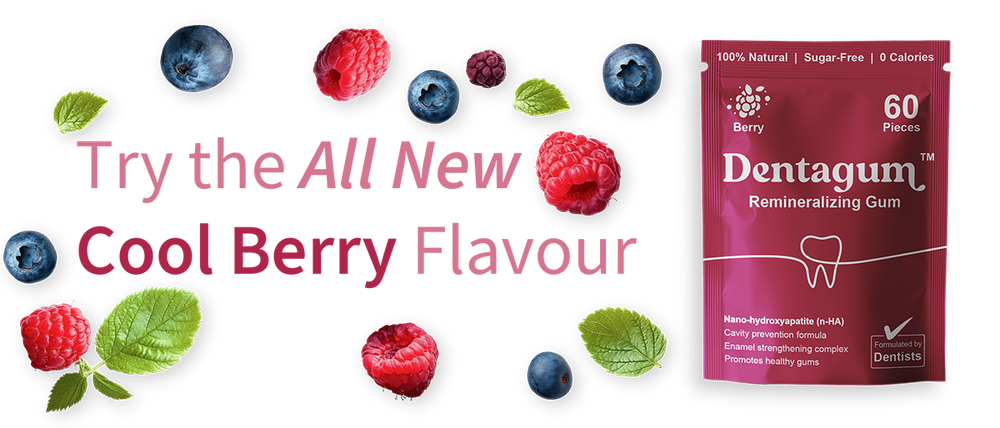
The post-meal gum habit is specifically designed around the window that matters most for early cavity reversal: the 20 minutes after eating when the enamel is partially demineralized and most receptive to mineral uptake.
Organic xylitol targets S. mutans, the primary bacteria metabolizing food residue into the lactic acid driving demineralization. With consistent daily use over weeks, xylitol progressively reduces the bacterial populations creating the acid challenge. The 2025 systematic review found this effect across 12 of 14 clinical studies.
Nano-hydroxyapatite deposits mineral directly into the microporosities of white spot lesions during each chewing session. Where saliva delivers dissolved calcium and phosphate that must organize into crystal structure, nano-HAp delivers pre-formed mineral in the same composition as enamel. The 2023 Biomimetics meta-analysis of 44 clinical trials confirmed contact time during chewing as the key variable. Twenty minutes of post-meal contact is exactly this window.
The saliva stimulation from chewing, to 10 to 12 times the resting rate, amplifies the natural remineralization process during exactly the window when enamel needs it most. This is the mechanism the ADA endorses, working in parallel with the active ingredients.
None of these replace professional dental assessment for existing lesions. But as the daily routine that creates the conditions for remineralization to occur and to outpace ongoing demineralization, the post-meal gum habit is the most evidence-backed, lowest-friction addition to a cavity reversal protocol available.
Try Dentagum risk-free — 30-day guaranteeFrequently Asked Questions
Can cavities be reversed naturally?
Early-stage cavities (white spot lesions, pre-cavitation) can be reversed through remineralization, which is the natural process by which saliva deposits calcium and phosphate back into partially demineralized enamel. Multiple systematic reviews and clinical trials confirm this. The interventions that support reversal (fluoride toothpaste, nano-hydroxyapatite, xylitol gum, stimulated saliva from chewing) amplify natural biological processes rather than introducing foreign chemistry. Cavitated cavities with visible holes cannot be reversed naturally or otherwise: they require restorative dental treatment.
What does a reversible cavity look like?
A white spot: a chalky, opaque area on the tooth surface that appears white rather than the normal translucent off-white of healthy enamel. White spots may only be visible when the tooth surface is dried, or they may be visible when wet. The surface of the tooth is intact; the white spot indicates subsurface demineralization, not structural collapse. Many white spot lesions are painless and invisible to the person who has them without a dental examination, which is why professional assessment is essential for accurate diagnosis.
How long does it take to reverse a cavity naturally?
The clinical trials that document early cavity reversal typically run for 6 to 24 months of consistent intervention. Individual outcomes vary based on lesion depth, salivary composition, and consistency of the remineralization protocol. General guidance suggests a minimum of 3 to 6 months of consistent daily remineralization habits before expecting visible improvement. The consistency matters more than any single intensive treatment: remineralization is a cumulative process that requires sustained favorable conditions over weeks and months.
Does xylitol gum reverse cavities?
Xylitol gum doesn't directly remineralize enamel. It reduces the bacterial populations (particularly S. mutans) that produce the acid driving demineralization. By reducing the bacterial acid source, xylitol creates a more favorable oral environment where the natural remineralization process (saliva depositing calcium and phosphate) can outpace ongoing acid attacks. Combined with a formula that also includes nano-hydroxyapatite for direct mineral delivery and saliva stimulation for amplified calcium/phosphate supply, xylitol gum is part of a multi-mechanism post-meal intervention that addresses the cavity-forming process from multiple angles simultaneously.
Do I still need to see a dentist if I'm remineralizing?
Yes, for several important reasons. You cannot reliably determine from visual inspection whether your lesion is at an early reversible stage or has already progressed to cavitation requiring restorative treatment. A dentist can establish the actual stage, identify lesions in locations you can't see (between teeth, on back surfaces), monitor whether your remineralization protocol is working over time, and intervene professionally if the lesion progresses rather than reverses. Remineralization habits and dental care are complementary, not alternatives to each other.
Can you reverse cavities with diet changes alone?
Diet changes reduce the acid attacks that drive demineralization, which is important but insufficient alone to reverse existing lesions in most cases. Reducing sugar frequency, eliminating constant grazing, rinsing with water after acidic foods, and maintaining adequate hydration all support the remineralization side of the balance. But active mineral delivery (from fluoride toothpaste, nano-HAp products, or saliva stimulation from gum chewing) is typically needed alongside dietary changes for early lesion reversal in a clinically meaningful timeframe. Diet alone is most powerful as prevention before lesions form, rather than as a reversal tool once a white spot has developed.
The Bottom Line
The honest answer to "can you reverse cavities naturally" is: yes, during the specific pre-cavitation window, through the natural process of remineralization amplified by evidence-backed interventions. The answer is no once the tooth's surface has structurally collapsed into a visible hole.
The window is real, it's clinically confirmed across multiple systematic reviews and randomized controlled trials, and it's more accessible than most people realize. White spot lesions are reversible. The 74% arrest rate in a 518-patient clinical trial with hydroxyapatite toothpaste is a meaningful number. The combination of fluoride, nano-HAp, xylitol, and stimulated salivary flow addresses the problem from multiple angles simultaneously.
The urgency matters. A white spot today that progresses to a cavity tomorrow requires a drill and a filling. The same lesion reversed today requires nothing more than consistent daily habits. The post-meal window, those 20 minutes after eating when enamel is most demineralized and most receptive to mineral uptake, is the highest-leverage moment in the entire reversal process. Covering it consistently with the right tool is the most important single habit change most people can make for their long-term oral health.
Try Dentagum risk-free — 30-day guarantee at dentagum.coResearch Summary
- PubMed systematic review. "Therapies for White Spot Lesions." White spot lesions (WSLs) "can be reversed and do not form cavities." 45 studies included from initial 273 references. Remineralizing agents effective for WSL treatment confirmed.
- Clinical trial review (Vitadentlabs, 2026). 2025 clinical trial of 518 children: 74% of active early lesions arrested over 24 months using hydroxyapatite-fluoride combination toothpaste (58 of 78 lesions). Cocco F et al. "Hydroxyapatite-Fluoride Toothpastes on Caries Activity." Int Dent J. 2025.
- RCT (Scientific Reports, Nature, 2025). 32 patients, 100 white spot lesions in permanent anterior teeth. Groups compared nano-HAp paste (Apagard Primo) and CPP-ACP (MI Paste) among others. Both effective for WSL remineralization with measurable outcomes at follow-up.
- Pawinska M, Paszynska E, Amaechi BT, Meyer F, Enax J, Limeback H. "Clinical evidence of caries prevention by hydroxyapatite: an updated systematic review and meta-analysis." J Dent. 2024;151:105429. Confirms nano-HAp for caries prevention and remineralization.
- Söderling E et al. BMC Oral Health, 2025. Xylitol gum significantly reduced S. mutans in 12/14 studies. Confirms xylitol's role in reducing acid-producing bacteria, creating favorable remineralization environment.
- American Dental Association. Sugar-free gum endorsed for 20 minutes after meals. Stimulates saliva to 10-12x resting rate. Acid buffering, calcium/phosphate delivery, food particle clearance. ADA's explicit alternative for post-meal oral care when brushing isn't possible.
- ICDAS classification (International Caries Detection and Assessment System). Stages 0-6. Stages 1-2 generally reversible. Stage 3 borderline. Stages 4-6 require restorative treatment. Widely used clinical tool for caries staging and management decisions.
References
- Featherstone JDB et al. "Therapies for White Spot Lesions: A Systematic Review." PubMed. https://pubmed.ncbi.nlm.nih.gov/28259311/
- Pawinska M, Paszynska E, Amaechi BT et al. "Clinical evidence of caries prevention by hydroxyapatite: an updated systematic review and meta-analysis." J Dent. 2024;151:105429. https://www.sciencedirect.com/science/article/abs/pii/S0300571224001805
- "Effect of remineralization after in office followed by home treatment of white spot lesions in children randomized controlled trial." Scientific Reports, Nature, 2025. https://www.nature.com/articles/s41598-025-15829-5
- Cocco F, Salerno C, Wierichs RJ et al. "Hydroxyapatite-Fluoride Toothpastes on Caries Activity: A Triple-Blind Randomized Clinical Trial." Int Dent J. 2025;75(2):632-642.
- Söderling E et al. "Specific Effects of Xylitol Chewing Gum on Mutans Streptococci Levels." BMC Oral Health, 2025. https://link.springer.com/article/10.1186/s12903-025-06602-1
- American Dental Association. "Chewing Gum." Oral Health Topics. https://www.ada.org/resources/ada-library/oral-health-topics/chewing-gum
- Limeback H, Enax J, Meyer F. "Clinical Evidence of Biomimetic Hydroxyapatite in Oral Care Products." Biomimetics, 2023. https://pmc.ncbi.nlm.nih.gov/articles/PMC9844412/
