
Can Gum Help Sensitive Teeth? What the Science Says
If your teeth wince at cold drinks or sweet food, the problem likely starts at your dentinal tubules. Here's how chewing the right gum after meals may actually help address that, and the science behind why it works.

Yes, certain types of gum can help with tooth sensitivity, but the ingredient list matters enormously. Standard gum does almost nothing. Gum containing remineralizing ingredients like nano-hydroxyapatite or xylitol works through a completely different mechanism, one that targets the actual cause of sensitivity rather than just masking the pain signal.
Here's what's happening in your mouth when your teeth hurt, and why the right chewing gum after meals might be a more useful tool than most people realize.
Why Teeth Become Sensitive in the First Place
Tooth sensitivity, clinically called dentin hypersensitivity, happens when the dentinal tubules become exposed. These are microscopic channels that run through the dentin layer beneath your enamel, leading directly toward the nerve of the tooth. When they're covered by healthy enamel or sealed by natural mineral deposits, you feel nothing. When they're exposed, fluid movement inside them in response to temperature, pressure, or sugar triggers a pain signal.
Dentinal tubules become exposed in several ways: enamel erosion from acidic foods and drinks, receding gums that uncover the root surface, aggressive brushing, or the gradual thinning of enamel over time. Once the tubules are open, every cold drink, every hot coffee, every bite of something sweet becomes a reminder.
The two main approaches to managing sensitivity are either numbing the nerve (what potassium nitrate does) or physically sealing the tubules. The second approach is more durable because it addresses the structural problem rather than the pain signal.
What Chewing Gum Actually Does to Your Mouth
Before getting to specific ingredients, it's worth understanding what chewing itself does for your oral environment, because it's more significant than most people expect.
Chewing stimulates saliva production. That's not just a comfort thing. Saliva is your mouth's primary natural defense system: it buffers acid, delivers calcium and phosphate to your enamel, and helps remineralize early areas of damage. A 2023 systematic review and meta-analysis published in BMC Oral Health confirmed that chewing gum consistently increases salivary flow, even in people with reduced secretory capacity.
More saliva after a meal means faster acid neutralization, a shorter window during which your enamel is under attack, and more minerals available for natural repair. On its own, that's genuinely useful for people with sensitivity caused by enamel erosion. But when you add remineralizing ingredients to the gum, the effect compounds.
How Nano-Hydroxyapatite Gum Addresses Sensitivity
Nano-hydroxyapatite (nano-HAp or nHA) is the ingredient with the strongest clinical evidence for sensitivity relief in a gum format. It's a synthetic form of the mineral that makes up your tooth enamel and dentin, produced in nanoparticle sizes small enough to physically enter the dentinal tubules and seal them.
Research published in a 2022 scoping review in the International Journal of Environmental Research and Public Healthconfirmed that nano-hydroxyapatite "forms a protective layer on the external surface of dentin, resulting in the occlusion of dentin tubules by mineral hydroxyapatite, thus reducing dentinal permeability and preventing fluid disturbance within the tubules." That fluid disturbance is exactly what triggers the pain signal. Block it, and the sensitivity diminishes.
A 2023 systematic review and meta-analysis published in Biomimetics looked specifically at hydroxyapatite in oral care products for dentin hypersensitivity. One of the studies it reviewed found that adding HAP to chewing gum reduced hypersensitivity by 6% to 80% compared to placebo. The review also found that HAP performed as well as or better than fluoride controls for reducing sensitivity across the clinical studies included.
An 8-week randomized controlled trial published in BDJ Open in 2021 attributed nano-HAp's desensitizing effect specifically to its ability to form hydroxyapatite plugs inside the tubules, a mechanical sealing effect rather than a pharmaceutical numbing effect. The plugs reduce permeability, reduce fluid movement, and reduce the pain response.
The gum format is particularly well-suited to delivering this benefit because contact time matters. The longer nano-HAp stays in contact with your teeth, the more opportunity the particles have to deposit in the tubules. Toothpaste gets rinsed away in two minutes. Gum stays for ten to twenty, which is a meaningful difference.
The Role of Xylitol in Sensitivity Relief
Xylitol doesn't seal tubules directly the way nano-HAp does. Its contribution to sensitivity is more indirect, but still relevant.
By reducing the population of Streptococcus mutans bacteria in your mouth, xylitol lowers the amount of acid those bacteria produce after meals. Less acid means less enamel erosion over time. Less enamel erosion means fewer exposed dentinal tubules. For people whose sensitivity is driven by gradual acid damage, that's a meaningful long-term protective effect.
Xylitol also stimulates saliva production in the same way chewing itself does, which adds to the acid-buffering effect described above. The two mechanisms (bacterial reduction and saliva stimulation) work in the same direction.
Why Gum Makes Sense as a Delivery Format for Sensitive Teeth
Most people with sensitive teeth already use a sensitivity toothpaste, and that's a good baseline. But toothpaste has a fundamental limitation: it's only in your mouth for two minutes, twice a day. The times when your enamel is most under attack are after meals, when acid from food and bacteria temporarily lowers your oral pH. That's exactly when you're not brushing.
Chewing a remineralizing gum for ten to twenty minutes after eating fills that gap. You're delivering nano-HAp and other remineralizing minerals to your teeth during the specific window when they need support most, while also stimulating the saliva that naturally buffers the acid exposure from your meal.
Think of it as extending your oral care routine into the parts of the day that toothpaste can't reach.
What to Look for in a Gum for Sensitive Teeth
Not all sugar-free gum delivers sensitivity benefits. The label matters. Here's what to look for.
Nano-hydroxyapatite (nHA): The standout ingredient for sensitivity relief in gum format. Look for it listed explicitly. Standard hydroxyapatite particles are too large to enter the tubules effectively. Nano-sized particles are what the clinical evidence supports.
Xylitol: A meaningful supporting ingredient for long-term enamel protection. Effective at reducing the acid-producing bacteria that accelerate enamel erosion over time.
A natural gum base: Chicle gum base (derived from the sapodilla tree) is a clean, natural alternative to synthetic petroleum-based gum bases. It's worth checking if a brand's formulation is built on something you'd actually want in your mouth for twenty minutes.
No sugar: Any sensitivity-focused gum must be sugar-free. Sugar feeds the exact bacteria you're trying to suppress.
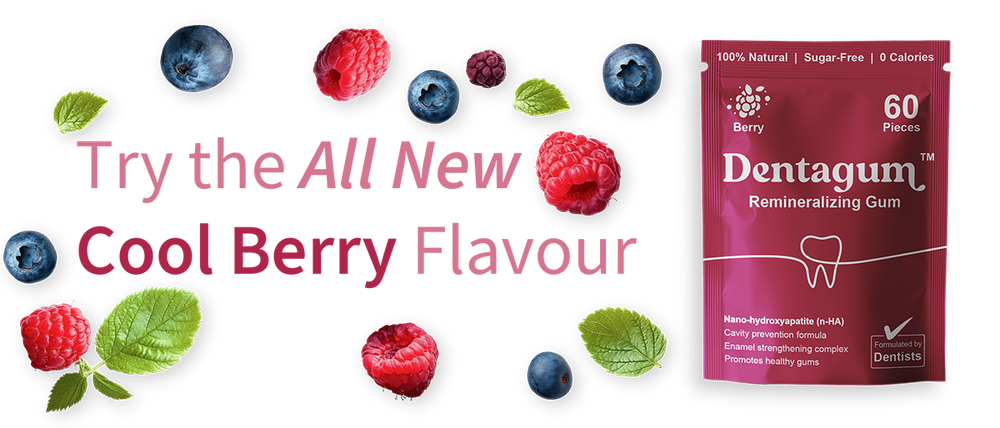
Dentagum's Remineralizing Chewing Gum combines nano-hydroxyapatite and organic xylitol in each piece, alongside organic mastic gum (which supports gum health and reduces inflammation), natural propolis, and an organic chicle base. It's designed to be chewed for 10-20 minutes after meals, which aligns with the contact time that makes the remineralizing mechanism work. In Dentagum's own clinical data, 91% of participants reported a significant reduction in cold sensitivity with consistent daily use.
How Long Does It Take to Notice a Difference?
This depends on what's causing your sensitivity and how consistently you use a remineralizing gum.
For sensitivity driven by surface-level enamel erosion or partially exposed tubules, many people start noticing improvement within two to four weeks of daily use. The tubule-sealing effect builds with repeated exposure as mineral deposits accumulate in and around the openings.
For more advanced sensitivity where enamel loss is significant or gum recession has exposed root surfaces, the timeline is longer and the gum alone may not be sufficient. In those cases, a combination of sensitivity toothpaste, remineralizing gum, and professional dental treatment gives you the best outcome.
If your sensitivity is sudden, severe, or getting worse, see your dentist. Sensitivity that appears without an obvious cause can sometimes signal a cracked tooth, decay, or a failing restoration, none of which a gum will address.
Frequently Asked Questions
Can chewing gum actually help with tooth sensitivity? Yes, if the gum contains remineralizing ingredients like nano-hydroxyapatite. A 2023 systematic review published in Biomimetics found that hydroxyapatite added to chewing gum reduced dentin hypersensitivity by 6% to 80% compared to placebo. The gum format is effective because it keeps the ingredient in contact with your teeth for 10-20 minutes, much longer than toothpaste.
What is the best gum for sensitive teeth? Look for gum containing nano-hydroxyapatite (nHA), which physically seals the dentinal tubules responsible for sensitivity pain. Xylitol is a strong supporting ingredient that reduces acid-producing bacteria and protects enamel long-term. Avoid any gum with sugar, which counteracts both benefits.
How does nano-hydroxyapatite reduce tooth sensitivity? Nano-hydroxyapatite particles are small enough to enter exposed dentinal tubules, where they form hydroxyapatite plugs that physically block the channels. This reduces the fluid movement inside the tubules that triggers the pain signal when you eat or drink something cold, hot, or sweet. It's a structural fix, not a nerve-numbing effect.
How long should I chew remineralizing gum for sensitive teeth? Research on remineralizing gum generally uses 10-20 minutes of chewing as the effective duration. That contact time allows nano-hydroxyapatite particles to deposit in the dentinal tubules and saliva stimulation to neutralize post-meal acid. Chewing for a shorter time reduces the benefit.
Can remineralizing gum replace sensitivity toothpaste? No, and it shouldn't try to. The two products complement each other. Sensitivity toothpaste works during your brushing routine. Remineralizing gum works after meals, during the window when your enamel is recovering from acid exposure and you can't brush. Used together, they cover more of the day.
When should I see a dentist about sensitive teeth? See your dentist if your sensitivity is sudden, worsening, localised to one tooth, or accompanied by pain that lingers after the cold or heat stimulus is removed. These can indicate a cracked tooth, cavity, or other issue that needs professional treatment. Remineralizing gum supports enamel health but it isn't a diagnostic or treatment tool.
The Bottom Line
Chewing gum can help with sensitive teeth, but only if it contains the right ingredients. The mechanism is real and clinically supported: nano-hydroxyapatite physically seals the exposed dentinal tubules that cause sensitivity, chewing stimulates the saliva that naturally buffers acid, and consistent daily use after meals builds on both effects over time.
It won't replace toothpaste, a dentist, or treatment for advanced sensitivity. But as a practical, daily support tool that fits into your routine between brushing, a well-formulated remineralizing gum is one of the more useful things you can add.
Dentagum's Remineralizing Chewing Gum is dentist-formulated with nano-hydroxyapatite, organic xylitol, and mastic gum, designed to fit into your routine after meals. Try it risk-free with a 30-day guarantee at dentagum.co.
RESEARCH SUMMARY
- Limeback H et al. "Clinical Evidence of Biomimetic Hydroxyapatite in Oral Care Products for Reducing Dentin Hypersensitivity: An Updated Systematic Review and Meta-Analysis." Biomimetics, 2023. Key finding: HAP added to chewing gum reduced dentin hypersensitivity by 6% to 80% compared to placebo. HAP was as good as or better than fluoride controls for reducing sensitivity.
- PMC Scoping Review. "Nano-Hydroxyapatite (nHAp) in the Remineralization of Early Dental Caries." International Journal of Environmental Research and Public Health, 2022. Confirmed nano-HAp forms a protective layer on dentin, occluding dentinal tubules and reducing permeability.
- "Immediate Effects of Biomimetic Hydroxyapatite Toothpaste and Mouthwash on Dentin Hypersensitivity: A Randomized Controlled Trial." MDPI, 2025. Biomimetic HAp achieves deep, stable occlusion of exposed dentinal tubules, producing measurable reductions in hypersensitivity.
- "Clinical Efficacy of Nanohydroxyapatite-Containing Toothpaste at Relieving Dentin Hypersensitivity: An 8-Week Randomized Controlled Trial." BDJ Open, 2021. nano-HAP reduces dentin hypersensitivity by forming hydroxyapatite plugs that occlude dentinal tubules.
- Dodds et al. "The Effect of Gum Chewing on Xerostomia and Salivary Flow Rate." BMC Oral Health, 2023. Systematic review and meta-analysis confirming chewing gum increases saliva production, with a Cochrane review supporting the finding.
- Scientific Reports, 2025. nano-HAp deposited on dentin surfaces increases calcium ion concentration in saliva, promoting remineralization and occluding dentinal tubules to minimize pulp irritation.
References
- Limeback H et al. "Clinical Evidence of Biomimetic Hydroxyapatite in Oral Care Products for Reducing Dentin Hypersensitivity: An Updated Systematic Review and Meta-Analysis." Biomimetics, 2023. https://pmc.ncbi.nlm.nih.gov/articles/PMC9844412/
- Anil A et al. "Nano-Hydroxyapatite (nHAp) in the Remineralization of Early Dental Caries: A Scoping Review." International Journal of Environmental Research and Public Health, 2022. https://pmc.ncbi.nlm.nih.gov/articles/PMC9102186/
- "Immediate Effects of Biomimetic Hydroxyapatite Toothpaste and Mouthwash on Dentin Hypersensitivity: A Randomized Controlled Trial." MDPI Dentistry Journal, 2025. https://www.mdpi.com/2673-6373/5/4/100
- "Clinical Efficacy of Nanohydroxyapatite-Containing Toothpaste at Relieving Dentin Hypersensitivity: An 8-Week Randomized Controlled Trial." BDJ Open, 2021. https://www.nature.com/articles/s41405-021-00080-7
- Dodds MWJ, Ben Haddou M, Day JEL. "The Effect of Gum Chewing on Xerostomia and Salivary Flow Rate in Elderly and Medically Compromised Subjects: A Systematic Review and Meta-Analysis." BMC Oral Health, 2023. https://pmc.ncbi.nlm.nih.gov/articles/PMC10280939/
- "In Vitro Study on the Bacteriostatic Effect of Amoxicillin-Loaded Nano-Hydroxyapatite and Its Capability in Occluding Dentinal Tubules." Scientific Reports, 2025. https://www.nature.com/articles/s41598-025-25128-8
