
Why Most Sugar-Free Gum Is Still Not Great for Your Teeth
Switching from sugar gum to sugar-free gum was the right first step. But "sugar-free" is a low bar. Most commercial sugar-free gum is sweetened with sorbitol (no antibacterial effect), built on a synthetic polymer base (microplastic generation documented in 2025), flavored with artificial mint compounds (no antimicrobial terpenes), and contains no active ingredients for enamel, bacteria, or gum health. Here's exactly what the gap looks like between a standard sugar-free gum and one that actually functions as an oral health tool.

Sugar-free gum is better than sugar gum: it doesn't feed the bacteria that cause cavities, and chewing any gum stimulates saliva flow that buffers post-meal acid. The American Dental Association endorses sugar-free gum for 20 minutes after meals based on this saliva mechanism. But "sugar-free" describes only what the gum doesn't contain. Most commercial sugar-free gum uses sorbitol as its primary sweetener (no antibacterial effect on S. mutans), a synthetic petroleum-derived polymer gum base (100 to 637 microplastic particles per gram documented in a 2025 ACS study), and artificial mint flavor compounds (no antimicrobial terpene complex). It contains no nano-hydroxyapatite for enamel mineral delivery, no propolis for gum inflammation, no mastic for periodontal pathogen coverage, and no xylitol for active bacterial killing. The saliva benefit is real. Everything else most people expect their "oral care gum" to be doing is not happening.
Most people who switch from regular gum to sugar-free gum feel like they've made the right oral health choice. And they have, relative to sugar gum. Sugar gum is actively harmful: the sucrose it contains feeds S. mutans and other cariogenic bacteria that produce the lactic acid driving tooth decay. Removing the sugar removes that harm.
But removing harm is not the same as providing benefit. And for most commercial sugar-free gum, that's where the oral health story ends: harm removed, benefit minimal. The gap between "doesn't hurt your teeth" and "actively helps your teeth" is larger than most consumers realize, and most brands have no interest in pointing it out.
This article maps that gap precisely: what standard sugar-free gum does, what it doesn't do, and what a gum that actually functions as an oral health tool does differently at each level of the formula.
The Baseline: What All Sugar-Free Gum Provides
Let's be accurate about what standard sugar-free gum does well, because the critique that follows only makes sense against an honest baseline.
Chewing any gum stimulates salivary flow to 10 to 12 times the resting rate. This elevated saliva flow does three genuinely useful things: it buffers post-meal acid through the bicarbonate system, accelerating pH recovery above the 5.5 enamel dissolution threshold; it delivers calcium and phosphate to enamel surfaces in the saliva; and it mechanically clears food debris from tooth surfaces. The ADA endorses 20 minutes of sugar-free gum after meals specifically for this mechanism. It is real, clinically confirmed, and produces the cavity-prevention effects that the 10-RCT xylitol systematic review measured.
Non-cariogenic sweeteners like sorbitol, mannitol, and aspartame don't ferment into acid the way sucrose does, so they don't feed the cariogenic bacteria beyond what the food already provided. The absence of an additional acid substrate is meaningful, particularly in prolonged chewing sessions that might otherwise keep delivering sugar to oral bacteria.
That's the genuine baseline. Saliva stimulation plus non-cariogenic sweetening. For people who eat frequently and never chew gum, adding this baseline is a meaningful improvement. The question is whether "meaningfully better than nothing" is good enough when the alternatives available deliver substantially more.
Problem 1: Sorbitol Is Not Xylitol
The dominant sweetener in most commercial sugar-free gum is sorbitol. Wrigley's Extra, Orbit, Eclipse, Trident (in most formulations), and most supermarket own-brand sugar-free gum use sorbitol as the primary or sole bulk sweetener. This matters because sorbitol and xylitol are not equivalent, and the difference is clinically significant.
Sorbitol is a six-carbon sugar alcohol. It is not fermented by S. mutans in the way sucrose is, which is why it's appropriate in sugar-free gum. But S. mutans doesn't take up sorbitol through the same phosphoenolpyruvate phosphotransferase system it uses for sucrose and xylitol. It effectively ignores sorbitol as a substrate. Sorbitol doesn't kill bacteria. It just doesn't feed them. The bacteria remain at their pre-existing population levels.
Xylitol is a five-carbon sugar alcohol. S. mutans does transport xylitol into its cells, expecting to metabolize it through the same PTS pathway. It cannot. The futile phosphorylation cycle that results kills the bacterium. With repeated daily xylitol exposure, S. mutans populations in the oral biofilm progressively decline. A 2025 systematic review (Söderling et al., BMC Oral Health) found xylitol gum significantly reduced S. mutans in 12 of 14 clinical studies versus sorbitol gum controls. The comparison was not versus no gum. It was xylitol gum versus sorbitol gum. Sorbitol gum produced significantly less bacterial reduction than xylitol gum.
This is the most important single distinction in evaluating sugar-free gum: sorbitol provides the saliva benefit, xylitol provides the saliva benefit plus active bacterial killing. Most commercial sugar-free gum provides only the former.
Flip the packet. Ingredients are listed in descending order by weight. If "Sorbitol" appears first, the gum is primarily sorbitol sweetened, regardless of whether xylitol also appears later in the list. Xylitol listed after sorbitol and several other ingredients is present in small quantities: likely not enough to drive the antibacterial effect documented in clinical trials, which used xylitol as the primary or sole sweetener. For the S. mutans killing effect, you need xylitol in meaningful quantity, which means it should appear as the first or second ingredient.
Problem 2: The Gum Base You're Chewing Is a Plastic
Of all the things most sugar-free gum has in common, this is the one that receives the least public attention and deserves the most.
The ingredient listed as "Gum Base" on every commercial gum label is legally permitted to conceal the entire composition of the gum's physical matrix under a single term. No individual component needs to be disclosed. And the components are: polyvinyl acetate (PVA, a synthetic plastic polymer), polyisobutylene (a petroleum-derived synthetic elastomer), and in some formulations polyethylene (the same material used to make plastic shopping bags).
You chew this material for 20 minutes per session, multiple times per day, every day.
A 2025 pilot study by American Chemical Society researchers detected 100 to 637 microplastic particles per gram of chewed gum, with approximately 94% of those particles released during the first 8 minutes of chewing. These particles originate from the mechanical fragmentation of the synthetic polymer gum base during chewing. They are ingested or absorbed through the oral mucosa during the chewing session.
This is a newly documented and not yet fully characterized concern. The health implications of ingesting microplastic particles at these quantities from daily gum chewing are under active research. What is not uncertain is that natural plant resin gum bases (mastic, chicle) don't generate microplastics during chewing, because they don't contain synthetic polymers to fragment.
Problem 3: The Flavor Is Providing Sensation, Not Antimicrobial Activity
"Natural and artificial flavors" is the ingredient term most commercial sugar-free gum uses to describe its mint flavoring. In practice, this typically means isolated menthol (the single compound primarily responsible for mint's cooling sensation) plus synthetic flavor modifiers.
Isolated menthol provides the taste and the distinctive cooling sensation of peppermint. It doesn't provide menthone, 1,8-cineole (eucalyptol), carvone, linalool, or the other terpene compounds present in natural peppermint and spearmint essential oils. These minor terpenes, alongside the dominant compound, are the antimicrobial fraction of natural mint. A scoping review of thymol, menthol, and eucalyptol found these compounds to be broad-spectrum antimicrobial substances against S. mutans, A. actinomycetemcomitans, E. faecalis, and Candida albicans. The same four terpene compounds that Listerine has used as active antibacterials since 1914 (eucalyptol, menthol, thymol, methyl salicylate) are all present in natural essential oils. They're absent from isolated menthol and synthetic flavor compounds.
The gum tastes like mint. But the antimicrobial reason that mint-flavored products were associated with oral health in the first place is the terpenoid chemistry, not the flavor itself. Commercial gum provides the sensation without the chemistry.
Problem 4: No Active Oral Health Ingredients
The fourth and most fundamental gap between standard sugar-free gum and functional remineralizing gum is the complete absence of active oral health ingredients in the former.
Standard sugar-free gum contains no nano-hydroxyapatite (no direct enamel mineral delivery during the chewing session). No propolis (no broad-spectrum antibacterial and anti-inflammatory coverage for gum health). No mastic gum antimicrobial compounds (no coverage of the periodontal pathogens that cause gum disease and chronic bad breath). No eggshell calcium (no additional calcium ion release during the post-meal acid window). No coconut oil (no lauric acid antibacterial mechanism).
The 2023 Biomimetics meta-analysis of 44 clinical trials confirmed nano-HAp's effectiveness for direct enamel mineral delivery and sensitivity reduction, with contact time during chewing as the key delivery variable. Every 20-minute post-meal chewing session with standard sugar-free gum is a missed opportunity for this delivery: the saliva benefit is running, but no mineral is being deposited directly into the enamel microporosities created by the preceding acid event.
This is the most consequential gap. The saliva mechanism provides calcium and phosphate to enamel surfaces. But it provides them in dissolved form at the concentrations present in saliva, which requires those ions to organize into crystal structure at the enamel surface. Nano-HAp provides pre-formed mineral in the exact size and composition needed to deposit directly into microporosities. The two mechanisms are additive, and standard sugar-free gum provides only the former.
The Cost Economics of the Gap
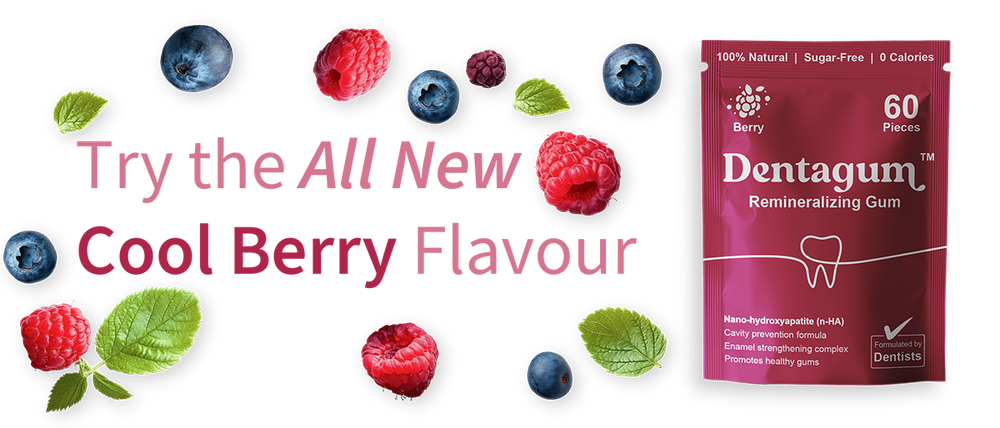
The standard commercial response to this analysis is that functional remineralizing gum costs more than a supermarket packet of Extra. That's true. A piece of Dentagum costs approximately $0.55. A piece of Wrigley's Extra costs approximately $0.05 to $0.10.
The relevant comparison isn't gum price versus gum price. It's the total cost of the oral care outcomes being addressed. A single dental filling in the US costs $200 to $600 depending on material and location, without insurance. A single periodontal cleaning (scaling and root planing) for established gum disease costs $500 to $4,000 for full-mouth treatment. A root canal costs $700 to $1,800 per tooth.
The annual cost of using Dentagum consistently (3 pieces per day, 365 days) at $0.55 per piece is approximately $600. That's roughly the cost of one filling, avoided. The economics of preventive oral care versus restorative dental treatment are well understood: every dollar spent on prevention avoids multiples of dollars in treatment. The question isn't whether functional remineralizing gum costs more than standard sugar-free gum. It's whether it costs more than the dental treatment it's working to prevent.
Who Standard Sugar-Free Gum Is and Isn't Good Enough For
To be fair: standard sugar-free gum is not valueless. For someone who currently chews sugar gum and is trying to stop, any sugar-free alternative is a significant improvement. For someone who doesn't chew any gum and starts chewing sugar-free gum after meals, they gain the ADA-endorsed saliva benefit. For someone with no history of cavities and low caries risk, the baseline saliva benefit may be sufficient to maintain that status quo.
Standard sugar-free gum is not good enough for: someone with existing white spot lesions trying to reverse early demineralization (needs nano-HAp for direct mineral delivery). Someone with recurring cavities despite regular brushing (needs xylitol's active bacterial killing, not just non-cariogenic sweetening). Someone with chronic bad breath (needs the antibacterial coverage of mastic, propolis, and natural terpenes against VSC-producing bacteria, not just fresh mint flavor). Someone concerned about the long-term implications of chewing petroleum-derived synthetic polymers daily (needs a natural plant resin gum base).
The honest assessment of who each product is appropriate for is part of category education that the industry largely skips. Most people buying "oral care gum" have at least one of those needs, because most people have at some point dealt with sensitivity, bad breath, a cavity, or early decay. The gap between what they're buying and what would actually address their specific situation is significant.
What to Look for on the Label: The Three-Second Test
You don't need to read this entire article in the supermarket aisle. Three things on the back of the packet tell you whether a sugar-free gum is providing meaningful oral health function beyond the saliva baseline:
First sweetener listed: xylitol or erythritol? If the first sweetener is sorbitol, the antibacterial benefit stops at saliva stimulation. If it's xylitol or erythritol first, the active bacterial killing mechanism is running.
Gum base disclosed or just "Gum Base"? If the label says only "Gum Base," it contains undisclosed synthetic polymers. If it specifies mastic, chicle, or other natural resins by name, the base is transparent and plant-derived.
Nano-hydroxyapatite in the ingredient list? If yes, direct enamel mineral delivery is present. If no, the only mineral reaching your enamel during the chewing session is what's already in your saliva.
Those three data points separate the full majority of commercial sugar-free gum from the small and growing category of functional remineralizing gum. Most products fail all three. A product that passes all three is doing something categorically different from what the supermarket aisle offers.
Try Dentagum risk-free — 30-day guaranteeFrequently Asked Questions
Is sugar-free gum bad for your teeth?
No. Sugar-free gum is not bad for your teeth, and standard sorbitol-sweetened sugar-free gum provides the ADA-endorsed saliva stimulation benefit when chewed for 20 minutes after meals. The honest critique is not that it's harmful but that most sugar-free gum is providing only a fraction of the oral health benefit a gum could provide, given what the clinical evidence now supports. The gap between "doesn't hurt" and "actively helps in multiple documented ways" is the story most consumers haven't been told.
Is all sugar-free gum the same for teeth?
No. Sugar-free describes only what the gum doesn't contain. The differences that matter for oral health are: what sweetener is used (sorbitol provides no antibacterial effect; xylitol actively kills S. mutans); what the gum base is made from (synthetic polymers release microplastics; natural resins don't); what flavor compounds are present (isolated menthol has no antimicrobial terpene complex; organic essential oils do); and whether active oral health ingredients (nano-hydroxyapatite, propolis, mastic) are present. A gum passing these four tests is in a fundamentally different oral health category from standard sorbitol gum.
What is the best sugar-free gum for teeth?
The evidence-based criteria for evaluating gum for oral health: xylitol as the primary sweetener (for active S. mutans killing), nano-hydroxyapatite in the formula (for direct enamel mineral delivery and sensitivity reduction), natural plant resin gum base (transparent ingredient disclosure, no microplastic generation), organic essential oils rather than artificial flavors (full antimicrobial terpene complex), and no aspartame, BHA, BHT, or titanium dioxide. A gum meeting all five criteria is providing the maximum oral health function currently supported by clinical evidence in a gum delivery format. Most commercial sugar-free gum meets none of them.
Why does sorbitol gum not kill bacteria the way xylitol does?
Because S. mutans's phosphoenolpyruvate phosphotransferase (PTS) system, the mechanism that transports sugars into the cell, doesn't uptake sorbitol the same way it takes up sucrose and xylitol. Sorbitol is not transported via the same pathway and doesn't initiate the futile energy cycle that kills S. mutans when xylitol is taken up. Sorbitol is simply not fermented by S. mutans into lactic acid, which is why it's safe in sugar-free gum, but it also doesn't trigger the bacterial death mechanism that xylitol's metabolic mimicry of sucrose creates.
Should I stop chewing regular sugar-free gum and switch?
If you currently chew sugar-free gum after meals consistently, you're getting the ADA-endorsed saliva benefit. Whether to switch to a functional remineralizing gum depends on what you're trying to achieve. For someone with recurring cavities, sensitivity, chronic bad breath, existing white spot lesions, or gum inflammation, the clinical evidence supports functional ingredients (xylitol for bacteria, nano-HAp for mineral, propolis and mastic for gum health) addressing those specific concerns more comprehensively than saliva stimulation alone. For someone with no current issues and low caries risk, the baseline may be sufficient. The question is whether the additional clinical evidence for functional ingredients represents meaningful benefit for your specific oral health situation.
The Bottom Line
Sugar-free gum is better than sugar gum. That's the easy part. The more useful and less commonly told story is what happens after you make that switch: most commercial sugar-free gum provides the saliva benefit the ADA endorses and nothing more. The sweetener doesn't kill bacteria. The gum base may be releasing microplastics during every chewing session. The flavor provides sensation without antimicrobial function. And no active ingredient in the formula is delivering mineral to enamel, addressing periodontal bacteria, or reducing gum inflammation.
None of this means the baseline saliva benefit isn't worth having. It is. But the gap between "does the minimum" and "does what the clinical evidence says a gum can do" is large, well-defined, and available to any consumer who knows what the three-second label test is checking for. Most people assume all sugar-free gum is roughly equivalent. It isn't. And knowing the difference is the first step to choosing a product whose ingredients match the oral health outcomes you're actually trying to achieve.
Try Dentagum risk-free — 30-day guarantee at dentagum.coResearch Summary
- Söderling E et al. BMC Oral Health, 2025. Xylitol gum significantly reduced S. mutans in 12/14 studies versus sorbitol gum controls. The comparison is xylitol vs sorbitol specifically, confirming the antibacterial gap between the two sweeteners rather than comparing to no gum.
- ACS Pilot Study, 2025. 100 to 637 microplastic particles per gram of chewed gum detected. Approximately 94% released in the first 8 minutes. Particles originate from synthetic polymer gum base fragmentation during mechanical chewing action.
- Arzani V et al. PMC 12032991, April 2025. Mint terpenes and terpenoids in oral health. Scoping review: thymol, menthol, eucalyptol are broad-spectrum antimicrobial substances against S. mutans, A. actinomycetemcomitans, E. faecalis, C. albicans. Full essential oil provides these; isolated menthol does not.
- Limeback H, Enax J, Meyer F. Biomimetics, 2023. 44 clinical trials. Nano-HAp effectiveness for direct enamel mineral delivery and sensitivity reduction confirmed. Contact time during chewing is key variable. Standard sugar-free gum provides no nano-HAp delivery.
- American Dental Association. Chewing Gum Oral Health Topics. Endorses sugar-free gum for 20 minutes after meals based on saliva stimulation mechanism. Explicitly states gum is an adjunct, not a replacement for brushing and flossing. Endorsement is based on the saliva mechanism that all sugar-free gum provides.
- IARC/WHO, 2023. Aspartame classified Group 2B possibly carcinogenic. Relevant for evaluating standard sugar-free gum containing aspartame (Wrigley's Extra, Orbit) versus sweetener-cleaner alternatives.
References
- Söderling E et al. "Specific Effects of Xylitol Chewing Gum on Mutans Streptococci Levels." BMC Oral Health, 2025. https://link.springer.com/article/10.1186/s12903-025-06602-1
- Elyvora US. "The Science of Chewing Gum: Undisclosed Plastics, Banned Additives." March 2026. ACS 2025 microplastics pilot study cited. https://elyvora.us/blog/chewing-gum-plastic-ingredients-banned-additives-clean-teeth-science-2026
- Arzani V et al. "Plant polyphenols, terpenes, and terpenoids in oral health." PMC 12032991, April 2025. https://pmc.ncbi.nlm.nih.gov/articles/PMC12032991/
- Limeback H, Enax J, Meyer F. "Clinical Evidence of Biomimetic Hydroxyapatite in Oral Care Products." Biomimetics, 2023. https://pmc.ncbi.nlm.nih.gov/articles/PMC9844412/
- American Dental Association. "Chewing Gum." Oral Health Topics. https://www.ada.org/resources/ada-library/oral-health-topics/chewing-gum
- IARC/WHO. "IARC Monographs Volume 134: Aspartame." 2023. https://www.iarc.who.int/featured-news/iarc-monographs-volume-134-aspartame/
